![]()
PART I
Thud! Professional
Status
Chapter 1 Managing your professional development
Chapter 2 Developing professional expertise
Chapter 3 Transitional change
Throughout Part I, we focus on the first few weeks of welcome, introduction and orientation to your first post as a qualified social worker and aim to ease your transition into the workplace in these very early stages.
In Chapter 1 we consider the requirements for registration, post-registration training and learning (PRTL) and continuing professional development (CPD), as well as the introduction of formal NQSW programmes (e.g. ASYE in England) which now frame much of the early workplace learning and development for social workers in both adult and children’s settings.
Initial workplace motivators and the development of professional expertise are primary considerations for Chapter 2, while the change from student to employee in Chapter 3 includes consideration of the ‘reality shock’ which frequently accompanies the ‘thud! ’ of acquiring professional status. It is commonly acknowledged that change is rarely achieved without some stress and anxiety, so our consideration of transitional change includes strategies, coping mechanisms and sources of support for the first few weeks in your new post. However, given the importance of maintaining your motivation and building job satisfaction for your longer term career, we return, in greater depth, to finding support and making best use of supervision in Part III – Jumping the Hurdles, and the negative consequences of stress together with positive coping mechanisms in Part IV – Going the Distance.
![]()
Chapter 1
Managing your
Professional Development
UK continuing professional development (CPD) frameworks
Post-registration training and learning (PRTL)
Formal NQSW programmes (e.g. ASYE and AYE)
Key considerations in understanding your professional pathway
It is widely recognised that the first year in employment is a critical period in your professional development, frequently characterised by a plethora of requirements to be demonstrated, evidenced, observed or assessed, in different ways and at different stages, as you move through the initial stages of your new career. It may be helpful to think of the various capabilities, standards and indicators involved in your continuing professional development as being broadly of three types, related to:
•Employers: job description, supervision arrangements, induction protocols, probation and appraisal systems.
•Regulatory bodies: registration and post-registration training and learning (PRTL).
•Formal NQSW programmes: involving regulators, employers and, sometimes, higher education institutions (e.g. ASYE in England and AYE in Northern Ireland).
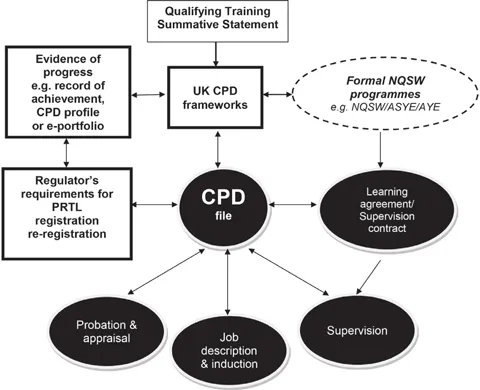
In order to keep on top of what can otherwise appear to be a rather complex and confusing range of requirements and standards you are expected to meet as an NQSW, alongside the day-to-day demands of your new job, it is important to have somewhere to store evidence of your continuing professional development. This is why we recommend that you set up an (electronic or paper) CPD file from day one in your new job. This will be of enormous help in ensuring that you have, readily to hand, all of the records and evidence you might need in relation to each of the key areas of your CPD (represented in Figure 1.1), relating to the requirements of regulatory bodies (square boxes), employers (oval boxes), and formal NQSW programmes (dotted oval), all of which will exert a significant influence on your early development as an NQSW. Differences in the ways that continuing professional development (UK CPD frameworks), post-registration training and learning (PRTL) and formal NQSW programmes (e.g. ASYE/AYE) operate in each of the four UK countries are summarised later in this chapter and at other relevant points throughout the book.
Figure 1.1 Continuing professional development file
There is more about professional development planning in Chapter 5, but here the strengths and areas for further development identified at the end of your qualifying education and training should be used as the first entry in your CPD file.
The UK CPD frameworks
Although arrangements for the CPD of social workers in the four countries of the UK vary, all place a responsibility on employers to provide appropriate training and development opportunities, and on you, as an NQSW, to make the most of the learning opportunities available and to gather evidence of your progress. This is to be presented for different purposes, in different formats and at different stages of your career. At a personal level, the essential elements of your initial CPD should include:
•an individual development plan, linking your qualification outcomes and future learning needs to your job description, induction and probation (all to be discussed in supervision)
•access to development activities (which may include formal NQSW programmes, such as ASYE or AYE)
•forward planning for appraisal by your employer (which should be linked to your individual development plan)
•a record of learning and activities which provide evidence of your progression and development.
Despite substantial work over the last few years to develop and promote CPD, social workers, their managers and employers have often found it hard to find the time or resources to engage positively with what has frequently been perceived as the disparate structures, activities and awards on offer. As part of the move to improve practice and raise standards, attempts to provide more coherent and effective frameworks have emerged, linked to career pathways and progression routes, in an attempt to improve the motivation, job satisfaction and retention of frontline social work practitioners. Formal requirements for CPD may be defined in the codes of practice, regulatory requirements, professional practice standards, practice governance frameworks, capabilities frameworks and career structures which contextualise social work practice in each of the four UK nations, but some of the key aspects currently in place across the UK are summarised in Table 1.1.
Post-registration training and learning (PRTL)
Post-registration training and learning (PRTL) is a key condition for continued registration as a professional social worker, with each of the four UK countries having developed slightly different approaches to their specific requirements. Full details are available on the websites of each of the care councils involved, but a very short synopsis is given at the bottom of Table 1.1.
Registration rules specify that every social worker must take individual responsibility for keeping a record of the PRTL they have...