![]()
- 1 -
Spelunking
Discovering the Typical Diamond You Already Are
Need to Know (and Believe)
•Being extraordinary is what creates value.
•“Normal” is a role played by many but lived by none.
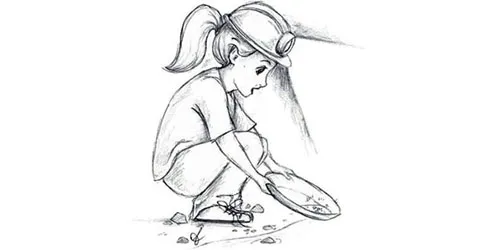
Spelunking. Isn’t that just the weirdest word? It makes me think of some nasty tree fungus or something. But it’s not. Spelunking happens to be cave exploration. And guess what you can do while spelunking? Why, you can sluice, of course!
Nope, that’s not a Dr. Seuss word, either. Sluicing (which sounds like juicing) is an old mining technique. You fill a wire box full of dirt and silt, then you slosh it around in running water to see if you’ve uncovered anything interesting. One minute you’re digging through muck from an underground stream; the next minute you unearth these amazing, albeit really rough and dirty, little bits of treasure.
This, you may be thinking, is all very nice, but it has absolutely nothing to do with me. That’s where you’re wrong. It’s not that I expect you to go grab a bucket and start hunting, but then again, let’s say you did. I did, last spring. Through pail after pail of North Carolina’s red earth, I picked and swirled and washed. And every batch was full of surprises. Before long, I had discovered dozens and dozens of stones: golden pyrite, silvery malachite, smoky quartz, rose quartz, sparkling mica. There were piles of them!
“We’re rich!” my son yelled. Of course, I hated to disappoint him, but as lovely as they are, none of these stones are worth much money because they’re very abundant—you know: normal, typical, common. They’re everywhere. On the other hand, precious gemstones, like diamonds, rubies, and sapphires, are very rare. That’s why they cost so much. If folks could dig them up in their own backyards, who would need a jeweler? Being extraordinary is what makes them valuable. And all we had was a bucket full of normal.
Here’s where we get to you and me. Our brains operate in a way that is less common, a way that is called “autism spectrum” or “Asperger syndrome” (AS), and it’s literally built into our hard-wiring. An AS label isn’t good or bad. It’s a description of our shared experiences. For example, you and I easily notice things others miss. We also miss things others easily notice. We feel emotions differently and sense the world differently. We think and fear and love and learn in ways that typical minds don’t. The fact is, in many (though not all) ways, we are not common.
I understand wanting to fit in, to blend in, for it to be easy. Wanting to not worry so much about “belonging.” Then again, I wonder if anyone really would be content being totally typical. Who chooses a hero “because he is so normal”? Who gets a compliment or wins an award or even lands a job by being run-of-the-mill? No one. That’s because normal is an illusion; it’s a role played by many but lived by none.
Look, you are in your own head twenty-four hours a day, seven days a week. You know every mistake you make, every doubt you have, every insecurity that wears you down. Dating, acne, the right way to stand or smile or dress for a party—normal people don’t overanalyze all of this craziness, right? Wrong. Typical people don’t feel normal a lot of the time, either.
Since I’ve been out of high school, I’ve made some discoveries. If by “normal” we mean “common,” then it turns out, it’s pretty normal to feel like you don’t fit in at all. Everyone has strengths. Everyone has challenges. And everyone has behind-the-scenes fears that others never see.
Now don’t get me wrong. Yes, some people do have an easier time naturally “playing well with others.” That’s an inborn talent. And envying others’ abilities only wastes the time you should be honing yours. Are you a gamer? Personally, I stink at pretty much every video game I’ve ever tried. So if Minecraft is your thing, you definitely have some skills that I don’t. That’s OK. On the other hand, I can dance like nobody’s business. Maybe you avoid dance floors like the plague and seriously believe you might die of either fright or embarrassment if you suddenly got stuck in a spotlight. That’s OK, too. However, not being a particularly good gamer doesn’t give me an excuse to avoid trying. Being terrified of dancing doesn’t mean you get to hide on the sidelines. At some point, you have to get in there and say, “You know what? Who cares if I look ridiculous? I just wanna have fun.”
Common is a relative experience. It’s all about the surroundings. Whatever differences, talents, or challenges you experience from being on the spectrum are, well, pretty typical. I get you. So if you need to feel normal, hang out with me. We’re both Macs in a PC world. Distinct. Innovative. Logical.
If you don’t mind getting your hands dirty, think of this whole growing-up thing as spelunking and sluicing—only you don’t have to hunt for anything “extra”ordinary. It turns out, you already are the discovery. You already are the treasure, as natural and as precious as a jewel. A diamond is, after all, just a lump of coal that handled a lot of pressure really well. So dust yourself off and get out into the light. You’ll be amazed at how you shine.
![]()
- 2 -
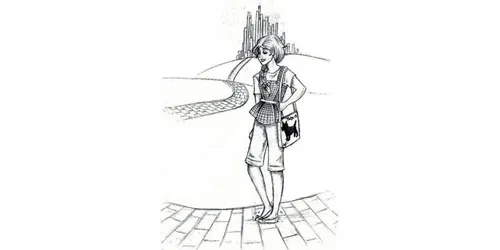
Follow the Yellow Brick Road
Why You Don’t Need a GPS to “Find Yourself”
Need to Know (and Believe)
•Lovability has nothing to do with anyone else…with whether they seek you or leave you.
•Good people reflect and magnify who you are, but lasting confidence (and contentedness) only grows from the inside-out.
•You can’t expect anyone else to do for you what you aren’t willing to do for yourself.
•We often mistake our most immeasurable gifts for shameful flaws.
•You are lovable. Right now. Without changing a single thing.
No Formula—Just a Road
Not long after I graduated from college, my grandmother sent me a book which proclaimed itself to be a “concrete set of do’s and don’ts so you can actually land the guy of your dreams.” I should’ve raised an eyebrow at that. Maybe two. The ridiculousness of that book still boggles my mind in about a thousand ways. You don’t “land” a person. You land a plane. People can’t be won like prizes, and even then, I knew it. Having the “right” people by your side doesn’t suddenly make you more worthwhile. It just makes you more dependent, more vulnerable, and more terrified of being alone. I knew that, too.
Good people reflect and magnify who you are, but lasting confidence (and contentedness) only grows from the inside-out. That part…well, I said I knew it. Maybe you “know” it, too. Intellectually. But in our hearts, I don’t think a lot of us believe it. I wanted, more than anything on earth, to feel powerfully, recklessly, unconditionally wanted. That, if I’d told the truth, was more important to me than any “perfect score” or list of achievements. Just imagine an oasis in a desert: you can see it out of reach…what you want most in the world—what seems almost possible—but it’s just an illusion. That’s happiness—that’s “Who am I?” built on other people’s approval…shaky, without substance. And for those of us who’ve spent a lifetime on the edges of “lovable,” the want—the need—to be wanted and liked and included is too powerful to resist.
So guess what I did with that book my grandmother gave me? I read it from cover to cover. Why? Well, the answer may feel very familiar to other girls on the spectrum. Underneath my competent, confident exterior, I was also lonely, insecure, and sure that between my “hypersensitivity” and perpetual intensity, I was simply really difficult—if not impossible—to love. And that is a dangerous place to be.
Yes, your education matters (a lot). Your work matters. Your passions matter. Your friendships matter. Your sense of humor and your physical health matter. But wherever you fall on the human spectrum, the single most important thing to each of us—the emptiness that we will do anything to fill—is this:
We ALL need to know that—right now, without changing a thing—we are already lovable. That we are wanted—deeply, enthusiastically—precisely as we are. So listen up: You are loved. By me. Really. As you are. Right now.
For those of us on the spectrum, feeling lovable is a tall order. I get it. More often than not, our parents don’t understand us. (My dad would walk away whenever I cried, and my mom didn’t understand how I could be “so smart” and “so naive” at the same time.) Our classmates resent us and maybe even taunt us or insult us. Our coworkers leave us out or hang us out to dry. And the people who are supposed to cherish us may love so cruelly that we lose all perspective on what kindness is even meant to be. Why? Simple. The way we think, feel, understand, and love doesn’t quite “fit.” We know it. And so does everyone else.
“Just be yourself” we’re told. But usually, it’s survival of the generic out there. It doesn’t feel very safe or smart—or even possible—to be authentic, to stop editing every thought and word…or to just give up. For sure, the world didn’t like me whenever I was honest. I was the butt of terrible jokes—was even told to kill myself. I was also often misunderstood by the people closest to me.
So, c’mon! How are we supposed to feel comfortable when nothing (or at least not a whole lot) about fitting in comes naturally? Of course, there are things we can do to make life easier. We can learn the “(Secret) Social Rules”—I even wrote a book about the ones I figured out—but no one can (or should) be on-guard twenty-four hours of every day, evaluating her every gesture, second-guessing her every word. That kind of life is an exhausting performance—a game of chess where you are trying constantly to anticipate other people’s moves and plan accordingly. And you know what? I stink at chess.
Here’s what I was good at: school, dancing, annoying people, and sounding full of myself. Throughout life, experience had proven over and over again that given enough time, I could successfully irritate and tire out any coworker, friend, boyfriend, or family member into not just being done with me, but into seriously disliking me, and quite possibly even hating me. “Enthusiastically wanted” for just “being you?” No. That didn’t make any sense at all.
Now, there is one important factor missing from this story—a major disadvantage I had that you don’t. I didn’t know I was an Aspie. For that matter, I had no idea what AS or autism was, let alone how it might relate to me. As far as I could tell (and everyone else said), Jenny was just an often-bossy, attention-loving, too-smart-for-her-own-good, over-dramatic crisis seeker. And without that spectrum identification, my life felt like a never-ending series of could-happen-at-any-moment catastrophes. There I’d be, doing my best at whatever it was I thought I was supposed to be doing—schoolwork, extracurriculars, studying (yes, studying) fashion magazines…heck, when my mom off-handedly mentioned that I didn’t know how to flirt (I was fifteen), I tackled that “failure” with such gusto that, a year later, “flirt” was my nickname. Literally.
In other words, whatever it took to get people to like me, I tried to do—perfectly. So many of us do. The trouble is, “people” aren’t a big blob of brainwashed clones with the same idea of what “likable” is. We’re tilling at windmills. Chasing shadows. And even if by some miracle you do manage to pull off the “she’s got it all together” persona—smart, accomplished, witty, charming (with effort), interesting, generous, physically attractive—you’re doomed. If you’re the best at everything, everyone else feels less by comparison.
The Trap
Spectrum girls, in particular, tend to be pretty hardcore perfectionists. We want to please other people. We want to be cared for. And dang it, we seriously need som...