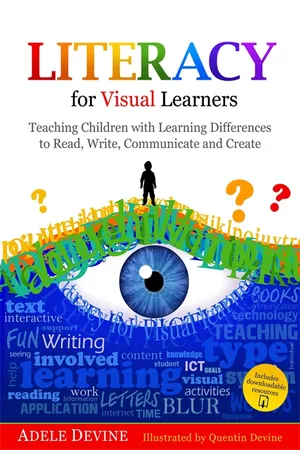
Literacy for Visual Learners
eBook - PDF

Literacy for Visual Learners

Teaching Children with Learning Differences to Read, Write, Communicate and Create

  1. 288 pages
  2. English
  3. PDF
  4. Available on iOS & Android
eBook - PDF

Literacy for Visual Learners

Teaching Children with Learning Differences to Read, Write, Communicate and Create

About this book

This book takes a fresh look at approaches to teaching reading, writing and communication skills. It presents a wealth of innovative ideas specifically designed to support visual learners, including those with autism spectrum conditions and special educational needs.

Some children are more responsive to visual stimulation than spoken words, and this book shows how to engage these children in literacy lessons by using strategies that cover everything from the latest assistive technology to getting creative on a limited budget. There are tips for sharing stories with children who find it hard to sit still, supporting reluctant writers, enabling the pre-verbal child to answer questions and helping the child who never stops talking to develop listening skills. The strategies are supported by practical resources, examples and case studies, to show how to instil in children the confidence to create and share their thoughts.

This is a must-have resource for special education teachers and coordinators, as well as speech and language therapists, looking for new strategies for teaching literacy.

Frequently asked questions

Yes, you can cancel anytime from the Subscription tab in your account settings on the Perlego website. Your subscription will stay active until the end of your current billing period. Learn how to cancel your subscription.
No, books cannot be downloaded as external files, such as PDFs, for use outside of Perlego. However, you can download books within the Perlego app for offline reading on mobile or tablet. Learn more here.
Perlego offers two plans: Essential and Complete
  • Essential is ideal for learners and professionals who enjoy exploring a wide range of subjects. Access the Essential Library with 800,000+ trusted titles and best-sellers across business, personal growth, and the humanities. Includes unlimited reading time and Standard Read Aloud voice.
  • Complete: Perfect for advanced learners and researchers needing full, unrestricted access. Unlock 1.4M+ books across hundreds of subjects, including academic and specialized titles. The Complete Plan also includes advanced features like Premium Read Aloud and Research Assistant.
Both plans are available with monthly, semester, or annual billing cycles.
We are an online textbook subscription service, where you can get access to an entire online library for less than the price of a single book per month. With over 1 million books across 1000+ topics, we’ve got you covered! Learn more here.
Look out for the read-aloud symbol on your next book to see if you can listen to it. The read-aloud tool reads text aloud for you, highlighting the text as it is being read. You can pause it, speed it up and slow it down. Learn more here.
Yes! You can use the Perlego app on both iOS or Android devices to read anytime, anywhere — even offline. Perfect for commutes or when you’re on the go.
Please note we cannot support devices running on iOS 13 and Android 7 or earlier. Learn more about using the app.
Yes, you can access Literacy for Visual Learners by Adele Devine, Quentin Devine in PDF and/or ePUB format, as well as other popular books in Education & Inclusive Education. We have over one million books available in our catalogue for you to explore.

Information

Table of contents

  1. Literacy for Visual Learners
  2. Acknowledgements
  3. List of Downloadable Resources
  4. Introduction: A Fairy Tale
  5. Chapter 1. Visual Learners are in Every Classroom: Preventing a Learning Difference From Becoming a Learning Difficulty
  6. Chapter 2. Learning Differences and Disabilities: Autism Spectrum Conditions, Dyslexia, Dysgraphia, Dyspraxia, Downs Syndrome, ADHD, Cerebral Palsy and Physical Disabilities Affecting Communication
  7. Chapter 3. Gifted Visual Learners: Past and Present
  8. Chapter 4. Visual Teachers: Past and Present
  9. Chapter 5. First Impressions! How We Introduce Literacy Can Help Develop a Positive Attitude to Learning
  10. Chapter 6. Motivation to Learn: Finding Out What Motivates the Individual Child Can Be the Key to Engaging Them to Want to Learn
  11. Chapter 7. Teaching Writing Right: Setting Them Up to Succeed, By Stepping Learning to Meet Individual Needs – Sandpaper Letters, Stamps and Pencil Grips
  12. Chapter 8. What’s in a Name? How Names and Labels Give Reading and Writing a Purpose
  13. Chapter 9. Reading: Practical Strategies Including Teaching Children Who Do Not ‘Get’ Phonics
  14. Chapter 10. Teaching a Child to Read High Frequency Words: A Structured Approach
  15. Chapter 11. Visuals for Communication: An Introduction to the Picture Exchange Communication System and Going Beyond ‘I Want…’
  16. Chapter 12. Augmentative and Alternative Communication (AAC): Switches, Buttons, Android, Eye Gaze and iPad Apps
  17. Chapter 13. Actions Speak Louder! Gaining Attention, Adding Meaning and Improving Communication Through Facial Expressions, Signing and Movement
  18. Chapter 14. Listening and Gaining Attention: Becoming a Good Listener, Tutorials, Intensive Interaction and Attention Autism
  19. Chapter 15. Functional Communication: Within School and Out and About
  20. Chapter 16. Organization, Order and Visual Structure: Functional Communication: Symbols, Schedules, Tick Lists, 'To do' Lists, Diaries, Calendars, Wall Charts and TEACCH
  21. Chapter 17. SEN Assist: Teaching Literacy Through the Class Computer
  22. Chapter 18. Dance, Drama and a Sprinkle of Shakespeare: Sparking Creativity and Bringing Stories to Life Using Costume, Masks, Puppets and Props
  23. Chapter 19. Look Here! They Can! Believing in Futures
  24. Chapter 20. Happy Endings
  25. References
  26. List of Useful Websites
  27. Index
  28. Blank Page