![]()
PART 1
THE MUSICAL ESSENCE OF HUMAN CONNECTION
![]()
1
LOVE, RHYTHM AND
CHRONOBIOLOGY
NIGEL OSBORNE
The origins of chronobiology: Hearts and flowers
Today, Highgate Hill is a busy thoroughfare, with public buildings, Victorian terraces and leafy spaces. In the late 17th century, however, it was largely rural, with a country mansion or two nearby, like the timber-framed Lauderdale House, and for the rest, rolling fields, copses, hedgerows and gardens. It was where the metaphysical poet, satirist and politician Andrew Marvell had a cottage and spent the latter years of his life.
It was perhaps the relative rural peace of Highgate Hill that inspired Marvell to write one of the most significant English-language poems of the 17th century, ‘The Garden’ (Marvell 2006). The garden of the poem is a metaphysical conceit: a Restoration Garden of Eden of tranquility, music, luminosity and abundance, graced with the power of beauty, quietude and reflection; but it is also the garden of the Fall, and the last verse is an extraordinary description of nature and time – culminating, or ultimately gloriously blooming, in the image of a clock made of flowers.
How well the skilful Gardner drew
Of flow’rs and herbs this dial new;
Where from above the milder Sun
Does through a fragrant Zodiack run;
And, as it works, th’ industrious Bee
Computes its time as well as we.
How could such sweet and wholsome Hours
Be reckon’d but with herbs and flow’rs!
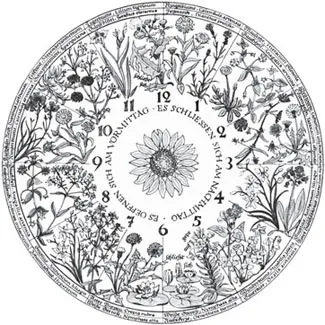
Carl Linnaeus, the father of modern taxonomy, was born in Sweden some 30 years after Marvell had written ‘The Garden’. Linnaeus’ motto was omnia mirari etiam tritissima – ‘wonder at all things, even the humblest’. He spent considerable time collecting and classifying specimens of nature in the fields and forests of Uppland and Västmanland. 1751 was the year of publication of Philosophia Botanicae (Linnaeus 2005), a complete review of the classifications, or taxonomies, Linnaeus had developed to date. We do not know if Linnaeus ever read Marvell’s poem, but Linnaeus’ treatise also included a design for a ‘flower clock’ uncannily like the garden of time that Marvell had imagined. It is not known whether Linnaeus ever ‘planted’ his clock, but it was based on the principle of flowers opening and closing at different times of day – for example, Morning Glory or Convolvulus tricolor opening at 5 a.m., Hawkweed or Hieracium umbellatum at 6 a.m., White Waterlily or Nymphaea alba at 7 a.m., and so on. Of course Linnaeus’ choices of plants and their opening times were dependent on seasons and climate zones.
FIGURE 1.1 CARL LINNAEUS’ ‘FLOWER CLOCK’
Linnaeus had observed patterns in the opening of flowers and knew that these were connected to daylight and times of day, and in turn to the production and dissemination of seeds. But he did not know how plants sensed the time of day – in other words, how they ‘knew’ when to open and close. It was not until 1959 that biophysicist Warren Butler and biochemist Harold Siegelman, using powerful spectrophotometry, discovered the secret (Butler et al. 1959). Butler called it phytochrome, a pigment existing in some form in most flowers, which reacts to red light. When the sun is shining, phytochrome molecules in the cytoplasm (that is to say, in the surface of a plant’s cells) absorb red photons. Red photons are quanta of the electromagnetic energy of the red-colour part of the spectrum of light. This absorbed energy triggers changes in the phytochrome molecule. The molecule then descends to the nucleus of the cell where it initiates gene regulation, with a number of effects, including the opening of petals. Far-red light, which is of frequencies between red and infra-red, causes the molecule to return to the cytoplasm, reversing the genetic activations, and the petals to close. So beneath Linnaeus’ clock of flowers there lies a complex biological timepiece: a photosensory, cellular, molecular and genetic clock.
This process, replicated in cells across surfaces of the plant, allows the plant to sense not only the presence of light but also its intensity, direction, duration and spectral quality, in other words the presence of different colours. This in turn allows the plant to regulate germination, growth direction, growth rate, chloroplast development (the control of photosynthesis), pigmentation, flowering and senescence. These processes are collectively known as photomorphogenesis. The line which leads from Marvell’s poetic imagination to Linnaeus’ observations and creativity, and further on to the discoveries of scientists such as Butler and Siegelman is one of the lines along which the science of chronobiology evolved. It is the science of biological clocks, the rhythms of life, how they are regulated and how they relate to external forces like the sun or the moon.
The rhythms of darkness and sunlight and of night and day are of course crucial to human beings, most evidently because of their relationship with sleeping and waking. We are rationally aware of times of day and night, but as anyone who has suffered from jet lag knows, our patterns of sleep are regulated by forces beyond the control of conscious thought. In fact, human beings have a system for sensing light not unlike plants, even though the respective biologies are separated by hundreds of millions of years of evolution. The human equivalent of the phytochrome is a pigment called melanopsin (Provencio et al. 1998). Melanopsin is present in photosensitive ganglion cells, or clusters of cells, very near to the surface of the retina of the eye. Unlike phytochrome, melanopsin absorbs photons from the blue and violet area of light. This intake of energy depolarizes the ganglion cells; continuing exposure increases the rate of firing of the cell. These rhythmic impulses travel along the retinohypothalamic tract, as messengers of the presence of light, to the Suprachiasmatic Nuclei (SCN) in the hypothalamus. The SCN is the command centre of the body’s reaction to day and night (Bernard et al. 2007).
Like the nuclei of plant cells, the cells of the SCN generate the equivalent of a 24-hour clock. The SCN does this through cycles of expression of genes, using the migration of molecules between the cytoplasm and the nucleus to turn on and off their transcriptions. What is important is that this is a largely autonomous DNA-regulated clock. When we physically change time zone, it continues regardless and operates as before. The flow of neural messengers of light from the retina to the SCN will ultimately ‘re-set’ our clock, but it can take several days, hence the sensation of jet lag. There is also a direct pathway between the photosensitive ganglion cells of the retina and the pineal gland at the joining point of the thalamus. When the pineal gland receives signals of reduced light directly from the retina – usually described as ‘dim-light onset’ – it secretes melatonin, related to the neurotransmitter serotonin, and associated with preparation for sleep. This may explain the challenging combination of sensations of drowsiness and wakefulness – melanopsin and melatonin versus the SCN – so often experienced after journeys across time zones. It also reminds us that our chronobiology can trigger powerful responses of arousal and counterarousal, and even more complex bio-chemical emotional changes. This becomes particularly important for the chronobiology of musical rhythm.
These 24-hour cycles are the basis of ‘circadian rhythms’ (from the Latin circa diem, ‘around the day’) a term originally coined by Franz Halberg in his Chronobiology Laboratories at the University of Minnesota in the 1950s. Circadian rhythms in humans embrace far more than sleep–wake cycles (Ahlgren and Halberg 1990). They include cycles of change in body temperature through the day and night, and cycles of hormonal change (for example in plasma cortisol, the glucocorticoid steroid hormone associated with stress and readiness for action). These bodily circadian rhythms are important for pharmacology: for establishing the most effective means, and the optimal time of day, to intervene in the body’s biochemistry. Indian classical musicians would argue that specific times of day and night are important for responses to music too.
The lives of human beings fall into many different cycles: the cycles of birth and death, various cycles of cellular renewal (red blood cells live for about four months, for example, while white cells live for over a year), of the seasons (where body weight may change to prepare for different temperatures and conditions of life), menstrual cycles, the 24-hour circadian rhythms we have described, and then shorter cycles, like gamma-wave parasympathetic and EEG fluctuations, beta-wave thermoregulatory Mayer waves, breathing, the heart, basic movements like walking, tongue articulations, eye saccades and the neurological clocks that support them (Osborne 2009a).
The chronobiology of musical rhythm: Minds and bodies
There is a particularly important window in our human chronobiology. I call it the ‘window of rhythm’ (Osborne 2009a). Only within this window lies our ability to perceive regular patterned pulses, to associate beats and to perform them meaningfully as musical rhythm. It is within this window that we are able to connect with one another without words, to potentiate movement for health, and to co-regulate each other via entrainment through rhythmical experience. In what follows, we shall explore the many ways this window enables therapeutic connection.
There is no perceived rhythm outside the window. There is, of course, audible sound – which is characterized not by individually perceivable pulses, but instead by pitch. Pitch is a measure of the periodic vibrations (cycles) in sound energy, recorded in hertz (Hz) – the number of cycles per second. Our human audible range is 20Hz (the lowest audible pitch) to 20,000Hz (the highest, brilliant and nebulous sounds). Interestingly, the window of rhythm opens, at its upper threshold, at roughly the point where pitched notes become inaudible to us – at 20Hz. It is here, at 20Hz and slower, that vibrations become perceivable to humans as regular patterned pulses. Below 20Hz we can feel our own physical motion as rhythmical, sense patterns within our body’s regulatory functions, and feel the rhythm of another’s touch. Within mechanical sound energy, although we can no longer hear pitched notes below 20Hz, we can sometimes ‘feel’ pressure waves at high amplitudes, and hear low frequency resultant tones or ‘beats’ in the space between notes heard close together. It is only in the window of rhythm that we have the possibility of taking these low-frequency felt pulses and making them audible to each other through ‘enacting’ (or playing) them as musical rhythm (Osborne 2009a). The boundary marking the frequency of the lowest imaginable note also marks the fastest perceivable and playable rhythm. An expert Hindustani tabla player, for example, can play coordinated pulses up to around 18Hz, in other words 18 finger movements or ‘beats’ per second. A skilled Western violinist can play a fast, measured tremolo at the tip of the bow up to around same speed, but no faster. The performance closest to the upper threshold of the window of rhythm recorded to date is by Ukrainian pianist Lubomyr Melnyk, who can play up to 19.5 notes per second.
Further into the window of rhythm, and therefore at slower rhythmic frequencies, we enter more familiar territories of music. The fastest typical classical tempi, for example Presto or Prestissimo, are in the area of three to four cycles per second, with subdivisions, or individual notes, around eight and possibly as high as 12 cycles per second. At 12Hz, this is in fact near to the limits of what is straightforward and comfortable, as opposed to literally possible, to play. The slowest, lowest frequency classical tempi, for example Grave or Larghissimo, may be as slow as 0...