![]()
Chapter 1
You Must Have
Determination
‘The three great essentials to achieve anything worthwhile are, first, hard work; second, stick-to-itiveness; third, common sense.’
Thomas A. Edison
‘The difference between a successful person and others is not a lack of strength, not a lack of knowledge, but rather a lack in will.’
Vince Lombardi Jr
Vincent Lombardi Jr was an American football player, born 11 June 1913 and died 3 September 1970; the N.F.L. Superbowl trophy is named after him. He is considered to be one of the best coaches in N.F.L. history and, while a head coach for N.F.L., he never had a losing season. He was persistent. For me, his quote sums up the importance of determination, sometimes known as having grit. However, I also love Edison’s word ‘stick-to-itiveness’!
Successful people get there through determination, not just talent
We like to think that extremely successful people have got to where they are because they have an exceptional talent. However, successful individuals, with or without dyslexia, are highly determined, have grit.
You can do the grit scale developed by Professor Angela Duckworth, which you will find at http://angeladuckworth.com.
Struggling with dyslexia as a child may grow determination
‘Most people who have made a million have difficult childhoods or have been frustrated in a major way. Dyslexia is one of the driving forces behind that,’ said Dr Adrian Atkinson who was a psychologist involved in the B.B.C. research on millionaires. So, the nature of a dyslexic individual’s life where they have to struggle from an early age may well incubate this concept of life that they have to be determined to get anywhere.
Determination and hard work are also necessary for dyslexic children learning to be literate. They may have got used to working like this and experienced successes as a result, so their internal programming sets them up to behave like this in future as an adult. Such individuals make very good employees. What employer doesn’t want someone who works hard, is really persistent and sociable in a team? This approach can create success at work despite an individual’s ongoing challenges with literacy or memory.
Talent is a building block, but skill needs practice
So what is the relationship between raw talent, determination and success? Walt Disney, who was dyslexic, was once sacked from his job at a newspaper, being told he lacked creativity! He was still developing; he needed more practice for his talent to shine through. Talent is a latent ability but it requires practice to turn it into skill. All individuals are born with the potential for strengths as well as weaknesses. There’s been a debate for years about whether dyslexia confers some specific strengths, and we don’t have a firm answer to this. However, I now argue in this book that we can point to general research on traits such as creativity and problem solving and many dyslexic people do have these traits. We can also identify the characteristics people need, and they can develop their strengths.
As an individual you will know what your talents are, and the key point here is that talent is a building block. It’s the start, not the finish, for successful people. When you have developed a lot of skill, your perception for the task and its context changes. You can see this from the way in which professional sport is now run. There is a role in football, rugby, baseball and all professional sports now to gather statistics. So, we have talented sportsmen and women, who have practised for years. Then we have the statisticians and coaches who take apart the games that have been played and draw certain conclusions on micro-managing set pieces within the play. This is beyond talent and beyond skill – it is interpreting events at an expert level and realising how to improve still further. This is exactly what people who are extremely successful do. They have talent, they practise to develop skill and they continue to reflect throughout their lives on how they can be even better at what they do.
Success comes from learning from failure
In fact, we know that success comes about through a cycle of experiences, including failures, that you learn from and eventually you get to success. This requires determination.
Steve Jobs, also dyslexic, found success in his 20s with Apple, but when he was in his 30s the Apple board of directors dismissed him. Jobs then founded a new company, NeXT, which was eventually acquired by Apple and then Jobs took Apple to even more success. He was demonstrating determination.
Idea of continuous improvement
Many management processes, such as self-development, quality assurance models and Total Quality Management, are all based on this idea of continuous improvement, making small incremental steps that involve working out what will work (and inevitably what doesn’t, i.e. failures) and then becoming more successful, which requires grit and determination. So, we need to acquire the determination to keep going in the face of failure and to learn from it.
Can we learn from unsuccessful dyslexics?
It is worth at this point considering briefly the opposite of what we are investigating. What about the dyslexic adults who do not consider themselves to be successful, or who we would generally feel do not have happy, fulfilled lives? Is there something we can learn from them?
Lack of literacy results in no or low-level jobs
First, it is necessary to be able to handle written materials in order to be able to study or work effectively. Traditionally, it was thought that dyslexic individuals would go into manual jobs because they wouldn’t be able to do jobs involving literacy. Of course, that now presents a significant problem as we have far fewer manual jobs. Those that do exist still require some literacy – for reading safety rules and often recording outcomes, for example. This situation will get worse in the future when the likelihood will be that there will be fewer jobs, and those that exist will require higher levels of skill. However, I digress somewhat. The key point is that it is very difficult to be economically successful if you cannot read or write at all. So those children who do not learn to read and write, or have alternative coping strategies such as fluently using technology, are at a huge disadvantage in adulthood.
Growing up not believing you can achieve leads to low self-esteem
Our experience as children sets up patterns of thinking and behaviour as adults. If you can’t do things your peers can do, if your hard work and determination doesn’t result in a good outcome, then a spiral of negative thinking patterns can begin. This is aggravated by a lack of diagnosis – often people do not know that their challenges exist as a result of dyslexia. Without diagnosis, or at least a glimmer that this may be the root cause of problems with learning to be literate, there may be no effective learning processes set up. As a result, instead of believing you can do anything you set your heart on, you may grow up believing that you cannot do anything. Even worse, you may believe that it’s always your fault when things go wrong. This results in, at best, unstable self-esteem and we will see in Chapter 2 how crucial self-esteem is for success.
Self-knowledge and positive mindset leads to a virtuous cycle
The result for many with low literacy is a poor understanding of themselves, consequential low self-esteem and negative thinking patterns. This can result in serious stress from being unable to pay bills and frustration at being unemployed. For those who are functionally illiterate, the result now, when we depend so much on digital communications, is isolation from mainstream society. As adults, if they get a job, they may well be forced to lie about their difficulties rather than create positive strategies, and this makes them feel worse about themselves. So what we have is a very vicious cycle. This does teach us that what we need to create for self-fulfilment is a virtuous cycle.
This is exactly what the respondents in the research meant when advising a young person. They advocated getting a diagnosis of dyslexia early so that you have time to come to terms with what it means for you. Recognise that you have strengths and things that you are good at and use these to grow and maintain good self-esteem. Learn or work out effective coping strategies for things you find more challenging. Interestingly, the second group of respondents spoke about creating a positive mindset, which wasn’t suggested by the questions but was consistently brought up. This was clearly something those respondents who had been successful in education had recognised as important to their successes. A significant part of a positive attitude is learning to reflect appropriately on experiences.
How we learn successfully
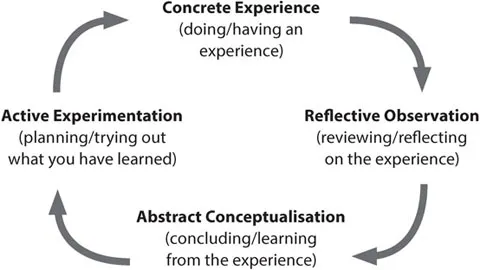
Let’s look at how we learn to learn effectively. Everything we learn from experience is based on reflecting on how things could have been done better. Whenever we do anything important, we should reflect to see if there are lessons to learn and improvements to make next time. Figure 1.1 demonstrates this.
Figure 1.1 Kolb’s learning cycle
This is Kolb’s learning cycle, which he produced in 1984. The idea is that every time we experience anything, we can maximise what we can learn from it. We need to first reflect upon the experience, then draw any general conclusions from it (conceptualise) and finally modify our behaviour according to what we have discovered. This is the very epitome of continuous improvement and learning that leads eventually to a successful outcome. So, now you can try this out.
Exercise in learning well
Think of something you did recently. It really can be anything, but preferably something that you wanted to go well. Now, examine it against the headings in the learning cycle model.
So, you have had an experience, now you are thinking about it (reflecting), what went well, what didn’t go so well? Have you learned something to apply more generally from this (conceptualising)? What would you do differently next time (modifying)?
Learn to reflect
Successful individuals are reflective. They make this cycle of continuously improving their skills and behaviour into part of everyday life. They learn to do it automatically. You may know that it is also a significant part of most training courses and that, in the professions, it is used to underpin all continuous professional development (C.P.D.) requirements for post-qualification development. In fact, it is seen to be so important that most professi...