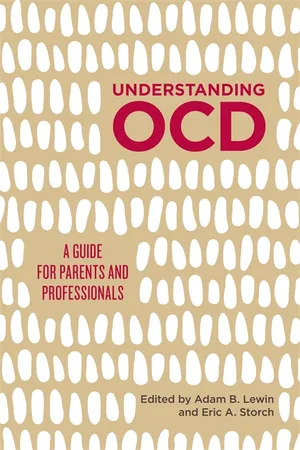
Giving a full overview of childhood obsessive compulsive disorder (OCD) and discussing all major treatment options, including cognitive behavioural therapy and medication, this guide provides the essential information that families, teachers, caregivers, clinicians and mental health professionals need in order to understand and treat childhood OCD. It covers origins, symptoms and related illnesses and explains how OCD is diagnosed. The book also suggests ways to maximise the outcomes of treatment, what to do when treatment doesn't work, and how to help manage OCD in children at school and in the home.
- 256 pages
- English
- ePUB (mobile friendly)
- Available on iOS & Android
eBook - ePub
About this book
Information
PART 1
Overview of
Childhood Obsessive
Compulsive Disorder
Childhood Obsessive
Compulsive Disorder
1
WHAT IS OBSESSIVE
COMPULSIVE DISORDER?
COMPULSIVE DISORDER?
Whether a person is a parent or a professional who is new to obsessive compulsive disorder (OCD), one of the first questions I often hear is “What exactly is OCD?” For many people, if they are familiar with OCD at all it is primarily through portrayals in the media. From the brilliant but impaired detective on Monk to the lead character from HBO’s Girls to the hilarious Bill Murray in What About Bob? there is no shortage of television or movie characters that purport to have OCD. You may have also heard the term used in everyday language by people saying things like “Oh, I’m a little OCD” about cleaning or germs or some other thing. The purpose of this chapter is to help you get a better, scientifically informed understanding about what OCD is and is not. As you will learn, what people think they know about OCD and what OCD actually is are often two quite different things.
Diagnostically, OCD is a mental disorder that is primarily diagnosed based upon the presence of obsessions and/or compulsions (APA 2013). The Diagnostic and Statistical Manual of Mental Disorders, Fifth Edition (DSM-5; the most current version of the “bible” of mental health diagnoses) defines obsessions as unwelcome and distressing ideas, thoughts, images or impulses that repetitively occur; and compulsions as behaviors or actions that an individual feels a need to perform and are often difficult to resist.Far from being odd or unusual experiences, most people have experienced non-clinical levels of obsessions and compulsions at some point in their lives (Abramowitz et al. 2014). Obsessing over an upcoming event (e.g., an exam or interview); worrying that you forgot to lock the front door or turn off the stove before leaving for a trip; always having your desk organized in a specific way; performing superstitious behaviors (e.g., always wearing a particular sports jersey on days that your favorite team plays): these are all examples of some minor obsessions and compulsions. Insignificant obsessions and compulsions are harmless and can actually prove to be beneficial to individuals. Ritualistic behaviors (or compulsions), such as taking time to organize one’s desk at the start or end of a workday can create a sense of relief and reduce anxiety. This may be why routines and rituals are extremely common among children and adults, from sleeping in the same position every night to buttoning your shirt in a particular fashion (Kanner 2005).
In other words, almost all of us are “a little bit OCD,” but only if by that you mean that you have some obsessive thoughts or compulsive behaviors from time to time. As with most other aspects of human life, obsessions and compulsions exist on a continuum, from the minor ones most people have to majorly impairing ones that will result in a diagnosis of OCD. Much like many other thoughts and behaviors, obsessions and compulsions only become problematic when they are carried out excessively, irrationally, for unreasonable amounts of time, to a level that causes significant distress to the person, or when they hinder daily living (Lack 2013).
The diagnosis of OCD
OCD is not in any way a “new” disorder. In fact, references to symptoms of what we now call obsessive compulsive disorder date back hundreds of years. Case studies and reports from history make it clear that OCD has been with the human species for a very long time, from Lady Macbeth’s excessive hand washing to Martin Luther’s excessive scrupulosity (Krochmalik and Menzies 2003). Attempts to really understand OCD began in the early 1800s, and it was viewed as “insanity with insight” because persons suffering from OCD did not have the disconnect from reality seen in psychosis (what we would today call schizophrenia; Salzman and Thaler 1981). A more contemporary understanding began by the early twentieth century, with several psychological frameworks for understanding why people had OCD competing for attention. Today, it is generally accepted that people who have OCD do so because of a combination of biological, psychological, and social factors, rather than just “one thing” causing it (Lack et al. 2015).
Concurrent with an increasing understanding of OCD was the development of diagnostic criteria. As diagnostic guidelines for mental disorders were developed in the twentieth century, two systems rose to prominence. The Diagnostic and Statistical Manual for Mental Disorders (DSM), published by the American Psychiatric Association, is currently the most widely used manual by mental health clinicians to define the symptoms of what are variously called mental disorders, mental illness, or psychopathology (including OCD) in the United States. The next most popular diagnostic manual that clinicians use, both outside and inside the US, is the International Statistical Classification of Diseases and Related Health Problems (ICD), currently in its tenth revision. Below we will cover how these guidelines are similar and different.
The DSM is currently on its fifth revision and contains some major changes in how OCD is conceptualized compared to prior versions. In the DSM-IV (APA 2000), OCD was classified as an anxiety disorder (as it was in all prior versions) while in the DSM-5 it has been removed from the anxiety disorders and placed in a new section titled “Obsessive-Compulsive and Related Disorders.” The other disorders in this section are body dysmorphic disorder, trichotillomania or hair-pulling, hoarding, and excoriation or skin-picking. The DSM-5 notes, however, that the “Obsessive-Compulsive and Related Disorders” section was purposefully placed right after the “Anxiety Disorders” section because of the shared characteristics between anxiety and obsessive-compulsive symptoms. Even with that consideration, it was and remains a highly controversial decision to remove OCD from the “Anxiety Disorders” and create a new category that it apparently exemplifies.
A section change was not the only OCD-related change given consideration when the DSM-5 was being developed. Changing of the wording in the diagnostic criteria for OCD was also debated, but only some small changes were made. For example, in item 1 under Obsessions the word “impulses” (DSM-IV-TR) was changed to “urges” (DSM-5). While “impulse” and “urge” both represent the seemingly uncontrollable drive associated with obsessions, “impulse” may confuse or influence clinicians and lead them to make an inaccurate diagnosis by confusing it with the impulse control disorders (Leckman et al. 2010). Other wording changes were also made, but do not significantly impact the diagnosis. Given these small changes, only the diagnostic criteria from the DSM-5 will be discussed.
The first criterion that must be met for a diagnosis of OCD is experiencing obsessions, compulsions, or a combination of the two (which is the most common form). Obsessions are intrusive, unwanted thoughts or urges that cause someone to feel anxious or upset. The person then performs some sort of compulsion in order to try to get those thoughts to go away, so that their anxiety will decrease. Compulsions typically involve repetitive acts that can be either observable behaviors (like hand washing) or mentally performed (like praying or counting). They tend to be very rigidly done (for example, washing one’s hands in a very complicated manner for a certain period of time) and happen in response to an obsessive thought. They do not, though, tend to either be realistically related to a feared outcome or, if they are, are obviously excessive in nature.
Next, the person’s obsessions and compulsions have to either take a significant amount of time each day or cause impairment in functioning. This often equates to at least one hour per day spent having obsessions or performing compulsive rituals, or someone experiencing problems in being able to interact with family and friends or succeed in school. Further diagnostic criteria are focused on ensuring that a medical condition, substance abuse, or other mental health diagnosis does not better account for what seem to be the OCD symptoms. Finally, the DSM-5 specifies the level of insight an individual has into their symptoms. Someone with good or fair insight is able to tell that their OCD-based beliefs are not likely true, while someone with poor insight thinks that such beliefs are more than likely accurate. A person with absent insight, on the other hand, is totally certain that their OCD-based beliefs are accurate and real.
In the World Health Organization’s (WHO) ICD-10, OCD is located in the “Neurotic, Stress-related and Somatoform Disorders” section, which is also where anxiety disorders are. Interestingly, OCD is actually separated from anxiety disorders and given its own subheading (WHO 2010), consistent with its separation in DSM-5. However, they are closely grouped in the ICD-10 and it would be easy to miss this distinction. Another noticeable difference between the DSM-5 and ICD-10 is in the definitions of obsessions and compulsions.
In ICD-10, obsessions are described as:
ideas, images, or impulses that enter the patient’s mind again and again in a stereotyped form. They are almost invariably distressing and the patient often tries, unsuccessfully, to resist them. They are, however, recognized as his or her own thoughts, even though they are involuntary and often repugnant. (WHO 2010, F42.1, p.118)
Compulsions are described as:
stereotyped behaviours that are repeated again and again. They are not inherently enjoyable, nor do they result in the completion of inherently useful tasks. Their function is to prevent some objectively unlikely event, often involving harm to or caused by the patient, which he or she fears might otherwise occur. Usually, this behaviour is recognized by the patient as pointless or ineffectual and repeated attempts are made to resist. Anxiety is almost invariably present. If compulsive acts are resisted the anxiety gets worse. (WHO 2010, F42.1, p.118)
Although the wording is a bit different, the basic concepts of what obsessions and compulsions are remains similar. The ICD-10 also specifically notes that obsessions and compulsions are not enjoyable for the individual experiencing them just as the DSM-5 mentions that obsessions are “intrusive and unwanted” (APA 2013).
In contrast to the ICD-10, the DSM-5 directly declares that there is an interactional relationship between obsessions and compulsions (the idea which underlies our most effective treatment, cognitive behavioral therapy—CBT—focusing on exposure and response prevention—ERP). In other words, obsessions are anxiety provoking and compulsions are performed to decrease stress and avoid an imagined unpleasant outcome (e.g., house burning down from leaving the stove on). Although the relief is typically brief in duration, the individual engages in one or more compulsions to alleviate their anxiety. The ICD-10 proclaims that “Underlying the overt behaviour is a fear, usually of danger either to or caused by the patient, and the ritual is an ineffectual or symbolic attempt to avert that danger” (WHO 2010, F42.1, p.118). This references obsessions but does not refer to them directly, which can be a bit confusing for many new to OCD.
Common types of obsessions and compulsions
Contrary to what some may think, the content and purpose of obsessions and compulsions (O/C) seems to differ little between clinical and non-clinical samples (Garcia-Soriano et al. 2011). Research has found that while compulsions are not as likely to be overt in non-clinical populations, people without OCD nonetheless engage in anxiety-reducing or anxiety-neutralizing behaviors (i.e., compulsions) when they have obsessive thoughts (Berman et al. 2010). Even the most commonly reported O/C, outlined below, are similar between those with and without OCD (Abramowitz et al. 2014).
Obsessions can be impulses (a desire to loudly cuss during a funeral), wishes (wishing someone to die), images (imagining your house setting on fire because the oven was left on), or doubts (thinking that you forgot to lock a door) that repeatedly come to mind at a level beyond what would be considered typical worrying over genuine life problems (Challis, Pelling, and Lack 2008). Most often, individuals with obsessions know that the intrusive thoughts are not “normal,” which only increases their anxiety. As Table 1.1 shows, obsessions may focus on a variety of themes, including contamination (germs and sickness), aggression and violence (either towards others or self-harm), sexuality, orderliness, religiosity, and extreme uncertainty (fear of forgetting to lock the door or make sure the oven is off before leaving home).
Table 1.1 Most common obsessions seen in OCD | |
Type of obsession | Examples |
Contamination | Bodily fluids, disease, germs, dirt, chemicals, environmental contaminants |
Religious obsessions | Blasphemy or offending God, high concern about morality and what is right and wrong |
Superstitious ideas | Lucky numbers, colors, words |
Perfectionism | Evenness and exactness, “needing” to know or remember, fear of forgetting or losing something |
Harm | Fear of hurting others through carelessness, fear of being responsible for something terrible happening |
Losing control | Fear of acting on an impulse to harm self or others, fear or unpleasant mental images, fear of saying offending things to others |
Unwanted sexual thoughts | Forbidden or “perverse” sexual thoughts, images, or impulses; obsessive thoughts about homosexuality; obsessions involving children or incest; obsessions about aggressive sexual behavior |
Compulsions, on the other hand, are repeated actions that are often performed as a means to reduce the anxiety and distress caused by an obsession (Challis, Pelling, and Lack 2008). Obsessions a...
Table of contents
- Cover
- Title Page
- Contents
- Introduction
- Part 1 Overview of Childhood Obsessive Compulsive Disorder
- Part 2 Treatment for Childhood Obsessive Compulsive Disorder
- Part 3 Considering Obsessive Compulsive Disorder at School and at Home
- References
- Subject Index
- Author Index
- Join Our Mailing List
- Dedication
- Copyright
- Of Related Interest
- Endorsements
Trusted by 375,005 students
Access to over 1.5 million titles for a fair monthly price.
Study more efficiently using our study tools.
Frequently asked questions
Yes, you can cancel anytime from the Subscription tab in your account settings on the Perlego website. Your subscription will stay active until the end of your current billing period. Learn how to cancel your subscription
No, books cannot be downloaded as external files, such as PDFs, for use outside of Perlego. However, you can download books within the Perlego app for offline reading on mobile or tablet. Learn how to download books offline
Perlego offers two plans: Essential and Complete
- Essential is ideal for learners and professionals who enjoy exploring a wide range of subjects. Access the Essential Library with 800,000+ trusted titles and best-sellers across business, personal growth, and the humanities. Includes unlimited reading time and Standard Read Aloud voice.
- Complete: Perfect for advanced learners and researchers needing full, unrestricted access. Unlock 1.5M+ books across hundreds of subjects, including academic and specialized titles. The Complete Plan also includes advanced features like Premium Read Aloud and Research Assistant.
We are an online textbook subscription service, where you can get access to an entire online library for less than the price of a single book per month. With over 1.5 million books across 990+ topics, we’ve got you covered! Learn about our mission
Look out for the read-aloud symbol on your next book to see if you can listen to it. The read-aloud tool reads text aloud for you, highlighting the text as it is being read. You can pause it, speed it up and slow it down. Learn more about Read Aloud
Yes! You can use the Perlego app on both iOS and Android devices to read anytime, anywhere — even offline. Perfect for commutes or when you’re on the go.
Please note we cannot support devices running on iOS 13 and Android 7 or earlier. Learn more about using the app
Please note we cannot support devices running on iOS 13 and Android 7 or earlier. Learn more about using the app
Yes, you can access Understanding OCD by Adam B. Lewin, Eric A. Storch in PDF and/or ePUB format, as well as other popular books in Psychology & Psychiatry & Mental Health. We have over 1.5 million books available in our catalogue for you to explore.