![]()
Part I
THEORY
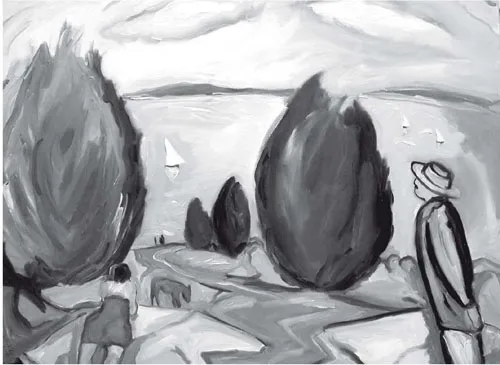
Pasture 6 Shaun McNiff
After
Sally Atkins
for Majken
We have cracked the categories
Analyzed the knowing
Decentered, deconstructed
The world
Art and beauty
Ourselves
And knowing itself,
Can we stay in that place of unknowing,
The uncertain, quivering,
Strange, mysterious
Dark and also beautiful
Place where the story breaks down,
The space between paradigms?
And what does the artist say to us?
She says
There is more, open the door
Something calls
The art
The other person
The tiny blue flower
In its green grass bed
Beside the path,
And what does it mean to be human?
To respond to that call?
To say:
Yes, I am here,
And to stay there
Not knowing
Yes, I am still here.
![]()
1
CULTIVATING
IMAGINATION
Shaun McNiff
As the popularity and relevance of expressive arts therapies continue to expand, we are on the verge of becoming a mainstream discipline. The realization of this opportunity will depend upon our ability to understand and articulate what we can offer the world. Our discipline is based upon the activation of the medicines of the creative imagination that operate in ways that cannot be explained by the linear paradigms and the analytic narratives which have characterized psychological thinking during the past century. In addition to articulating the healing function of the creative imagination, we need to realize that this “intelligence” has few limits in terms of what it can become. The expressive arts therapies have powers unrealized and applications yet to be imagined.
What is the creative imagination?
The lack of appreciation for the intelligence of the creative imagination originates largely in the dualistic world views that have for so long cast complementary elements—reason and intuition, science and art, the real and unreal, subjective and objective, empirical and imaginal—into polar camps which enjoy few possibilities for reciprocal creation. Imagination is an “integrative” intelligence that includes reason, intuition and many other contributors in keeping with the nature of reality. It is time to move past dualities of mind and to appreciate the complete “participation mystique” of imagination.
Imitating nature, the creative imagination operates by making connections between all things. In Art-Based Research (1998), I document how the expressive arts therapies can do much more in utilizing the creative imagination as a mode of discovery.
The literature documenting the process of creative discovery in science and industry speaks often about the process of imagination. We have heard many accounts of how creative scientists make their most important discoveries while pondering some aspect of nature outside the context of the laboratory or while relaxing in a state of reverie. Discovery frequently occurs during periods when the linear thinking of a particular experiment is suspended, and this allows the various aspects of a problem to take on a different relationship with one another. The relaxed reverie of imagining generates a new “integration” of the participating elements.
It seems that areas of life which are driven by the need to innovate and change embrace the creative imagination, whereas those sectors striving to justify themselves according to prevailing concepts of reality are less likely to acknowledge its existence as a primary intelligence. When we plan and assess everything that we do according to what we already know and accept imagination is apt to suffer.
The presumption that imagination is “only” idle fantasy and make-believe has been a serious deterrent to its growth. When cast as a trivial activity, imagination loses the benefit of energies focused on realizing its full potential and its capacity to work closely with reason and science in solving problems and creating new life.
It might be asked whether there is an “unreal” aspect to the working of imagination. For those who see imaginative reverie as simply another form of reality, a distinctly imaginative presence that can be distinguished from the structure of physical things, there is a constant need to differentiate the varied types of reality. The conventional view of “reality” is limited to “facts” and “hard data” as verified by the perceptions of reasonable people. In my work with psychiatric patients in the 1970s, I observed how the person labeled psychotic or schizophrenic was caught in a bind when it came to self-expression. Contents that they presented in their art or in their conversations that deviated from the most literal definitions of the external world were often viewed as confirming that they were out of touch with “reality.”
It seemed natural to me to view a person’s inner experience as simply a form of reality that differs from what exists in the material realm of consensual experience with others. When a patient made a painting or a poem expressing personal feelings, they were creating reality within the context of their individual relationships with the media. The experience of psychosis, approached as a disorder of imagination, involved an inability to distinguish amongst the different aspects of reality that might be interacting with one another in a particular situation.
The mind is disoriented by psychosis and unable to move from one type of experience to another in a way which is congruent with the experiences of other people. A person experiencing this condition no longer makes the subtle distinctions between inner and outer experiences that characterize healthy relations with the world. In psychosis the purely imaginal, and nevertheless real, phantoms of the inner world are experienced literally, as though they were material beings existing in the external world. It can be argued that the one-sided belief that only “hard data” are real is equally out of touch with reality. The phenomena of the creative imagination contribute in a productive way to improving the quality of life when inner visions take shape within the physical world.
How does imagination operate?
Creative vitality can be viewed as a condition in which all of a person’s or a community’s resources simultaneously generate stimuli and insights without necessarily following a logical or linear sequence of actions. The imagination is the intelligence that integrates and guides the creative transformation of what some might perceive as an unlikely mix of participants. In 1804, Jean Paul Richter described the imagination as the “faculty of faculties” which he likened to the process of pollination: “In genius all faculties are in bloom at once, and imagination is not the flower, but the flower-goddess, who arranges the flower calyxes with their mingling pollens for new hybrids” (1973, p.35). Imagination is the conductor of creative action, a force that operates by making fresh links between previously separate entities, always open and receptive to new possibilities while forever seeking out opportunities.
The vitality of the imagination is frequently experienced within groups and communities that are given the freedom and support to create. The community of creation is an energizing force that acts upon the people within it. As the Romantic poets observed, the life of imagination is furthered by an environment where “flying sparks” pass amongst people and ignite new ideas. This interactive and participatory dynamic also occurs within the individual imagination. The community of creation that we discover in the company of other people exists within ourselves.
Today, the general sense of imagination may be defined as an ability to creatively engage the world. Where not too long ago imagination was primarily identified with “unreality” and fantasy, imagination is now increasingly being viewed as a primary creative intelligence. Although for some people imaginative activity might suggest mental images or ideas of things that are not physically present, the more pervasive sense of imagination is focused on its identity as a force that is capable of creating new life.
We speak often about the creative imagination as the basis of genius in the arts and science as well as happiness in daily life, but there is very little about this intelligence in psychological literature. What has been written is often far removed from the experience of imagining. Perhaps this is because psychology and imagination are based on very different languages and worldviews. The latter requires a constant flight outside the limits of what currently exists, and the former exemplifies the methodical rigors of operating “within the lines” of currently accepted inquiry. The linear patterns of conventional psychological thought simply do not correspond to the more circuitous and paradoxical ways of imagination. Conventional dichotomies such as the split between reason and intuition polarize the study of the creative act. Psychology imagines itself as an empirical and analytic science, and it is not surprising that it is reluctant to recognize and seriously investigate an intelligence located beyond its current sphere of activity. Imagination’s identification with fantasy has no doubt contributed to its peripheral role as an object of psychological inquiry and as an accepted tool of inquiry.
Edith Cobb (1977) felt that when people enter into “reciprocal relations” with the natural world, they access creative energies that are generated by the ecology of forces moving within environments. In keeping with Richter’s integrative vision, Cobb’s ecological theory suggests that the intelligence of imagination operates through the “power of creative synthesis.” She views imagination as interplay between the individual person and the “otherness” of the external world, all of which correspond to the movements of nature. This view of imagination concurs with the Chinese and East Asian idea of ch’i, the vital force permeating all of life, which acts most effectively when spontaneous like a force of nature (McNiff 2015).
Everything participates in an environment of creative integration. There is no need for dichotomy between the participants. Private reverie utilizes perceptions of the natural world as sources for creative play. Cobb perceives the space between the individual and the object of desire as the realm from which “imagined forms” are created by the instrument of “mind” (1977, p.56).
Imagination is an intermediary sphere where the interplay between inner and outer worlds takes place. It is an open and dynamic realm where narrow fixation is discouraged because it interrupts the ecology of creative relations and dulls a person’s sensitivity to new influences. When we are immersed in reflection upon our mutual relations with nature, imagination acts as the integrating intelligence.
What can we do to cultivate imagination?
In keeping with Edith Cobb’s vision, the creative imagination is an intermediate realm, existing in the space created between a person and an object of reflection. The identification of imagination as an intermediate realm suggests a place, or more accurately a state of consciousness, where the different perspectives and participants in a situation can meet, influence one another, and create new patterns of interaction. This condition can be likened to the Middle Way of Buddhism or the Taoist sense of nature that avoid the traps of polarization. The middle realm is not a static center of equilibrium and it is not to be confused with the term “middle of the road” or with compromise. Gathering the strongest possible elements and allowing them to interact freely within a safe environment, the imagination integrates and transforms ideas into new relationships. Paolo Knill’s “intermodal” theory of expressive arts therapy is based upon the medial space of imagination (Knill, Barba and Fuchs 1995), as is Stephen Levine’s “poiesis” that affirms suffering and fragmentation as inseparable from the depths of creative imagination (1992). All of life is vital to the process.
Imagination’s middle realm is thoroughly immersed in the experience of the world but open to new perspectives, unfettered by fixed ideas, and always longing to create anew. It is a kinetic and dynamic area corresponding to the ancient Celtic conception of “thin places” where movements between matter and spirit occur with relative ease. Being in the intermediate realm of imagination can also be compared to what athletes experience when they are “in the zone.” There is a relaxed but totally focused flow from one thing to another. As with the aesthetic perception of beauty, the person is wholly engaged and detached at the time.
The middle realm operates according to what I call the “principle of simultaneity” (2015) that accepts many things happening at the same time. Different elements coexist, converge, and cooperate while staying completely true to themselves.
The possibilities for integration are endless, and kinesis is constant. As a new combination of elements is achieved, the movement continues. Creative types have a keen appreciation for how the pleasures of imagination involve continuous immersion in the process.
The imaginative realm is spacious and safe. The absence of an intermediate realm between polarized positions can create a tight squeeze that can be both restrictive and dangerous. When there is little room between opposing positions, they are apt to act out their needs for expression onto one another. When this happens, the “invaded” territory is likely to perceive the incursion as a threat, rather than as the stimulation of a partner in the larger interplay of creation.
As in the Buddhist tradition, the middle way accepts contradictory principles and enables them to interact with one another and to find a creative way of integrating their energies. While the middle of the road or centrist attitudes desire to eliminat...