Palmistry is an integral part of Jyotish practice (astrology) that helps to determine an individual's physical, mental and karmic potential. A full explanation of how to read a palm from the point of view of Vedic wisdom is provided, with tips on how to identify and time those areas impacting on wealth, health and longevity. This book teaches you to analyse the possible implications of life-events as seen from the lines (Rekha) on the palm. This book also offers a number of methods to placate astrological influences via the use of yantra, mantra and gemstones, for example, explaining which gemstones to wear and on which finger. This guide is a thorough introduction to the practice of Vedic palmistry for students and practitioners of the Vedic tradition and those with a general interest in the occult sciences of India, but also for anyone interested in what the hand can tell them about their life potential and circumstances.
- 176 pages
- English
- ePUB (mobile friendly)
- Available on iOS & Android
eBook - ePub
About this book
Information
Topic
MedicinePART I
TOPOGRAPHY
OF THE HAND
OF THE HAND
Chapter 1
WHICH HAND DO
— I LOOK AT? —
— I LOOK AT? —
There is some level of controversy over which hand should take precedence during palm analysis. Which hand represents what – and how to judge with factors such as gender, career and preference in use. The following provides five popular answers to this question:
•More ancient sources advise the right hand of a male is preferred during analysis, with the opposite being true of women. A man’s left hand is considered his cast lot from birth, his right hand bearing those Rekha most likely to have been ‘modified’ by sustained effort/work (or the lack of it). The reverse is held to be true for a woman.
•The left hand is inscribed by that which has already passed (previous incarnation/karmas). Upon the right hand are those events which are current or yet to be. In short, each palm is unique to these expressions. This is true for either male or female.
•The hand that dominates, that is, leads by action or is steadiest, is to be preferred in analysis. That is to say, the hand by which an individual makes their livelihood. Rekha in this hand are most likely to affect the future.*
•Rekha seen in both hands are to be taken into due consideration, similar patterning taken as confirmation of fate. Where Rekha are divergent, the dominant hand should be taken to provide a final analysis.
•If a person is ambidextrous (preferring neither hand in daily tasks), the hand which bears the greatest profusion or depth of line is to be preferred.
*Throughout this book I will adhere to this third method, my instructor’s preferred method of analysis (see Appendix for more information).
Chapter 2
HAND TOPOGRAPHY
— AND ĀYURVEDA —
— AND ĀYURVEDA —
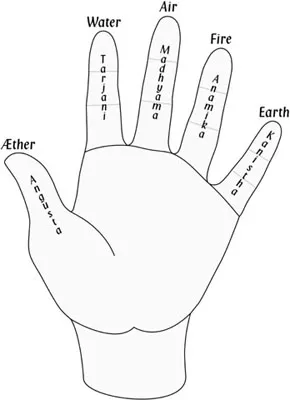
Key: Angusta = thumb, Tarjani = forefinger, Madhyama = middle finger, Anamika = ring finger and Kanistha = little finger. The five states of matter, or Pañca Mahabhuta, are represented by thumb/æther, forefinger/water, middle/air, ring/fire and little finger/earth.
According to some Āyurvedic sources, Sushruta1 is thought to have said: ‘Human hands are truly greatest amongst all tools, for they are the means by which all tools are fashioned.’ Having such emphasis placed upon the hands, it seems only natural they should find themselves central to ancient practices of divination.
Vedic Palmistry identifies the four fingers and thumb as corresponding to the five states of matter2 (pañca mahabhuta), the five senses (buddhīndriyas3), the five sense organs (pañca jñanendriyani4) and the five actions (karmendriyas5). The four fingers and their associated mounds (parvata) relate to four of the nine planets. The five remaining planets are assigned various positions or sthana about the palm. Each of the three phalanges on the four fingers denotes one of twelve zodiacal signs (known as Rashis6), with the two hands being symbolic of consciousness (puruṣa) and latent matter (prakṛti). Two hands relate also to discharged karma and those karmas yet to unfold. Destiny (dharma) is to be read from the lines upon the palm or through the appearance of symbols (chinha), nested in amongst a profundity of these lines. The presence of the latter was deemed an auspicious sign (laksanya), awarded either to alleviate or to teach a valuable life lesson. Using Āyurvedic principles, hands are firstly decoded using the principle of dominant element and dosha.7 The five elements and their corresponding dosha are:
Vāta = Air and Æther
Pitta = Fire
Kapha = Water and Earth
As elements and dosha are interrelated, the qualities of each become detectable on the hand. As hands are generally less subject to change on the body, their analysis becomes an ideal first-tier investigative tool.
AIR HAND
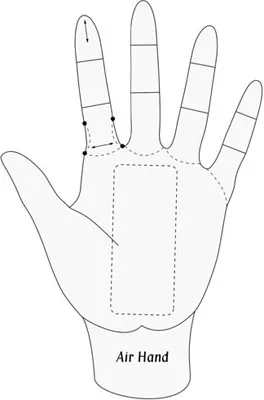
Air Hands have much in common with the Āyurvedic dosha Vāta (inclusive of æther).
Qualities of the Air Hand include dryness and coolness with delicate ‘narrow’ bone structuring and spatial irregularities of the phalanges. Often the distal phalanges appear ovular at the tip, while the fingers appear overly long8 or short in relation to the length of the palm. For example, narrow palms will appear to accentuate finger length whereas long narrow palms will appear to shorten the finger length. Additionally, there may be a slight narrowing at the base of the proximal phalanges, while thumbs often appear long, wiry, dexterous and often double-jointed.
Overall, the Air Hand tends toward a rectangular form with slightly protruding joints. Rekha tend to be fine, profuse and branched, displaying multiple broken lines or cross-hatching. The nail beds are often dried, frayed and white. Nails are generally thin, brittle, chewed, lined or irregular looking; with an overall smoky whiteness. Typical traits of an Air Hand type include: dexterity, adaptability and an inherent distrust of authority figures. They are often verbally communicative, erratic, artistic, creative and slippery (hard to pin down). Though easily enthused, they are unable to sustain any long-term plan, often subject to mental fatigue or periodic physical exhaustion.
FIRE HAND
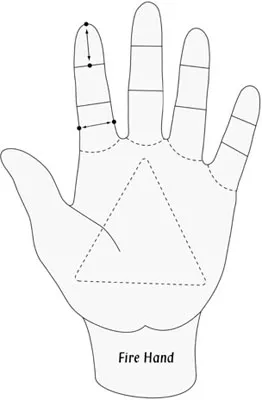
Fire Hands have much in common with the Āyurvedic dosha Pitta.
Qualities of the Fire Hand include warmth, smoothness (usually padded and shiny) with colourful blotches, redness, freckles and so on. Fingers are of medium length with little variation in width9 except close to the lower proximal phalanges. The palm of the Fire Hand often shows a subdued triangular quality, its natural contours revealing a subtle triangular depression when fingers and thumb are brought together. Rekha tend to be well-defined, of medium depth but display a good number of reddened crosses or forks at the ends of primary lines. Keerthi Rekha may be present (ring finger/fire element) or strong Rekha present upon Kuja-sthana10 displaying prominence or heightened colouration.
Nail beds are often raised, pink an...
Table of contents
- Cover
- Title Page
- Contents
- Introduction: Vedic Palmistry
- Part I: Topography of the Hand
- Part II: The Lines (Rekhas)
- Part III: Planets and Zodiac Signs
- Part IV: Nakshatras (Lunar Mansions)
- Part V: Upayas (Remedial Measures)
- Appendix: The Bajaj Seer (An Introduction to Vedic Palmistry)
- Bibliography
- Index
- Join our mailing list
- Acknowledgements
- Dedication
- Copyright
- By The Same Author
- Endorsements
Trusted by 375,005 students
Access to over 1.5 million titles for a fair monthly price.
Study more efficiently using our study tools.
Frequently asked questions
Yes, you can cancel anytime from the Subscription tab in your account settings on the Perlego website. Your subscription will stay active until the end of your current billing period. Learn how to cancel your subscription
No, books cannot be downloaded as external files, such as PDFs, for use outside of Perlego. However, you can download books within the Perlego app for offline reading on mobile or tablet. Learn how to download books offline
Perlego offers two plans: Essential and Complete
- Essential is ideal for learners and professionals who enjoy exploring a wide range of subjects. Access the Essential Library with 800,000+ trusted titles and best-sellers across business, personal growth, and the humanities. Includes unlimited reading time and Standard Read Aloud voice.
- Complete: Perfect for advanced learners and researchers needing full, unrestricted access. Unlock 1.5M+ books across hundreds of subjects, including academic and specialized titles. The Complete Plan also includes advanced features like Premium Read Aloud and Research Assistant.
We are an online textbook subscription service, where you can get access to an entire online library for less than the price of a single book per month. With over 1.5 million books across 990+ topics, we’ve got you covered! Learn about our mission
Look out for the read-aloud symbol on your next book to see if you can listen to it. The read-aloud tool reads text aloud for you, highlighting the text as it is being read. You can pause it, speed it up and slow it down. Learn more about Read Aloud
Yes! You can use the Perlego app on both iOS and Android devices to read anytime, anywhere — even offline. Perfect for commutes or when you’re on the go.
Please note we cannot support devices running on iOS 13 and Android 7 or earlier. Learn more about using the app
Please note we cannot support devices running on iOS 13 and Android 7 or earlier. Learn more about using the app
Yes, you can access Vedic Palmistry by Andrew Mason in PDF and/or ePUB format, as well as other popular books in Medicine & Alternative & Complementary Medicine. We have over 1.5 million books available in our catalogue for you to explore.