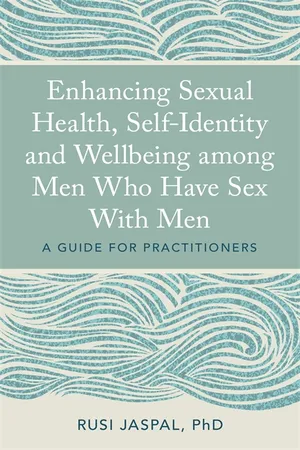
By analysing research into links between low psychological wellbeing and sexual risk-taking behaviours that occur in men who have sex with men (MSM), this book demonstrates what impact social and psychological interventions could have on MSM at risk of poor sexual outcomes. At the heart of the book is Identity Process Theory, co-developed by the author, a social psychological theory of identity construction, threat and coping. The book considers the emerging debates in MSM's health, such as the use of Grindr and 'chemsex', and also explores the socio-structural factors, such as homophobia and stigma, that threaten the self-identity of MSM. The book offers principles and techniques from this theory that can be used as an effective intervention and therapeutic model with MSM to build more positive identities and reduce sexual risk-taking.
eBook - ePub
Enhancing Sexual Health, Self-Identity and Wellbeing among Men Who Have Sex With Men
A Guide for Practitioners
- 216 pages
- English
- ePUB (mobile friendly)
- Available on iOS & Android
eBook - ePub
Enhancing Sexual Health, Self-Identity and Wellbeing among Men Who Have Sex With Men
A Guide for Practitioners
About this book
Information
Topic
Sciences socialesSubtopic
Études LGBTPart I
INTRODUCTION
Chapter 1
Social Psychology for
Practitioners in Sexual
Health and Wellbeing
Practitioners in Sexual
Health and Wellbeing
Gay, bisexual and other men who have sex with men (MSM) can face a series of psychosocial challenges during the life course. Some of these challenges are transient and short-lived, while others persist over time. Some are societal in nature, while others are psychological in origin. Individuals may encounter homophobia, stigma, and rejection from others. They may perceive aspects of identity (such as their sexual orientation) to be problematic, internalise stigma, and experience feelings of low self-worth, guilt and shame. The antecedents of these social and psychological challenges are multifarious and include the presence of particular stereotypes, images and representations in our social context, as well as specific past experiences that shape our perspectives on our identities and the world around us. The consequences of these social and psychological challenges can be similarly far-reaching and impinge on various dimensions of our lives, not least on sexual health and psychological wellbeing. Some individuals may come to experience shame, anxiety and depression, and engage in behaviours that can put their sexual health at risk.
The tripartite relationship between sexual health, self-identity and wellbeing constitutes the focus of this volume. The inter-relations between these three components will be outlined and discussed in the chapters that follow. The following three cases illustrate and exemplify the social and psychological challenges faced by MSM, as well as the ways in which wellbeing and sexual health may be affected:
Case 1: Mark, an HIV-negative gay man
Mark is a 27-year-old gay man who has recently moved from a small town in Derbyshire to London, having completed his studies. When he arrived in London six months ago, Mark immediately took full advantage of his new life in the capital and was keen to make new friends, to socialise and to explore the gay scene in London. He rented a flat with three other gay friends in an area with a large gay population. Given that his hometown in Derbyshire did not have any gay bars or clubs, he was particularly excited about exploring the gay scene in London and was sure that he would enjoy it. Mark downloaded Grindr1 on his phone and was delighted to see that there were so many gay men in his neighbourhood. He compared this to his experience of being gay in Derbyshire, which had felt very lonely, and now felt elated to be in such a gay-friendly city. Each time he opened Grindr on his phone, he was propositioned by attractive gay men and ended up meeting two or three new guys a week. He liked the fact that there were so many guys on the application and he felt that he was making up for the disappointing sex life he had had in his home town. Mark also discovered that there were two gay saunas in his area, which he began to frequent in order to meet sexual partners. He had never had so much sex before. Mark knew about HIV and that people could catch it from not using a condom. However, given that the guys he was meeting did not ‘appear’ to have HIV, he did not see himself as being at risk. Although he had condoms at home, sometimes he did not bother using them, especially if condom use was not suggested by his sexual partners. On one occasion, he was invited to a chemsex2 party in his neighbourhood. Although slightly nervous at first, Mark went along to see what it was like. Most of the guys at the party were taking drugs and eventually Mark was offered drugs too and accepted. Suddenly, he felt an enormous bout of confidence and felt able to approach guys that he found attractive. He greatly enjoyed the sex he had that night. Since that night, Mark has regularly attended chemsex parties, and no longer enjoys sober sex as much. These days Mark goes to parties almost every weekend and, while it was just a bit of fun at the beginning, now it feels as if it is taking over his life. He no longer feels as able to concentrate on other things in his life, like his friends, his job and his new boyfriend. Many of the people who matter to Mark seem to be distancing themselves from him and he feels increasingly lonely. Recently, Mark noticed a white sore around his anus and booked an appointment with his doctor who diagnosed him with both syphilis and rectal gonorrhoea. Though he tested negative for HIV, the doctor informed him that he was at high risk of infection. This has made Mark reflect on his life in London. He realises that he does not really enjoy the casual sexual encounters he has been having and that he often regrets them afterwards. He feels fearful of getting HIV as he now realises that he is at significant risk. Mark wants to make some changes in his life but does not know where to begin. It feels as if a lot of things need to change but Mark wonders what his life will be like if he makes these changes.
Case 2: Ahmed, a British Muslim gay man
Ahmed is a 25-year-old British Pakistani Muslim gay man. He grew up in a conservative Muslim family in a large Pakistani community in inner-city Bradford. Most of his neighbours, family friends and school friends were, like him, of Pakistani background, and he had almost no friends of other ethnic backgrounds. From a very early age, Ahmed realised that he was attracted to men but did not understand why he felt this way and what this meant. He felt abnormal and ashamed of himself and initially tried to fight his same-sex attraction. When Ahmed went to the mosque and began to read the Koran, he came to believe that his feelings were sinful and that he must attempt to change them. As a teenager, he convinced himself that his feelings were transient and that he would eventually change and become heterosexual. At school, other boys would tease Ahmed and call him gay because he did not like to play football and because most of his friends were girls. These early experiences of teasing and bullying caused Ahmed immense psychological distress and made him feel inadequate. He became withdrawn at school and in other contexts. After a while, rumours began to circulate about Ahmed’s sexual orientation and soon several of his classmates joined in and bullied him. Some even threatened him with physical violence. These experiences, coupled with his early belief that homosexuality was sinful, led Ahmed to believe that he was right all along – that being gay was a terrible thing and that the bullies were in fact right to treat him as they did. Ahmed tried to immerse himself in religion as a means of distancing himself from his sexual orientation but, as he got older, he found it increasingly difficult to resist sexual urges. He watched gay porn online but always felt awful about himself afterwards – this made him feel confused, guilty and dirty. He downloaded Grindr on his smart phone and began to meet up with guys for sex. These experiences too contributed to his sense of low self-worth and perceived immorality. One of the men he met on Grindr invited him to a gay club in London. Ahmed felt uneasy about going to a club where he might be recognised and ‘outed’ to other people, but decided to take the risk and accepted the invitation. In the club he felt immensely uncomfortable and at times even feared that God would deliver some form of divine punishment to him for being in that environment. Now that Ahmed has completed his degree at the University of Bradford, his parents have begun to discuss arranged marriage and to introduce him to potential spouses – the daughters of relatives and family friends. This has made him feel very anxious and conflicted. On the one hand, he knows he feels no attraction to women but, on the other hand, he believes that an arranged marriage could be an effective ‘distraction’ from his gay lifestyle. Sometimes Ahmed refuses to discuss marriage with his parents, which has caused them to become suspicious. Ahmed in turn is fearful of the consequences – both for himself and for his family’s reputation – if people in his community find out that he is gay. Ahmed is feeling increasingly depressed, anxious and helpless. He cannot imagine having a relationship with another man, even though deep down he would like to. The idea of a relationship scares him so he just meets other guys for sex. Ahmed’s use of Grindr has increased significantly and he is now meeting more and more guys for casual sex. He does not really understand why he is doing this.
Case 3: Juan, a gay man living with HIV
Juan is a 33-year-old gay man from Spain. He was diagnosed with HIV at a gay men’s health charity in his hometown during the summer of 2014. As he did not view his sexual behaviour as risky, Juan expected to receive a negative test result and was thus shocked to learn that he was in fact HIV-positive. The gay men’s health charity referred Juan to the local hospital to confirm the reactive test result. Although his CD4 count was still relatively high, Juan requested to initiate antiretroviral therapy (ART) immediately. Still shocked at his diagnosis, Juan viewed his medication as an unfortunate daily reminder of his HIV infection. Moreover, days after initiating treatment, Juan began to experience negative physical side effects. He discussed his side effects with one of the doctors at the clinic, who was dismissive and unhelpful. The doctor appeared to be suggesting that this is what life with HIV is like and that Juan should simply get used to it. Juan felt that the doctor was unsympathetic towards him because he was gay and living with HIV. This situation was further complicated by the fact that Juan had a very difficult relationship with his family. As a child, he suffered sexual abuse, and he felt let-down by his parents who never acknowledged this. He felt unable to disclose his HIV status to his family, with whom he was living at the time of his diagnosis. In fact, given his strict Catholic upbringing, he also felt unable to come out as gay and, thus, he felt that he had to conceal both his sexual identity and his HIV status from significant others. This made him resent his parents. Although Juan did have a small group of HIV-positive friends from whom he derived some social support, he viewed himself as different from them and implicitly stigmatised his own friends, whom he regarded as responsible for their infection. A year after his diagnosis, Juan decided to move to London to distance himself from his family and in order to ‘be himself’. However, he felt lonely in London. Concerned about his declining health, Juan registered as a patient at his local sexual health clinic. His HIV consultant advised him to initiate ART immediately, reassuring him that he would be well looked after and that any side effects would be dealt with. However, Juan, still distrustful of medical professionals following his experience in Spain, initially refused treatment. This posed a dilemma for him because, on the one hand, he was well aware of his poor disease prognosis in the absence of medication but, on the other hand, he did not wish to think about his HIV infection and feared further side effects and indifference from his medical team. In view of a significant drop in his CD4 count, Juan reluctantly began ART. With his new drug regimen, he experienced no physical side effects but did continue to experience psychological adversity, including loneliness, depression and shame. Juan decided not to attend support groups, partly because he did not wish to disclose his HIV status to others and because he did not think he would have anything in common with other support group attendees. Indeed, he continued to deny that he had engaged in sexual risk behaviours in an attempt to differentiate himself from others living with HIV. As Juan’s mental health has begun to deteriorate, he is missing doses of his medication, which has increased the risk of drug resistance and of onward HIV transmission to his sexual partners. He finds it difficult to discuss these issues with his doctor and has also started to miss appointments. To deal with his feelings of loneliness, Juan is meeting sexual partners online and in gay bars. After facing rejection from potential sexual partners to whom he has disclosed his HIV status, he feels more ashamed and distressed about being HIV-positive. He has started to attend chemsex parties in London because nobody asks him his status there, allowing him to forget about HIV and to experience a sense of connection and intimacy with other men. Juan now has a detectable viral load but is not consistently using condoms with sexual partners of unknown HIV status.
This is not a book about chemsex in London, difficulties in adjusting to an HIV diagnosis among Spanish gay men, or the potential incompatibilities between religion and homosexuality among British Muslim gay men per se. Rather, this book is about the things that these cases have in common, namely the role of identity in determining sexual health and wellbeing outcomes among MSM. The cases allude to changes in personal and social circumstances, the desire to gain and maintain a sense of control and competence in complex situations, and the impact that events and circumstances can have on one’s sense of self-worth. They demonstrate that the reasons underlying behaviours that some observers may perceive to be reckless and irresponsible actually have more complex underpinnings that are rooted in culture, context and identity. They emphasise the impact that self-identity and sexual health can have for psychological wellbeing.
The cases also raise a series of challenging questions among practitioners who may work with the individuals described in them. How can HIV risk and HIV prevention be communicated to Mark in a way that will lead to effective and enduring behaviour change? How can he be supported to disengage from chemsex in a way that does not stigmatise him and that does not disrupt his life narrative? Why is Ahmed experiencing such distress in relation to being Muslim and gay? Why does he not just distance himself from his religion if this is deemed to be incompatible with his sexual orientation? Why does he appear to be taking more sexual risks now that he has problems at home? Despite his knowledge of HIV and of the effectiveness of ART, why is Juan so reluctant to initiate and to adhere to ART? Why does he actively avoid other people living with HIV? How can he be retained in HIV care? More generally, how can practitioners be better equipped to support Mark, Ahmed and Juan with their sexual health and wellbeing needs? The overarching aim of this volume is to draw attention to these challenging questions and to equip practitioners with the social psychological tools for understanding the tripartite relationship between self-identity, sexual health and wellbeing; for developing effective clinical practice cognisant of this tripartite relationship; and for constructing theory-driven public health interventions. A central thesis of this volume is that a combination of both individual and public health interventions is required in order to address the aforementioned questions and to enact effective and enduring change in patients.
In view of the multi-level nature of this project – focusing on both individual health and public health – social psychology seems the ideal starting-point. Social psychology is essentially the study of how the individual interacts with the social world – the individual’s cognition, emotion and behaviour is understood to be shaped by the social world (Jaspal and Breakwell 2014). Social psychology thus focuses on individual cognition, social influence processes, relationships with others and how people think, feel and behave as group members. Social psychologists have a long-standing interest in solving problems. They tend to favour methodological approaches, such as experiments and interviews, to understand the ways in which people think and behave and, crucially, to try to predict how people will think and behave in particular contexts. Description is important because it enables us to understand the past and present, but prediction is equally as important because it enables us to foresee, with varying degrees of accuracy, future events. While some social psychological theories describe, others predict.
Given that the description and prediction of attitudes and behaviour have constituted the principal focus of social psychology, it is easy to see why social psychologists have made such important contributions to the field of sexual health, self-identity and wellbeing among MSM. After all, if one can understand how and why people have engaged in risk behaviours in the past, one is better positioned to develop individual and public health interventions for preventing these behaviours in the future. For instance, Juan (Case 3) is clearly experiencing significant psychosocial challenges in relation to his HIV diagnosis, due in part to social stigma in Spain, his religious background which he perceives to be homonegative, and fears of rejection from sexual partners. These issues appear to be associated with his decreased self-care and increased engagement in sexual risk-taking behaviours. Furthermore, his poor experience of HIV care seems to be related to his current disengagement from services. In short, by understanding some of these psychosocial issues, practitioners may be able to tailor HIV care in wa...
Table of contents
- Cover
- Title Page
- Contents
- Foreword by Professor Dame Glynis Breakwell
- Foreword by Dr Laura Waters
- Part I: Introduction
- 1. Social Psychology for Practitioners in Sexual Health and Wellbeing
- Part II: Theory and Research
- Part III: Practice
- Part IV: Conclusion
- References
- Subject Index
- Author Index
- About the Author
- Join Our Mailing List
- Acknowledgements
- Copyright
- Of Related Interest
Trusted by 375,005 students
Access to over 1.5 million titles for a fair monthly price.
Study more efficiently using our study tools.
Frequently asked questions
Yes, you can cancel anytime from the Subscription tab in your account settings on the Perlego website. Your subscription will stay active until the end of your current billing period. Learn how to cancel your subscription
No, books cannot be downloaded as external files, such as PDFs, for use outside of Perlego. However, you can download books within the Perlego app for offline reading on mobile or tablet. Learn how to download books offline
Perlego offers two plans: Essential and Complete
- Essential is ideal for learners and professionals who enjoy exploring a wide range of subjects. Access the Essential Library with 800,000+ trusted titles and best-sellers across business, personal growth, and the humanities. Includes unlimited reading time and Standard Read Aloud voice.
- Complete: Perfect for advanced learners and researchers needing full, unrestricted access. Unlock 1.5M+ books across hundreds of subjects, including academic and specialized titles. The Complete Plan also includes advanced features like Premium Read Aloud and Research Assistant.
We are an online textbook subscription service, where you can get access to an entire online library for less than the price of a single book per month. With over 1.5 million books across 990+ topics, we’ve got you covered! Learn about our mission
Look out for the read-aloud symbol on your next book to see if you can listen to it. The read-aloud tool reads text aloud for you, highlighting the text as it is being read. You can pause it, speed it up and slow it down. Learn more about Read Aloud
Yes! You can use the Perlego app on both iOS and Android devices to read anytime, anywhere — even offline. Perfect for commutes or when you’re on the go.
Please note we cannot support devices running on iOS 13 and Android 7 or earlier. Learn more about using the app
Please note we cannot support devices running on iOS 13 and Android 7 or earlier. Learn more about using the app
Yes, you can access Enhancing Sexual Health, Self-Identity and Wellbeing among Men Who Have Sex With Men by Rusi Jaspal in PDF and/or ePUB format, as well as other popular books in Sciences sociales & Études LGBT. We have over 1.5 million books available in our catalogue for you to explore.