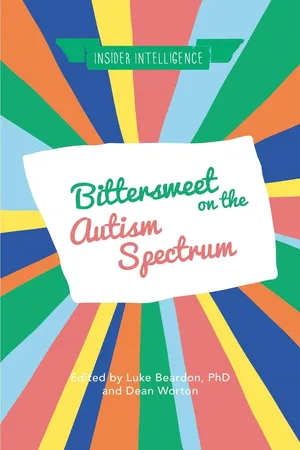
In this rich and diverse collection, 28 writers describe what positive experiences they have had as an autistic person, and show how the most unexpected subject areas can be a source of the positive. They demonstrate that individuals can, and do, experience life in positive ways, sometimes in the face of adversity. Sharing both dark and joyful moments with unreserved honesty, their insights are moving, often hilarious, creative, and highly intelligent, and usually surprising. From hair-raising travelling experiences to parenting with verve, volunteering to teaching, running a marathon to taking on a PhD, they show that autism need not limit life. Introduced by Luke Beardon and Dean Worton, their stories challenge stereotypes surrounding autism, empower, and entertain.
- 272 pages
- English
- ePUB (mobile friendly)
- Available on iOS & Android
eBook - ePub
Bittersweet on the Autism Spectrum
About this book
Information
Chapter 1
Opening the Umbrella
(Multicoloured Thank You Very Much!)
Introduction by Luke Beardon
The following is such a powerful quotation it seems appropriate to start with it:
The privilege of being oneself is a gift many take for granted, but for someone with AS, being allowed to be oneself is the greatest and rarest gift of all.
Alyssa is a gifted writer and the quotation above illustrates how superb she is at articulating her thoughts. The chapter as a whole is stimulating and insightful.
I think that one of the key messages, so brilliantly delivered in the chapter, is that so much can be gained by first allowing an individual to identify with themselves; second, for those around them to understand the individual and accept them for who they truly are – as opposed to who they may historically have tried to be. So many adults that I have the privilege of speaking to tell me of the relief of getting an identification and subsequently feeling empowered to stop emulating others, or trying to be what others want them to be (i.e. more in line with the general population). I don’t think it’s a case of ‘just letting people with autism/Asperger’s syndrome (AS) behave in any way they want’, which is a criticism I have heard in the past, and nor do I think that this is a sentiment that people with autism/AS see as appropriate either; however, what is clear to me is that allowing an individual to understand themselves and develop the confidence to engage with the world and be accepted as a person with autism/AS is critical. Perhaps, one day, this will be more common than ‘the rarest gift of all’.
Diagnosis as an adult
Early in life I recognised the different tune humming through me, out of synch with other children my own age. Not with nature, not with the rhythms of the planet; those songs I understood. But with the world – the ‘peopled world’ – those harmonies were a constant clash.
It has often been said that many people with AS identify with the unpeopled world, whether it be nature, machines or the arts. Take the unpredictability of ‘humanity’ out of our life’s equation and our AS anxiety drops to a mere murmur.
For years, all those quirks (which on a bad day I called my ‘random defects’ and on a good day I called ‘just being me’) I kept tightly under wraps. I had learnt early on that to say certain things got me stared at, stony silence or edged out of a conversation. I thought that when I reached that magical and elusive age called ‘adulthood’, all would fall into place and I’d finally hit my stride, somehow catch up to everyone else and work out what they were all on about. I would gesture, laugh and participate with ease – just like I saw others do. However, no elusive age arrived and the eventual catalyst for appreciating my own rhythm came in a very different guise: a diagnosis of Asperger’s, well into my thirties.
My diagnosis seemed to happen by chance, but if truth be told, I’m a big believer that nothing happens by chance.
As a school teacher, I come across a lot of children. One given year I had a child arrive in my class who had been diagnosed with Asperger’s syndrome. Wanting to be prepared and give this child the best opportunity to learn, I decided to do some research. In my quest for information, I remember picking up Rudy Simone’s book Aspergirls (2010, Jessica Kingsley Publishers) at a bookstore. I casually flicked through a few pages; paused here and there; read just enough to raise an eyebrow. I shut it a little too quickly, put it down and walked away. A few moments later I was drawn back to the book. I flicked through a few more pages, swallowed hard, put it down and again walked away. When I was pulled back to that bookshelf for a third time, as I picked up the title and stared at the cover, I heard a distinct voice inside my head say ‘buy this book’.
I did.
I read that book and as I did, I realised I was reading about myself. And I cannot tell you the relief that washed over me.
I know such an idea sounds strange – suddenly discovering one has a recognised medical dysfunction1 and feeling relief, but allow me to elaborate.
For too many years I had questioned and agonised over why life felt so baffling and people so impenetrable. The cards that life deals – work, relationships, health, tragedies, happiness – all seemed to me like thorny, oversized pills to swallow. Yet, how did other people seem to sail smoothly through these aspects of life? While I felt utterly ill-equipped, many seemed to thrive. Was I was missing a vital tool or piece of information that everyone else had?
And here I was in a bookstore, reading in a stranger’s book all my thoughts, reactions and emotions – a carbon copy of my inner life – secrets that I had never told a soul. Within those pages I found a profound relief that someone, somewhere actually, finally, understood.
After some initial research and a recommendation, I made an appointment with a doctor of clinical psychology.
Why the big beautiful umbrella?
Being in that psychologist’s office – the waiting, the interview, the assessment – although I was at first acutely nervous, turned out to be a fairly painless process.
For the first time in many, many years, I felt I could actually be myself. As I relaxed back into the couch, the tense mask I had worn each and every day began to slip away. For once, I didn’t have to remind myself to look the psychologist in the eyes. I could take my time to speak. It didn’t matter if I stumbled over my words or didn’t understand her question: I could ask her to repeat it; ask her to be clearer.
The privilege of being oneself is a gift many take for granted, but for someone with AS, being allowed to be oneself is the greatest and rarest gift of all.
As she explained my newly acquired, tailored-for-me diagnosis of Asperger’s syndrome, the psychologist drew a sweeping arc on her whiteboard. This, she explained, was to represent the autism spectrum under which there were many manifestations, Asperger’s being just one. And under autistic spectrum disorder (ASD)2 there could be over 150 different manifestations, each combination of traits as unique as the individual.
As I listened, staring at the whiteboard, sitting in that office, I remember a clear, striking thought: that’s my umbrella.
At that very moment a long-held pressure valve deep at the core of me just gave way. Relief – I suddenly had an answer, a name for it: Asperger’s.
Finally, someone else sees me.
The Aspie invisibility cloak
Officially, I come under the banner of ‘the invisible Aspie’. I wasn’t diagnosed until well into my thirties. I knew nothing about Asperger’s; I hadn’t heard of the word before I became a teacher – even then I had just a vague understanding. I had been to psychologists before when I was younger. The subject of Asperger’s was never raised.
So how did a diagnosis of AS, with all of its blindingly obvious traits, pass me by for almost 40 years? There are many possible reasons.
Diagnosis of AS 25 years ago was in its infancy. Looking back in the literature, diagnosis of boys was prevalent; diagnosis of girls was extremely rare. It is only recent news that girls with AS can manifest very different traits to their male counterparts. As a result, mistakes were made and many children were overlooked. A fair few adults today, aged 40 plus, are just now being diagnosed with AS. For these people, a diagnosis in middle age may mean great upheaval but also that life suddenly begins to make sense.
Growing up I learned to watch others. Girls with AS are more capable of observing social norms than boys, and they are more likely to imitate these norms even though they can’t decode or truly understand them. Any girl navigating her way through the teenage years does everything possible to fit in. Girls with AS can do this to an extreme and become excellent mimics, imitators and actors.
Taking into account these factors, it’s easy to understand why my Asperger’s was invisible.
With any unmasking in life there comes a seismic shift of the psyche; in other words a remarkable shift of perspective – both for the one diagnosed and their loved ones. From my personal experience, although dramatic and initially confronting, the diagnosis of AS was an illuminating experience.
What if everyone – parents, teachers, health professionals – all started seeing the diagnosis of AS as a gift? Not autism spectrum disorder, but autism spectrum difference?
After all, a diagnosis gives one permission to be one’s truest self; why spend years being something that you are not? Finally finding your stride, your true rhythm, can be the key to unlocking great creativity and purpose.
And with such direction, such freedom of expression, one can not only survive but thrive.
After diagnosis: the grief of lost years
Initially after seeking and getting a diagnosis of Asperger’s there is relief; the euphoria that a puzzle has been solved. The confused past can be reassessed and future disasters possibly averted.
But then comes the grief. A sadness for lost time; a hindsight that spans over years of confusion, along with the memories and exhaustion of constantly keeping one’s head just above water. How much better could life have been if we’d only known?
There is anger too. Anger at others for their lack of understanding; for measuring us by an invisible standard we couldn’t hope to meet. Anger at ourselves for tolerating what should never have been tolerated; for bending ourselves into unrecognisable shapes to fit someone else’s idea of normal.
There is a period of withdrawal in order to analyse the foggy past and attempts to figure out a way, with our new understanding, into the future. There is the picking over every past relationship and the sifting through of relationships that are now.
Then there are promises made to ourselves, and conversations needed to be broached with others, the revelation of our diagnosis, should they wish to come close to us now.
As with all types of grief, this process takes time. We have lost an old, confused but familiar life and found ourselves in a different future. Some patterns are hard to break; some reactions are difficult to gain...
Table of contents
- Cover
- Title Page
- Contents
- Preface
- 1. Opening the Umbrella (Multicoloured Thank You Very Much!)
- 2. How Volunteering with Bradford Autism Support Gave Me Confidence and Helped Me Come to Terms with My Own Diagnosis of Asperger’s Syndrome
- 3. A New Career Path: Undertaking a PhD: The Doctor Will See You Now!
- 4. Becoming a Parent Is Really, Really Hard... Who Would Have Guessed?
- 5. Autism and Music
- 6. How Discovering Creative Writing Opened Up a Whole New World for the Aspie in Me
- 7. Lifelines: How I Manage My Autism to Create a Positive Life Experience
- 8. Positive Experiences of Being on the Autistic Spectrum: Personal Reflections from Joanna Treasure
- 9. A Year in Normandy: Learning a Foreign Language and Culture
- 10. The Story Behind a Story: My Novella – The Atlas Legacy
- 11. My London Marathon Experience: Walking into a New Day
- 12. In an Economic Climate When the Most Able in Society Are Having Difficulty Finding Work, What Chance Do Those with Disabilities Have? Tony’s Journey
- 13. Loyal Companions: Animals Can Teach Us All a Lot about Happiness and Acceptance
- 14. Celebrating the Autism Spectrum
- 15. Positive Experiences for Sarah (Aged 27): Enjoying Freedom That I Never Thought I’d Have
- 16. How Our Negative Experiences Can Raise Awareness of Autism and Produce Positive Results for Society
- 17. Aspies’ Experiences in Theatre
- 18. The Day I (Nearly) Became a Male Prostitute
- 19. My Radio Show: Making People Happier with My Strong Music Interest and Knowledge
- 20. Turning Points: How Thinking Outside the Box Helped Me Overcome Hurdles in My Music Teaching Career
- 21. Why Bother? Aiming to Create Social Fairness and Harmony
- 22. Positives I Can Draw from Experiences as a Result of the Tragic Events on 7 July 2005 in London
- 23. Interview with a Music Lover on Positive Aspects of His Life
- 24. Revelations on Planet Autism
- 25. Two Very Different Birth Stories
- 26. Syndromes, Spectra and Starlight
- 27. Turning a Negative into a Positive
- 28. Dream Big: There Can Be Another End to the Rainbow
- Dedication
- Copyright
- Books In The Same Series
- Endorsement
Trusted by 375,005 students
Access to over 1.5 million titles for a fair monthly price.
Study more efficiently using our study tools.
Frequently asked questions
Yes, you can cancel anytime from the Subscription tab in your account settings on the Perlego website. Your subscription will stay active until the end of your current billing period. Learn how to cancel your subscription
No, books cannot be downloaded as external files, such as PDFs, for use outside of Perlego. However, you can download books within the Perlego app for offline reading on mobile or tablet. Learn how to download books offline
Perlego offers two plans: Essential and Complete
- Essential is ideal for learners and professionals who enjoy exploring a wide range of subjects. Access the Essential Library with 800,000+ trusted titles and best-sellers across business, personal growth, and the humanities. Includes unlimited reading time and Standard Read Aloud voice.
- Complete: Perfect for advanced learners and researchers needing full, unrestricted access. Unlock 1.5M+ books across hundreds of subjects, including academic and specialized titles. The Complete Plan also includes advanced features like Premium Read Aloud and Research Assistant.
We are an online textbook subscription service, where you can get access to an entire online library for less than the price of a single book per month. With over 1.5 million books across 990+ topics, we’ve got you covered! Learn about our mission
Look out for the read-aloud symbol on your next book to see if you can listen to it. The read-aloud tool reads text aloud for you, highlighting the text as it is being read. You can pause it, speed it up and slow it down. Learn more about Read Aloud
Yes! You can use the Perlego app on both iOS and Android devices to read anytime, anywhere — even offline. Perfect for commutes or when you’re on the go.
Please note we cannot support devices running on iOS 13 and Android 7 or earlier. Learn more about using the app
Please note we cannot support devices running on iOS 13 and Android 7 or earlier. Learn more about using the app
Yes, you can access Bittersweet on the Autism Spectrum by Luke Beardon, Dean Worton in PDF and/or ePUB format, as well as other popular books in Psychology & Autism Spectrum Disorders. We have over 1.5 million books available in our catalogue for you to explore.