The must-read summary of Theodore Modis' book: "Conquering Uncertainty: Understanding Corporate Cycles and Positioning Your Company to Survive the Changing Environment"
This complete summary of the ideas from Theodore Modis' book "Conquering Uncertainty" shows that anticipating the future of a business and taking suitable action, particularly during times of rapidly changing competitive business conditions, can be challenging. However, business changes are not random and unpredictable – they actually align with seasons along a well defined pattern called ''the S-curve''. This summary explains that once a business can forecast which season will be next, actions can be taken to empower the corporation to successfully adapt to the coming economic climate. Levels of investment, research, innovation and the introduction of new products can be timed using S-curves and the company's position on its S-curve. In other words, eliminating business uncertainty is achieved when a company executes a successful business strategy – a strategy that takes into account the economic conditions of the immediate future. Companies which do so can prosper, irrespective of external conditions.
Added-value of this summary: • Save time • Understand the key concepts • Increase your business knowledge
To learn more, read "Conquering Uncertainty" and discover how to make the right decisions at the right time.
The projected life cycle of consumer products and the rate at which substitute products will gain market share is of vital interest to any company or organization which wants to definitively forecast future revenue streams.
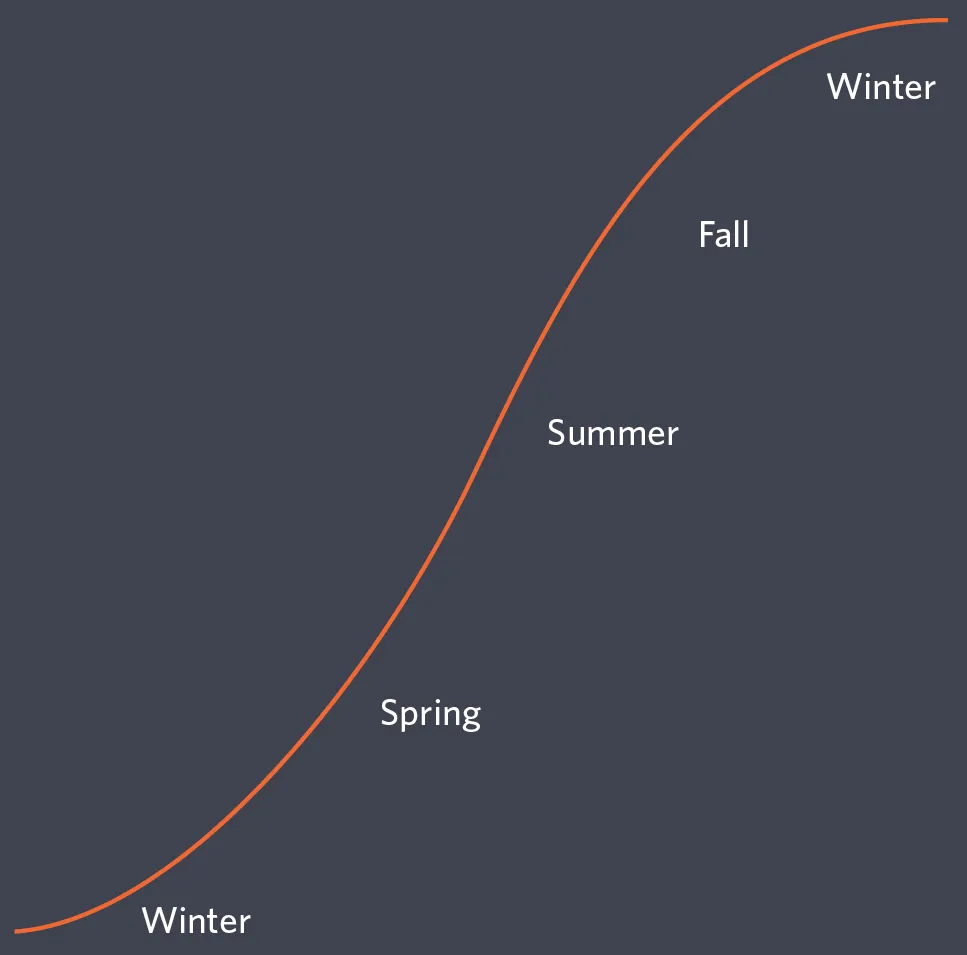
Interestingly, the same life cycle patterns which show up in natural, biological systems also holds true for business markets and consumer products as well. This pattern -- described as an S-shape pattern -- reflects the natural consequences of the life cycle products go through. It also allows future demand and market penetration levels to be forecast accurately.
An S-shaped curve looks like this:
Two interesting points:
The time frame is an important consideration. If the time frame is relatively short, the new product is considered to be revolutionary. A longer time frame, on the other hand, leads to an evolutionary description for the product.
The growth cycle never stops halfway through. Therefore, if the first half pattern develops, you can accurately forecast the second half pattern as well.
The S-curve growth pattern has been shown to hold in many commercial markets. There are a number of reasons:
Rates of growth can be constrained by limited resources during the rapid market penetration stages.
The rapid growth stage is consistent with the concept of market acceptance growing as more adapters emerge.
There is a consistent substitution pattern as people change from older-generation products to next-generation products.
A uniform growth rate for new products is unrealistic and unlikely to occur in business or in nature.
The third point, the market substitution effect, leads to another naturally occurring pattern which is also replicated in business markets:
The market value of company 1 (whose product is mature and nearing the end of its life cycle) is always transferred to company 2 which is in the throes of introducing a new product. This substitution -- between products, technologies, services or accepted practices -- is the natural result of the S-shaped curve occurring in business.
‘‘The thesis is simple. Most people in positions of authority, whether in government, business, the third sector or international organizations, simply don’t know what they are doing when they respond to change.’’
-- Joseph Coates, futurist, Coates & Jarratt
‘‘What I have learned from my experience with S-shaped curves can be summarized by two realizations. The first is that many phenomena go through a life cycle: birth, growth, maturity, decline and death. The element in common is how the change takes place; for example, the slow and steady way things march to an end is not unlike the way they come into existence. My second realization concerns predictability. There is a promise implicit in a process of natural growth, which is guaranteed by nature: The growth cycle will not stop halfway through. If I have the first half as given, I can predict the future; if I am faced with the second half, I can deduce the past.’’
-- Theodore Modis
STRUCTURING AN ENTERPRISE ACCORDING TO ITS SEASON
Business, in the form of products, companies and entire industries, goes through five cycles which align with the S-curve:
Management decisions which are correct for one season might be entirely inappropriate for another season. Therefore, knowing where you are on the cycle is vital.
Taking each of the seasons in turn:
1. Winter - Up to 7% market penetration
New products are generally born in the chaos of winter. Some die in their infancy, while the hardy will survive.
Typical winter management decisions are:
To fire bureaucrats and encourage entrepreneurism.
To focus on core competencies and hire people with multi-disciplinary skills.
To go after niche markets with short-term strategies. To develop a strong, decentralized corporate culture.
On the product side of the business, managers should:
Realize prices will be customer driven and of marginal profitability.
Develop a sales force which is highly opportunistic.
Watch for which products will survive their infant mortality.
The advantage of winter is new ideas come to the surface. Thedisadvantage is that nobody makes any decent profits.
2. Spring 7% - 30% market penetration
In spring, companies are invigorated by their early success, and are busy learning how to achieve economies of scale and on improving their products.
Typical spring management decisions are:
To encourage more product innovation, particularly research on the next-generation of successful products.
To focu...
Table of contents
Cover
Book Presentation: Conquering Uncertainty by Theodore Modis
Trusted by 375,005 students
Access to over 1.5 million titles for a fair monthly price.
Study more efficiently using our study tools.
Frequently asked questions
Yes, you can cancel anytime from the Subscription tab in your account settings on the Perlego website. Your subscription will stay active until the end of your current billing period. Learn how to cancel your subscription
No, books cannot be downloaded as external files, such as PDFs, for use outside of Perlego. However, you can download books within the Perlego app for offline reading on mobile or tablet. Learn how to download books offline
We are an online textbook subscription service, where you can get access to an entire online library for less than the price of a single book per month. With over 1.5 million books across 990+ topics, we’ve got you covered! Learn about our mission
Look out for the read-aloud symbol on your next book to see if you can listen to it. The read-aloud tool reads text aloud for you, highlighting the text as it is being read. You can pause it, speed it up and slow it down. Learn more about Read Aloud
Yes! You can use the Perlego app on both iOS and Android devices to read anytime, anywhere — even offline. Perfect for commutes or when you’re on the go. Please note we cannot support devices running on iOS 13 and Android 7 or earlier. Learn more about using the app
Yes, you can access Summary: Conquering Uncertainty by BusinessNews Publishing in PDF and/or ePUB format, as well as other popular books in Commerce & Commerce Général. We have over 1.5 million books available in our catalogue for you to explore.