Self-injurious behavior occurs in almost half of those with autism and is one of the most devastating and challenging-to-treat behaviors. There are many different forms of self-injury, such as head banging, hand biting, hair pulling, excessive scratching, and much more. With contributions from the leading experts in research and treatment, the book provides a comprehensive analysis of self-injurious behavior (SIB) in people with Autism Spectrum Disorder (ASD) or related developmental disabilities, and the different methods available to treat them.
Medical and behavioral researchers have studied SIB for over 50 years, but many practitioners and parents are still unfamiliar with the wide range of contributing causes and treatment options. Beginning with an explanation of SIB and its various forms, the contributors outline the many possible underlying causes of self-injury, such as seizures, hormonal imbalance in teenagers, gastrointestinal conditions, allergies, and stress, and show how a multi-disciplinary approach when uncovering the causes of self-injury can lead to successful treatment strategies. They explain the treatment options available for SIB, including nutritional, medical, psychiatric, sensory, and behavioral approaches, and show how an integrative approach to treating self-injury may be effective for many individuals.
The book will be an invaluable addition to the bookshelves of any practitioner working with people with an ASD or related condition, as well as parents and direct care providers.
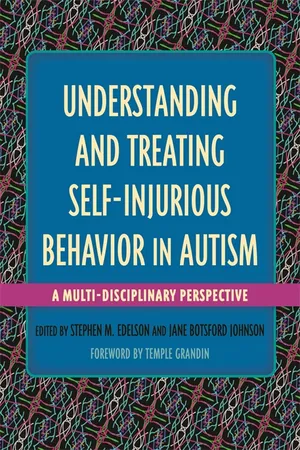
eBook - ePub
Understanding and Treating Self-Injurious Behavior in Autism
A Multi-Disciplinary Perspective
- 304 pages
- English
- ePUB (mobile friendly)
- Available on iOS & Android
eBook - ePub
Understanding and Treating Self-Injurious Behavior in Autism
A Multi-Disciplinary Perspective
About this book
Information
Topic
EducationSubtopic
Inclusive EducationTable of contents
- Cover
- Endorsements
- Half Title
- Of Related Interest
- Title Page
- Copyright
- Dedication
- Acknowledgments
- Contents
- Foreword
- Introduction
- 1. Targeted Medical Therapies and Self-Injury
- 2. Self-Injurious and Aggressive Behaviors in Autism: Looking Below the Surface
- 3. Self-Injurious Behavior, Aggression, and Epilepsy in Autism Spectrum Disorder
- 4. A Neuropsychiatric Model for Evaluating and Treating Self-Injurious Behavior in Autism
- 5. Examining the Impact of Medication Side Effects on Problem Behavior
- 6. Self-Injurious Behaviors in Children with Autism Spectrum Disorder: Impact of Allergic Diseases
- 7. Medical and Nutritional Approaches to Treating Self-Injurious Behavior and Aggression in Autism Spectrum Disorder: Fifteen Case Studies
- 8. Dietary and Nutrition Intervention to Address Self-Injurious Behavior in Autism: Thoughts from Five Years of Clinical Care
- 9. Sensory Processing Disorder and Self-Injurious Behaviors
- 10. Assessment and Intervention for Self-Injurious Behavior Using Positive Behavior Support
- 11. Using Functional Communication Training to Treat Self-Injurious Behavior
- 12. Assessment and Intervention for Self-Injurious Behavior Related to Anxiety
- 13. A Stress-Reduction Approach to Addressing Self-Injurious Behavior in Individuals with Autism
- Appendix A: Biological Contributors to Self-Injurious Behavior
- Appendix B: Targeted Questionnaire to Identify Chapters of Interest
- Appendix C: The Structured Interview for Assessment of Medication Side Effects (SIAMSE)
- Appendix D: Comprehensive List of Behavioral Indicators of Anxiety
- Subject Index
- Author Index
Trusted by 375,005 students
Access to over 1.5 million titles for a fair monthly price.
Study more efficiently using our study tools.
Frequently asked questions
Yes, you can cancel anytime from the Subscription tab in your account settings on the Perlego website. Your subscription will stay active until the end of your current billing period. Learn how to cancel your subscription
No, books cannot be downloaded as external files, such as PDFs, for use outside of Perlego. However, you can download books within the Perlego app for offline reading on mobile or tablet. Learn how to download books offline
We are an online textbook subscription service, where you can get access to an entire online library for less than the price of a single book per month. With over 1.5 million books across 990+ topics, we’ve got you covered! Learn about our mission
Look out for the read-aloud symbol on your next book to see if you can listen to it. The read-aloud tool reads text aloud for you, highlighting the text as it is being read. You can pause it, speed it up and slow it down. Learn more about Read Aloud
Yes! You can use the Perlego app on both iOS and Android devices to read anytime, anywhere — even offline. Perfect for commutes or when you’re on the go.
Please note we cannot support devices running on iOS 13 and Android 7 or earlier. Learn more about using the app
Please note we cannot support devices running on iOS 13 and Android 7 or earlier. Learn more about using the app
Yes, you can access Understanding and Treating Self-Injurious Behavior in Autism by Stephen M. Edelson, Jane Botsford Johnson in PDF and/or ePUB format, as well as other popular books in Education & Inclusive Education. We have over 1.5 million books available in our catalogue for you to explore.