![]()
Part 1
Ecotherapy
What it is and how to do it
![]()
Chapter 1
Introduction
Entering the forest
I only went out for a walk, and finally concluded to stay out till sundown, for going out, I found, was really going in.
John Muir (2001 [1938])
In this chapter I will explore these questions:
»What is ecotherapy?
»What is the relevance of ecotherapy to mental health?
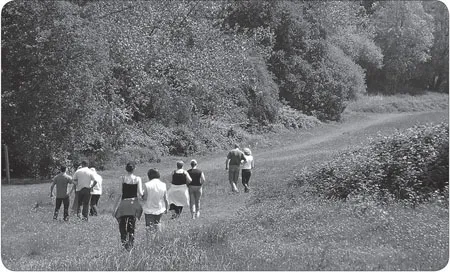
A group out on an ecotherapy walk in Essex
Putting ‘eco’ into recovery
What is ecotherapy and how does it help people’s recovery from mental illness and emotional distress?
Imagine a scene: you are on your own or with a friend and you are lying in a flower-filled meadow in summer, birds are singing and you can smell wild roses nearby. Up above the sky is a deep blue and bright clouds drift across your field of view. You let out a deep sigh, letting go. And when you let go you notice more of the sensations around you. Thoughts and emotions subside and you are content to be in the right place. Do you know what I’m talking about?
Ecotherapy is about creating a deeper connection to nature and feeling better for it. It has affinities with other nature-based activities such as green exercise, conservation work, pet ownership, mountaineering and gardening. But what is special about ecotherapy and how did I begin to do this work?
When I was quite young I realised I had a way of introducing others to nature and infecting them with my fascination and excitement. I have managed to retain that openness to nature and an ability to enable others to feel relaxed and uplifted by spending time outdoors. Once I realised I had this ability when working with people outdoors I wondered if it was possible to increase these positive experiences of lifted mood and clearer mind. I drew on other skills and experiences in my life to develop a way of working that I now call, for want of a better word, ecotherapy.
Exploring how to do nature-based ecotherapy with people recovering from mental distress, and to evaluate it so others can do ecotherapy themselves, has now become my passion.
How do we do ecotherapy? I usually work with a group. It is important at the start to get us all physically relaxed, releasing tensions but more importantly getting people in touch with their bodies. Our bodies are part of nature and so it is a way of beginning the process of connecting. I remind people that we are made of the same stuff as the rest of nature. Our bodies are up to 70 per cent water and the clean water we drink has been circulating through life forms for millions of years, likewise the food we eat, and our breath comes courtesy of all the plants around us. Being in touch with our physical self also brings us into the present. It is from the full experience of the present that we can open up our senses and increase our contact with nature around us.
To further increase that sense of being in the now I do breathing exercises based on meditation. Mindfulness is a core part of the approach I am advocating here. I also encourage people to let go of memories of what has happened that day and what they imagine might occur later: to let go and enjoy being wherever they are.
I am guiding people away from ego to eco, the bigger world that is alive around them. In this process some people can have a profound sense of being connected to nature at a deep level. The healing thoughts can come from a realisation that we, humans and animals and plants, share the same fundamental qualities: we are born and we will one day die, we live and deal with good and bad times, we are wounded and we heal. It is possible to break out of our isolated self and recognise we participate in a wider ecological self where matter, air and social connections pass through us continuously.
I remind everyone to stay with the open relaxed state we are in as we move off on a leisurely walk through grassland and woods, open and intimate greenery. In winter maybe we go and feed the ducks, in summer we listen to birdsong. I encourage sensory ‘openness’ to smells and sounds which further takes people away from their possible preoccupation with self.
At the core of ecotherapy is the combination of increased awareness of the present and an immersion in wild nature. Recovery is often spoken of in terms of changing thoughts and feelings in order to live a happier more positive life. Cognitive behavioural therapy (CBT) and counselling are two of the methods used for achieving this. I think this is fine and yet I’m interested in something different. If a person can put aside for a moment their internal dialogue and imaginings of what might happen and begin to pay full attention to what is happening in the present then they can open up to a different way of seeing. If this different way of seeing, attending to the world, is done in nature then the work of ecotherapy can begin. There is a quality of experience that is different when people connect to nature as opposed to human-made environments. In wild nature we are surrounded by other living things which grow of their own volition according to their own character; they face similar challenges of survival, and have a beauty we are drawn to.
Imagine an experience that:
•improves your mood and Clarity of thinking
•has no known side-effects
•is backed by research
•and is free.
WELCOME TO ECOTHERAPY!
Participating in a group enlarges the experience. We can chat, get to know other people and share our wonderment. If you just want to be on your own in nature that’s fine too: the permissive atmosphere allows for many choices. And for those who are uncertain of others a group walk allows you to choose your distance in relaton to others and how much you want to get involved or not.
My invitation to everyone is to put a little eco into your recovery (and prevention of stress) by shaking off city life for a while, reconnecting with life around you and listening to the woods singing.
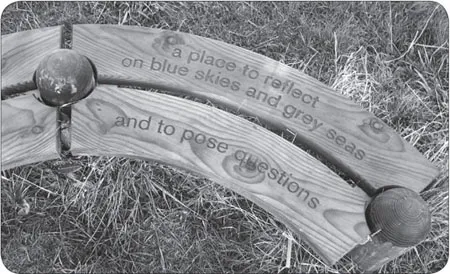
Bench at Minister’s Pool near Nairn, Scotland
The particular relevance of ecotherapy to current issues in mental health
The UN has identified depression, along with cancer and heart disease, as one of the major global health challenges of the twenty-first century.
To emphasise the significance of mental illness a handy statistic is often quoted: one in four of us will experience mental illness sometime in our lives. I can see why campaigners use this ratio to get a simple message across but I don’t think it helps the cause. The one in four statistic divides the ill from the well in a simplistic way; you either are or are not mentally ill. In turn it elicits a schadenfreude response among the majority who see themselves as ‘stressed yes, but certainly not mental’.
In fact, who among us will live a life of complete sanity at all times? Consider the number of people just coping and not entering the health system, plus everyone who goes to their GP with a stress-related physical illness. Nearly half of us report feeling stressed, and over a quarter say they have been stressed for over a year.
Mental illness is a socially defined category in which psychological and biological notions are drawn in to legitimise the labelling. However, this is not the place to discuss the causes of mental distress. I want to make a point because I believe ecotherapy is for all of us not just the diagnosed. I hope everyone can agree that there is a problem in our society: too many of us are too often mentally distressed, and we need to do more to improve lives.
The sheer numbers of stressed and depressed are a challenge to us all to change the way we live our lives and the life choices we make. More and more people are now realising that the way the world is run needs to change but also they as individuals can take more control over their health and well-being. Spending time in nature is one important way we can all look after ourselves.
Approaches to improving the mental health of the nation are changing, whether it is people with mild stress and depression or more severe and enduring conditions. The trend is towards greater integration of those affected by mental illness into mainstream activities. In turn this approach presupposes offering much less medicalised forms of treatment. How can we enrich people’s lives, reduce social exclusion and provide a greater choice of activities that will help individuals more successfully overcome their difficulties?
The work we do in ecotherapy is congruent with the the NHS National Service Frameworks (NHS 1999). Ecotherapy is not intended as a replacement of existing treatments but as a complementary approach based on evidence-based research. It encourages a non-medicalised and non-drug-related approach to self-development and recovery. It is cost effective compared to conventional therapies and drug treatments.
The following list of characteristics of ecotherapy uses the same terms the government used (bold text) when giving advice on what it expected of mental health treatment.
•Ecotherapy activities are almost entirely outdoor based not confined to a specialist building base.
•They enable those who feel excluded to be involved in mainstream activities as much as segregated provision. Ecotherapy is open to all and is not seen as specifically for people who have experienced mental ill health; in that sense it is socially inclusive. Excluded groups are targeted.
•Participant involvement: it is essential to have service-user involvement in the decision making and planning of services such as ecotherapy.
•Most of our work is carried out in diverse partnerships with other agencies. This ensures greater opportunities for funding and increased take-up by service users.
•Joined-up working is evident, for example in the links we have made between people’s health and well-being and the appreciation and protection of the local countryside.
•Many of our activities have been shown to increase self-confidence.
•All our work is monitored and evaluated and the results are shared so that the learning can be used by others.
•Working with trees inevitably creates a mindset that is looking to the long-term future. Our work is designed to be sustainable and enduring. Ecotherapy builds resilience.
•In addition the government is emphasising a holistic view of treatment for mental health users that goes beyond medical interventions.
•Good practice is shared with others about what works, after the work is monitored and evaluated.
Since the National Service Frameworks were published in 1999 there have been two changes of government and I exp...