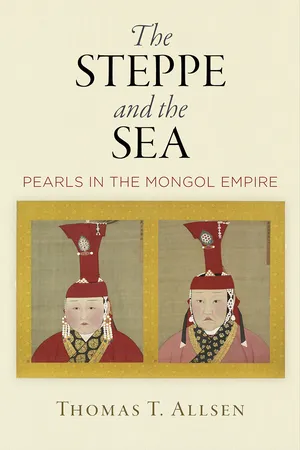
In 1221, in what we now call Turkmenistan, a captive held by Mongol soldiers confessed that she had swallowed her pearls in order to safeguard them. She was immediately executed and eviscerated. On finding several pearls, Chinggis Qan (Genghis Khan) ordered that they cut open every slain person on the battlefield. Pearls, valued for aesthetic, economic, religious, and political reasons, were the ultimate luxury good of the Middle Ages, and the Chingissid imperium, the largest contiguous land empire in history, was their unmatched collector, promoter, and conveyor. Thomas T. Allsen examines the importance of pearls, as luxury good and political investment, in the Mongolian empire—from its origin in 1206, through its unprecedented expansion, to its division and decline in 1370—in order to track the varied cultural and commercial interactions between the northern steppes and the southern seas.Focusing first on the acquisition, display, redistribution, and political significance of pearls, Allsen shows how the very act of forming such a vast nomadic empire required the massive accumulation, management, and movement of prestige goods, and how this process brought into being new regimes of consumption on a continental scale. He argues that overland and seaborne trade flourished simultaneously, forming a dynamic exchange system that moved commodities from east to west and north to south, including an enormous quantity of pearls. Tracking the circulation of pearls across time, he highlights the importance of different modes of exchange—booty-taking, tributary relations, market mechanisms, and reciprocal gift-giving. He also sheds light on the ways in which Mongols' marketing strategies made use of not only myth and folklore but also maritime communications networks created by Indian-Buddhist and Muslim merchants skilled in cross-cultural commerce.In Allsen's analysis, pearls illuminate Mongolian exceptionalism in steppe history, the interconnections between overland and seaborne trade, recurrent patterns in the employment of luxury goods in the political cultures of empires, and the consequences of such goods for local and regional economies.
- 240 pages
- English
- ePUB (mobile friendly)
- Available on iOS & Android
eBook - ePub
About this book
Trusted by 375,005 students
Access to over 1.5 million titles for a fair monthly price.
Study more efficiently using our study tools.
Information
Publisher
University of Pennsylvania PressYear
2019Print ISBN
9780812251173
9780812251173
eBook ISBN
9780812295900
PART I

From the Sea to the Steppe
CHAPTER 1
Properties of Pearls
Humans’ fascination with pearls is connected with their mysterious origins. The emergence of a beautiful, lustrous object from an unattractive sea creature seems a most unlikely phenomenon. We can begin with a summary of current scientific understanding of the natural properties of pearls and then turn to an examination of the cultural meanings that humans regularly ascribed to them, thereby adding to their value.
In general terms, pearls are calcareous concretions of living mollusks organically produced in response to the invasion of a foreign body, itself usually of organic origin.1 In reaction to the irritation the mollusk coats the invader, the nucleus, with calcium carbonate in concentric layers over a period of years.
The phylum Mollusca consists of more than a hundred thousand living species, many of which produce pearls, commonly from nacre, the aptly named mother-of-pearl. Pearls are first attested in the fossil record about 200 million years BP and become common in the Cretaceous Period, 65–145 million years BP. While many species produce pearls, only a few bivalves produce those of commercial value. For our purposes these can be divided into two categories: saltwater oysters and freshwater mollusks. Of the former, the best known come from the genera Pinctada found in tropical seas. Of the latter, pearls are produced by a great number of genera found in the rivers and lakes of Eurasia and the Americas.
As early hominids sought mollusks as a food source, human engagement with pearls goes back several million years. Because pearls deteriorate over time, however, the earliest evidence of human association with them are those excavated from graves located around the head of the Persian Gulf and in Mesopotamia dating to the fourth and third centuries BCE, and the earliest literary references appear later in Near Eastern epics.2
The property of pearls most attractive to humans is their luster, reflectivity, and transparency. These special optical properties are connected with their composition, which scatters light within the constituent crystalline structure, and their spherical shape, which makes it appear that reflected light is emanating from the pearl’s interior.
As regards their physical properties, pearls are relatively soft compared with gemstones but nonetheless difficult to crush because of their crystalline structure. The color of pearls varies greatly—they may be white, black, red, gold, blue, or green—and generally reflects the color of the interior surface of the shell. Weight and size are equally variable. Their specific gravity is 2.6–2.8, and they are thus light in contrast to gemstones. The largest known pearl measured by its maximum length is 23.3 cm, but natural pearls exceeding 8 cm are extremely rare, and those less than 3 mm have limited commercial value, while those below 2 mm are termed “seed pearls.”
The shape of pearls is also endlessly variable: round, teardrop, flattened, elongated, and irregular, called “baroque.” A round shape, even in the smaller sizes, is unusual, perhaps only one in a thousand. Since as size increases round varieties become increasingly rare, large spherical pearls have long been the most valuable.
Given the intrinsic attractiveness of pearls, it is not surprising that human communities across the Eurasian landmass responded positively to them or that they readily embellished and magnified their natural attributes, regularly imputed to them extensive spiritual-magical powers, or placed upon them such elevated market values.
The inclination to add value to objects has several important implications that are elaborated in subsequent chapters. First, pearls do not stand alone in this regard; many other commodities have a “prime” or prestige value but no use or utilitarian value. The former, as Colin Renfrew argues, can be attributed to the human proclivity “to give a social and symbolic significance to material goods” that are not adaptive but enhance status and political influence. The possession and ceremonial use of such goods, moreover, is not merely a “reflection” of that status but the means by which it is achieved and broadcast.3 This perspective is in full accord with political processes frequently observed at Chinggisid courts.
Next, while the purpose of utilitarian objects can often be inferred from their structure and other physical properties, the purpose of purely symbolic goods is more variable, culturally specific, and harder to read.4 And in selling such goods from distant lands, merchants had to take into account their varied local, regional, and “international” cultural meanings and thereby became deeply involved in the dissemination of these images through space and time.
The images and popular tales surrounding pearls, their high value, strange origin, and unique power are extensively documented. Throughout antiquity and the Middle Ages the wealth of the sea was measured by its yield of pearls; other marine products such as coral and ambergris were valued but were clearly of secondary importance.5 Their elevated status among the treasures of nature is indicated by the frequent use of pearls in figures of speech to communicate notions of value, beauty, rarity, excellence, and esoteric knowledge in major languages of Eurasia, including those like Turkic that evolved far from the sea, evidence that the pearl culture of the south diffused steadily north.6 There was in fact a common and coherent set of aesthetic qualities imposed on pearls that crossed innumerable temporal, spatial, and cultural boundaries. While the symbolic and spiritual associations attached to pearls were more variable, the essential point is that everywhere they possessed such properties.
Though pearls as a class of objects were held in the highest esteem, it was also recognized that there was great variation in their individual quality, which ranged from those “fit for a king” to the cheap and unsorted varieties.7 For the nonprofessional, works on collecting and connoisseurship were composed in Persian, Arabic, Sanskrit, and Chinese.8 The basic standards were established early and lived long. Already in the first century CE Pliny asserted that the value of pearls is determined by their “brilliance, size, roundness, smoothness and weight,” criteria that are found in the ninth-century Arabic commercial handbook attributed to Jāḥiẓ.9
Specialists, naturally, developed an elaborate vocabulary to convey information on the qualities of individual pearls to indicate slight variations in shape, size, color, and luster. And, of course, each major trading community had its own, similarly elaborate vocabulary.10 Consequently, to operate successfully in the international pearl market, a merchant needed to command several hundred technical terms and their equivalents in a number of foreign languages.
In various times and places pearls of different and unusual colors, sometimes used in combination, were in vogue. Sasanian women reportedly dressed their hair with pearls of five distinct colors, and at the court of Maḥmūd of Ghazna (r. 998–1030) pearls of strange hues, some with black dots, were valued and displayed as rarities and anomalies.11 There is, however, little doubt that white was long the great favorite among elites and connoisseurs for adornment, display, and gift giving.12
As for shape, roundness was preferred and tested by rolling a pearl about on a plate.13 Also much esteemed were any pair of pearls that were identical, especially those extremely rare “twins” found in the same oyster. For the Muslim collector of the Middle Ages, such twins constituted the ultimate matched set.14
Size and weight were also critical; they were normally sorted into a dozen grades from small seed pearls to extra-large pearls, the latter known interchangeably in Arabo-Persian as durr or ḥabb.15 Those of great size were extolled in poetry and described in prose with a number of stock literary formulas.16 More concretely and helpfully, pearls are sometimes said to be the “size of sheep dung” in the Mongolian tradition or the size of sparrow eggs or hazelnuts in Islamic literature.17 It is indicative of the penetration of West Asian standards to the East that Chinese sources also make reference to pearls “as large as hazelnuts.”18
Since, however, pearls were such a valuable commodity, merchants and jewelers relied on more exact means of determining their weight. In Muslim lands, this was most often expressed in terms of coinage, since official currency had a measure of stability.19 Pearls were at times weighed by the mithqāl, about 4.5 grams, a unit that was also used to establish the mint weight of coins, which for dirhams in the early Muslim era was set at seven-tenths of a mithqāl.20 As a matter of practice, however, the weight of pearls was equated to that of coins in circulation, most commonly the gold dinar.
The final criterion for judging pearls was provenance. This was an important consideration because it was well understood by early specialists on precious gems, such as the famed polymath al-Bīrūnī (973–ca. 1050), that each of the major oyster fishing beds from China to East Africa and the Red Sea produced pearls with distinctive and desirable characteristics.21 That premodern connoisseurs regularly made clear distinctions among the pearls from across the southern seas that come from only two species, Pinctada radiate and Pinctada maxima, leads to the conclusion that the slight variations in their development had much more to do with local environmental conditions and harvesting methods than with the kind of oyster producing them.22
There were, then, many options available to premodern consumers in Afro-Eurasia. Starting in Northeast Asia, the source closest to the Mongolian homeland, were the “northern pearls (beizhu)” taken from mussels in the Sungari and other rivers of Manchuria. Their harvest was a component of the mixed economy of the Jürchens during the pre-imperial and Jin eras (1115−1234), and their extraction, though greatly diminished, continued to the end of the Qing.23 Japan, as noted by Marco Polo, produced saltwater pearls in white and red that were imported to the mainland.24 China, too, had pearl fisheries along its lengthy shoreline; the most famous were off the Hepu, west of the Leizhou Peninsula, and at Yaizhou, on the northeastern corner of Hainan Island. Both had been worked by indigenous non-Chinese people since the early Han and very likely long before.25 And in the myriad rivers and lakes found throughout southern and southwestern China there were also abundant supplies of freshwater pearls; these are first attested in Guilin during the Former Han (202 BCE–9 CE) and were still harvested in the early twentieth century.26

MAP 2. Distribution map of Pinctada radiate and Pinctada maxima. American Philosophical Society.
The fisheries of mainland Southeast Asia and those of the Philippines, Java, and Sumatra were known to the Chinese and Muslims through commercial contacts.27 Marco Polo’s claim that in...
Table of contents
- Cover
- Half title
- Title
- Copyright
- Dedication
- Contents
- Introduction
- Part I. From the Sea to the Steppe
- Part II. Comparisons and Influence
- Conclusion
- List of Abbreviations and Primary Sources
- Notes
- Bibliography
- Index
- Acknowledgments
Frequently asked questions
Yes, you can cancel anytime from the Subscription tab in your account settings on the Perlego website. Your subscription will stay active until the end of your current billing period. Learn how to cancel your subscription
No, books cannot be downloaded as external files, such as PDFs, for use outside of Perlego. However, you can download books within the Perlego app for offline reading on mobile or tablet. Learn how to download books offline
We are an online textbook subscription service, where you can get access to an entire online library for less than the price of a single book per month. With over 1.5 million books across 990+ topics, we’ve got you covered! Learn about our mission
Look out for the read-aloud symbol on your next book to see if you can listen to it. The read-aloud tool reads text aloud for you, highlighting the text as it is being read. You can pause it, speed it up and slow it down. Learn more about Read Aloud
Yes! You can use the Perlego app on both iOS and Android devices to read anytime, anywhere — even offline. Perfect for commutes or when you’re on the go.
Please note we cannot support devices running on iOS 13 and Android 7 or earlier. Learn more about using the app
Please note we cannot support devices running on iOS 13 and Android 7 or earlier. Learn more about using the app
Yes, you can access The Steppe and the Sea by Thomas T. Allsen in PDF and/or ePUB format, as well as other popular books in History & Central Asian History. We have over 1.5 million books available in our catalogue for you to explore.