Ten essays analyzing the history and effects of the Paris Peace Conference following World War I.
The settlement of Versailles was more than a failed peace. What was debated at the Paris Peace Conference of 1919–1920 hugely influenced how nations and empires, sovereignty, and the international order were understood after the Great War?and into the present.
Beyond Versailles argues that
this transformation of ideas was not the work of the treaty makers alone, but emerged in interaction with nationalist groups, anti-colonial movements, and regional elites who took up the rhetoric of Paris and made it their own. In shifting the spotlight from the palace of Versailles to the peripheries of Europe,
Beyond Versailles turns to the treaties' resonance on the ground and shows why the principles of the peace settlement meant different things in different locales. It was in places a long way from Paris?in Polish borderlands and in Portuguese colonies, in contested spaces like Silesia, Teschen, and Danzig, and in states emerging from imperial collapse like Austria, Egypt, and Iran?that notions of nation and sovereignty, legitimacy, and citizenship were negotiated and contested.
"This is an excellent collected volume, well-conceived and very well written. . . . This is not at all a top-down history of the diffusion of ideas about national self-determination. Rather, it is an examination of the ways in which these ideas were taken up, re-fashioned, and reasserted at many levels to serve local and regional agendas, while at the same time influencing international debates about the meanings and possible implementations of self-determination." —Pieter M. Judson, author of
The Habsburg Empire: A New History
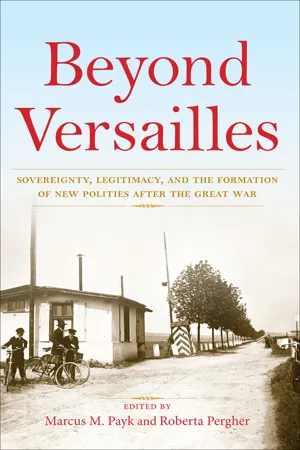
eBook - ePub
Beyond Versailles
Sovereignty, Legitimacy, and the Formation of New Polities After the Great War
- 246 pages
- English
- ePUB (mobile friendly)
- Available on iOS & Android
eBook - ePub
Beyond Versailles
Sovereignty, Legitimacy, and the Formation of New Polities After the Great War
About this book
Information
1 Plebiscites and Postwar Legitimacy
Brendan Karch
Introduction
As the curtain fell on the First World War in November 1918, most of the Continent east of Paris lay in disarray. Millions of hungry Europeans lacked a functioning government. The redrawing of borders and reestablishment of order from Alsace to Anatolia would take five more years, cost many millions more lives, and require extensive diplomatic wrangling. While most borders were decided by military force or Allied dictate, local citizens in five disputed border regions were given an electoral choice over which state to join. Roughly two million Europeans participated in this new democratic experiment. In Upper Silesia and parts of East and West Prussia, Germany and Poland competed for votes. In Schleswig-Holstein, the Danes sought to take back lands ceded a half century earlier to Prussia. And on the ruins of the Habsburg Empire, votes were cast in Carinthia and Sopron to decide Austria’s borders with its Yugoslav and Hungarian neighbors. These were the plebiscites—a series of voting exercises invoked by the Allied powers to decide national boundaries in contested borderlands.1
In the aftermath of the First World War, plebiscites became popularly discussed as one form, among many, of forging democratic legitimacy on the ruins of fallen empires. Far from the Paris negotiations, competing notions of legitimacy were being tried out on the ground for the first time. The epicenter of experimentation was central and eastern Europe. Citizens voted for constitutional conventions, assembled in mass protest, or embraced socialist or national revolutions. Much of this democratic energy was homegrown and preceded the caesura of 1918. Principles of self-determination were not simply a foreign import of Woodrow Wilson’s imagination. The Habsburg, German, and British Empires—along with Bolshevists and Austro-Marxists—all proposed various forms of self-determination under federal or socialist principles.2 The plebiscites were far from a comprehensive solution to the problems of European order. But as mechanisms for resolving specific borderland disputes in central Europe, they very much fit the spirit of the age.
This spirit of 1918, as I argue, was one of profound contradictions. These voting exercises brought democratic promise to the call for a landscape of nation-states in postwar Europe. Yet while the plebiscites were discussed as a continent-wide measure to settle national loyalties and boundaries, their use was limited by Allied realpolitik to just a few key zones, all involving Austrian or German borders. A desire to draw borders along clear ethnonational lines competed against many other factors: historical boundaries, secret treaties, military force, reward for war victors or punishment for its losers, anti-Bolshevist sentiment, colonial hubris, or avoidance of international embarrassment. The Allies were willing to resort to democratic practice in border drawing only in a small number of cases where the outcome was of marginal importance to the postwar order. Elite nationalist activists and statesmen generally defined the “self” in national self-determination as the collective body enumerated by “objective” ethnolinguistic statistics rather than a community bound by democratic wishes. This interpretation further blunted the will to call for plebiscites.
The most surprising contradiction, however, revealed itself when plebiscites were implemented: the greatest stumbling block to creating a democratic nation-state order was the will of voters. The more one analyzes the motivations, propaganda, voting behavior, and outcome of the plebiscites, the harder it becomes to support the logic that a well-ordered democratic continent was best divided along national lines. In this chapter special emphasis is placed on Upper Silesia, where the 1.19 million votes cast made it larger than the other four plebiscites combined.3 Voters in Upper Silesia and other contested borderlands experienced the post-1918 period as one of material deprivation and loss of trust in government and fellow citizens. These new grievances were not always channeled into pre-scripted national boundaries. Plebiscite propaganda often invoked an instrumentalist attitude toward national belonging by emphasizing material and social benefits over ethnolinguistic ties. National identity—insofar as borderland residents even possessed such identities—emerged as only one consideration among many as plebiscite voters decided on their future state citizenships. As the plebiscites showed, the closer one approached the democratic practice of self-determination in central and eastern Europe, the less national self-determination appeared a coherent blueprint for order.
Plebiscites in the Postwar Political Landscape
Amid the scramble to redraw borders after November 1918, national governments or international bodies discussed the use of plebiscites for a panoply of European regions, including Alsace, the Banat, Bessarabia, Burgenland, Dalmatia, Danzig, parts of East Prussia, Eupen and Malmedy, Fiume, Eastern Galicia, Klagenfurt, the Saar, Schleswig-Holstein, Smyrna, South Tirol, Teschen, western Thrace, Transylvania, and Upper Silesia. Nearly all were contested territories situated on the ruins of central and eastern Europe’s four fallen empires. The plebiscite became one technique among many to establish the legitimacy of the nation-state in this political vacuum and was applied only to cases involving one of the defeated Central powers, Germany or Austria. To understand why, it is necessary to examine the range of diplomatic solutions invoked by Allied peacemakers as piecemeal solutions for a fractured continent.
The Allied powers alone commanded enough authority on the international stage to adjudicate matters of peace between any two competing countries’ territorial claims. The principle of legitimacy for post-1918 Europe was most famously outlined by Wilson’s Fourteen Points. Yet Wilson never uttered the term national self-determination in his speech and generally avoided using it.4 The term is more directly traceable to David Lloyd George, who, in January 1918, declared “national self-determination” along with “no annexations” the core principles of any peace settlement.5 While Wilson had long positioned himself as an anti-autocratic liberal internationalist, western European leaders were largely responding to central and eastern European calls for self-determination. In April 1917, democratic revolutionaries in Russia called for “the establishment of permanent peace on the basis of the self-determination of peoples.”6 A year prior, Lenin had articulated the right to self-determination as a tool for undermining capitalism by freeing subject peoples from their imperial chains.7 During earlier war occupations, eastern front armies had dangled promises of autonomy in front of subject peoples. The Germans declared their intent to resurrect a new Poland in November 1916. Although seen by many Poles as a cheap ploy to recruit more of their people as cannon fodder, Germany backed up their plan with “nation-building” measures such as new Polish-speaking schools and local elections.8 These wartime measures in turn were partly inspired by prewar nationalist politics in the Habsburg Empire, where Austro-Marxists, Czech nationalists, and others had theorized and enacted policies to promote sustainable national “bodies” on a multiethnic territory.9 Wilson and Lloyd George followed the lead of these empire breakers and reformers in central and eastern Europe.
Until 1918, few nationalists, especially in Austria-Hungary, called for full nation-state sovereignty. Many Polish or Czech nationalists foresaw continued imperial domination and bet on the victory of the Habsburg state in the First World War. They often collaborated with authorities in the hopes of winning concessions or autonomy, rather than independence, after victory.10 Only the collapse of major powers on all sides of the war—Russia as well as the Central powers and the Ottoman Empire—created the political vacuum that could be filled by a nation-state order. Even then, experts and politicians played a greater role in determining borders than did voters. Armed with prewar census statistics and ethnographic maps that conveniently bolstered their causes, leaders such as Edvard Beneš and Roman Dmowski convinced negotiators in Paris to draw state boundaries that advantaged Czech and Polish national claims. The vast majority of Europeans east of Berlin did not choose their new citizenships. Their most meaningful form of democratic engagement came, rather, in universal suffrage and the ability to shape constitutional conventions. Millions of “optants” voted with their feet to join their new national “homelands” or were forced to do so by ethnic cleansing. Those who stayed became minorities, promised the protection of an ultimately ineffective League of Nations minority system.11 These provisions affected millions of Europeans who had no choice in the drawing of borders.
Plebiscites were only to be used in limited areas that were “objectively” contestable based on specific political or ethnographic criteria. The Allies’ logic, as expressed to Germany in a June 1919 memorandum, proved deceptively simple: “Where the affinities of the population are undoubted, there is no necessity for a plebiscite; where they are in doubt, there is a plebiscite enjoined.”12 But this statement already revealed cracks in the theoretical foundation of the nation-state order. Affinities could be in doubt for two main reasons. First, many regions counted several languages and ethnicities among their populations. Very often local ethnic boundaries—insofar as they existed—followed urban-rural or class divides. In Upper Silesia, for example, cities were dominated by a German-speaking bourgeoisie, while urban workers and rural peasants mostly spoke a Polish-leaning dialect known as schlonsak (though most were at least minimally bilingual). Plebiscites meant to disentangle loyalties in these multilingual borderlands were destined by Allied logic to be majoritarian exercises, in which the numerically stronger ethnicity could dictate the region’s fate to the minority. By acknowledging the necessity of such plebiscites, the Allied powers admitted the impossibility of drawing neat nation-state borders. Moreover, given the ethnolinguistic diversity of the Continent, nearly every border zone in central and eastern Europe, according to the Allies’ standard of doubt, was potentially up for grabs.
A second, deeper unease further undermined the logic of the plebiscites: that people’s “affinities” might not line up with their ethnicity or language use. This suspicion proved the raison d’être for the plebiscites in the first place. Allied peacemakers, led in this instance by Lloyd George, slowly came to realize that ethnic traits did not predetermine voting behavior and that census statistics alone were not sufficient for drawing borders. But it was a realization that was only selectively applied. The plebiscites in Marienwerder/East Prussia and in Upper Silesia were called because Germany defiantly insisted that Polish speakers, although a majority in both regions, preferred to remain in their German homeland rather than join the new Poland. In both plebiscites, German claims were proven right, as Germany garnered the majority of votes. Hundreds of thousands voted against their supposed ethnolinguistic belonging. If “affinities” could run so contradictory to ethnic self-identification in these disputed border regions, then one could easily foresee equally confounding results across the multiethnic landscape of eastern Europe. To preserve the neatness of the Wilsonian ideal in central Europe and to privilege the claims of allies, it was wise to limit the use of the plebiscite in order to keep the democratic genie in the ethnonational bottle.
Several other political imperatives also interceded to limit the use...
Table of contents
- Cover
- Title Page
- Copyright
- Contents
- Acknowledgments
- Introduction
- 1. Plebiscites and Postwar Legitimacy
- 2. Teschen and Its Impossible Plebiscite: Can the Genie Be Put Back in the Bottle?
- 3. National Self-Determination and Political Legitimacy after Versailles: Leon Wasilewski and the German-Polish Borderlands, 1919–39
- 4. The End of Egypt’s Occupation: Ottoman Sovereignty and the British Declaration of Protection
- 5. Ordering the “Land of Paradox”: The Fashioning of Nationality, Religion, and Political Loyalty in Colonial Egypt
- 6. Fashioning the Rest: National Ascription in Austria after the First World War
- 7. National Claims and the Rights of Others: Italy and Its Newly Found Territories after the First World War
- 8. Between Race, Nation, and Empire: Tensions of (Inter)-Nationalism in the Early Interwar Period, 1919–23
- 9. Persian Visions of Nationalism and Inter-Nationalism in a World at War
- 10. “Emblems of Sovereignty”: The Internationalization of Danzig and the Polish Post Office Dispute, 1919–25
- Index
Trusted by 375,005 students
Access to over 1.5 million titles for a fair monthly price.
Study more efficiently using our study tools.
Frequently asked questions
Yes, you can cancel anytime from the Subscription tab in your account settings on the Perlego website. Your subscription will stay active until the end of your current billing period. Learn how to cancel your subscription
No, books cannot be downloaded as external files, such as PDFs, for use outside of Perlego. However, you can download books within the Perlego app for offline reading on mobile or tablet. Learn how to download books offline
We are an online textbook subscription service, where you can get access to an entire online library for less than the price of a single book per month. With over 1.5 million books across 990+ topics, we’ve got you covered! Learn about our mission
Look out for the read-aloud symbol on your next book to see if you can listen to it. The read-aloud tool reads text aloud for you, highlighting the text as it is being read. You can pause it, speed it up and slow it down. Learn more about Read Aloud
Yes! You can use the Perlego app on both iOS and Android devices to read anytime, anywhere — even offline. Perfect for commutes or when you’re on the go.
Please note we cannot support devices running on iOS 13 and Android 7 or earlier. Learn more about using the app
Please note we cannot support devices running on iOS 13 and Android 7 or earlier. Learn more about using the app
Yes, you can access Beyond Versailles by Marcus M. Payk, Roberta Pergher, Marcus M. Payk,Roberta Pergher, Marcus Payk, Roberta Pergher in PDF and/or ePUB format, as well as other popular books in History & European History. We have over 1.5 million books available in our catalogue for you to explore.