An exploration of the history and significance of the Palace of Culture and Science in Warsaw, Poland.
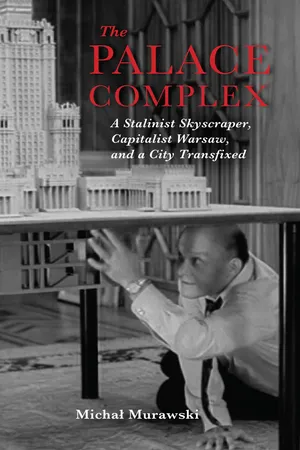
The Palace of Culture and Science is a massive Stalinist skyscraper that was "gifted" to Warsaw by the Soviet Union in 1955. Framing the Palace's visual, symbolic, and functional prominence in the everyday life of the Polish capital as a sort of obsession, locals joke that their city suffers from a "Palace of Culture complex." Despite attempts to privatize it, the Palace remains municipally owned, and continues to play host to a variety of public institutions and services. The Parade Square, which surrounds the building, has resisted attempts to convert it into a money-making commercial center. Author Michal Murawski traces the skyscraper's powerful impact on twenty-first century Warsaw; on its architectural and urban landscape; on its political, ideological, and cultural lives; and on the bodies and minds of its inhabitants.
The Palace Complex explores the many factors that allow Warsaw's Palace to endure as a still-socialist building in a post-socialist city.
"The most brilliant book on a building in many years, making a case for Warsaw's once-loathed Palace of Culture and Science as the most enduring and successful legacy of Polish state socialism." —Owen Hatherley,
The New Statesman's
"Books of the Year" list (UK)
"An ambitious anthropological biography of Poland's tallest and most infamous building, the Palace of Culture and Science in Warsaw. . . . It is a truly fascinating story that challenges a tenacious stereotype, and Murawski tells it brilliantly, judiciously layering literatures from multiple disciplines, his own ethnographic work, and personal anecdotes." —Patryk Babiracki,
H-Net History
eBook - ePub
The Palace Complex
A Stalinist Skyscraper, Capitalist Warsaw, and a City Transfixed
- 340 pages
- English
- ePUB (mobile friendly)
- Available on iOS & Android
eBook - ePub
About this book
Information
Subtopic
21st Century HistoryIndex
History1
THE PLANNERS
Conceiving the Palace Complex
JÓZEF SIGALIN (1909–1983) WAS THE KEY BUREAUCRAT AND expediter of all things related to architecture and planning in 1950s Warsaw. His contemporary and rival Edmund Goldzamt (1921–1990) was the most prominent and erudite spokesperson of architectural Stalinism in Poland during this period. As the key Polish interlocutor for the Palace’s Moscow-based design team, Sigalin played a decisive role in determining the scale, program, appearance, and location of the Palace in Warsaw. As the foremost Polish interpreter and adapter of Stalinist socialist realist architectural doctrine, meanwhile, Goldzamt was instrumental in lending ideological expression to what it was that made the Palace at once “socialist,” “Varsovian,” and “Polish.” Sigalin and Goldzamt, then, were among the most influential participants in the architectural world of 1950s Warsaw. But they were also two of its most incisive and prolific chroniclers, producing extensive written documentation of their thoughts and experiences, primarily in the form of theoretical treatises (in Goldzamt’s case) and diaries and memoirs (in Sigalin’s). Although I do not limit my horizon to Sigalin’s and Goldzamt’s perspectives, my distillation of the ideology and practice of architectural Stalinism in 1950s Warsaw takes the works, lives, and words of Sigalin and Goldzamt as its guiding points of departure.
Obedient Executors?
In the 1950s and today, critics have showered condemnation on both Sigalin and Goldzamt. Writer and diarist Leopold Tyrmand—whose 1954 Diary is an exceptionally detailed and candid account of Warsaw’s everyday life during the Stalin period, written from a determinedly antiregime perspective—describes them as “architectural politruki” (political commissars), “tame, limited, obedient executors” (Tyrmand 1999, 195). In Tyrmand’s prediction, Sigalin and Goldzamt would one day be forgotten, but their “criminal stupidity” (195) and “servility in face of non-architectural ideologies will terrify our grandchildren” (203).

Figure 1.1a. Edmund Goldzamt. Photograph from the family archive, courtesy of Anna Guryanova.

Figure 1.1b. Galina Guryanova and Edmund Goldzamt outside the Palace of Culture, late 1950s. Photograph from the family archive, courtesy of Anna Guryanova.


Figure 1.2. Józef Sigalin. Photograph Polish Press Agency (PAP).
It is impossible to reflect on the activities of Sigalin, Goldzamt, and other prominent figures of the time without reference to the political context and without awareness of one’s own political and aesthetic worldview. My own account of their activities and motivations aspires to be frank, but it is not devoid of sympathy. There is no doubt that both figures participated in the political machinations of the day and that their own success necessitated the marginalization of many of their colleagues. But a purely negative characterization obscures the fact that both Sigalin and Goldzamt evaluated their actions not only in terms of the purity of principles or implementation but also in terms of the effectivity of their contribution to the enormous task at hand—the creation of a new, socialist capital city on the rubble of the old one. Both had been committed communists already before the war, and the tumult of war and genocide made a painful and direct mark on each of their lives. Goldzamt, who came from a family of Jewish intellectuals in Lublin, had seen most of his relatives killed in the German-occupied region of Poland. Goldzamt himself escaped to Lviv, Tashkent, and finally Moscow, where he completed his architectural training during the war years. Sigalin was a decade older, and his link to the capital city was stronger. He came from a well-established family of Warsaw industrialists, also of Jewish heritage. His older brothers, Grzegorz and Roman, had been successful modernist architects in Warsaw before 1939. The toll on Sigalin’s family was perpetrated by Soviets as well as by Nazis, however, and predated the outbreak of war. Grzegorz, who traveled to Moscow throughout the 1930s as an architect and member of the Polish Communist Party, was caught up in Stalin’s 1937 purges and died at an unspecified time in the Lubyanka, Moscow’s NKVD headquarters (Kołodziejczyk 2012). Roman, a Polish artillery captain, was taken prisoner after the Soviet invasion of eastern Poland in September 1939. He was, in all likelihood, executed in 1940 at Kharkov as part of the broader Stalin-decreed massacre of Polish officers, referred to under the umbrella term Katyń, a reference to the forest where most of the killings took place.1 And in July 1943, Sigalin’s mother and sister swallowed poison capsules in a freight car heading for the Nazi death camp at Treblinka (Kołodziejczyk 2012). The writings of Goldzamt and Sigalin are replete with generalized invocations of the horrific impact of war on the human population and physical matter of the city, but they are silent about their own experiences. In his memoirs, Sigalin acknowledges that his brother was “murdered at Katyń in 1940” (Sigalin 1986a, 10), but he does not attribute blame—until 1989, the official line of the PRL [Polska Rzeczpospolita Ludowa—Polish People’s Republic] and Soviet governments was that the Germans had perpetrated Katyń.2
Goldzamt and Sigalin met in Moscow in 1948. Sigalin was already a powerful figure in the Warsaw architectural community while Goldzamt was a precocious twenty-seven-year-old diploma student at the Moscow Institute of Architecture, the recipient of a stipend from the Polish Ministry of Education. During their Moscow conversations, Goldzamt presented his interpretation of the principles of socialist realist architecture—as he had learned them during his studies in Moscow—and summarized to Sigalin how they ought to be applied in the reconstruction of Warsaw. In Goldzamt’s own recollection, Sigalin’s response was to say, “Comrade Mundek,3 I have to have this!”4 The document Goldzamt prepared in response to Sigalin’s request came to form the basis of his 1949 presentation of the doctrine of socialist realism to a Warsaw congress of party-affiliated architects. However, their initial friendship and pursuit of common interests soon turned into mistrust and acrimony; by 1952 their disagreements became public, and this bitterness is reflected in Sigalin’s account of the Parade Square design process.
De-Stalinization also had a different effect on each architect. Goldzamt (who had a reputation as a zealous ideological enforcer) had his position of influence compromised completely, and he turned to academic research on socialist urbanism, Italian towns, and William Morris (Goldzamt 1967, 1968, 1987). He designed the occasional building, including a modernist seaside hotel in the resort town of Kołobrzeg. Though he divided his time between Poland and the Soviet Union, he was said to have felt less comfortable in Warsaw than in Moscow, where he died in 1990.
Sigalin (a more consummate organizer and power broker than Stalinist Jacobin) was soundly attacked in 1955 and submitted to self-criticism at the March 1955 meeting of the Association of Polish Architects with the admission, “I knew how to bang the command drums all too well” (Majewski 2009, 15). Some of Warsaw’s most prominent architects, many of them not known for their coziness with the party, signed an open letter in his defense, in which they declared their respect for his person and achievements. Although Sigalin’s closeness to power never again came to match the phenomenal level of the 1950s (head of the Bureau for Reconstruction between 1945 and 1951, chief architect of Warsaw 1951–1956, and plenipotentiary for the construction of the Palace of Culture and Parade Square 1952–1955), he continued to play a significant role in many architectural and planning projects throughout the 1960s and 1970s.
The three-volume memoirs of Sigalin (Warsaw 1944–1980) span over thirty years, but they focus on the first ten years of postwar reconstruction. They include a number of retrospective reflections but also the transcripts of meetings and discussions at which architects, politicians, and members of the public pored over the rebuilding and later postwar development of Warsaw. I will devote significant space to materials taken from these memoirs—they serve as an excellent ethnographic record of the time, reproduced by Sigalin from notes he took while participating in (like no one else) and observing (with a clear sense of detachment) the events of the day. One of the aims driving this book—written on the basis of my own notes taken during a later but in many senses equivalent and comparable (if less dramatic) period of political, economic, and architectural upheaval in Warsaw—will be to demonstrate how much of the work done by Sigalin and his contemporaries fulfilled and even surpassed its aims. The essential features of the built environment of Warsaw in the twenty-first century were designed and realized during the 1940s and 1950s by Sigalin, Goldzamt, and the other members of his remarkable, tragic, and heroic generation. Bearing in mind Sigalin’s initial fascination with Goldzamt’s interpretation of Stalinist architectural doctrine, it makes sense to recount a few of Goldzamt’s most expressive formulations about the foundational significance of city centers in socialist urbanism.
No City without a Center
Goldzamt’s 1956 book is an expansive, erudite, and heavily ideologized exploration of how urban planning has responded to the problem of the relationship between centers and peripheries. Although it draws on examples from across the world and from throughout the history of Western civilization, its recurring focus is on Leningrad, Moscow, and especially Warsaw, culminating in a long analysis of the significance of the Palace and Parade Square to the task of creating a socialist urban environment.5 For Goldzamt, “There can be no such thing as a city without a center. The very idea of the city incorporates within itself the fact of the existence of the primary catalyst of the urban organism: the central ensemble or arrangement” (1956, 11). The whole is not able to exist as a unity, in other words, without containing a dominant entity (dominanta)6 that holds it together. For Goldzamt—whose extrapolation of centrality anticipates some of Henri Lefebvre’s later formulations to quite an uncanny degree—urban centers have always functioned as the “urbanistic and architectural expressions of the ruling system and its ideology . . . central ensembles are the most powerful monuments of their epoch, monuments of the national culture . . . material carriers of the dominant worldview” (Goldzamt 1956, 16).7
But Goldzamt’s account is not focused on how city centers embody or reflect hegemonic social norms: he is more interested in the manner of their functioning as “actual tools of ideological impact” (1956, 16) and in the means by which socialist city planning is able to eradicate the “perennial contradiction between center and periphery, exacerbated during the epoch of industrial capitalism” (18). Goldzamt, in other words, is interested in the city center not merely as an expression of social transformation but as an active agent in its implementation. So how does he square the egalitarian imperative behind socialist urbanism with the Stalinist elevation of the agentic center? Goldzamt distinguishes between the leveling effect of socialist town planning on the distribution of wealth and access to dignified living conditions among inhabitants on one hand and, on the other, the architectural differentiation between center and periphery, which the realization of an egalitarian urban environment necessarily entails:
Socialist urbanism eradicates class differences within the city, creating across all districts identical conditions for living, in terms of dwelling, work, communal services and aesthetic experiences. . . . But the eradication of the social contradiction between the city center and the suburbs does not entail the elimination of all differences in architectural solutions, nor does it entail the eradication of central ensembles, with their particular form and spatial role. To the contrary—the democratism of socialist society . . . necessitates the enormous significance of the centers of socialist cities. What is more, their prominence in the life of socialist cities must become incomparably higher than that of the ceremonial or financial-commercial centers of feudal and capitalist cities. The foundation of the strengthening of the role of the center in the practice of Soviet, Polish and the other people’s democracies is the transformation of the infrastructure of social ties carried out by central ensembles (18).
The writings of Warsaw’s Stalinist ideologues, then, offer a counterpoint to the view that Stalinist decisionmakers or ideologues saw architecture “as merely part of a representational superstructure” and that, in their ideological universe, “the material world as such”—as opposed to the “collective labor of building it”—had “no agency” (Fehérváry 2013, 62). Goldzamt’s pronouncements could not be any clearer in their understanding of how the Stalinist urban organism—when possessed of the right characteristics, chief among these being a powerfully articulated centrality—is able to and should become a powerful agent in the transformation of society, simultaneously actualizing and illustrating the “coming unity of interests in socialist society, the unity of the interests and ideals of the entire population of the socialist city” (Goldzamt 1956, 20). Echoing German expressionist architect and theorist Bruno Taut’s influential notion of the Stadtkröne (1919), Goldzamt writes that the “particular destiny and ideological role” of the central ensemble “determine the deployment in its construction of only the most monumental types of public construction and architectural form, w...
Table of contents
- Cover
- Title Page
- Copyright
- Dedication
- Contents
- Preface: Politicized Perambulations
- Acknowledgments
- Introduction: Palace Complex / Complex Palace
- 1. The Planners: Conceiving the Palace Complex
- 2. Public Spirit, or the Gift of Noncapitalism
- 3. Designing Architectural Power: Scale, Style, and Location
- 4. Site-Specific: Varsovian Interpretations of the Palace
- 5. Varsovianization: The Palace Complex after 1989
- 6. “The Center of the Very Center”
- 7. The Extraordinary Palace
- Conclusion: Complex Appropriations
- Epilogue: The Still-Socialist Palace and the War against Postcommunism
- Appendix: Palaceological Survey: Summary of Results
- Bibliography
- Index
- About the Author
Trusted by 375,005 students
Access to over 1.5 million titles for a fair monthly price.
Study more efficiently using our study tools.
Frequently asked questions
Yes, you can cancel anytime from the Subscription tab in your account settings on the Perlego website. Your subscription will stay active until the end of your current billing period. Learn how to cancel your subscription
No, books cannot be downloaded as external files, such as PDFs, for use outside of Perlego. However, you can download books within the Perlego app for offline reading on mobile or tablet. Learn how to download books offline
We are an online textbook subscription service, where you can get access to an entire online library for less than the price of a single book per month. With over 1.5 million books across 990+ topics, we’ve got you covered! Learn about our mission
Look out for the read-aloud symbol on your next book to see if you can listen to it. The read-aloud tool reads text aloud for you, highlighting the text as it is being read. You can pause it, speed it up and slow it down. Learn more about Read Aloud
Yes! You can use the Perlego app on both iOS and Android devices to read anytime, anywhere — even offline. Perfect for commutes or when you’re on the go.
Please note we cannot support devices running on iOS 13 and Android 7 or earlier. Learn more about using the app
Please note we cannot support devices running on iOS 13 and Android 7 or earlier. Learn more about using the app
Yes, you can access The Palace Complex by Michal Murawski in PDF and/or ePUB format, as well as other popular books in History & 21st Century History. We have over 1.5 million books available in our catalogue for you to explore.