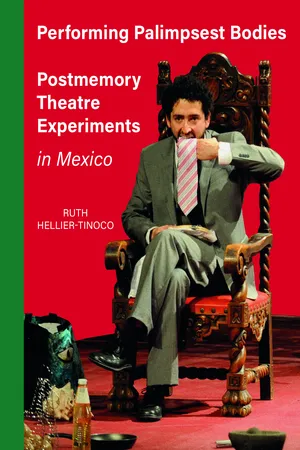
Proposing the innovative concept of palimpsest bodies to interpret provocative theatre and performance experiments that explore issues of cultural memory, bodies of history, archives, repertoires and performing remains, Ruth Hellier-Tinoco offers an in-depth analysis of four postdramatic and transdisciplinary collective creation theatre projects. Combined with ideas of postmemory and rememory, palimpsest bodies are inherently trans-temporal as they perform re-visions of embodied gestures, vocalized calls and sensory experiences.
Focusing on one of Mexico's most significant contemporary theatre companies, La Máquina de Teatro, directed by renowned artists Juliana Faesler and Clarissa Malheiros, this ground-breaking study documents the playfully rigorous performances of layered, plural and trans identities as collaborative, feminist and queer re-visions of official histories and collective memories.
Illustrated with over one hundred colour photos, Performing Palimpsest Bodies: Postmemory Theatre Experiments in Mexico will appeal to creative artists and scholars interested in contemporary theatre and performance studies, critical dance studies, collective creation and performance-making.
Frequently asked questions
Yes, you can cancel anytime from the Subscription tab in your account settings on the Perlego website. Your subscription will stay active until the end of your current billing period. Learn how to cancel your subscription.
No, books cannot be downloaded as external files, such as PDFs, for use outside of Perlego. However, you can download books within the Perlego app for offline reading on mobile or tablet. Learn more here.
Perlego offers two plans: Essential and Complete
Essential is ideal for learners and professionals who enjoy exploring a wide range of subjects. Access the Essential Library with 800,000+ trusted titles and best-sellers across business, personal growth, and the humanities. Includes unlimited reading time and Standard Read Aloud voice.
Complete: Perfect for advanced learners and researchers needing full, unrestricted access. Unlock 1.4M+ books across hundreds of subjects, including academic and specialized titles. The Complete Plan also includes advanced features like Premium Read Aloud and Research Assistant.
Both plans are available with monthly, semester, or annual billing cycles.
We are an online textbook subscription service, where you can get access to an entire online library for less than the price of a single book per month. With over 1 million books across 1000+ topics, we’ve got you covered! Learn more here.
Look out for the read-aloud symbol on your next book to see if you can listen to it. The read-aloud tool reads text aloud for you, highlighting the text as it is being read. You can pause it, speed it up and slow it down. Learn more here.
Yes! You can use the Perlego app on both iOS or Android devices to read anytime, anywhere — even offline. Perfect for commutes or when you’re on the go. Please note we cannot support devices running on iOS 13 and Android 7 or earlier. Learn more about using the app.
Yes, you can access Performing Palimpsest Bodies by Ruth Hellier-Tinoco in PDF and/or ePUB format, as well as other popular books in Media & Performing Arts & Mexican History. We have over one million books available in our catalogue for you to explore.
Theatre for generating futures: Performing archives, remaining differently
In a corporeal sense, the so-called past is neither gone nor actual, it is neither exactly accumulative nor does it simply vanish – the body intertwines imagination, memory, sensorial perception, and actuality in very sophisticated ways. The body itself moves according to these intertwinements while permanently producing new mnemonic, sensorial, actual, and imaginative connections that generate movement. In a corporeal sense, the past is a becoming.
—Eleonora Fabião, “History and Precariousness”
Our work as critics [...] [involves] the task of locating what traces of the past linger in the present and devising strategies to move more humanely toward the future.
—Roselyn Costantino
As the noted cognitive neuroscientist Michael Gazzaniga once said:
“everything in life is memory, save for the thin edge of the present.”
—Joseph Jebelli, “We can cure Alzheimer’s”1
experiment:try out new concepts or ways of doing things [verb]; a course of action tentatively adopted without being sure of the eventual outcome [noun].
Scenario of becoming
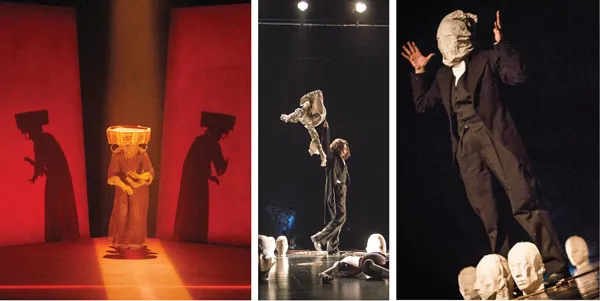
At the end of Time of the Devil, Malheiros strikes a pose of in-between potentialities. Her palimpsest body is an archival repertoire of remains, envisioning traces of myriad existential questions about the materiality life as she buries her face with the covering of death masks. At the beginning of Mexican Trilogy, Malheiros moves slowly forward, voicing myths of origins and time. Her unfolding palimpsest body is a repertorial archive of remains, revealing hidden fragments of stories as she is accompanied by two spectral shadow-bodies who journey with her (Figure 105). In these complex multifaceted works by La Máquina de Teatro, remains become opportunities for re-imaginings. Performing remains of bodies of history in live transdisciplinary theatre offers multiple possibilities. To draw on Gabriel Yépez, these are “works that articulate a relation between the body as a holder of collective memory and as an unfolding of poetic presences.”2 Through performing palimpsest bodies in postmemory theatre experiments the past is a becoming.3
Figure 105.
In this brief Epilogue I retrace key elements of these performances as I gesture to the future. I return again to Diana Taylor’s work on archives, repertoires and performing cultural memory, reiterating her depiction of a “collaborative production of knowledge [in which] writing and embodied performance have often worked together to layer the historical memories that constitute community.”4 Together, the embodied performances of La Máquina and these writings work to constitute community. Through these remains you are connected with traces of Faesler and Malheiros; with all with the many artists and audiences involved with their projects; and with the bodies of history incorporated into these projects. Your body is a palimpsest of collective memories and an unfolding of poetic presences.
Performing remains/performance remains5
For this study, I have engaged the notion of palimpsest bodies as a creative-interpretive idea for performing remains of bodies of history in postmemory theatre experiments. A palimpsest always contains trans-temporal traces, offering a form of plurality and dynamic tension. A palimpsest body re-members embodied gestures, vocalized calls and sensory experiences that resonate from deep within. Through these palimpsest bodies, matters of originals and copies are thrown into an intricate entanglement.6 Through relationships of postmemory and through corporeal traces of rememory, these palimpsest bodies re-imagine other ways of being. Through experiments with disparate remains, these bodies perform productive tensions and missed encounters. Schneider has described how “theories of trauma and repetition […] instruct us [that] it is not presence that appears in performance but precisely the missed encounter – the reverberations of the overlooked, the missed, the repressed, the seemingly forgotten.”7 In Hirsch’s concept of postmemory, past traumas are understood as fragments of stories, repeated, projected and re-imagined. In Morrison’s notion of rememory, past traumas of half-forgotten occurrences are experienced in corporeal traces. By reactivating scenarios through remains of bodies of history, these palimpsest bodies offer possibilities for forming reverberations of the overlooked, the missed, the repressed, and the seemingly forgotten.
In discussions of performing corporeality in Mexico, Antonio Prieto Stambaugh has considered how embodied performances resist amnesia and unsettle memories. He describes how “the memory of the creators, and in some cases also the spectators, is embodied in different ways indicating a staging of the intimate or secret subjectivity.”8 Reiterating Yépez, these works perform a relation between the body as a holder of collective memory and as an unfolding of poetic presences. At the heart of these performance projects of La Máquina, participants use personal and collective experiences of rememory to inquire into bodies of history, offering great potential to unsettle memories and stage intimate stories. It is through the trans-temporal crossings of multiple remains that these corporeal processes delve into difficult questions that confront official knowledge. As they reactivate scenarios of material already worked on they connect shared histories and personal subjectivities through palimpsest bodies. Returning to the words of choreographer Shobana Jeyasingh, a palimpsest has the “capacity to be home to more than one story at any given time. The surface of things resonates with the secrets of the unknown possibilities.”9 In workshops and performances, the practitioners of La Máquina play with time through simultaneity, co-existence, multiplicity and juxtaposition. They merge and accumulate iterations of numerous stories, histories, journeys and lives. Through liminal performance and postdramatic theatre strategies they perform layered, plural and trans identities. Through their rigorous and playful processes of collective creation, they cross cultural fictions and historical realities to generate unexpected tensions.
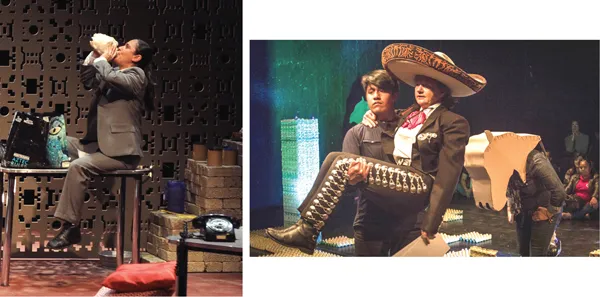
Figure 106.
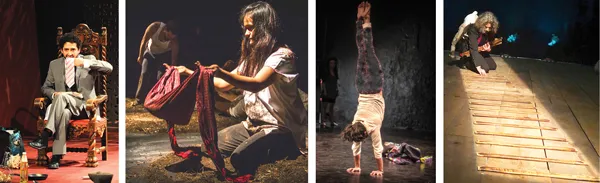
Analysing the potential of live performance, Peggy Phelan has explained that “Performance remains a compelling art because it contains the possibility of both the actor and the spectator becoming transformed during the event’s unfolding.”10 Drawing on Jill Dolan’s discussions of theatre and utopia, these performances “offer a place to scrutinize public meanings [and] also to embody and […] enact the affective possibilities of ‘doings’ that gesture toward a much better world.”11 In the projects of La Máquina, through the pulsating sensory environment of live performance and within a social framework of collective memory, these multifaceted, provocative bodies invite and challenge spectators and participants to embrace an aesthetic of multiplicity and openness to dynamic relationships. Through an environment of convivio, they engage “a politics of invitation, [and] a politics of community.”12 From multi-year processes leading to finalized theatre performances, to ongoing processes of work-in-progress, to co-participatory performative events on stage, these projects facilitate poetic unfoldings with the potential to transform. Seeking to confront and transform stereotypes, they offer feminist and queer re-visions of official histories and collective memories. As bodies make gestures, read words, strike poses, sing songs and stand witness they are engaged in and with incomplete pasts, unfolding and folding time, performing unfixity and possibility.13
Figure 107.
Four reflections
1. Mexican Trilogy / Scenic Correlation of Memory and Times
La Malinche does not have time: the past and present are running simultaneously through our history. Yesterday’s La Malinche is in today’s women, not with the stigma of a traitor, but like a metaphor of multiplicity of Mexican women.
—Estela Leñero Franco, “Malinche/Malinches,” Revista Proceso
With an ensemble of five performers and a small group of creative artists, this complex set of inter-connected theatre pieces was generated over three years working through three bo...
Table of contents
Cover Page
Title Page
Copyright
Dedication
Contents
List of illustrations
Acknowledgements
Section One: Outlines
Section Two: Four Performance Projects
Epilogue: Theatre for generating futures: Performing archives, remaining differently