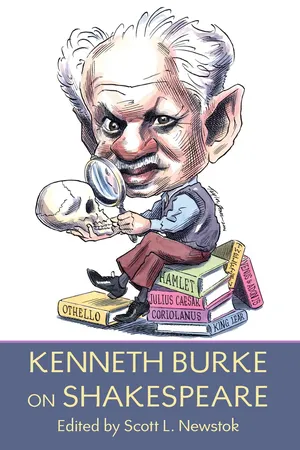
This volume gathers and annotates all of the Shakespeare criticism, including previously unpublished notes and lectures, by the maverick American intellectual Kenneth Burke (1897–1993). Burke's interpretations of Shakespeare have had an impressive influence on important lines of contemporary scholarship; playwrights and directors have been stirred by his dramaturgical investigations; and many readers outside academia have enjoyed his ingenious dissections of what makes a play function. Burke's intellectual project continually engaged with Shakespeare's works, and Burke's writings on Shakespeare, in turn, have had an immense impact on generations of readers. Carefully edited and annotated, with helpful cross-references, Burke's fascinating interpretations of Shakespeare remain challenging, provocative, and accessible. Read together, these pieces form an evolving argument about the nature of Shakespeare's plays and poems. Included are thirteen analyses of individual plays and poems, an introductory lecture explaining his approach to reading Shakespeare, and a substantial appendix of hundreds of Burke's other references to Shakespeare. Scott L. Newstok also provides a historical introduction and an account of Burke's legacy. Burke's enduring familiarity with Shakespeare likely helped shape his own theory of dramatism, an ambitious elaboration of the teatrum mundi conceit. Burke is renowned for his landmark 1951 essay on Othello, which wrestles with concerns still relevant to scholars more than a half century later; his ingenious ventriloquism of Mark Antony's address over Caesar's body has likewise found a number of appreciative readers, as have (albeit less frequently) his many other essays on the playwright. Burke's first and final pieces of literary criticism both examine Shakespearean plays, thereby bookending an impressive, career-long contribution to the field of Shakespeare studies. Among the many major Shakespearean critics who have gratefully acknowledged Burke's influence are Paul Alpers, Harold Bloom, Stanley Cavell, René Girard, Stephen Greenblatt, and Patricia Parker.
- 364 pages
- English
- PDF
- Available on iOS & Android
eBook - PDF
Kenneth Burke on Shakespeare
About this book
Information
Topic
LittératureSubtopic
RhétoriqueTable of contents
- Front cover
- Title page
- Copyright page
- Table of contents
- Acknowledgments
- Editor’s Introduction: Renewing Kenneth Burke’s“ plea for the Shakespearean drama”
- Notes on the Text
- Introduction: Shakespeare Was What?
- 1 Psychology and Form
- 2 Trial Translation (from Twelfth Night)
- 3 Antony in Behalf of the Play
- 4 Imagery
- 5 ‘Socio-anagogic’ Interpretation of Venus and Adonis
- 6 Othello: An Essay to Illustrate a Method
- 7 Timon of Athens and Misanthropic Gold
- 8 Shakespearean Persuasion: Antony and Cleopatra
- 9 Coriolanus—and the Delights of Faction
- 10 King Lear: Its Form and Psychosis
- 11 Notes on Troilus and Cressida
- 12 Why A Midsummer Night’s Dream?
- 13 Notes on Macbeth
- Appendix: Additional References to Shakespeare in Burke’s Writings
- Notes
- Index of Works by Shakespeare
- General Index
- About the Author
- About the Editor
- Back cover
Trusted by 375,005 students
Access to over 1.5 million titles for a fair monthly price.
Study more efficiently using our study tools.
Frequently asked questions
Yes, you can cancel anytime from the Subscription tab in your account settings on the Perlego website. Your subscription will stay active until the end of your current billing period. Learn how to cancel your subscription
No, books cannot be downloaded as external files, such as PDFs, for use outside of Perlego. However, you can download books within the Perlego app for offline reading on mobile or tablet. Learn how to download books offline
Perlego offers two plans: Essential and Complete
- Essential is ideal for learners and professionals who enjoy exploring a wide range of subjects. Access the Essential Library with 800,000+ trusted titles and best-sellers across business, personal growth, and the humanities. Includes unlimited reading time and Standard Read Aloud voice.
- Complete: Perfect for advanced learners and researchers needing full, unrestricted access. Unlock 1.5M+ books across hundreds of subjects, including academic and specialized titles. The Complete Plan also includes advanced features like Premium Read Aloud and Research Assistant.
We are an online textbook subscription service, where you can get access to an entire online library for less than the price of a single book per month. With over 1.5 million books across 990+ topics, we’ve got you covered! Learn about our mission
Look out for the read-aloud symbol on your next book to see if you can listen to it. The read-aloud tool reads text aloud for you, highlighting the text as it is being read. You can pause it, speed it up and slow it down. Learn more about Read Aloud
Yes! You can use the Perlego app on both iOS and Android devices to read anytime, anywhere — even offline. Perfect for commutes or when you’re on the go.
Please note we cannot support devices running on iOS 13 and Android 7 or earlier. Learn more about using the app
Please note we cannot support devices running on iOS 13 and Android 7 or earlier. Learn more about using the app
Yes, you can access Kenneth Burke on Shakespeare by Kenneth Burke, Scott Newstok in PDF and/or ePUB format, as well as other popular books in Littérature & Rhétorique. We have over 1.5 million books available in our catalogue for you to explore.