This fourth volume in the comprehensive series "fills a gap in the existing narrative" of WWII's Mediterranean air war (
Journal of Military History).
The fourth volume in this momentous series commences with the attacks on the Italian island fortress of Pantellaria, which led to its surrender and occupation achieved almost by air attack alone. The account continues with the ultimately successful, but at times very hard fought, invasions of Sicily and southern Italy as burgeoning Allied air power, now with full US involvement, increasingly dominated the skies overhead. The successive occupations of Sardinia and Corsica are also covered in detail.
This is essentially the story of the tactical air forces up to the point when Rome was occupied, just at the same time as the Normandy landings were occurring in northwest France. With regards to the long-range tactical role of the Allied heavy bombers, only the period from May to October is examined, while they remained based in North Africa, with the narrative continuing in a future volume.
This volume also delves into the story of "the soldiers' air force." Frequently overshadowed by more immediate newsworthy events elsewhere, the soldiers' struggle was often of an equally Homeric nature.
"No future publication on the Mediterranean air war will be credible without use of this series." —
Air Power History
eBook - ePub
A History of the Mediterranean Air War, 1940–1945
Sicily and Italy to the Fall of Rome 14 May, 1943–5 June, 1944
- 680 pages
- English
- ePUB (mobile friendly)
- Available on iOS & Android
eBook - ePub
A History of the Mediterranean Air War, 1940–1945
Sicily and Italy to the Fall of Rome 14 May, 1943–5 June, 1944
About this book
Information
Print ISBN
9781911621102
Subtopic
European HistoryCHAPTER 1
SETTING THE SCENE
When on 13 May 1943 the Axis armies in Tunisia surrendered and hostilities in North Africa ceased, for the first time since June 1940 a situation had arisen where there were no opposing ground forces on the African continent within sufficient range of each other to undertake combatant activities. Hostile action between the opposing nations of the Allies and the Axis could now be undertaken only at sea or in the air. This would appertain until one side or the other sought to carry out an invasion of the opponent’s territory. At this point that meant essentially actions precipitated by the Allies.
From the bases available for such actions this offered the Allied nations the alternatives of landings along the northern coastal area of the Mediterranean Sea which were considered to be the Italian islands of Sicily or Sardinia, the French island of Corsica and/or the mainland coast of the south of France, or those of south-western Greece – or perhaps most hazardous of any, the southern extremity of Italy itself.
At this stage of the war the United States expressed no enthusiasm for becoming involved in Greece or in the Balkans generally. Indeed, their favoured global strategy would encompass such action as might give the prospect of forcing Italy out of the war by armistice or surrender at the earliest possible date, allowing all efforts then to be concentrated on a massive invasion of Western Europe from the United Kingdom, followed by the direct defeat of the Third Reich on its home ground. The British view, which was pressed hard with the benefit of painful experience, was that this would simply not be possible for some considerable time to come. The US High Command was encouraged throughout this period by those elements that had not favoured the ‘Germany First’ policy which had been agreed between President Roosevelt and Prime Minister Winston Churchill, and, of course, by Josef Stalin and the Soviet Union. This group would have preferred primary efforts to be directed at Imperial Japan which they viewed as the enemy which had initially brought their nation into the war. Their primary concern was that this opponent should not be allowed too long a period in which to render their defences too strong to conquer.
Following the clearance of the Axis from Africa, the ‘quid pro quo’ which now placated them for the time being was that the potential advantage towards the desired main invasion might now lay in obtaining possession of either Sicily or Sardinia – or both. If this pushed Italy out of the war it could well tie down considerable elements of the German Wehrmacht in that country and away from a future Western Front. The Allied bombing offensive which was now getting underway from bases in England, could be enhanced by the possession of airfields in the Mediterranean which might allow raids against targets in the eastern and southern areas of the German empire which were at too great a range to be effectively attacked from bases in North Africa. These could also offer more clement weather for launching such attacks than was frequently the case in England.
Nonetheless, while the Americans might well accept further major action in the Mediterranean area on the basis of these arguments, they did not at this stage necessarily envisage a further invasion of mainland Italy following occupation of one or other of the islands. This did not exclude the possibility should Italy thereby be forced out of the war, to acquire territory beyond the port of Naples in the west and the airfields complex in the Foggia area to the east. The latter area would quite considerably enhance the base for the Allied heavy bombers, while the former would maintain the need for the Germans to maintain a sizeable defensive garrison in the country.
Still with the slaughter of the Western Front during 1914-18 in recent memory, the British preferred any strategy which offered potential for a more mobile methodology which might prove less costly in terms of lives, Churchill much favouring action in Southern Europe. Coupled with this, he had always in mind a desire to ensure a strong British presence in those parts of Europe which he considered it necessary to maintain as a balance to Soviet ambitions in the area. At this time, such desires were seen by the Americans as representing typical British imperial aims in the longer term which they were reluctant to aid and support.
Considerable discussion and planning had been undertaken during the final weeks of the Tunisian Campaign regarding the next move to be made. The fact that most of the senior commanders who would direct and lead the next stage of the war here were those responsible for controlling the conclusion of the African fighting, did at times have a constraining effect on future planning. Nonetheless, by mid April agreement had been reached regarding the site for the future invasion which would be Sicily, although in such a manner and in such secrecy as to prevent the Axis nations from having any degree of certainty as to the likely target. To the end the Germans were uncertain of which location the Allies would opt for. Hitler suspected that landings in Southern France or even in Greece were potentially possible. The Italians, however, viewed Sicily – correctly – as the most likely.
When the fighting in Tunisia ended the Allied air forces had grown into a very powerful body indeed. Following the reorganisation which had taken place during February 1943 (as described and set out in Volume 3), the command structure particularly had been put fully in place.
Thus by the middle of May it was all over in Africa, and already planning was well advanced for the next venture, the invasion of Sicily. In six months the Allied air forces in the Mediterranean area had grown at an incredible rate to become a powerful striking force with a multiplicity of duties. Three major air forces were now in this area, being RAF Middle East, US 9th Air Force and US 12th Air Force, this latter including all the American units which had arrived in Tunisia from the west. All three now came largely within the structure of North-West African Allied Air Force, and each provided units for the various commands of the latter organisation.
With the end of the fighting in Tunisia certain re-organisations took place within North-West African Tactical Air Force. 242 Group was transferred from the now-defunct Eastern Air Command to Coastal Air Force. However, many of the fighter and light bomber squadrons were actually retained by Tactical and were amalgamated into Desert Air Force or Tactical Bomber Force. Several other RAF squadrons and US groups were switched around between the various commands.
During this early stage of planning amongst the Allied forces one new area of disagreement appeared amongst the US protagonists, specifically arising from their navy. American warships were to undertake a relatively minor role in the invasion, mainly protecting the Allied convoys before, during and after the actual landings – a role which would be shared with the Royal Navy. Support would also be given to the troops as they went ashore and consolidated. This, however, was accepted as being a subsidiary role to that of the British who therefore provided the overall naval commander in the person of Admiral Sir Andrew Cunningham. Cunningham was already long established in this position and was fully acceptable to his trans-Atlantic allies. When the time came the two largest and most important commands responsible to him would be the mainly Royal Navy Eastern Naval Task Force, which would be commanded by Admiral Sir Bertram Ramsay (the hero of the Dunkirk evacuation), and the mainly US Navy Western Naval Task Force, to be led by Vice-Admiral H.Kent Hewitt.
The situation which rapidly arose was very similar to that which had blown up between XII ASC and the USAAF in Tunisia. The US Navy was used to having its own substantial air force of considerably greater size and influence than the British Fleet Air Arm; the position of the former had been considerably enhanced by its performance in the Pacific. Effectively, where operations were concerned the American Admirals wanted to have their own air force and dictate to them how and what they should do. The US Navy’s historian, Captain Samuel Eliot Morison in the volume dealing with Sicily – Salerno – Anzio in his monumental series History of United States Naval Operations in World War II frequently makes clear his opposition, and that of his superiors, to the concept of an independent air force which would subsequently lead him to criticise the lack of air cover during the first day or two of the landings.
From the moment the various forces set up their command structures and sought to produce viable, mutually-supporting plans, this attitude infiltrated the relationship at least between naval and air. Morison:
“Despite their physical separation, United States Army and Navy plans for Husky were well coordinated but those of the Northwest African Air Forces remained inchoate to the last minute, and a mystery to their companion arms.“Although Air Chief Marshal Tedder had a planning staff in the École Normale at Bouzarea, it might as well have been in a blimp over the Atlantic, since it would have nothing to do with tactical problems, only with strategic bombing. ‘So far it has been impossible to pin the air down to anything’, wrote Hewitt to Admiral Kirk at Norfolk Navy Yard. ‘It appears that the air show is to be run entirely independently.’ And indeed, it was. Hewitt sent Capt Jerauld Wright to General Spaatz’s headquarters to ask that either he be given control of a certain amount of airpower in the assault, or that the General place on board his flagship an officer who had power to order close air support. These requests were refused on two grounds: the targets against which the Admiral proposed to employ planes, such as enemy coastal batteries and strong points (so Capt Wright was told), were naval and not air targets; and there would be no need for local control of air power at the beaches, because all proper targets – enemy planes and airfields – would by that time have been driven away or destroyed.“General Eisenhower defends this attitude on two grounds; that major air operations ‘never ceased’, and that the enemy air force was ‘a fleeting and frequently a fugitive target, impossible to pinpoint in advance’. Consequently, ‘the air plan was certain to appear imprecise when compared with military and naval plans’. True enough; but the real reason that the Allied Air Forces refused to cooperate was the current doctrine of their leaders that they should not co-operate; they did not wish to support ground or naval forces at a beachhead. The top air commanders of both countries were trying to prove that air power, alone and unco-ordinated, could win the war. They almost managed to prove the opposite.”
This rant, for that is what it appears to be, seems to bear little relationship to the tactical methodology so recently agreed earlier in the year. Neither does it consider the successes of that methodology prior to and during the ultimate conquest of North Africa.
Preparing for the next phases
The period from mid-May until the launch of the actions relating to the forthcoming invasion fell into two phases. Initially, the USAAF by day and the RAF’s 205 Group by night, commenced a rapidly growing bombing campaign against Sicily, Sardinia and the small island fortress of Pantelleria. These attacks were firstly concentrated mainly at airfields but included also ports and shipping targets.
Secondly many of the units now based throughout North Africa underwent a period of training and of rest and re-equipment of units which had until recently been involved in operations. New units to the area – particularly those which had recently arrived in Morocco directly from the United States – were put through a period of induction and training.
With all these activities being undertaken, in many cases units were on the move between different bases throughout the next four-six weeks. Consequently, not until the start of July can a relatively stable Order of Battle be provided for the Allied Mediterranean Air Command units which would be available for the forthcoming events.
Initially, however, the basic command structures are set out here with an indication in each case of the units under command and the nature of their aircraft. A full Order of Battle will then be provided as at the eve of the main Sicilian landings. In the first instance, it had been agreed between the forces that the units in the Strategic Air Force would be predominantly US, while those in the Coastal Air Force would in the main be British; the number of national units forming the Tactical Air Force would be of approximately equal size.
Readers should first be reminded that during World War II in very broad terms US wings were equivalent to RAF groups while US groups were equivalent to RAF wings. However, both nation’s squadrons may be considered the basic operational units. Despite this, US squadrons normally remained part of the parent group while RAF squadrons could be moved from wing to wing as required. Generally, there were three squadrons in each USAAF Fighter Group or four squadrons in each Bomber Group. In the RAF squadrons of a variety of duties could, when appropriate, belong to the same wing, and the number of squadrons in a wing could vary quite significantly. As a final note of confusion both RAF and USAAF squadrons were intended to operate as three flights; RAF flights could on occasion operate separately or be attached directly to wings. US squadrons were generally somewhat larger than those of the RAF.
At this point it is probably useful to provide some details of which commands and operational units were to hand at this critical mid May 1943 moment in the war. We therefore commence by setting out the main sub-commands reporting to Mediterranean Air Command with an indication of their size, duties and equipment. Direct control would be provided by North-West African Air Forces which provided the overall command structure to:
North West African Tactical Air Force
North West African Strategic Air Force
North West African Coastal Air Force
North West African Troop Carrier Command
North West African Photographic Reconnaissance Wing
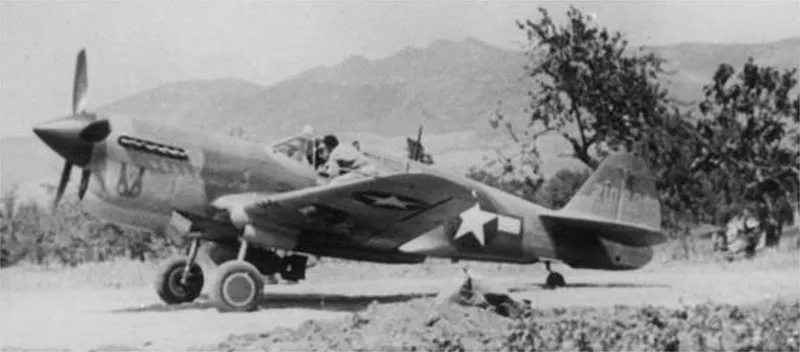
P-40F Warhawk 210690 of...
Table of contents
- Cover
- Title
- Copyright
- Contents
- Preamble
- Chapter 1. Setting the Scene
- Chapter 2. Operation Corkscrew
- Chapter 3. Operation Husky – The Invasion of Sicily
- Chapter 4. On into Italy
- Chapter 5. 1944 – New Plans
- Chapter 6. Operation Diadem: Rome – at last!
Trusted by 375,005 students
Access to over 1.5 million titles for a fair monthly price.
Study more efficiently using our study tools.
Frequently asked questions
Yes, you can cancel anytime from the Subscription tab in your account settings on the Perlego website. Your subscription will stay active until the end of your current billing period. Learn how to cancel your subscription
No, books cannot be downloaded as external files, such as PDFs, for use outside of Perlego. However, you can download books within the Perlego app for offline reading on mobile or tablet. Learn how to download books offline
We are an online textbook subscription service, where you can get access to an entire online library for less than the price of a single book per month. With over 1.5 million books across 990+ topics, we’ve got you covered! Learn about our mission
Look out for the read-aloud symbol on your next book to see if you can listen to it. The read-aloud tool reads text aloud for you, highlighting the text as it is being read. You can pause it, speed it up and slow it down. Learn more about Read Aloud
Yes! You can use the Perlego app on both iOS and Android devices to read anytime, anywhere — even offline. Perfect for commutes or when you’re on the go.
Please note we cannot support devices running on iOS 13 and Android 7 or earlier. Learn more about using the app
Please note we cannot support devices running on iOS 13 and Android 7 or earlier. Learn more about using the app
Yes, you can access A History of the Mediterranean Air War, 1940–1945 by Christopher Shores,Giovanni Massimello,Russell Guest,Frank Olynyk,Winfried Bock,Andy Thomas in PDF and/or ePUB format. We have over 1.5 million books available in our catalogue for you to explore.