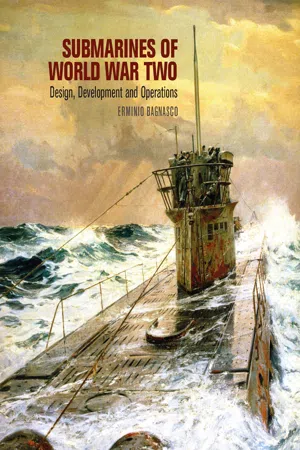
For the first time in naval warfare submarines played a major role in the war at sea in the years 1939–45, and this major reference book describes all the classes of vessel that were deployed by the eighteen combatant nations during those years. They were responsible for the sinking of 33 million tons of merchant shipping with the German and US navies achieving the greatest advantage with this devastating strategic weapon.Most of the countless books about submarines in WWII confine themselves to the boats of one particular navy or another: in this book every class of boat, from midgets to the large U-cruisers, of all the nations is covered in detail – more than 2, 500 boats – and projected and experimental designs are also included. This furnishes the reader with an overall picture that allows for comparison between the technical and operational aspects of all the submarines that took part in the War. This is further helped by the inclusion of more than 400 illustrations. The author also outlines the evolution of the submarine and submarine warfare – including the interplay of wartime experience, design improvement and tactical innovation – thereby placing the subject in its true historical perspective.This new edition of a classic work has been completely redesigned and overhauled to make the most of the author's superb collection of photographs, and will appeal to a wide new audience for whom this important work has been unavailable for many years.
- 288 pages
- English
- ePUB (mobile friendly)
- Available on iOS & Android
eBook - ePub
About this book
Information
Topic
StoriaSubtopic
Storia militare e marittimaItaly
On 10 June 1940, Italy entered the war on Germany’s side against Britain and against a France already reeling under the attacks of the Panzers and Stukas. For the first time in her brief history as a unified country, Italy was in direct confrontation with the major European naval powers – or more accurately, power – because Italy delayed entry until it was obvious that the French were about to be removed from the conflict, and indeed, that Britain seemed likely to capitulate as well.
The relatively young Italian Navy was about to be faced with the most severe test in its history: 39 months of warfare in the Mediterranean against the most expert, famous and, as yet, largest navy in the world. At first, the Italians had the advantage in numbers, but too often were handicapped by limited and inadequate equipment. A far more severe handicap was the weakness of the Italian high command, and the deplorable lack of collaboration between different branches of the services. Generally, however, Italian units fought as well as their equipment and orders allowed, often with great gallantry and skill, despite the legends of wartime propaganda. It was not the crews and captains that were lacking in these qualities, but their admirals and admiralty. So although Italy was defeated, the Italian Navy emerged from the war with some honour.
The war in the Mediterranean was chiefly a war of supply lines: defence of one’s own and attack on those of the enemy being the chief causes of battle. The opposing capital ships met only in short-lived encounters, partly because of the timidity of the Italian high command and partly because of the increasing dominance of air power, which imposed caution on both sides. In this situation, the activity of light surface units in the defence and attack of convoys was of particular importance, and the role of the submarine was vital.
Unfortunately for the Italians, the results obtained by their submarines rarely met expectations, and failed to justify the resources put into the building up of Italy’s underwater fleet during the years before the war. This failure stemmed from a combination of technical and strategic reasons. Few Allied merchantmen appeared in the Mediterranean during the early years of the war, except in the intermittent and heavily-defended convoys which broke through the Sicilian Channel en route to Malta or Alexandria. There were large numbers of Allied warships in the Mediterranean, and the Italian boats could show few successes against these, which caused the Germans to send a number of U-boats to the Mediterranean, where they obtained some notable successes.
The real reasons for the poor performance of Italian submarines appear to be technical. In their basic qualities as underwater craft, they compared very unfavourably to their British and German contemporaries. Their diving times were comparatively slow and they were not particularly handy under water. Their large conning towers were very visible on the surface and slowed the dive still more. Diving speed was particularly important in the enclosed and aircraft-dominated waters of the Mediterranean, and the Italian boats’ deficiency in this respect led to a high proportion of losses. Their situation worsened by the lack of effective fire-control computers, ASDIC or radar. Against the strong opposition of British anti-submarine forces, these deficiencies often proved fatal.

Submarines moored at Taranto in 1942, alongside an old ex-Austro-Hungarian hulk converted to a floating barracks for submarine crews. In the foreground is Giovanni da Procida of the Mameli Class, outboard Ciro Menotti of the Bandiera Class. Note the camouflage.

The naval review, honouring Hitler, in the Gulf of Naples on 5 May 1938. During this display, eighty submarines surfaced simultaneously and fired salutes. In the foreground is a Calvi Clas...
Table of contents
- Cover
- Title
- Copyright
- Contents
- Data key/abbreviations/bibliography
- PREFACE
- INTRODUCTION
- FRANCE
- GERMANY
- GREAT BRITAIN
- ITALY
- JAPAN
- NETHERLANDS
- UNITED STATES OF AMERICA
- UNION OF SOVIET SOCIALIST REPUBLICS
- THE LESSER POWERS
Trusted by 375,005 students
Access to over 1.5 million titles for a fair monthly price.
Study more efficiently using our study tools.
Frequently asked questions
Yes, you can cancel anytime from the Subscription tab in your account settings on the Perlego website. Your subscription will stay active until the end of your current billing period. Learn how to cancel your subscription
No, books cannot be downloaded as external files, such as PDFs, for use outside of Perlego. However, you can download books within the Perlego app for offline reading on mobile or tablet. Learn how to download books offline
Perlego offers two plans: Essential and Complete
- Essential is ideal for learners and professionals who enjoy exploring a wide range of subjects. Access the Essential Library with 800,000+ trusted titles and best-sellers across business, personal growth, and the humanities. Includes unlimited reading time and Standard Read Aloud voice.
- Complete: Perfect for advanced learners and researchers needing full, unrestricted access. Unlock 1.5M+ books across hundreds of subjects, including academic and specialized titles. The Complete Plan also includes advanced features like Premium Read Aloud and Research Assistant.
We are an online textbook subscription service, where you can get access to an entire online library for less than the price of a single book per month. With over 1.5 million books across 990+ topics, we’ve got you covered! Learn about our mission
Look out for the read-aloud symbol on your next book to see if you can listen to it. The read-aloud tool reads text aloud for you, highlighting the text as it is being read. You can pause it, speed it up and slow it down. Learn more about Read Aloud
Yes! You can use the Perlego app on both iOS and Android devices to read anytime, anywhere — even offline. Perfect for commutes or when you’re on the go.
Please note we cannot support devices running on iOS 13 and Android 7 or earlier. Learn more about using the app
Please note we cannot support devices running on iOS 13 and Android 7 or earlier. Learn more about using the app
Yes, you can access Submarines of World War Two by Erminio Bagnasco in PDF and/or ePUB format, as well as other popular books in Storia & Storia militare e marittima. We have over 1.5 million books available in our catalogue for you to explore.