This political and military history of Paraguay chronicles the dictatorship of General Alfredo Stroessner from 1954 to the coup that overthrew him in 1989.
1989 was a crucial year for Paraguay. After thirty-five years of dictatorship, General Alfredo Stroessner was overthrown by a coup d'état. In this sweeping historical study, Paraguayan historian Antonio Luis Sapienza chronicles Stroessner's rise to power during the coup of 1954; his long tenure maintained through fraudulent elections, military alliances, a right-wing political party, and assistance from the United States; and his eventual downfall.
While in power, Stroessner launched major development projects, improving roads, water and sewage facilities, and an airline. At the same time, abuse of human rights and oppression of political opposition became the norm. Dozens of political prisoners were tortured and even executed, and thousands driven into exile.
Like most dictators, Stroessner oversaw major expansions of the military and police. Nevertheless, it was Paraguay's armed forces, led by General Andres Rodriguez, that brought a violent end to his rule. Sapienza provides a detailed analysis of the coup that sent Stroessner into exile in Brazil.
Extensively illustrated with photographs and maps,
The 1989 Coup d'etat in Paraguay is a unique study of an important episode in Latin American history.
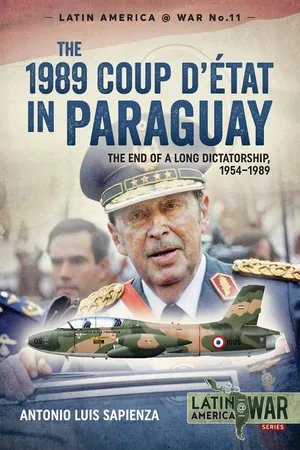
eBook - ePub
The 1989 Coup d'Étát in Paraguay
The End of a Long Dictatorship, 1954–1989
- 64 pages
- English
- ePUB (mobile friendly)
- Available on iOS & Android
eBook - ePub
About this book
Information
1
THE HISTORICAL BACKGROUND
Alfredo Stroessner Matiauda (1912–2006)
Alfredo Stroessner (the original German surname was Strößner) was born in the city of Encarnación, Paraguay, on 3 November 1912. His father was a German immigrant, from the town of Hoff in Bavaria, called Hugo Wilhelm Strößner who was registered as Stroessner upon arrival in Paraguay, and his mother was Heriberta Matiauda, a Paraguayan citizen. They had four children, the first two of whom died, then Alfredo and a girl who was named Heriberta after her mother. Alfredo’s most popular nickname was El Rubio (the blond one), but he had others, like Alemán (the German) or Gringo ra’y (Son of a foreigner).
Alfredo went to an elementary school in his hometown and was a very good student, and then started at the secondary school in Posadas, Argentina, just across the Paraná River from Encarnación. It was then that he decided to be a military officer, a decision that was supported by his father.
On 1 March 1929, when he was only 16 years old, he was accepted as a cadet in the Military School in Asunción, the capital of Paraguay. To become an officer, cadets had to complete a four-year programme in the Military School, but it was shortened to three-and-a-half years due to the Chaco War, which broke out in June 1932. All cadets were sent to the theatre of operations in the Chaco, Stroessner among them. Alfredo had chosen to specialise in the artillery within the Army, and his platoon was in charge of several Stokes-Brandt mortars in the first stages of the war. He was part of the 6th Infantry Regiment (R.I.6). After his successful participation in the Battle of Boquerón, he was promoted to the rank of 2nd Lieutenant on 1 October 1932. In December, he was transferred to the 1st Artillery Group. He stayed in the Chaco during the three years of the conflict, although he was allowed to visit Asunción and his relatives in Encarnación several times. Throughout the war, he commanded a platoon and was known to be very disciplined and organised, which is why his commanders had a high opinion of him. On 31 March 1934, he was promoted to 1st lieutenant on the battlefield, and once the war was over, he received the highest decorations, the Chaco Cross, the Defender Cross and the Medal of Boquerón.
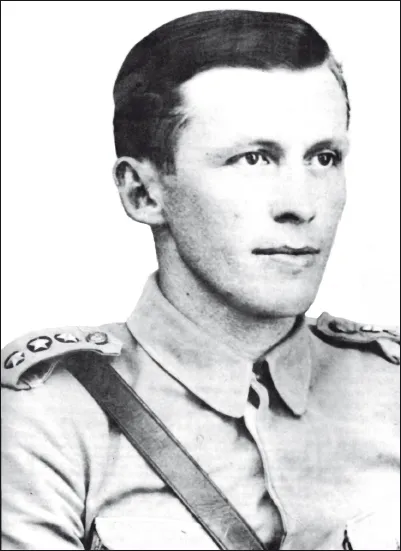
Captain Alfredo Stroessner in 1936. (Instituto de Historia y Museo Militar del MDN)
Promoted to captain in 1936 and then major in 1940, he was sent to Brazil for a specialisation course in artillery. On 31 December 1945, he was promoted to lieutenant colonel when he was only 33 years old, and was given the command of the Army Artillery Group “General Bruguez” which was based in the city of Paraguarí. In that year, he married a teacher, Eligia Mora Delgado, and they had three children: two boys and a girl. During his lifetime, Stroessner had several mistresses with whom he had other children.
In 1947, there was an Army revolt and most military units fought against the government of General Higinio Morinigo, but Lieutenant Colonel Stroessner decided to support the government. On 28 April of that year, Stroessner commanded an artillery attack on the Navy headquarters in the Sajonia neighbourhood of Asunción, and practically destroyed the place with mortar fire. He was then detached to the south of the country to fight the rebel naval forces that came from Argentina in the captured gunboats Paraguay and Humaitá. With the help of the Government Air Arm, the loyal troops stopped the advance of the gunboats, which had to seek refuge in Argentina.
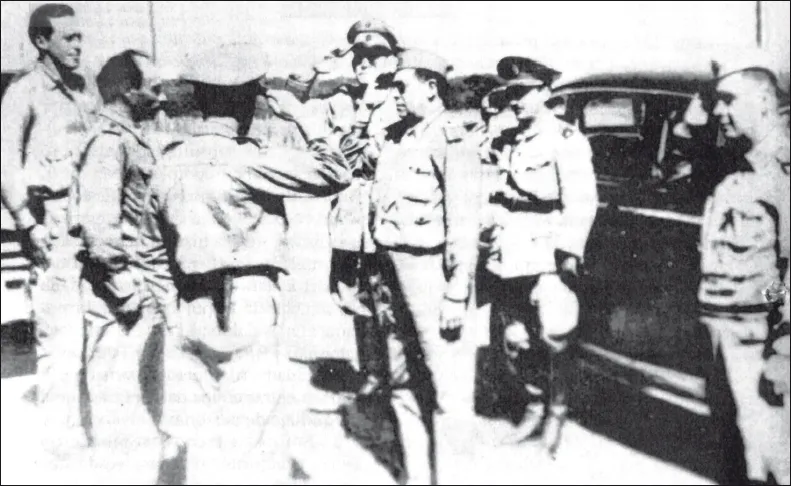
Lt. Col. Alfredo Stroessner (first left) with a group of officers meeting the President of Paraguay, Lt. Gen. Higinio Morinigo (centre) during the Revolution of 1947. (Instituto de Historia y Museo Militar del MDN)
Finally, after five months of combat, the rebel forces were defeated. Straight after the 1947 revolution, Stroessner became a member of the Colorado Party. He was promoted to full colonel on 1 March 1948. In that year, during one of the many coups – between 1948 and 1954 there were six presidents in Paraguay – Stroessner found himself on the “wrong side” and briefly had to go into exile in Argentina, but as soon as there was a new government, he returned to his previous post in the Army.
On 15 August 1949, Stroessner was promoted to brigadier general (two-star general) and just two years later he was a lieutenant general (three-star general) and was appointed as commander of the First Military Region during the government of Federico Chaves. In 1951, he was appointed as Commander-in-Chief of the Armed Forces. It was then that Stroessner started travelling in order to contact military authorities in the US, Brazil and Argentina, and establish strategic alliances. During the 1950s, General Stroessner received flight training in the Paraguayan Air Arm and even became a certified C-47 pilot.
Getting into power: the 1954 coup d’état
In 1953, Dr Federico Chaves was elected president of Paraguay. Although he was formally married, he had a mistress, Isabel Vallejos, who was a widow. She started manipulating the president for her own purposes and in a few months, Chaves was just a puppet, and therefore Vallejos held the real power. That was so evident that civil and military authorities, and even diplomats, visited her house instead of the Government Palace for many reasons: to get a promotion, to start a lucrative business or receive help with work, money or even health matters. She was the “power behind the throne” and that caused a lot of distress to many people, including the Commander-in-Chief of the Armed Forces. There were even many cases of indiscipline in the armed forces, while different internal groups within the Colorado Party started disputing power quotas. Inflation was high and access to common goods such as flour, sugar, and beef became a luxury. Many products were rationed and people had to queue in line for hours to get a state voucher for those goods. The former President of the Central Bank, Epifanio Mendez Fleitas, a prominent figure in the Colorado Party, was also conspiring against the government and there were rumours of an imminent coup, so Stroessner decided to act.
On 4 May 1954, military forces commanded by Stroessner besieged Asunción and attacked the Police Headquarters to gain control of the government. The president sought refuge in the Military School building, but the commander there, Brigadier General Marcial Samaniego, was loyal to Stroessner and kept Chaves as prisoner, so the only option for him was to resign. The Colorado Party then appointed its own president, Tomás Romero Pereira, as the Provisional President of Paraguay while a consensus candidate was sought. As there were no strong civilian candidates at that time, they offered the Presidency to Alfredo Stroessner. Elections were held on 11 July, with Stroessner as the only candidate. He officially became President of the country for the first time on 15 August 1954, to serve until 1958. He was only 41 years old. In 1956, Stroessner signed a decree promoting himself to the highest rank in the armed forces, General of the Army (four-star general).
The Stroessner government over the years
From the start, Stroessner defined himself as an extreme anti-communist leader, which was perfect for the US Government’s national security doctrine during the Cold War. Paraguay was then a very poor country and most of the population – almost 1.4 million people – did not have access to educational and health services. There was less than 100km of paved roads, no national airline, a very poor merchant navy, running tap water was non-existent, there was a very inefficient electric power system for only a few neighbourhoods in the capital, and among many other problems basic goods were scarce.
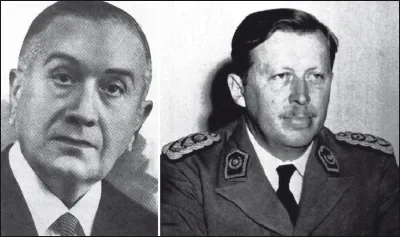
President Dr. Federico Chaves Careaga (1949-1954) Right: Lt. Gen. Alfredo Stroessner Matiauda, Commander-in-Chief of the Armed Forces. (Author)
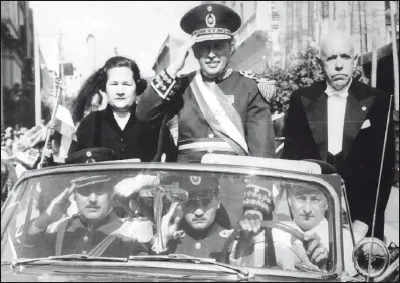
Lt. Gen. Alfredo Stroessner (centre) and his wife Ligia Mora on his inauguration day of 15th August 1954. (Instituto de Historia y Museo Militar del MDN)
Stroessner fulfilled his promises to pacify the country, achieve greater financial stability and modernise the infrastructure. He obtained the support of businessmen and landowners to achieve political and economic stability, and above all to attract foreign investment. Therefore, starting in the mid-1950s, his government focused on huge public works under the motto “Peace and Work”, which were financed by a series of loans from the Exim Bank and the Development Loan Fund of the United States. Between 1960 and 1980, Paraguay received more than a billion dollars in loans from the American government. The first huge project was the running tap water system for the capital and the main cities. This was followed by the construction of more paved roads, first to his hometown of Encarnación, and then to the east tow...
Table of contents
- Cover
- Title
- Copyright
- CONTENTS
- Foreword
- Introduction
- 1 The Historical Background
- 2 Prelude To The Coup
- 3 The Coup
- 4 The Aftermath
- Conclusion
- Sources
- Acknowledgements
- About the Author
- Plates
Trusted by 375,005 students
Access to over 1.5 million titles for a fair monthly price.
Study more efficiently using our study tools.
Frequently asked questions
Yes, you can cancel anytime from the Subscription tab in your account settings on the Perlego website. Your subscription will stay active until the end of your current billing period. Learn how to cancel your subscription
No, books cannot be downloaded as external files, such as PDFs, for use outside of Perlego. However, you can download books within the Perlego app for offline reading on mobile or tablet. Learn how to download books offline
Perlego offers two plans: Essential and Complete
- Essential is ideal for learners and professionals who enjoy exploring a wide range of subjects. Access the Essential Library with 800,000+ trusted titles and best-sellers across business, personal growth, and the humanities. Includes unlimited reading time and Standard Read Aloud voice.
- Complete: Perfect for advanced learners and researchers needing full, unrestricted access. Unlock 1.5M+ books across hundreds of subjects, including academic and specialized titles. The Complete Plan also includes advanced features like Premium Read Aloud and Research Assistant.
We are an online textbook subscription service, where you can get access to an entire online library for less than the price of a single book per month. With over 1.5 million books across 990+ topics, we’ve got you covered! Learn about our mission
Look out for the read-aloud symbol on your next book to see if you can listen to it. The read-aloud tool reads text aloud for you, highlighting the text as it is being read. You can pause it, speed it up and slow it down. Learn more about Read Aloud
Yes! You can use the Perlego app on both iOS and Android devices to read anytime, anywhere — even offline. Perfect for commutes or when you’re on the go.
Please note we cannot support devices running on iOS 13 and Android 7 or earlier. Learn more about using the app
Please note we cannot support devices running on iOS 13 and Android 7 or earlier. Learn more about using the app
Yes, you can access The 1989 Coup d'Étát in Paraguay by Antonio Luis Sapienza in PDF and/or ePUB format, as well as other popular books in History & 20th Century History. We have over 1.5 million books available in our catalogue for you to explore.