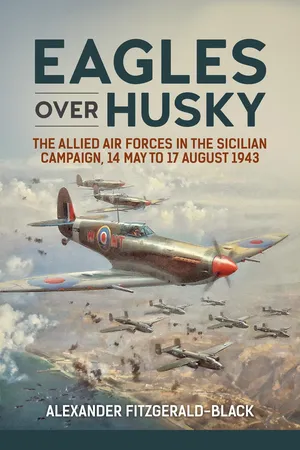
In the summer of 1943, the United Nations began Operation HUSKY, the invasion of Sicily. The Eagles over HUSKY – the airmen of the Allied air forces – played a crucial role in the assault. The Luftwaffe and Regia Aeronautica provided a significant part of the Axis force meant to defend the island and throw the Allies back into the sea. The Allied air forces foiled this effort and inflicted losses on a German Air Force badly needed on other fronts. Raids on mainland Italian railway transport crippled Axis resupply efforts. The same strikes brought pressure on the Italian state to denounce Fascism and join the Allied side. Army commanders relied heavily on tactical air power to destroy Axis forces in Sicily. The result was a strategic victory which forced Nazi Germany to stand alone in defense of southern Europe. Most histories of the campaign focus on the escape of German forces across the Strait of Messina. Eagles over Husky challenges the notion that the Allied militaries bungled total victory in Sicily. It assesses one of the greatest air battles of the Second World War. This is a topic that has been relatively unexamined by historians of the campaign, who tend to focus on army matters. Eagles over Husky tells the integrated story of the air war waged during the Battle of Sicily. The author draws upon experiences, perspectives, and sources from both Allied and Axis camps to inform the analysis and enhance the narrative.
eBook - ePub
Eagles over Husky
The Allied Air Forces in the Sicilian Campaign, 14 May to 17 August 1943
- 192 pages
- English
- ePUB (mobile friendly)
- Available on iOS & Android
eBook - ePub
Eagles over Husky
The Allied Air Forces in the Sicilian Campaign, 14 May to 17 August 1943
About this book
Information
Subtopic
European HistoryIndex
History1
From SYMBOL to HUSKY
Casablanca, Morocco. Made famous in November 1942 by the release of Casablanca, an American romantic drama set in Vichy French Morocco, the major port city was also the site of a crucial meeting of Allied political and military leaders in January 1943, code-named SYMBOL. As a major port, Casablanca had been a key target of Operation TORCH, the Anglo-American invasion of North Africa in the first half of November 1942. Indeed, the film Casablanca was rushed to release to take advantage of the publicity these events offered. After stiff initial Vichy French opposition, the city surrendered on 11 November, once surrounded by forces of Major General George S. Patton’s Western Task Force. Now, as the New Year dawned on 1943, American and British delegations assembled at the Anfa Hotel, situated on the outskirts of Casablanca, to decide the future of the war against the Axis powers of Germany, Japan, and Italy. President Franklin D. Roosevelt and Prime Minister Winston S. Churchill were both in attendance, along with their military Chiefs of Staff, led by General George C. Marshall and General Sir Alan Brooke respectively. Premier Joseph Stalin declined to attend, citing the ongoing Battle of Stalingrad as requiring his presence in the Soviet Union. In spite of his absence, the outcomes of the Casablanca Conference would shape how the war was won, especially in the West.
The American and British delegations arrived in early January to a city bustling with Major General George S. Patton’s occupying GIs. Roosevelt became the first president to travel via airplane on a circuitous route taking him through Miami, Trinidad, and Brazil before crossing the Atlantic near its narrowest point to Gambia and sailing northward to Casablanca. Churchill’s transport flew direct from Britain, along the now familiar route Allied aircraft took around the Bay of Biscay and the coasts of Spain and Portugal. The delegations settled into requisitioned seaside villas in Anfa, an upscale suburb of the city. The British delegation arrived with a common purpose while the Americans and their new Joint Chiefs of Staff (JCS) established in 1942 were relatively unprepared.
News of Stalin’s absence had given Churchill an opportunity he did not intend to miss. The conference was to decide what the Allies would do in 1943. The Soviets and the Americans were both expected to push for the opening of a second front in northern France. Churchill and Brooke had other ideas. They wanted to open a second front in the Mediterranean in 1943, following on the momentum of eventual victory in North Africa. Brooke described the British strategic vision in his personal papers:
The soft underbelly of Europe was the whole of southern Europe including a portion of southern France, the whole of Italy and the whole of Greece, all of which Germany was defending, and all of which is difficult to defend. It’s like a series of fingers spread out into the sea. In order to defend it you’ve got to disperse your forces through it … By defeating the Italian forces and wiping them off the map, forcing German detachments to take over the jobs that the Italians had been doing and to detain forces in Italy was the idea.1
Without Stalin, the Americans and Soviets could not line up in opposition to this strategy. To ensure their vision came to pass the British arrived with immaculate preparation. First, the well-established British staff system enabled their delegation to arrive with well-prepared arguments for continuing the war in the Mediterranean to Sicily. Second, the British brought with them superior administrative resources. They positioned HMS Bulolo, a pre-war 6,000-ton passenger and cargo liner converted into a combined operations headquarters, in the Port of Casablanca. This ship provided communications with London, clerical staff, and an extensive archive of papers supporting the argument for Sicily. Third, the British had an ace up their sleeve in Field Marshal Sir John Dill. Dill was Brooke’s predecessor as Chief of the Imperial General Staff, the professional head of Britain’s military. Unable to get along with Churchill, in late 1941 the Prime Minister promoted Dill and posted him to Washington as Chief of the British Joint Staff Mission. His year with the JCS was to prove incredibly valuable. He was a trusted confidant and knew the minds of the American officers, allowing him to help the British delegation prepare for likely American counter-arguments. These factors and the relative state of the American delegation would secure the British vision to knock Italy out of the war in 1943.2
For their part, the American JCS were unprepared to do anything but make counter-arguments. The US Army and Navy were divided on their priorities between Europe and the Pacific respectively. The US Navy’s Admiral Ernest King agreed with the “Europe First” strategy established at the December 1941 Arcadia Conference, but he was wary of having forces idle in the Atlantic while the Japanese remained a threat in the Pacific.3 His fear that “it was doubtful when – if ever – the British would consent to a cross-Channel operation” fuelled these concerns – and tensions. At one point at Casablanca, Brooke accused King of favouring the Pacific War, nearly leading to fisticuffs between the two military leaders.4 General Marshall, Chief of Staff of the US Army, had significant misgivings for what he felt was an ill-advised and opportunistic campaign in the Mediterranean. He noted, “I think the Mediterranean is a kind of dark hole into which one enters at one’s peril.”5 Marshall favoured carrying out Operation ROUNDUP, a cross-Channel invasion plan, in 1943. Yet the Americans arrived unready to make a compelling argument for this option. They had left most of their experts and staff officers back in Washington and were forced to cobble together a staff on the spot in the face of the British delegation’s superior resources.6 According to one historian of the Mediterranean war, “Marshall arrived in Morocco remarkably unprepared to do anything but cast a veto on the alternatives as Brooke defined them.”7 For his part, General Henry “Hap” Arnold, Chief of the US Army Air Forces, was primarily concerned with ensuring that his command’s resources remained concentrated for decisive effect. Arnold could rationalize diverting resources for Sicily from the Combined Bomber Offensive in the United Kingdom because it would keep resources – especially heavy bombers – from being removed to the Pacific.8 Finally, unlike Churchill, Roosevelt did not have his own vision for 1943. He adopted a wait-and-see policy that played right into British hands. While Brooke and his deputies worked on the JCS in conference, Churchill would work on Roosevelt behind the scenes.9
Thanks to Dill, the British delegation knew about the Europe-Pacific divide that existed between Marshall and King. When the conference began on 14 January 1943 prioritizing between Europe and the Pacific led to heated debate. Brooke accused the Americans of failing to emphasize Germany’s defeat while Marshall accused the British of avoiding a cross-Channel attack. The sides did however agree to continue US operations in the South Pacific with a British invasion of Burma later in the year. These objectives were to be accomplished with existing resources in the Pacific. But Marshall refused to budge on his position of building resources in the United Kingdom for a cross-Channel attack in 1943. He felt this was the best way to draw forces away from the Soviets in Eastern Europe. The British set out to disassemble this argument. First, the Battle of the Atlantic was far from over; Germany’s U-boat force needed to be weakened to ensure a safe crossing of the Channel. Second, the Luftwaffe still had air superiority over Europe and air superiority was to be a prerequisite for a successful invasion of northern France. Third, the logistics infrastructure and shipping required to maintain the 40-plus divisions required for the undertaking was not yet assembled in the Atlantic.10 Perhaps the best argument against ROUNDUP was Brooke’s assessment of the likely German response. At the time, Allied intelligence placed 42 German divisions in France. This was more than enough to counter whatever force the Anglo-Americans could get across the Channel and supply in 1943. Therefore it was unlikely that Germany would need to shift resources from the Eastern Front to contain this threat.11 Continuing operations in the Mediterranean with the aim to knock Italy out of the war was the better option. An Italian collapse would remove 54 divisions, over 2,000 aircraft, and the still-formidable Italian navy from the Axis order of battle.12 If the Allies were successful, the German OKW would be forced to move troops from either Russia or France to occupy the Italian mainland and replace Italian units in the Balkans. Since the Mediterranean was a vast theater largely made up of water, the Germans would have to deploy precious Luftwaffe and Kriegsmarine resources to support these units. Furthermore, moving forward in the Mediterranean would yield new air bases to wage the war against German industry and could even entice Turkey to side with the Allies.
With this foundational logic, the Combined Chiefs of Staff (CCS) – the British Chiefs of Staff and the American Joint Chiefs of Staff – turned their attention to options for what to do after the Allies secured North Africa. Building on this momentum also made sense because the forces needed to achieve further success were already available there. They considered two options, an invasion of Sardinia, code-named Operation BRIMSTONE and an invasion of Sicily, code-named Operation HUSKY. Taking Sicily was Brooke’s preferred option from the start. Marshall agreed. Both felt that the capacity of ports and air bases in Sardinia was limited, meaning that the assault force would have to be fairly small. The Germans could either withdraw entirely or reinforce the island to prolong the struggle for a base that was of limited use for enabling future operations. Roosevelt and Churchill were both against BRIMSTONE. Roosevelt realized that the small size of the force required would mean taking Sardinia would largely be a British operation and he needed American soldiers in the fight. For Churchill, the operation would be too small to take to Stalin as an alternative to a cross-Channel invasion in 1943.13 Clearing Sardinia would also not resolve the Allies’ shipping capacity problem as clearing Sicily could. Sicily had long operated as a counter to Malta as an air and naval base for striking at Allied lines of communication in the central Mediterranean. Removing the Axis garrison would allow the Allies to route merchant ships safely through the Mediterranean to the Suez Canal instead of the lengthy journey around the Cape of Good Hope at the bottom of the African continent. This would free up an estimated 225 merchant ships and their cargo capacity for other tasks, something Admiral King was keen to agree to.14
For his support of the Sicily operation, General Marshall secured renewed planning for a cross-Channel invasion in 1944. This eventually became known as Operation OVERLORD, the invasion of Normandy. The fact that the CCS compromised in this way has led many historians to the conclusion that Casablanca led to a flawed strategy. Some assessments lament the lack of American preparation to make an argument for an invasion of northern France in 1943. Philips Payson O’Brien’s recently published study How the War was Won argues that concentrating Allied air and naval resources in the United Kingdom instead of distributing resources to the Mediterranean and the Pacific would have allowed for a successful invasion in 1943.15 This does not, however, make up for the fact t...
Table of contents
- Cover
- Dedication
- Title
- Copyright
- Contents
- List of Photographs
- List of Maps
- List of Tables
- Aircraft Nomenclature
- Acknowledgements
- Prologue: Tunisgrad
- 1 From SYMBOL to HUSKY
- 2 An Air Offensive of Unprecedented Dimensions
- 3 The Climax of the Air Superiority Battle: The Landings and Advance Inland
- 4 Air Power for Strategic Effect: Breaking Italian Fascism and the Etna Line
- 5 Of Straits and Narrows: The Allied Air Forces and the Axis Evacuation of Sicily
- Epilogue
- Appendices
- Bibliography
Trusted by 375,005 students
Access to over 1.5 million titles for a fair monthly price.
Study more efficiently using our study tools.
Frequently asked questions
Yes, you can cancel anytime from the Subscription tab in your account settings on the Perlego website. Your subscription will stay active until the end of your current billing period. Learn how to cancel your subscription
No, books cannot be downloaded as external files, such as PDFs, for use outside of Perlego. However, you can download books within the Perlego app for offline reading on mobile or tablet. Learn how to download books offline
Perlego offers two plans: Essential and Complete
- Essential is ideal for learners and professionals who enjoy exploring a wide range of subjects. Access the Essential Library with 800,000+ trusted titles and best-sellers across business, personal growth, and the humanities. Includes unlimited reading time and Standard Read Aloud voice.
- Complete: Perfect for advanced learners and researchers needing full, unrestricted access. Unlock 1.5M+ books across hundreds of subjects, including academic and specialized titles. The Complete Plan also includes advanced features like Premium Read Aloud and Research Assistant.
We are an online textbook subscription service, where you can get access to an entire online library for less than the price of a single book per month. With over 1.5 million books across 990+ topics, we’ve got you covered! Learn about our mission
Look out for the read-aloud symbol on your next book to see if you can listen to it. The read-aloud tool reads text aloud for you, highlighting the text as it is being read. You can pause it, speed it up and slow it down. Learn more about Read Aloud
Yes! You can use the Perlego app on both iOS and Android devices to read anytime, anywhere — even offline. Perfect for commutes or when you’re on the go.
Please note we cannot support devices running on iOS 13 and Android 7 or earlier. Learn more about using the app
Please note we cannot support devices running on iOS 13 and Android 7 or earlier. Learn more about using the app
Yes, you can access Eagles over Husky by Alexander Fitzgerald-Black in PDF and/or ePUB format, as well as other popular books in History & European History. We have over 1.5 million books available in our catalogue for you to explore.