![]()
CHAPTER 1
THE SIX FRAMES IN SCHOOLS: PRACTICES FROM TAIWAN
Lin Ching Chen and Yaw-Huei Chen
ABSTRACT
This chapter reports a six-year integrated information literacy instruction program in Taiwan that brought together concepts from informed learning, especially the six frames, with inquiry-based learning frameworks in schools. A total of eleven inquiry projects have been implemented from grades 1 through 6. Six projects selected for each grade are explained in detail. The themes of the projects are designed based on the essence of six frames, each project involving one to three frames depending on the integrated subjects. Through the descriptions, we present how the information literacy instruction is integrated into various subject matters via the framework of inquiry-based learning, such as the Super3 and Big6 models. Students’ performances in subject content and information literacy of the six projects are delineated quantitatively and qualitatively.
Keywords: Six frames; inquiry learning; information literacy; informed learning; Big6 model; Super3 model
PRELUDE
After reading the books, titled “Teaching information & technology skills: The Big6 in elementary schools” and “The seven faces of information literacy”, we became interested in the concepts of Big6, inquiry learning, and information literacy. In 2004, we invited a group of teachers to collaboratively conduct an inquiry learning project in a 6th grade class of an elementary school, in Taiwan. The school library had more than 50,000 books and the computer lab had many computers with fast access to the Internet. The teachers guided students to complete the project via the Big6 model with considerable efforts. However, during the process, we found the following situations:
Students directly copied and pasted information from the Internet without any hesitation.
Students complained, “Why couldn’t we copy and paste information from the Internet? We have been used to doing it since we were 1st graders.”
When students presented their reports, they read the words straight from the PowerPoint slides, instead of using their own words.
Students could not answer their peers’ questions about the content of their reports.
So, we began to ask, “What is the problem?” “Don’t students have enough resources?” “Don’t we help them enough?” We believe that teaching is a start of change. We believe that if we can find a better way to teach students about using information wisely, to help them expand their repertoire, and to let them really experience information power, these situations can definitely be changed. Here our story starts.
----------------------------------------------------------
With the fast development of information and communication technologies, and the overwhelming flood of information, how to use information in different forms successfully, responsibly, and reflectively is an important issue today. This is what informed learning aims for. Every citizen can wisely engage with the information practices of his/her profession, discipline, and workplaces (Bruce, 2008). However, as educators, how can we help learners reach this final goal? What kind of abilities and attitudes should learners be equipped to complete the life-long journey? Many researchers verify that information literacy, which includes the abilities and attitudes to recognize, locate, evaluate, use, and create effectively the needed information, is the key (American Association of School Librarians (AASL), 2007, 2009).
Although most people agree that information literacy is essential for learning in the twenty-first century, how to provide a wider range of learning contexts to expand learners’ repertoire is a more critical concern. In Taiwan, the main instructional focus at K-12 levels is to memorize subject content of textbooks through countless drills-and-practices; other perspectives, for example, learning to learn, critical thinking, and social responsibility have been less stressed or implemented. Therefore, the six frames for informed learning can provide our students with a balanced framework of subject matters and learning process (Bruce, 2008; Chen & Chen, 2016).
The six frames include the content frame, the competency frame, the learning to learn frame, the personal relevance frame, the social impact frame, and the relational frame (Bruce, 2008). These frames provide students with various lenses for experiencing different information practices. Each frame represents a special view of information, learning, and teaching; however, Bruce (2008) suggests that school curricula had better cover all of them.
Information literacy is not equal to disconnected skills. Many studies suggest that it is most effectively taught as an integral part of subject content learning, because the existing learning situations can provide meaningful environments for students practicing information literacy (AASL, 2009; Chen & Chen, 2016; Lloyd, 2010). In other words, integrated information literacy instruction can improve students’ information literacy and subject content by delivering instruction at their point of need. Therefore, students can recognize the real need to link information literacy to the contexts of subject areas.
Furthermore, researchers find that the teaching of information literacy across content areas can be enhanced by the use of inquiry-based learning (Eisenberg, Lower, & Spitzer, 2004; Kuhlthau, Maniotes, & Caspari, 2015). The main purpose of inquiry-based learning is to teach students how, rather than what, to learn; it requires students to take active responsibility for their own learning and to apply concepts in a new situation (Loyens & Rikers, 2011). It is believed that inquiry learning promotes a deeper understanding of the subject matter through the process of questioning, seeking evidence, developing explanations, evaluating the explanations, and communicating conclusions.
Eisenberg and Berkowitz (1999) develop an inquiry-based Big6 model for integrating information literacy into learning subject matter. The model has six stages: task definition (TD), information seeking strategies (ISS), location & access (L&A), use of information (UI), synthesis (S), and evaluation (E). Afterwards, Eisenberg and Robinson (2007) construct the Super3 model, which includes three stages of plan, do, and review for young learners to start thinking in terms of process. Several studies confirm that the Big6 and Super3 models can improve students’ learning in information literacy and subject content (Abdullah & Zainab, 2008; Chen, Chen, & Ma, 2014; Heider, 2009).
In response to the above theories, the six-year integrated information literacy instruction program in Taiwan is born. The six frames offer guiding themes and backdrops for the whole instruction, while the Big6 and Super3 models provide the frameworks to execute curricula-related inquiry projects each semester. The final goal of the instruction is to help students to become informed learners who can use information successfully and reflectively.
STAGES & THEIR ACTORS/ACTRESSES
The six-year integrated information literacy instruction program is developed and implemented at Chiayi Elementary School, located in the southern part of Taiwan. Approximately 900 students enroll in this urban school from grades 1 through 6, with five classes in each grade. Since 2005, with the support from the principal, this school adopts the information literacy curriculum and integrates it into various subject matters.
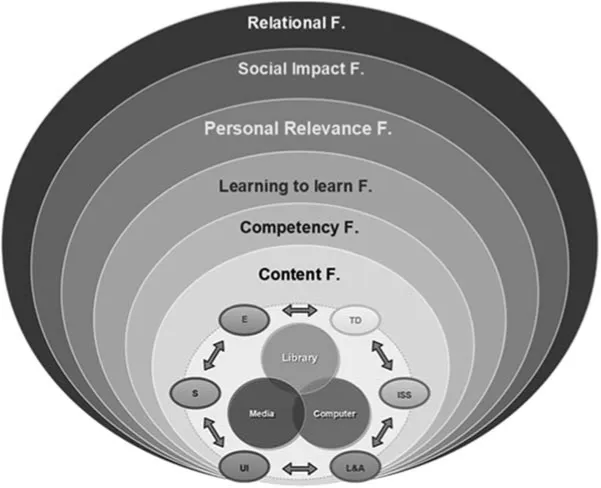
The framework for the schools’ integrated information literacy curriculum is composed of three main areas from center to periphery: diverse scopes, inquiry process, and six frames (Fig. 1.1). In terms of multiple literacies, information literacy includes library, media, and computer literacies in the circle of diverse scopes (Eisenberg, Lowe, & Spitzer, 2004; Farmer, 2007). The inquiry process circle refers to the abilities and attitudes to recognize, locate, organize, evaluate, use, and create effectively the needed information (AASL, 2007). Since the Big6/Super3 models are used for the inquiry projects, this circle is denoted as stages of TD, ISS, L&A, UI, S, and E. As for the third area, it consists of a series of ripples which represent six frames. Six frames provide inquiry projects with meaningful lenses for the integrated curriculum, so that various disciplines can be infused into it. Through working on the inquiry projects, students would apply what they have learned about the diverse scopes and the inquiry process in real situations, and experience different information practices.
Fig. 1.1. Framework for the Integrated Information Literacy Curriculum.
The curriculum is taught once a week from grades 1 to 2, and twice from grades 3 to 6 with the addition of computer literacy. Each instructional period is 40 minutes. There are more than 50,000 books in the school library and two computer labs for whole class teaching as well as group activities. An interactive whiteboard and projector are installed in each classroom.
Key actors and actresses in this program include three teacher librarians, six classroom teachers, the principal, and parents, who all agree with the essence of information literacy and informed learning. The three teacher librarians, Ms Gong, Ms Liang, and Ms Shen, teach the lower-, middle-, and upper-grade information literacy instruction, respectively. When an inquiry project starts each semester, they collaborate with classroom teachers to integrate information literacy into the selected curriculum units. In other words, teacher librarians and teachers, as a team, work together closely to plan, implement, evaluate, and reflect on learning activities, thus the core of information literacy can be fulfilled. Furthermore, the six classroom teachers, as a seed teacher in each grade, would share their experiences with another four colleagues and upload newly designed teaching materials to the Information Literacy Resources web site we produce for this team (http://ilr.etech.ncyu.edu.tw). Therefore, every teacher can incorporate information literacy into the school curriculum if they would like to.
In addition to teacher librarians and classroom teachers, the principal and parents also play crucial roles in this program. With full support from school administration and parents, the three teacher librarians devote their time and energies to design and develop the six-year integrated information literacy instruction in detail. Furthermore, we regularly discuss with Ms Gong, Ms Liang, and Ms Shen the essence of information literacy, information literacy teaching strategies, and the problems they face. Without these supports, the best actors/actresses would not be able to perform on this stage.
PLOTS
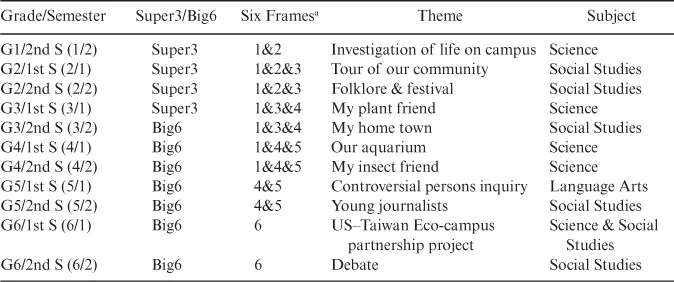
Although the framework is important to complete an inquiry project, the project’s theme is a more critical issue to expand students’ learning repertoire. Different frames then provide students with various lenses to experiencing different information practices. Following this theory, a total of 11 inquiry projects are carried out each semester starting at the second semester of 1st grade. The inquiry themes are designed based on the essence of six frames for informed learning, and they all relate to the school curricula, so that students can apply the information literacy skills in real situations. In other words, the integrated information literacy instruction provides students with meaningful learning contexts to engage interesting problems. Key aspects of the 11 inquiry projects are listed in Table 1.1.
From Table 1.1, we can see that until the seventh project, My Insect Friend, the content frame has been one of the curriculum focuses. That means both subject matter and information use are important in the projects from Investigation of Life on Campus in grade 1 through My Insect Friend in grade 4. However, beginning from 5th grade, information literacy instruction involves more controversial issues. Regardless of the projects of Controversial Persons Inquiry, Young Journalists, US-Taiwan Eco-Campus Partnership Project, and Debate, they all require students to be equipped with thorough critical thinking and reasoning ability during the inquiry process. Therefore, the discipline content are not the focus anymore; on the contrary, the frames of personal relevance, social impact, and relation play more important roles during the inquiry process. Six projects which represent each grade and various frames will be described in more detail below.
Table 1.1. Key Aspects of Inquiry Projects.
a Six frames: 1. Content frame; 2. Competency frame; 3. Learning to learn frame; 4. Personal relevance frame; 5. Social impact frame; and 6. Relational frame.
The first inquiry project, Investigation of Life on Campus, which belongs to the content and competency frames, is infused into 1st grade science curriculum. In addition to the disciplinary content, its main focuses are teaching students to observe nature with patience, to ask reasonable questions, and to und...