I.B.Tauris in association with the Institute of Ismaili Studies
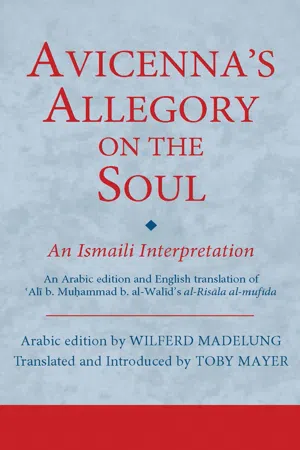
The Persian philosopher Ibn Sina (d. 1037), known in Europe as Avicenna, was arguably the greatest master of Aristotelian thought in the Muslim world. The symbolical Poem on the Soul (Qasidat al-nafs), which portrays all earthly human souls as in temporary exile from heaven, is traditionally attributed to Avicenna, and was received with enthusiasm by its commentators. A highly significant commentary on the Qasida was written by ?Ali b. Muhammad b. al-Walid (d. 1215 CE), a major early representative of the Tayyibi Ismaili tradition, which emerged and flourished in medieval Yemen. In his view, the poem encapsulated Tayyibi beliefs, whose doctrines bear striking parallels with late antique Gnosticism. Avicenna s Allegory on the Soul presents the first edition of the Arabic text of Ibn al-Walid s commentary, The Useful Epistle (al-Risala al-mufida), alongside an English translation and extended introduction. It offers invaluable insight into the intricacies of Muslim thought and a deeper understanding of Avicenna s substantial intellectual legacy."
- 224 pages
- English
- ePUB (mobile friendly)
- Available on iOS & Android
eBook - ePub
About this book
Information
Introduction
Avicennan Allegory: Between Philosophy and Religion
In Muslim dream interpretation (or ‘oneiromancy’, taʿbīr), a pigeon is a beautiful omen. The dove and pigeon family has potent scriptural and cultural associations. While the Christian tradition even views the bird as a symbol of the Spirit (following Matthew 3:16, where it descends in a dove’s form on Jesus at his baptism), the Muslim tradition mainly associates it with another narrative traceable to the Bible: the first evidence for Noah that the world-destroying flood was receding was that his dove returned to the ark with an olive branch.1 This is clearly a motif of great antiquity, as in the Epic of Gilgamesh (ca. 2100 bce), Utnapishtim also releases a dove to try to find dry land and return to him. Such accounts rest on a fundamental behavioural feature of birds of the genus Columbidae, namely, that they can return home from even vast distances. The mysterious mechanism which underlies this ability remains debated, some claiming that navigation is through the use of infrasound, some that it is through an acute sensitivity to atmospheric odours, and some that a specially adapted nerve allows ‘magnetoception’. In view of this homing ability, pigeons were kept and bred as a popular pastime in the great urban centres of the medieval Muslim world. The objective of the sport of pigeon-flying (zajl) was to test from how great a distance a bird could return to its dovecot, and it was claimed that the champion birds (called ‘celestials’, samāwiyyāt) could fly, say, from the Bosphorus to Baṣra at one stretch. From as early as the 3rd/9th century trained carrier-pigeons also had a serious military and intelligence role in Muslim lands by conveying long-distance messages.2 In the medieval Arabic texts contained within this volume, the soul itself is presented as a ‘homing pigeon’ par excellence – descending here from an impossibly remote heavenly abode and then navigating all the way back to it.
This volume involves two distinctive philosophical artefacts from the early 5th/11th century and the late 6th/12th century. The first is a brief allegorical poem, the Qaṣīdat al-nafs (‘The Poem on the Soul’), attributed to Ibn Sīnā (‘Avicenna’), the great master of Muslim Aristotelianism, who was not generally known to be a poet; it is a poem, moreover, with a seemingly anomalous, Platonic portrayal of the soul as fallen down into its earthly, material embodiment which it pre-existed, and from which it may well yet escape. The second is a line-by-line commentary on this poem, entitled al-Risāla al-mufīda, by ʿAlī b. Muḥammad b. al-Walīd, an early leader (dāʿī muṭlaq) of the Ṭayyibī branch of Ismailism which took root and flourished in medieval Yemen. His exegesis is based on Ṭayyibī cosmological teachings which are, in some respects, cognate with those of the Gnostic movements of late antiquity. Based on the idea that our physical universe is overshadowed by, and results from, a primordial rupture in the architecture of the higher, spiritual world, these are unusual doctrines within the intellectual scene of medieval Islam.
Despite his great reputation as a Peripatetic (mashshāʾī), Abū ʿAlī al-Ḥusayn b. ʿAbd Allāh Ibn Sīnā (d. 428/1037) did not just re-work teachings passed down from Aristotle but interwove certain Platonic and Neoplatonic themes in a whole that was more than the sum of its parts. A Platonic debt is felt, for instance, in certain texts by Ibn Sīnā on the human soul’s predicament, development and final salvation. In such texts he limns his teachings in stories rich in imagery, in a manner that echoes Plato’s use of narrative. The latter had articulated his philosophical thought through a dramatic, dialogic format, and also myth. Though the Corpus Platonicum remained neglected in Arabic compared with the Corpus Aristotelicum,3 some knowledge of Plato, unmediated by Neoplatonism, did percolate into Muslim philosophy, for example through quotations by Claudius Galen (d. ca. 216 ce). These included a summary of the Timaeus, that major case of the Platonic ‘reasonable myth’.4 Ibn Sīnā remained unsure of Plato’s value as a philosopher on account of the meagreness of the textual evidence available to him, and Plato’s influence on his narrative experiments is unlikely to have been direct.5
4 Or ‘truth-like myth’ (Gk. eikôs muthos). In addition to Galen’s summary, the Timaeus came to exist in three translations in Arabic. Abū Bakr Muḥammad b. Zakariyā al-Rāzī moreover wrote an Arabic super-commentary on Plutarch’s commentary on the Timaeus. The Republic, the Sophist, the Phaedo (also in Persian), the Crito, the Laws and the Symposium (but it seems, only Alcibiades’ speech) were made available in Arabic in varying degrees of expurgation, abbreviation and paraphrase. See R. Walzer, ‘Aflāṭūn’, EI2. Also see P. Kraus, R. Walzer, F. Rosenthal and F. Gabrieli, ed., Plato Arabus (London, 1951–1953), 3 vols.
Allegories had already been circulating in Arabic philosophy before Ibn Sīnā’s stories came to be viewed as their prime exemplar. It was Ḥunayn b. Isḥāq (d. 260/873), the famous translator of Greek texts into Arabic, who wrote down the first version of Salāmān wa Absāl in Arabic, distinct in its details from Ibn Sīnā’s tale a century and a half later.6 Many allegories feature in the Rasāʾil Ikhwān al-Ṣafāʾ (‘Epistles of the Brethren of Purity’), dating from the first part of the 4th/10th century.7 Ibn Sīnā’s older contemporary and a fellow ranking functionary of the Buwayhids, the philosopher Aḥmad b. Muḥammad Miskawayh (d. 421/1030) showed some interest in the genre, as demonstrated by his text Lughz Qābis (‘The Riddle of Cebes’).8 In view of such precedents, Ibn Sīnā’s symbolic narratives should be seen as forays into an already attested philosophical genre in Arabic, not solely his invention.
Table of contents
- The Institute of Ismaili Studies
- Contents
- Introduction
- Note on the Arabic Edition
- ʿAlī b. Muḥammad b. al-Walīd
- The Epistle Useful in Elucidating What is Enigmatic in the Qaṣīda
- Select Bibliography
- ʿAlī b. Muḥammad b. al-Walīd
Trusted by 375,005 students
Access to over 1.5 million titles for a fair monthly price.
Study more efficiently using our study tools.
Frequently asked questions
Yes, you can cancel anytime from the Subscription tab in your account settings on the Perlego website. Your subscription will stay active until the end of your current billing period. Learn how to cancel your subscription
No, books cannot be downloaded as external files, such as PDFs, for use outside of Perlego. However, you can download books within the Perlego app for offline reading on mobile or tablet. Learn how to download books offline
Perlego offers two plans: Essential and Complete
- Essential is ideal for learners and professionals who enjoy exploring a wide range of subjects. Access the Essential Library with 800,000+ trusted titles and best-sellers across business, personal growth, and the humanities. Includes unlimited reading time and Standard Read Aloud voice.
- Complete: Perfect for advanced learners and researchers needing full, unrestricted access. Unlock 1.5M+ books across hundreds of subjects, including academic and specialized titles. The Complete Plan also includes advanced features like Premium Read Aloud and Research Assistant.
We are an online textbook subscription service, where you can get access to an entire online library for less than the price of a single book per month. With over 1.5 million books across 990+ topics, we’ve got you covered! Learn about our mission
Look out for the read-aloud symbol on your next book to see if you can listen to it. The read-aloud tool reads text aloud for you, highlighting the text as it is being read. You can pause it, speed it up and slow it down. Learn more about Read Aloud
Yes! You can use the Perlego app on both iOS and Android devices to read anytime, anywhere — even offline. Perfect for commutes or when you’re on the go.
Please note we cannot support devices running on iOS 13 and Android 7 or earlier. Learn more about using the app
Please note we cannot support devices running on iOS 13 and Android 7 or earlier. Learn more about using the app
Yes, you can access Avicenna's Allegory on the Soul by Wilferd Madelung, Toby Mayer in PDF and/or ePUB format, as well as other popular books in Philosophie & Orientalische Philosophie. We have over 1.5 million books available in our catalogue for you to explore.