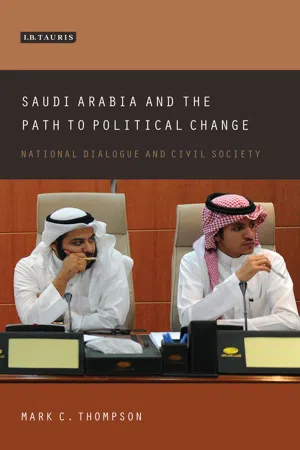
State-society dialogue in Saudi Arabia is one of the most contested issues in the country today, yet little is known about the National Dialogue process, and its relationship with Saudi society is frequently and widely misunderstood. The first to examine the Saudi Arabian National Dialogue process in its entirety, Mark C. Thompson investigates the relationship between the King Abdulaziz Center for National Dialogue (KACND) and the key social constituencies of Saudi society. Since its establishment in 2003, the KACND has attempted to promote a culture of dialogue and has encouraged the debate of contentious socio-political issues by bringing individuals together from across the Kingdom. Drawing on Antonio Gramsci's theory of hegemony, the author asks whether the Saudi socio-political system is moving from a form of patrimonial state to one of ideological hegemony and, if this is the case, whether the KACND is a catalyst, or even a driving force, in this transition.
Saudi Arabia and the Path to Political Change investigates the practices and the impact of the KACND and assesses the extent to which the institution's activities, and the ongoing National Dialogue process, represent a viable attempt to address emerging political concerns in Saudi Arabia. Covering pivotal issues including women's empowerment, public health and employment, the author here explores the extensive impact of the KACND's activities on internal cross-constituency communication and discourse and shows how the process relates to wider regime strategies and to the evolution of the Saudi polity. Based on approximately 120 interviews conducted in Saudi Arabia from 2009 to 2011 and drawing on the evidence of a wide range of focus groups and interviews with National Dialogue participants, KACND officials, government ministers, lawyers and journalists, this book provides a unique insight into the effects and consequences of Saudi National Dialogue, and questions the extent to which wider ideological debate is possible in the Kingdom.
eBook - ePub
Saudi Arabia and the Path to Political Change
National Dialogue and Civil Society
- 400 pages
- English
- ePUB (mobile friendly)
- Available on iOS & Android
eBook - ePub
About this book
Information
CHAPTER 1
THE SAUDI MONARCHICAL STATE
Defining the Saudi State
The current body of Saudi specific literature emphasizes the ‘top-down’ nature of the Saudi political system, indicating that all significant policy decisions emanate from the recognized Al Sa‘ud power circles.1 Scholars are currently debating the extent of Saudi ‘political modernization’ and ‘economic liberalization’,2 with a divergence of opinion on whether a great deal or very little has occurred within the existing formal structures.3 However, Nonneman notes that the nature and extent of debate in Saudi Arabia regarding expanding elections to the majlis al-shura also indicate a changing political culture that may support longer-term political evolution.4 Indeed, it would appear that the challenge is not to describe a perfect process which will almost certainly not take place, but to distinguish these partial steps as ones that are not cosmetic, but ones that may alter the distribution of power and influence the political system.5
Neo-patrimonial states and neo-patriarchal society
Since its inception in 1932, the modern Saudi state has traditionally been studied and interpreted through a prism of concepts such as (neo)-patrimonialism and/or (neo)-patriarchalism. Whilst the use of these concepts facilitates an understanding of the socio-cultural and historical-political nature of the Saudi state, they might not accurately convey more recent developments and transfigurations within the Saudi state power structure. In ‘neo-patrimonial’ states the ruler organizes the government around himself personally, maintaining other members of the elite in a relationship of dependence on his personal grace and good favour. For this reason, the concept of neo-patrimonialism has been used to describe the patron-client network character of Saudi polity, as politics dominates the relationship between the state elites, economics, socio-cultural factors and, more especially, the nature of Islam.6 Most specifically, it is tied to the person of the absolute ruler and to the realm of prerogative and favouritism surrounding him.
A patrimonial state is one that possesses advanced administrative capabilities, but is still, in terms of ethos, tied to the ‘political’ factor in general.7 In the case of Saudi Arabia, the advanced administrative capabilities of the Kingdom include the bureaucratic functions of the state and public institutions, which employ a plethora of civil servants who are closely tied to the individual power structures of the various Al Sa‘ud-run state ministries. Patrimonialism, along with clientelism, has, Chaudhry says,8 often been used to describe the social effects of the domestic deployment of state-controlled rents, but in this respect the term fails to recognize the ability of modern organizational institutions to develop and mature, as has occurred in Saudi Arabia; the Saudi Confederation of Chambers of Commerce, Industry and Agriculture (SCCCIA) being but one example. Notwithstanding, Hertog argues that for the Saudi state to develop, the state needs to cultivate new links to society. Thus, Hertog proposes a combination of different approaches when analyzing the contemporary dynamics of Saudi political economy: an amalgamation of rentier and distributive state theories, in addition to a patron-client analysis and an examination of neo-patrimonialism.9
In a neo-patriarchal society, the individual is still primarily influenced by asabiyya, that is, by tribal tradition and group loyalty, namely family, tribe and/or sect. Thus, by being patriarchal, the discourse of the state aims at subjugation rather than information.10 Although Islam remains the Kingdom’s ruling ideology, tribalism and kinship ties constitute another underlying dimension to the formation of the modern Saudi state. According to Champion, tribal psychology continues to permeate Saudi society, although the author prefers the term ‘neo-tribal’ or ‘familialism’ as they better describe this imprint of asabiyya.11 The Kingdom’s transition from a rural society to a predominantly urbanized one may have modified the manner by which traditions and kinship solidarity are perceived; therefore the question is not whether these traditional bonds have been loosened, but rather whether they have been strengthened in a manner that reflects the contemporary socio-political and socio-cultural environment.
Governing systems
In Saudi Arabia, as Hertog explains, state building has comprised the creation of patron-client relations and the imposition of a ‘large state’ on society.12 Moreover, governing systems, where they can be found, are usually based on tradition, customs and convention, rather than religious principles.13 However, Hamzawy argues that reformers in Saudi Arabia and experts outside the country need to question their negative understanding of traditional politics,14 as despite traditional values remaining prevalent in Saudi society, all aspects of society have been transformed by outside influences. Thus, traditional systems should now be viewed as ‘neo-traditionalist systems’, or post-traditional, as the nature of politics develops according to the socio-political climate in any given period.15 In addition, ‘gradualism’ can be applied when discussing contemporary Saudi politics, as reforming authoritarian polities follow a gradual path and this is an uneven process that entails the creation of new spaces where citizens learn how to assert their rights and absorb the institutionalization of public choice as the governing principle of the state-society relationship.16 Nonetheless it should be stressed that gradualism is not synonymous with political stagnation.17 Hence, it is necessary to identify and to distinguish any newly created spaces occurring in a socio-political environment and to analyze whether or not these processes are altering the distribution of power within the political system or simply constitute empty cosmetic gestures designed to placate the government’s critics. Therefore, do concepts such as patrimonialism accurately reflect the structure of the contemporary Saudi state, and the roles of the dominant Al Sa‘ud government and Saudi society at large? Or is, in fact, a new hegemonic system emerging?
The Al Sa‘ud monarchical institution
Al Rasheed maintains that the dominant narrative of Saudi Arabia has been one of state formation and state transformation.18 Kostiner and Teitlebaum concur, although they emphasize that this statebuilding process is inextricably linked the evolution of the Al Sa‘ud monarchical institution.19 The Al Sa‘ud monarchical institution is often classified as an absolute monarchy, dominated and reliant on the rentier nature of the Saudi economy. Nevertheless, a more appropriate description of the Saudi state is of an oligarchy whose pillars are the extended Al Sa‘ud family and the religious establishment, i.e., the ‘ulama and umara’20 and, therefore, the Kingdom possesses many of the characteristics of a ‘parental state’ whereby the policies of the Al Sa‘ud government attempt to shape and guide Saudi society. Additionally, the role of the Al Sa‘ud is said to manifest itself on three levels—as a ruling institution, as a royal family and as an institution that integrates with the Wahhabi ‘ulama.21 Indeed, Cordesman argues that, contrary to western perceptions, the Al Sa‘ud is not an absolute monarchy in the western sense. More exactly, the Al Sa‘ud adheres to a form of Saudi political tradition based on social consensus and pragmatism rather than ideology,22 and for this reason the role of the Al Sa‘ud closely resembles that of an authoritarian political party operating within a one party state.23 Therefore, although it is axiomatic in some circles to refer to the Saudi government as an absolute monarchy, the Al Sa‘ud monarchy does not operate along the lines of a ‘traditional’ autocratic monarchical institution and, as Gause rightly notes,24 many attempts at assessing the status of the Al Sa‘ud fall into the trap of being too schematic about a more complex and nuanced reality.
A more precise description and function of the Al Sa‘ud government is arguably that of an ‘arch-distributor’,25 in that the function of the government is to monitor ties between the dominant core elites, major patron-client networks and subaltern classes. This transformation from a traditional tribal monarchy into a ruling political institution has resulted in the Al Sa‘ud maintaining complete control over state bureaucracy and state institutions.26 This process of political power consolidation intensified during the reign of King Khalid (1975 – 82), with princes occupying senior ministerial posts, in particular the Al Sudairi brothers, reinforcing their ministerial powerbases.27 As a result, national politics is not played out within the realms of the Al Sa‘ud family per se, but through the national ministries.28 At its most extreme, this system has created a number of institutional, regulative and distributive ‘fiefdoms’, sometimes with overlapping areas of jurisdiction.29 Individual princes have facilitated this process by strengthening personal control over associated political capital; in other words, money, prestige, networks, military and secret service capacities.30 These forms of political clientelism are a product of centuries-old ideas of privilege, and confusion between the national state apparatus and those who are manipulating it.31 In this situation the state may assume more despotic characteristics so that politics is conducted through informal networks. Nonetheless, these informal networks and structures are not usually oriented to the public realm and to national political processes.32
Patronage and corporatism
Patronage and clientelism are practices that integrate the individual vertically into social life on the basis of conformity, of accepting the legitimacy of the status quo and becoming trained to its accepted rules of conduct.33 In Saudi Arabia, the ruling family established a national patron-client relationship with the Saudi populace as a whole, and as the sole recipient of the state’s oil rent, the Al Sa‘ud soon assumed the aura of a ‘super-tribe’ within the state structure. State-sponsored patron-client networks were established within Saudi society with the aim of ‘clientelizing’ the Saudi population en masse, and this manifested itself in the creation of the Saudi social contract.34 Within these processes, two varieties of clientelism emerged: political and administrative. Political clientelism can be categorized as large clienteles, aggregate groups or actors who operate at a systemic level and who influence broader policy issues, whilst administrative clientelism can be defined as a more personal process that often involves micro-political involvement between bureaucrats and businessmen. Thus, clientelism and ‘vertical dependency’ are informal ties through which services and some goods are exchanged between people of unequal status.35
Hertog’s assessment of the Saudi state is that it remains a strongly authoritarian, highly centralized system where societal and functional groups are controlled and arranged by the state.36 In this case, the state can be categorized as comprising the various Al Sa‘ud factions, or power circles, and the constituencies that are linked to each individual power circle through the mechanisms of political clientelism. Together, these circles and constituencies can be referred to as Saudi political society. The role and functions of these policy circles can be illustrated by locating them within a model of three concentric circles of influence:37
• the Principal Circle: this comprises the most powerful and influential members of the ruling Al Sa‘ud;
• the Second Circle: this includes less powerful members of the ruling family, leading members of the religious establishment, plus influential and upwardly mobile academic/bureaucratic technocrats;
• the Third Circle: this amalgamates constituents from all elite groups who wield little power but are nevertheless in a position to influence decision-making.
Hertog argues that ‘corporatism’ offers the best framework to capture this top-down nature of Saudi politics, because the concept illustrates the limiting and orchestrating of state-society participants, the exclusivity of politics and the segmentation of group representation through state actors.38 Corporatism may be understood as a solidaristic social and political ideology, or a type of political government with certain distinct strategies, or as an explanatory and interpretive method of studying state-society relations. Some view corporatism as merely a political sub-system, opposite to pluralism, based on the process of ‘interest intermediation’ via the state. ‘Corporatism’ is not an easy concept to define as it may contain all sorts of shades of meaning, but Ayubi defines corporatism as a particular set of questions pertaining to state-society relations, characterized by an articulation of modes of production and/or by a fluid and overlapping social configuration.39 Ayubi ar...
Table of contents
- Cover
- Author biography
- Title Page
- Copyright Page
- Dedication
- Contents
- Acronyms and Abbreviations
- Introduction
- 1. The Saudi Monarchical State
- 2. The State and Reform: Key State Actors, Non-State Actors and Constituencies
- 3. The Genesis of the King Abdulaziz Center for National Dialogue and National Meetings
- 4. KACND: Dialogue Training Programmes
- 5. KACND and the Dominant Ideology
- 6. The Cultural Discourse Meetings
- 7. KACND and Sectarianism
- 8. KACND: Women’s Center and Issues
- 9. Youth Issues and Societal Frustration
- 10. National Dialogue: Indirect Consequences
- Conclusion: Institutionalized Opinion
- Appendices
- Notes
- Bibliography
Trusted by 375,005 students
Access to over 1.5 million titles for a fair monthly price.
Study more efficiently using our study tools.
Frequently asked questions
Yes, you can cancel anytime from the Subscription tab in your account settings on the Perlego website. Your subscription will stay active until the end of your current billing period. Learn how to cancel your subscription
No, books cannot be downloaded as external files, such as PDFs, for use outside of Perlego. However, you can download books within the Perlego app for offline reading on mobile or tablet. Learn how to download books offline
Perlego offers two plans: Essential and Complete
- Essential is ideal for learners and professionals who enjoy exploring a wide range of subjects. Access the Essential Library with 800,000+ trusted titles and best-sellers across business, personal growth, and the humanities. Includes unlimited reading time and Standard Read Aloud voice.
- Complete: Perfect for advanced learners and researchers needing full, unrestricted access. Unlock 1.5M+ books across hundreds of subjects, including academic and specialized titles. The Complete Plan also includes advanced features like Premium Read Aloud and Research Assistant.
We are an online textbook subscription service, where you can get access to an entire online library for less than the price of a single book per month. With over 1.5 million books across 990+ topics, we’ve got you covered! Learn about our mission
Look out for the read-aloud symbol on your next book to see if you can listen to it. The read-aloud tool reads text aloud for you, highlighting the text as it is being read. You can pause it, speed it up and slow it down. Learn more about Read Aloud
Yes! You can use the Perlego app on both iOS and Android devices to read anytime, anywhere — even offline. Perfect for commutes or when you’re on the go.
Please note we cannot support devices running on iOS 13 and Android 7 or earlier. Learn more about using the app
Please note we cannot support devices running on iOS 13 and Android 7 or earlier. Learn more about using the app
Yes, you can access Saudi Arabia and the Path to Political Change by Mark C. Thompson in PDF and/or ePUB format, as well as other popular books in Politics & International Relations & Middle Eastern History. We have over 1.5 million books available in our catalogue for you to explore.