Fluid stages, morphing theatre spaces, ambulant spectators, and occasionally disappearing performers: these are some of the key ingredients of nomadic theatre. They are also theatre's response to life in the 21st century, which is increasingly marked by the mobility of people, information, technologies and services. While examining how contemporary theatre exposes and queries this mobile turn in society, Liesbeth Groot Nibbelink introduces the concept of nomadic theatre as a vital tool for analyzing how movement and mobility affect and implicate the theatre, how this makes way for local operations and lived spaces, and how physical movements are stepping stones for theorizing mobility at large.
This book focuses on ambulatory performances and performative installations, asking how they stage movement and in turn mobilize the stage. By analyzing the work of leading European artists such as Rimini Protokoll, Dries Verhoeven, Ontroerend Goed, and Signa, Nomadic Theatre demonstrates that mobile performances radically rethink the conditions of the stage and alter our understanding of spectatorship.
Nomadic Theatre instigates connections across disciplinary fields and feeds dramaturgical analysis with insights derived from media theory, urban philosophy, cartography, architecture, and game studies. It illustrates how theatre, as a material form of thought, creatively and critically engages with mobile existence both on the stage and in society.
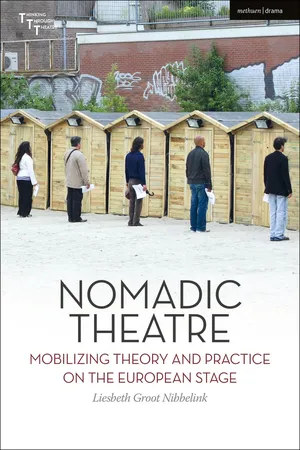
eBook - ePub
Nomadic Theatre
Mobilizing Theory and Practice on the European Stage
- 224 pages
- English
- ePUB (mobile friendly)
- Available on iOS & Android
eBook - ePub
Nomadic Theatre
Mobilizing Theory and Practice on the European Stage
About this book
Information
1
Introduction
Deterritorializing the Stage
Primary Coordinates
In 2005, the German performers’ collective Rimini Protokoll presented Call Cutta, a remarkable example of mobile phone theatre. In this ambulatory performance, a single spectator navigates the streets of Berlin’s Kreuzberg district, guided by a call-center employee in Calcutta, India, who provides directions over the phone. The mobile phone connects the two places of performance, and interactively engages a single performer and a single spectator in a conversation about the local particularities at both ends of the line. Call Cutta is presented as theatre, it surely can be considered as such—as both the performer and the spectator are joined in a situation that is distinctively staged—yet it radically plays with the conventions of theatre. In Call Cutta, spectators have become mobile; they have left their traditional seat in the (darkened) auditorium and instead traverse the city. They are also mobilized out of the larger audience: they are singled out and start and finish the performance one by one. Subsequently, not only the spectators have become mobile; the theatre space is in motion as well. The theatre space loses the architectural coherence usually conferred by physical buildings or clearly designated areas, and, seen from the perspective of the spectator in Berlin, starts to move along with the spectator. Finally, the stage is also in motion. Instead of spectators looking at a stage, one may wonder: where exactly is this stage? The stage seems to be smashed to pieces—split up between a “here,” an “over there,” and a “Hertzian space” in-between.1 In an essay on Call Cutta, theatre scholar and director Heiner Goebbels observes that, actually, one did not see this performance: there were no performers on a stage, no protagonists to identify with; actually there was no one to be seen (2007, 118). This is rather remarkable, given the etymology of the word “theatre”: a place for seeing or viewing (Freshwater 2009, 5). The performer has left the center, Goebbels observes; in fact the center of the stage is empty, which makes room for the spectator as a subject of communication. Rimini Protokoll removes the focus on (the presence of) the actor, without occupying the center with something else—for instance, the ego of the artist—and redirects attention to how the spectator is perceptively engaged with this performance (2007, 123–4). All in all, an ambulatory performance like Call Cutta mobilizes the codes, conventions, and boundaries of the stage, and therefore deterritorializes the stage.
Call Cutta is not the only performance in which this disruption of conventional territories in the theatre can be seen at work. Over the last decade, there seems to have been an increasing number of performances that literally attempt to mobilize the spectator and rethink the conditions of the stage.2 Whether the urban games of Blast Theory or Gob Squad, the video walks by Janet Cardiff and George Bures Miller, promenade performances by Lone Twin, Benjamin Vandewalle or Wrights & Sites, Ligna’s radio ballets, Lundahl & Seitl’s headphone theatre, Christine de Smedt’s social choreographies, or Female Economy’s urban safaris, to name but a few, they all twist the relationships between performers, spectators, and space.3 Spectators traverse the city by bike; they are driven around in wheelchairs or cars, travel by motorbikes or in mini-vans, or drift across labyrinthine performance installations. Performers forsake their usual center-stage position and turn into guides, tour operators, or voices on an audiotape. Theatre spaces are produced in the appointment of temporary and changing coordinates; contrary to the usual conflation with a theatre building, they emerge in and as the process of performance and as temporary situations.
In this book, I examine how ambulatory performances and performative installations stage such movements and in turn mobilize the stage. Through a detailed analysis of theatre performances by leading European artists and companies such as Rimini Protokoll, Dries Verhoeven, Ontroerend Goed, and Signa, this books demonstrates how mobile performances radically rethink the conditions of the stage and alter our understanding of spectatorship. These artists create new and exciting dramaturgical strategies, by playing with the (dis)placement of performers, the mobilization of spectators, and the movements of theatre spaces. This way of theatre-making profoundly impacts our modes of theorizing and analyzing performance. Such work has been studied in terms of participatory, interactive, or immersive theatre (Frieze 2016; Alston 2016; Hill and Paris 2014; Machon 2013; White 2013; Deck and Sieburg 2008), but these terms are not central to my analysis. Nomadic Theatre instead focuses on how we might look at ambulatory performances and performative installations from a process-based perspective, and with a genuine commitment to movement, mobility, and changeability. Mobile theatre performances, on the one hand, play with conventions and solidified forms of theatre, while on the other they self-reflexively point to the very thing theatre is made of, as they continuously reveal the theatre as a live and transitory event. On top of this, that which initially appears as physical movement only, on closer inspection involves theoretical movement as well. Mobile theatre puts our thoughts in motion, inviting us to examine how movement and mobility effect and implicate the theatre, how these forms address and position spectators in performance, how mobility is staged and effects the stage, and why some theatre practitioners prefer these mobile forms of theatre-making.
Both these physical and theoretical movements are examined through a specific, newly invented concept: nomadic theatre. From the outset, I wish to emphasize that I do not use the term to designate a genre. I do not seek to label or categorize a set of performances—this would create a form of arrest that does not do justice to either the process-character of these events, or to the movements that precisely mobilize thought. Instead, I use this concept to deploy a mode of thinking that attempts to be as mobile and flexible as the phenomena it wishes to describe. By exploring the potential of nomadic theatre as an analytical concept, I navigate through a field without demarcating that field. While analyzing performances and their dramaturgical strategies, I traverse a field that refuses to become territory, with three flexible coordinates as my guides: performer, spectator, and space. I follow the movements and temporary occupations of this threefold constellation, which is also a way of thinking through practice and of mobilizing theory.
The term “nomadic theatre” is occasionally used to identify travelling theatre troupes or street theatre events, yet as an analytical concept it does not yet exist. Nomadic theatre is a product of invention and creation, through which I stage an encounter between the theatre and the nomadic, mainly as has been theorized by Gilles Deleuze, partly in collaboration with Félix Guattari. This study explores the potential of nomadic theatre, by putting the concept to work in a milieu of European theatre performances, Deleuze and Guattari’s nomadology, and related insights derived from disciplines as diverse as media theory, urban theory, cartography, architecture, and game theory. Following Deleuze and Guattari’s take on philosophical concepts, concepts themselves are creative, in the sense that they produce events. Events cannot be captured; they can only be neared. Similarly, a quasi-philosophical concept like nomadic theatre, which at some points fundamentally differs from a philosophical concept, can only be approached by a process of bordering and encircling. This is precisely what this introduction does: it borders and circles around the concept of nomadic theatre, in relation to its object, and through these approximations both object and concept grow in force and volume. The introduction is a rather lengthy one, since nomadic theatre cuts across a wide range of domains, debates, and disciplines. Firstly, I connect mobile theatre and performance to larger developments in society and to specific debates in theatre and performance studies—contexts that are relevant to the analysis of dramaturgical strategies later on in this book. Secondly, I provide an introduction to (Deleuzian) nomadology, and to the concept of nomadic theatre. Finally, I describe and reflect on the methodology of concept-based performance analysis and, closely connected to this, briefly elaborate on the topic of spatial dramaturgy. Dispersed through this trajectory are some considerations regarding central choices and arguments made in this book.
On the Move
Life in the twenty-first century is increasingly marked by the mobility of people, information, technologies, goods, and services. We live in a world that seems constantly on the move, which also creates tensions between the global and the local, or between the sedentary and those who (are forced to) move (Hopkins and Solga 2015). In Europe, migration is one of the most decisive and dividing issues on the political agenda of nation states. Contemporary theatre and performance, evolving in close parallel to societal developments, expose and respond to this “mobile turn” in society (Cresswell and Merriman 2011).4 Many European theatre-makers have critically addressed issues as diverse as political or economic migration, border politics and surveillance tactics, fluid citizenship and the globalization of labor, the increasing numbers of refugees and the hardening of asylum procedures, or the significant role that mobile communication technologies play in all this.
In Mobilities (2007), sociologist John Urry argues that during the last decades, the concept of mobility began to move beyond referring purely to physical or vehicular mobility, and now equally involves other mobility systems that deal with the transport and distribution of information, services, money, goods, technologies, and with virtual and imaginary travels. Taking theatre’s capacity to actively mirror and respond to developments in society into account, it is not a surprise that theatre increasingly incorporates such hybrid mobility systems and reflects on how these systems change and impact societal processes and cultural experience. This is also observed by Fiona Wilkie, in Performance, Transport and Mobility: Making Passage (2015a). Whereas Wilkie focuses on states of transit and various types of travel and transport (on foot, by train, or by boat, for instance), I am interested instead in movement, mobility, flexibility, and changeability as recurring tropes in theatre and performance, in parallel to societal developments. Our lifeworld changes rapidly: we are witness to shifting centers of power, both politically and economically; to large-scale environmental crises and climate change; to societies struggling with an increasing heterogeneity of ethnic identities. In response to these shifts and changes, one can observe another “movement,” that is, the rise of nationalism, populism, and post-secularism, and, often connected to this, stringent border politics, the re-entrance of dualistic thinking (us vs. them), and the (over)articulation of difference. These are wide-spread, world-spanning developments, yet they certainly characterize the current political and societal climate in Europe as well. How to cope with such complex issues is a concern of many contemporary theatre artists. The works discussed in this book also relate to these questions, either directly or indirectly. These performances certainly do not attempt to change the world directly, nor do they naively try “to make the world a better place.” Instead they do what theatre is good at, in my view fulfilling a pivotal role in contemporary society: they provide a “thinking arena” or denkpiste, as the Flemish say it so aptly, a space for reflection and engagement. They carve out time to explore, elaborate, and experiment with these issues and, vitally, they create situations in which we can actually engage with and (physically) experience complex and ambiguous phenomena, allowing us to (re)connect with themes and topics that often seem too large to handle.
Theatre, Technology, Mobility
Next to this large-scale societal context, mobile, digital technologies inflect the ways in which theatre is made, composed, and practiced. What is more, the performances discussed in this book are part of a larger development in which digital equipment such as smart phones, tracking devices, GPS-based software, and other locative media fuse with artistic and cultural practice. Mobile media and pervasive computing not only enter the theatre but are equally put to use in urban games, museums, city tours, Layar-based artworks, heritage walks, biomapping, environmental storytelling, architectural apps, or networked (music) performances (Farman 2014, 2012; Verhoeff 2012; Doruff 2009). These examples can all be understood as cultural expressions of a world “on the move” and as practices that profoundly change our concepts of space, time, or reality. These practices work with layered or mixed realities, in which the physical environment is augmented by digital space, or they surpass physical distance by web-based connectivity. Both contemporary theatre and performance then, as well as these twin practices, seem to be invaded by what John Urry terms a “mobilities paradigm,” where space is increasingly charged with temporality and time gets infused with spatiality; where distance is countered by simultaneity, synchronicity, or co-presence, and daily life is increasingly spent in “movement-space” (2007, 44–7).
Remarkably, while these space-time reconfigurations define the spatio-temporal identity of the twenty-first-century world, they equally emerge as the distinctive properties of (mobile) theatre performances. Mobility in performance foregrounds the spatiality of performer–spectator relationships: performers and spectators start to conjoin with scale, gauged between the extremely close, the far distance, and an occasional disappearance. These configurations similarly emphasize the temporality and situationality of theatre spaces. We can see this at work in Call Cutta, but also in No Man’s Land (2008–14), a promenade performance by Dutch director Dries Verhoeven, presented in a range of major European cities, each time slightly adapted to local circumstances. No Man’s Land distributes the spectators over twenty slightly different trajectories; each track exhibits a single spectator following a migrant on a walk through the city. The spectator wears headphones and listens to an audio track that provides a commentary on both the walk and the encounter. Both Call Cutta and No Man’s Land redefine the spatio-temporal conditions of the stage. In Call Cutta, the stage is constituted through co-presence, whereas No Man’s Land operates through simultaneity: the stage is distributed over the urban environment and resurfaces as a series of synchronous trajectories. Both performances reconceptualize the notion of (aesthetic) distance, and challenge the idea that a theatre performance always takes place in a fixed location. They both enquire, each in their own way, into what exactly constitutes the shared space that is so characteristic of theatre—a significant question that becomes dramaturgically active as well (see Chapters 2 and 3).
Not all the cases discussed in this study use mobile or digital technology, but these performances seem equally scripted by digital culture, even if distinctively analogue. They work, for instance, through interactivity, connectivity, changeability, and co-creation, key terms that also define digital and participatory culture (Bay-Cheng et al. 2010; Lister et al. 2009; van den Boomen et al. 2009). This pertains in particular to some of the one-to-one performances I will discuss, performances in which one spectator encounters one performer. Both Ontroerend Goed’s The Smile Off Your Face (2006–present5) and Dries Verhoeven’s Trail Tracking (2005) draw on spectators’ personal memories and sensorial perceptions. They rely on user-generated content and personal customization, which also characterize digital, participatory technology, social media platforms, and other expressions of algorithmic culture. When theatre and performance start using similar formats and strategies, we might understand this as a form of cultural transcoding, referring to situations in which computer-based processes are translated to other realms of cultural experience (Manovich 2001).
One-to-one communication is perhaps hardly noteworthy in relation to city tours or serious games, yet in comparison to the above mentioned twin practices, isolating or singling out the spectator in the theatre is quite a remarkable gesture, as it mobilizes the very notion of audience. The audience, or the public, throughout theatre history has been regarded as representative of the society at large; the audience embodies a community that mirrors a wider (political, democratic) community (Lehmann 2006; cf. Rancière 2009). So what remains of the public when spectators no longer sit next to each other, in a group, but are singled out, and asked to enter or leave the theatre after each other? This question of course not only involves theatre conventions, but further relates the mobility of the spectator to the much larger question of how these theatre performances position relationships between performance and the spectator, and between the theatre and society at large. Taking the mobile spectator as a starting point, then, ultimately leads to questions of theatrical engagement, an issue that is also on Andy Lavender’s agenda, in Performance in the Twenty-First Century: Theatres of Engagement (2016). It is not a coincidence that he discusses similar theatre-makers and companies and, amongst others, the work of Rimini Protokoll, Dries Verhoeven, and Ontroerend Goed, who are well-known in Europe for their critical inquiries and creative strategies for audience engagement. Lavender explicitly chooses a broad-spectrum approach to societal and political engagement, asking what happened in theatre after postmodernism, whereas this book opts for a much more spatially oriented approach to the topic, and above all provides a specific methodology for analyzing mobile forms of theatre-making, and a pathway for thinking through practice.
A Note on Participation
Theatre’s embeddedness in mobile, digital culture and the changing qualities of the stage alter the “modes of spectating” through which spectators engage with performance (Oddey and White 2009). The works discussed here can be qualified as participatory or interactive performances but these are not the terms that I am interested in, however strange this may seem, so a few clarifications are to be made. I agree with some game studies scholars that participation is to be preferred above interactivity. The argument here, to put it (too) boldly, is that interactivity promises a mutual two-way stream of influence, which is hardly ever the case—certainly not in my case studies—and “mutated” forms of interactivity are better seen as a subset of participation.6 I regard the relation between p...
Table of contents
- Cover
- Halftitle Page
- Title Page
- Contents
- List of Figures
- Acknowledgments
- 1. Introduction: Deterritorializing the Stage
- 2. Encounter: Meeting Multiplicity in Dries Verhoeven’s No Man’s Land
- 3. Displacement: The Situated Pathways of Rimini Protokoll
- 4. Cartographies: Trail Tracking and Map-Making as Staging Strategy
- 5. Diagrams: Staging Proximity in Ontroerend Goed’s The Smile Off Your Face
- 6. Architextures: The Rhizomatic Gameboards of Signa’s The Ruby Town Oracle
- 7. Distributed Performance: Epilogue
- Notes
- Bibliography
- Index
- Imprint
Trusted by 375,005 students
Access to over 1.5 million titles for a fair monthly price.
Study more efficiently using our study tools.
Frequently asked questions
Yes, you can cancel anytime from the Subscription tab in your account settings on the Perlego website. Your subscription will stay active until the end of your current billing period. Learn how to cancel your subscription
No, books cannot be downloaded as external files, such as PDFs, for use outside of Perlego. However, you can download books within the Perlego app for offline reading on mobile or tablet. Learn how to download books offline
Perlego offers two plans: Essential and Complete
- Essential is ideal for learners and professionals who enjoy exploring a wide range of subjects. Access the Essential Library with 800,000+ trusted titles and best-sellers across business, personal growth, and the humanities. Includes unlimited reading time and Standard Read Aloud voice.
- Complete: Perfect for advanced learners and researchers needing full, unrestricted access. Unlock 1.5M+ books across hundreds of subjects, including academic and specialized titles. The Complete Plan also includes advanced features like Premium Read Aloud and Research Assistant.
We are an online textbook subscription service, where you can get access to an entire online library for less than the price of a single book per month. With over 1.5 million books across 990+ topics, we’ve got you covered! Learn about our mission
Look out for the read-aloud symbol on your next book to see if you can listen to it. The read-aloud tool reads text aloud for you, highlighting the text as it is being read. You can pause it, speed it up and slow it down. Learn more about Read Aloud
Yes! You can use the Perlego app on both iOS and Android devices to read anytime, anywhere — even offline. Perfect for commutes or when you’re on the go.
Please note we cannot support devices running on iOS 13 and Android 7 or earlier. Learn more about using the app
Please note we cannot support devices running on iOS 13 and Android 7 or earlier. Learn more about using the app
Yes, you can access Nomadic Theatre by Liesbeth Groot Nibbelink, Adrian Kear, Maaike Bleeker, Joe Kelleher, Heike Roms, Adrian Kear,Maaike Bleeker,Joe Kelleher,Heike Roms in PDF and/or ePUB format, as well as other popular books in Media & Performing Arts & Theatre Direction & Production. We have over 1.5 million books available in our catalogue for you to explore.