The Charter of Fundamental Rights of the European Union is the most developed and comprehensive legally binding human rights instrument in the social field of the European Union. It is becoming increasingly important and is the first instrument that includes both civil and political rights on one hand and social rights on the other. Despite this, the Court of Justice of the European Union has only rarely dealt with fundamental social rights. In this context, employment rights need to be examined in this new rights framework. Following on from previous volumes setting out links between European labour law and fundamental social rights (as enshrined in relevant UN, ILO and Council of Europe instruments), in this book the ETUI Transnational Trade Union Rights (TTUR) Expert Network examines the justiciability of social rights and critically analyses the effectiveness of those rights embodied in the EU Charter.
Thus, this book completes the trilogy of ETUI TTUR books on fundamental social rights at European level following the publication, also by Hart Publishing, of The European Convention of Human Rights and the Employment Relation (2013) and The European Social Charter and the Employment Relation (2017).
eBook - ePub
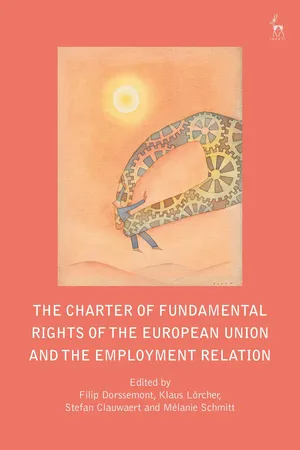
The Charter of Fundamental Rights of the European Union and the Employment Relation
- 712 pages
- English
- ePUB (mobile friendly)
- Available on iOS & Android
eBook - ePub
The Charter of Fundamental Rights of the European Union and the Employment Relation
About this book
Information
1
Introduction
KLAUS LÖRCHER, FILIP DORSSEMONT, STEFAN CLAUWAERT AND MÉLANIE SCHMITT
‘Labour rights are human rights.’ This principle is expressed in the Charter of Fundamental Rights of the European Union (Charter or CFREU), the most developed and comprehensive legally binding human rights instrument – also in the social field – at EU level. In this respect it is – or at least should be – becoming more and more important. It is well known that this instrument is the first to include both civil and political rights, on one hand, and social rights, on the other, after a very long period of separation between the so-called first- and second-generation human rights.
I.CONTEXT
The Court of Justice of the European Union’s (CJEU) jurisprudence on CFREU has been increasing, dealing with a number of articles. However, only rarely has it dealt with fundamental social rights. Given this context, and after nearly a decade since the Charter became legally binding, this makes it all the more relevant to focus now on CFREU employment rights and to explore them in detail.
A first assessment of the CFREU by the European Trade Union Institute (ETUI) Transnational Trade Union Rights network (TTUR)1 took place under the leadership of Brian Bercusson, three years before the Charter became legally binding.2 Several new developments have taken place in the meantime. Without being exhaustive, one might refer in particular to the following:
–the CFREU is now legally binding;
–the (CJEU’s) jurisprudence using or referring to the CFREU is increasing;3
–the reports on the CFREU’s implementation (Commission, Parliament, Fundamental Rights Agency (FRA)) are at least sometimes becoming points of reference;
–the still increasing and sometimes already overwhelming quantity of academic literature (commentaries, articles, analyses and so on);
–the problems related to ‘Better Regulation’, REFIT, Economic Governance, Brexit and so on; and finally,
–the impact of the recently proclaimed European Pillar of Social Rights.
The wider European legal context has already been analysed by the TTUR Group with two main publications putting the employment relation at the heart of human rights standards coming from the Council of Europe:
–The European Convention on Human Rights and the Employment Relation (hereinafter: the ECHR publication);4
–The European Social Charter and the Employment Relation (hereinafter: the ESC publication).5
II.OBJECTIVES
It is against this background that this publication will complete the ‘European human rights trilogy’ concerning the ‘employment relation’.6
In putting this publication together, in principle we envisaged applying the same approach as in the two previously mentioned books:
–providing arguments for the justiciability of social rights;
–making the employment rights in the CFREU more widely known in legal circles;
–being part of a development giving those rights more visibility by contributing to the increasing (legal) debate;
–contributing to strengthen the impact of the social rights also in respect of Europe’s fundamental rights architecture, in particular with regard to the Council of Europe’s instruments (ECHR and ESC), but thereby also taking into account in particular the international dimension (UN and ILO);
–taking account within the framework of the description of the context (including, if appropriate, real problems in the world of work, such as possible data on non-implementation, austerity measures, digitalisation and so on);
–looking at gaps in the explicit guarantee of fundamental social rights that cannot be solved by (progressive) interpretation;
–providing guidance to trade unions, NGOs and others on how to make use of the Charter in order to defend and promote fundamental social rights in the world of work.
In particular, the last four indents could be considered to be the ‘added value’ of this publication.
III.STRUCTURE AND CONTENTS
From an editorial point of view, the general structure of this publication was also envisaged to be in harmony with the ECHR and ESC publications. First, the subject is approached from two angles.
Part I (‘General Part’) is aimed at dealing with all relevant transversal questions. This includes the description and analysis of the general framework of the Charter in the following introductory chapters:
–the CFREU and its specific role of protecting fundamental social rights (including Articles 2, 3 and 6 TEU);
–the CFREU in the future of Europe (dealing with problems and challenges coming from, inter alia, ‘Better Regulation’, REFIT, European Pillar of Social Rights and Brexit);
–the EU’s Social Constitution in relation to the ‘Economic Constitution’.
Before starting with the comments on the specific rights guaranteed by the Charter, the general concept of the ‘employment relation’, as well as the impact of the ‘horizontal’ provisions in Title VII (Articles 51–53) are also addressed. With regard to the latter, it appeared useful to separate their respective contents by theme, not by the order of the Articles concerned. Accordingly, three chapters address the following:
–the concept of the ‘Employment Relation’ (containing, as transversal substantive issues, in particular the definition of ‘workers’ and ‘employers’);
–the ‘Field of Application and Limitations’ (Articles 51 and 52(1)). This core issue pays specific attention to the addressees of the Charter – on one hand, the EU, and on the other hand, the Member States implementing EU law – and addresses the general framework for assessing the conformity of limitations on the Charter’s rights;
–‘Interpretation and Minimum Level of Protection’ deals in particular with the Preamble, as well as with Articles 52(2) to (7) and 53.
Finally, and also in line with the ECHR and ESC publications, a specific chapter on procedure before the EU courts (mainly Articles 263(4) and 267 TFEU) also reflects on possible litigation strategies for trade unions.
Part II (‘Specific articles’) provides legal analyses of the individual articles addressing issues of the employment relation. Here, a (difficult) choice had to be made concerning which articles should be commented on. Of course, those Articles that appear to be of particular importance are analysed: Articles 1, 5, 7, 8, 10, 11, 12, 15, 16, 17(2), 20, 21, 23, 27, 28, 30, 31, 32, 33 and 47. Conversely, Articles that have only a certain link to the employment relation, but which are considered to be of minor importance are not commented on separately, but possibly referred to in the comments on other Articles (eg Article 17(1) in the chapter on Article 16, Article 26 in the chapter on Article 21 and Article 29 in the chapter on Article 15).
In order to provide readers with a transparent structure of the commentaries in Part II (Specific Articles) it is oriented towards the following guidelines:
I.Introduction
A.Context and main contents
B.Relationship to other provisions of the Charter
C.Relationship to other relevant instruments
i.EU instruments
ii.Council of Europe instruments
iii.ILO instruments
iv.UN instruments
v.Other instruments (if appropriate)
II.Contents
A.General observations
B.Field of application
C.Specific rights
D.Limitations
E.Enforcement
III.Conclusions
In order to show, as much as possible, the material scope of the provisions, the focus of the commentaries will be on ‘Specific rights’ (II.C). Thus, readers might find more easily what might be most relevant in the context of the ‘employment relation’. However, the material scope has to be distinguished from the ‘Field of application’ (Article 51(1)), which defines the ‘door opener’ for the application of the Charter in relation to Member States, t...
Table of contents
- Cover
- Dedication
- Title Page
- Preface
- Table of Contents
- List of Contributors
- Abbreviations
- 1. Introduction
- PART I GENERAL PART
- PART II SPECIFIC ARTICLES
- Bibliography
- Index
- Copyright Page
Trusted by 375,005 students
Access to over 1.5 million titles for a fair monthly price.
Study more efficiently using our study tools.
Frequently asked questions
Yes, you can cancel anytime from the Subscription tab in your account settings on the Perlego website. Your subscription will stay active until the end of your current billing period. Learn how to cancel your subscription
No, books cannot be downloaded as external files, such as PDFs, for use outside of Perlego. However, you can download books within the Perlego app for offline reading on mobile or tablet. Learn how to download books offline
Perlego offers two plans: Essential and Complete
- Essential is ideal for learners and professionals who enjoy exploring a wide range of subjects. Access the Essential Library with 800,000+ trusted titles and best-sellers across business, personal growth, and the humanities. Includes unlimited reading time and Standard Read Aloud voice.
- Complete: Perfect for advanced learners and researchers needing full, unrestricted access. Unlock 1.5M+ books across hundreds of subjects, including academic and specialized titles. The Complete Plan also includes advanced features like Premium Read Aloud and Research Assistant.
We are an online textbook subscription service, where you can get access to an entire online library for less than the price of a single book per month. With over 1.5 million books across 990+ topics, we’ve got you covered! Learn about our mission
Look out for the read-aloud symbol on your next book to see if you can listen to it. The read-aloud tool reads text aloud for you, highlighting the text as it is being read. You can pause it, speed it up and slow it down. Learn more about Read Aloud
Yes! You can use the Perlego app on both iOS and Android devices to read anytime, anywhere — even offline. Perfect for commutes or when you’re on the go.
Please note we cannot support devices running on iOS 13 and Android 7 or earlier. Learn more about using the app
Please note we cannot support devices running on iOS 13 and Android 7 or earlier. Learn more about using the app
Yes, you can access The Charter of Fundamental Rights of the European Union and the Employment Relation by Filip Dorssemont,Klaus Lörcher,Stefan Clauwaert,Mélanie Schmitt in PDF and/or ePUB format, as well as other popular books in Law & Labour & Employment Law. We have over 1.5 million books available in our catalogue for you to explore.