Jeffrey Goldsworthy is a renowned constitutional scholar and legal theorist whose work on the powers of Parliament and the interpretation of constitutional and statute laws has helped shape debates on these topics across the English-speaking world. The importance of democratic constitutionalism is central to Professor Goldsworthy's work: it lies at the heart of his defence of Parliamentary supremacy and shapes his approach to both constitutional and statutory interpretation. In honour of Professor Goldsworthy's retirement, this collection provides new perspectives from a range of leading public law scholars and theorists on the legal and philosophical principles that govern the making and interpretation of laws in a constitutional democracy. It also addresses some of the challenges to democratic constitutionalism that have arisen in light of contemporary developments in Australia, Canada, New Zealand, the United Kingdom and the United States.
eBook - ePub
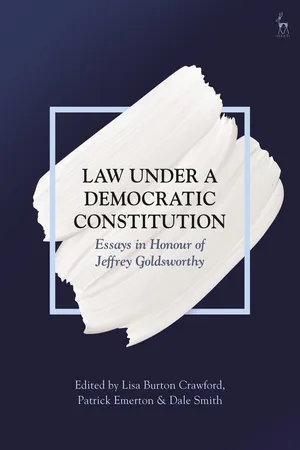
Law Under a Democratic Constitution
Essays in Honour of Jeffrey Goldsworthy
- 336 pages
- English
- ePUB (mobile friendly)
- Available on iOS & Android
eBook - ePub
Law Under a Democratic Constitution
Essays in Honour of Jeffrey Goldsworthy
About this book
Information
1
Introduction
This collection is published to mark the retirement of now Emeritus Professor Jeffrey Goldsworthy – one of the most distinguished constitutional theorists and legal philosophers that Australia has produced. Jeff’s work traverses constitutional and administrative law doctrine, constitutional and statutory interpretation and legal philosophy, drawing insights from each field in order to illuminate the others. Few scholars could lay claim to such breadth and depth of expertise.
Jeff’s contribution to legal scholarship is not easily captured in a small number of themes. Nevertheless, the title of this collection – Law Under a Democratic Constitution – was chosen to encapsulate one theme which we suggest is integral to Jeff’s work. That is a deep commitment to what Jeff has described as the:
democratic ideal of government by ordinary people, elected to represent the opinions and interests of ordinary people. According to this ideal, ordinary people have a right to participate on equal terms in the political decision-making that affects their lives as much as anyone else’s, and should be presumed to possess the intelligence, knowledge and virtue needed to do so. Proponents of this ideal do not naively believe that such a method of government will never violate the rights of individuals or minority groups. But they do trust that, in appropriate political, social and cultural conditions, clear injustices will be relatively rare, and that in most cases, whether or not the law violates someone’s rights will be open to reasonable disagreement. They also trust that over time, the proportion of clear rights violations will diminish, and ‘that a people, in acting autonomously, will learn how to act rightly’.1
This commitment to democratic rule is central to Jeff’s view that it is Parliament, not the courts, which should be chiefly responsible for resolving contentious political issues, including those concerning rights. It is also central to his accounts of both constitutional and statutory interpretation. Those accounts emphasise the centrality to the interpretive process of publicly available evidence of ‘speaker’s meaning’ (very roughly, the meaning the lawmaker intended to communicate by enacting the legal text). They also emphasise the obligation on judges, typically, to give effect to that (publicly accessible) meaning, rather than giving effect to their own views about what law should have been made.
These ideas have not always proven to be fashionable. As Jeff has observed:
The once popular idea of legislative sovereignty has been in decline throughout the world for some time. … A dwindling number of political and constitutional theorists continue to resist the ‘rights revolution’ that is sweeping the globe, by refusing to accept that judicial enforcement of a constitutionally entrenched Bill of Rights is necessarily desirable. To be one of them can feel like King Cnut trying to hold back the tide.2
But while he may have sometimes felt as if the tide were against him, Jeff never retreated from the fearless style of commentary which he perceived to be the defining role of a legal scholar. His philosophical commitments went hand in hand with commitments to intellectual integrity, and the rigorous and transparent analysis of the law. As the contributors to this volume observe, his work is ‘measured’,3 ‘careful’4 and ‘nuanced’;5 it is always meticulously researched and reasoned, and never hyperbolic.
It has also proven, over time, to be hugely influential. Jeff’s writings on parliamentary sovereignty are widely regarded as seminal, particularly in the United Kingdom where it is now nearly mandatory to cite Jeff’s work in any serious academic discussion of this topic.6 His opposition to constitutionally entrenched bills of rights has also been influential across the common law world.7 His ‘pioneering’ work on constitutional interpretation – and his particular account of how that should be done, which he calls ‘moderate originalism’ – is now recognised as having anticipated many of the more recent developments in originalist thought in the United States.8 And, in recent years, Jeff has been an outspoken critic of sceptical approaches to the role of legislative intent in statutory interpretation, arguing for the indispensability of legislative intent as the central organising principle in the interpretive process.9 His work on this topic has helped shape the views of current and former judges in the High Court of Australia, giving succour to those who are inclined to take the notion of legislative intent seriously,10 and providing food for thought to some of those tempted by scepticism about legislative intent.11
This book is intended not only as a tribute to Jeff, but also to advance these important debates. The first three chapters – by Larry Alexander, Dale Smith, Patrick Emerton and Lisa Burton Crawford – examine the role of legislative intention in legal interpretation, an increasingly contentious topic. The chapters that follow – by Larry Solum, Nicholas Aroney, Heidi Hurd and Kevin Toh – suggest new ways of understanding Jeff’s case for moderate originalism and, in some cases, new ways of resisting that argument. The final group of chapters – by Alison Young, Richard Kay, Richard Ekins and TRS Allan – discuss parliamentary sovereignty and some of the contemporary challenges it faces. We thank the authors for their valuable contributions. Jeff provides a response to each in chapter 13.
We also thank the authors and a larger group of academics for participating in the workshop commemorating Jeff’s retirement, which was held at Monash University in July 2017. This workshop was generously supported by the Australian Research Council, the Centre for Comparative Constitutional Studies at the Melbourne Law School and the Monash University Faculty of Law. We give special thanks to Farrah Ahmed, Jonathan Crowe, Julie Debeljak, Rosalind Dixon, Dan Meagher, Michael Moore, Scott Stephenson, Adrienne Stone and Lulu Weis for attending this workshop and providing detailed and insightful commentary on the papers that now form this volume. We also thank Grant Huscroft for taking part in this workshop. We are grateful to Roger Wu, Cate Read and Lachlan Peake for their assistance in copy-editing this volume, and to the Melbourne Law School Academic Research Service for its support. Finally, we thank the Australian Research Council for supporting this project under its Discovery Projects funding scheme (project number DP140102670) and Hart Publishing for the opportunity to publish this collection.
In conclusion, we suggest that one of the keenest insights into Jeff’s career can be found in a footnote accompanying the above-quoted passage, in which Jeff defends the democratic ideal of government by ordinary people. In it, Jeff writes:
I hope the term ‘ordinary people’ does not seem patronising. I cannot think of an alternative, and I regard myself as an ‘ordinary person’.12
This statement speaks not only to Jeff’s philosophical commitments, but also to his character. While he may describe himself as an ‘ordinary person’, Jeff is a true giant in his field. And yet, all those who have had the privilege of working with Jeff will tell a similar tale: that he is an exceptionally warm, generous and unpretentious person, who treats everyone he encounters with the same great kindness and respect. We have had the good fortune of working closely with Jeff for many years. He has been a doctoral supervisor to two of us, and a colleague and mentor to us all. We thank him for his guidance and support, and especially his friendship.
We hope that this collection makes a fitting tribute to this extraordinary scholar.
Lisa Burton Crawford, Patrick Emerton and Dale Smith
1J Goldsworthy, Parliamentary Sovereignty: Contemporary Debates (Cambridge University Press, 2010) 9–10 (footnotes omitted). The internal quote is from R Dahl, Democracy and Its Critics (Yale University Press, 1989) 192.
2Goldsworthy (n 1) 9.
3Richard Ekins, ‘Models of (and Myths about) Rights Protection’ in chapter 11 of this volume.
4TRS Allan, ‘Political Obligation and Public Law’ in chapter 12 of this volume.
5Heidi M Hurd, ‘The Moral Motivations for Moderate Originalism’ in chapter 7 of this volume.
6Alison L Young, ‘Populism and Parliamentary Sovereignty: The Goldsworthy Solution’ in chapter 9 of this volume; Richard S Kay, ‘Democracy, Mixed Government and Judicial Review’ in chapter 10 of this volume.
7Ekins (n 3).
8Lawrence B Solum, ‘Goldsworthy on the Normative Justification for Originalism’ in chapter 5 of this volume.
9Patrick Emerton and Lisa Burton Crawford, ‘Statutory Meaning without Parliamentary Intention: Defending the High Court’s “Alternative Approach” to Statutory Interpretation’ in chapter 4 of this volume.
10See, eg, S Gageler, ‘Legislative Intent’ (2015) 41 Monash University Law Review 1, 10–11.
11See, eg, R French, ‘The Courts and the Parliament’ (2013) 87 Australian Law Journal 820, 825–26.
12Goldsworthy (n 1) 9.
2
Goldsworthy on Interpretation of Statutes and Constitutions: Public Meaning, Intended Meaning and the Bogey of Aggregation
LARRY ALEXANDER
I.Introduction
Jeffrey Goldsworthy has had a long and distinguished scholarly career. Much of his scholarship has been focused on legal interpretation. And it is that aspect of his scholarship that will be my focus here; for it is with respect to legal interpretation that Goldsworthy’s views and mine intersect.
Rather than try to distill Goldsworthy’s views from the many articles and book chapters in which they appear going back decades, I am going to examine their most recent iteration – a book chapter in which Goldsworthy contrasts his views on legal interpretation with my own. In doing so, I will try to demonstrate two points: (1) the superiority of my views as a theoretical matter; and (2) the irrelevancy of the differences between our views as a practical matter.
Before discussing Goldsworthy’s views, however, I think it would be useful to give a summary of my views point by point, so that I can identify the precise point or points on which Goldsworthy and I part company.
II.Alexander on Interpretation in General and on Legal Interpretation in Particular1
A.On the Nature of Texts
1. A text, as I shall be using the term, is a set of symbols – of any kind – that is meant by its producer – the author(s) – to communicate a message to the intended audience. The symbols used can be marks, sounds, dots and dashes, smoke, flags, pictures – indeed, anything can be used as symbols capable of conveying messages. And although we are usually interested in the actual authors of a text, texts produced by one author can be appropriated by another author to convey the same or a different message. And one can meaningfully ask what message a text would convey if it had been produced, not by its actual author, but by some different author.
2. If there is no author – no person who produced the marks, sounds, etc in order to convey a message – then we do not have a text. The marks, sounds, etc may be a sign of something, much as smoke is a sign of fire, or geese flying south are a sign that winter is coming. Marks that might look like symbols, when we understand they are not – think of cloud formations that resemble the letters C-A-T – render certain questions nonsensical that would make sense were there an author. (Consider: Are the clouds speaking English or French? Are they referring to all felines or only to tabby cats?) Even when there is an author and a text, the text may be a sign of something other than the message conveyed. For example, the text may be a sign that the author has poor handwriting or can use word processing. Or its message may be a sign that the author was angry, or agitated, or in love.
3. Texts are individuated by the messages that their authors are intending to convey thereby. That is why the text of the US Constitution in Spanish can be the same as its text in English, or why its text in one font can be the same as its text in a different font. Even though those tokens of the text differ from one another, they are tokens of the same text if the message they convey is the same.
4. When our interest is in the actual authors of a text and the message that they intended to convey thereby, we are acting as ‘originalists’. If we are unsure of the meaning of some word in the text, then, given that our inte...
Table of contents
- Cover
- Title Page
- Table of Contents
- List of Contributors
- 1. Introduction
- 2. Goldsworthy on Interpretation of Statutes and Constitutions: Public Meaning, Intended Meaning and the Bogey of Aggregation
- 3. What is Statutory Purpose?
- 4. Statutory Meaning without Parliamentary Intention: Defending the High Court’s ‘Alternative Approach’ to Statutory Interpretation
- 5. Goldsworthy on the Normative Justification for Originalism
- 6. Originalism and Explanatory Power: Text, Structure and the Interpretation of Constitutions
- 7. The Moral Motivations for Moderate Originalism
- 8. Authenticity, Ontology and Natural History: Some Reflections on Musical and Legal Interpretations
- 9. Populism and Parliamentary Sovereignty: The Goldsworthy Solution
- 10. Democracy, Mixed Government and Judicial Review
- 11. Models of (and Myths about) Rights Protection
- 12. Political Obligation and Public Law
- 13. Response to Contributors
- List of Professor Jeffrey Goldsworthy’s Publications
- Index
- Copyright Page
Trusted by 375,005 students
Access to over 1.5 million titles for a fair monthly price.
Study more efficiently using our study tools.
Frequently asked questions
Yes, you can cancel anytime from the Subscription tab in your account settings on the Perlego website. Your subscription will stay active until the end of your current billing period. Learn how to cancel your subscription
No, books cannot be downloaded as external files, such as PDFs, for use outside of Perlego. However, you can download books within the Perlego app for offline reading on mobile or tablet. Learn how to download books offline
Perlego offers two plans: Essential and Complete
- Essential is ideal for learners and professionals who enjoy exploring a wide range of subjects. Access the Essential Library with 800,000+ trusted titles and best-sellers across business, personal growth, and the humanities. Includes unlimited reading time and Standard Read Aloud voice.
- Complete: Perfect for advanced learners and researchers needing full, unrestricted access. Unlock 1.5M+ books across hundreds of subjects, including academic and specialized titles. The Complete Plan also includes advanced features like Premium Read Aloud and Research Assistant.
We are an online textbook subscription service, where you can get access to an entire online library for less than the price of a single book per month. With over 1.5 million books across 990+ topics, we’ve got you covered! Learn about our mission
Look out for the read-aloud symbol on your next book to see if you can listen to it. The read-aloud tool reads text aloud for you, highlighting the text as it is being read. You can pause it, speed it up and slow it down. Learn more about Read Aloud
Yes! You can use the Perlego app on both iOS and Android devices to read anytime, anywhere — even offline. Perfect for commutes or when you’re on the go.
Please note we cannot support devices running on iOS 13 and Android 7 or earlier. Learn more about using the app
Please note we cannot support devices running on iOS 13 and Android 7 or earlier. Learn more about using the app
Yes, you can access Law Under a Democratic Constitution by Lisa Burton Crawford, Patrick Emerton, Dale Smith, Lisa Burton Crawford,Patrick Emerton,Dale Smith in PDF and/or ePUB format, as well as other popular books in Law & Comparative Law. We have over 1.5 million books available in our catalogue for you to explore.