- 240 pages
- English
- ePUB (mobile friendly)
- Available on iOS & Android
eBook - ePub
About this book
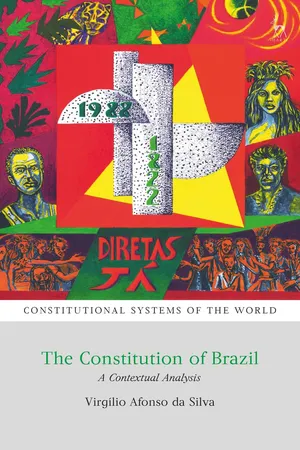
This book offers an original and comprehensive analysis of Brazilian constitutional law and shows how the 1988 Constitution has been a cornerstone in Brazil's struggle to achieve institutional stability and promote the enforcement of fundamental rights. In the realm of rights, although much has been done to decrease the gap between constitutional text and constitutional practice, several types of inequalities still affect and sometimes impair the enforcement of the ambitious bill of rights laid down by the Brazilian Constitution. Within the organisation of powers, the book not only describes how its legislative, executive and judicial functions are organised, but above all else, it analyses how a politically fragmented National Congress, a powerful President and an activist Supreme Court engage with each other in ways that one could hardly grasp by reading the constitutional text without contextual analysis. Similarly, the book also shows how the three-tiered federation established in 1988 has undergone a process of centralisation led not only by the central government but also by the Brazilian Supreme Court. In addition to chapters on organisation of powers, fundamental rights, federalism, and the legislative process, the book also presents an overview of Brazilian constitutionalism with a special focus on the transition from authoritarianism to democracy, which led to the enactment of the 1988 Constitution. In the conclusion, the author argues that part of the Constitution's transformative potential remains to be realised. Enforcing the Constitution, not changing it, has been the real challenge in the last three decades and will continue to be for many years to come.
Information
1
A Long and Winding Road to the 1988 Constitution
Political Organisation from 1500 until 1822 – Brazilian Constitutions before 1988 – Constitution-Making Process – Legitimacy of the 1988 Constitution
Brazil has been an independent country since 1822. This means that politically, institutionally and constitutionally speaking, the history of Brazil as a sovereign state began in that year. The Portuguese arrived three centuries before, in 1500. Before their arrival, the Brazilian territory was populated by several indigenous ethnic groups, especially the Tupi, who lived primarily along the coast and spoke one of the Tupi-Guarani languages. A second, less homogeneous group lived mainly in the interior and spoke one of the Macro-Je languages.1
It remains unclear how many indigenous groups and in general how many inhabitants lived in the current Brazilian territory when the Portuguese arrived. Until quite recently, many still assumed that the scenario before 1500 had simply been of a virgin and almost empty land, with a few indigenous groups scattered in small clusters in an immense area. Still according to this view, the aboriginal peoples would have been hunter-gatherers, who lived in small groups displaying virtually no social and political organisation. The contrast with the Inca Empire – in the Andean region today occupied by countries such as Ecuador, Peru and Chile, which had a population of millions of inhabitants and displayed a complex social, political and economic organisation – has always cast the study of the organisation of the indigenous peoples of other regions of South America in a shadow. The oversimplified view according to which, especially if compared to the case of the Inca Empire, in the current Brazilian territory there had been only primitive tribes, organised exclusively on the basis to kinship relations, without any social and political differentiation, had prevailed for quite some time.
It is currently well known that the social, cultural and political landscape in the Brazilian territory before the arrival of the Portuguese was much more complex than what had usually been assumed. Although there is still much to learn about that period, it is nevertheless well established that there were far more indigenous peoples and that there was more contact among them than was supposed until recently, and that in some cases there was social stratification and political complexity.2
Although some indigenous civilisations probably achieved their zenith well before the arrival of the Portuguese, there is no doubt that the event that marked (negative and definitely) these civilisations was the arrival of the Portuguese and the colonisation process. Within a very short period of time, a considerable part of the indigenous population was decimated, especially due to the contact with previously unknown diseases. The Portuguese military conquests and the slavery of many natives have only completed this tragic destiny.
In the centuries that followed the arrival of the Portuguese – and, it could be argued, until the end of the twentieth century – the rights of indigenous groups to their land, culture, political and social organisation had been to a greater or lesser extent violated, ignored or, at best, tolerated insofar as they were compatible with the law of the settlers or, after Brazil’s independence, with Brazil’s official constitutional and legal system. Until recently, Brazilian legislation in this realm aimed – sometimes explicitly, sometimes implicitly – at integrating indigenous peoples into what has always been called (both in constitutional texts and in ordinary legislation) the ‘national communion’. It is not a coincidence that constitutional texts and ordinary legislation have always referred to indigenous persons by the term silvícolas, that is, ‘those who live in the jungle’ or simply ‘wild’. Real changes occurred only with the promulgation of the 1988 Constitution.
I.AN OVERVIEW OF BRAZILIAN POLITICAL ORGANISATION FROM 1500 UNTIL 1822
The period ranging from the arrival of the Portuguese, in 1500, until the declaration of independence of Brazil, in 1822, may be roughly divided into three periods: (1) pre-colonial, from 1500 to 1530; (2) colonial, from 1530 until 1808; and (3) post-colonial, from 1808 to 1822.3
A.Pre-Colonial Period
In 1494, Portugal and Spain divided the world outside Europe into two. The Treaty of Tordesillas established a meridian 370 leagues west of the Cape Verde Island. According to the treaty, the lands to the east of this meridian belonged to Portugal and those to the west, to Spain. It is unclear what Portugal and Spain knew exactly about the lands divided by the Treaty of Tordesillas, especially about the eastern part of current South America. The fact is that the only relevant amount of land crossed by the meridian defined by the treaty is the current Brazilian territory. Thus, in 1500 only the eastern part of the current territory of Brazil belonged to Portugal. Until 1530, although there had been some Portuguese expeditions, there had not been systematic exploration of the new territory. The only relevant regular activity in this period was the extraction of the highly prized Brazilwood (the tree that eventually gave its name to the country).
Even though Portugal’s main rival in the overseas exploration was Spain, the decision of King João III to colonise the new territory was a reaction against the threat posed by the French incursions in the new territory. As a matter of fact, France did not recognise the Treaty of Tordesillas and assumed the uti possidetis principle, according to which ‘whoever effectively occupied an area owned it’.4
B.Colonial Period
The long colonial period can be divided into several different periods. From a political and institutional point of view, the most relevant subdivision is that based on the different forms of administration during these almost three centuries. In the beginning, Portugal decided to occupy and govern Brazil by means of the so-called hereditary captaincies, which had already been used in the Madeira Islands. Portions of land were granted to private persons, the Captain Generals, who were responsible for exploring and protecting the new land.
In 1548, Portugal decided to establish a new administrative system, the Governorate General. Although the captaincies had been maintained, the colony was unified under the administration of the Governor General. The extreme decentralisation of the captaincies was abandoned in favour of a centralised administrative system. The city of Salvador was the capital of the colony.
In 1580, a crisis in the succession of King Sebastião of Portugal was the pretext for Spain to unify both crowns. During the Iberian Union, the administration of Brazil was again slightly decentralised. The Governorate General ceased to exist for the whole country and the territory was divided into two: the state of Brazil in the south and the state of Maranhão in the north. After several changes in the administrative configuration of these states in the second half of the seventeenth and first half of the eighteenth century, in 1774, they were merged again into the Viceroyalty of Brazil, with Rio de Janeiro as its capital.5 This status was maintained until 1808.
C.A European Court in the Tropics
In 1807, the Napoleonic army invaded the Iberian Peninsula and in December of that year invaded Portugal. This event radically changed the history of Brazil. The prince regent of Portugal, João VI, decided to transfer the Portuguese court to Brazil.6 For the first (and supposedly only) time in history, a European court transferred its seat to another continent. The capital of the Kingdom of Portugal was no longer Lisbon, but Rio de Janeiro.
The transfer of the court to Rio de Janeiro immediately and radically changed Brazilian history.7 The colonial status could not be maintained any longer: first, because the Portuguese court now lived in Brazil, and secondly, because the British military protection was immediately ‘paid’ as soon as João VI arrived in Brazil: even before he arrived in Rio de Janeiro, he signed a decree opening the Brazilian ports to the ‘friendly nations’, that is, to Britain. If the colonial status was based on the so-called ‘colonial exclusivity’, that is, Brazil could only trade with Portugal, then opening the ports to Britain, which meant allowing direct commercial relations between Brazil and Britain, undermined, at once, the colonial status of Brazil.
Additionally, after the Portuguese court settled in Rio de Janeiro, several economic, educational and cultural activities that had been hitherto forbidden were eventually allowed. A Brazilian bank was founded, medical schools were created, newspapers and books were now printed in Brazil, among several other measures. In a few years, the economic, commercial, financial and cultural landscape in Brazil was radically changed.
In 1815, after Napoleon’s defeat, João VI could have returned to Portugal. But he chose not to do so. He remained in Brazil and even changed the status of the relationship between Portugal in Brazil, now united within the United Kingdom of Portugal, Brazil and The Algarves. The old captaincies were converted into provinces of the new united kingdom, with Rio de Janeiro as its capital.
It can be argued that the territorial unity of Brazil, definitely consolidated only many years after independence, was considerably strengthened when João VI was in Brazil. On the other hand, however, the long absence of the king and the court, the economic and above all commercial crisis caused by the end of the colonial pact as well as the commercial privileges granted to Britain created the ideal atmosphere for a political revolution in Portugal. In 1820, the so-called Porto Liberal Revolution erupted, aiming above all at substituting a liberal constitutional monarchy for the ancien régime.
The election of a constituent assembly (called ‘Cortes’) and the ultimatum for the immediate return of the king and the court to Portugal were strong enough to convince King João VI to return to Portugal. Before returning, however, he issued a decree investing his heir son, Pedro, with the title of ‘Regent of the Kingdom of Brazil’.
A very common interpretation of the objectives of the Lisbon Cortes was that it was part of a plan to recolonise Brazil. However, there is no evidence that there has ever been any such plan. As Barman puts it, ‘[a]t the worst, the deputies can be accused of setting the wrong priorities, of being blind to the realities of the situation, and so of taking for granted the unity of the Portuguese world’.8 The lack of political tact of the Cortes therefore premeditated a separatist movement that was not inevitable.
In January 1822, Pedro decided to stay in Brazil and a few months later, in June, summoned a constituent assembly. The path to the independence of Brazil seemed to be definitely paved. On 7 September 1822, after having been informed that Portugal had revoked all his acts as prince regent, Pedro declared the independence of Brazil.9 On 1 December 1822, he was crowned the emperor of Brazil: Dom Pedro I.10
The official historiography has usually presented the process of independence of Brazil as peaceful and without almost any kind of resistance. This version of history played an important political role in building national identity and unity. However, especially in the Northern provinces, the independence process was far more contentious than it has usually been presented, especially because many of these provinces did not recognise the legitimacy of the Rio de Janeiro government. That is, there was a resistance to the independence that was not necessarily linked to Portuguese interests, but to Brazilian local peculiarities and interests.
II.BRAZILIAN CONSTITUTIONS BEFORE 1988
Brazil had seven constitutions before the enactment of the 1988 Constitution. In the sections below, the main features of these constitutions as well as the contexts in which they were drafted will be presented. These sections offer only a simplified overview, and do not aim at presenting in detail the complex web of constitutional, institutional and social issues that led to a given constitutional design or to a constitutional breakdown. Thus, it is not a constitutional history of Brazil. Still, hints of these constitutional, institutional, and social issues may be found in other chapters of this book.11
A.Brazilian Empire: The 1824 Constitution
As mentioned above, the prince regent and future emperor had summoned a constituent assembly in June 1822, even before the independence of Brazil. This assembly, however, began its work only in May 1823, and it did not last long. Soon the disagreements between the emperor and the members of the assembly – especially concerning the relationship between the legislative and the executive branches – became unbearable. The emperor wanted more control over the legislature than the members of the assembly were willing to grant. In November 1823, the emperor dissolved the Constituent Assembly, promising to summon a new one and to offer a constitution draft that would be ‘twice as liberal’ as the project that was being drafted by the assemblymen.12 But he did none of these. In 25 March 1824, the ‘Political Constitution of the Empire of Brazil’ – this was its official name – was granted by the emperor himself.
Even though the 1824 Constitution formally complied with the major principles of the liberal constitutionalism of the early nineteenth century, especially the separation of powers and the guarantee of fundamental rights, it would be a mistake to consider the Brazilian constitutionalism under the 1824 Constitution a liberal one, at least for two reasons.
First, the separation of powers laid down by the Constitution was a very particular one: a quadripartite separation, supposedly inspired by the work of Benjamin Constant.13 But Constant argued that the royal power should be a ‘neutral power’, separated from the other three branches and responsible for keeping the harmony among them.14 But under the 1824 Constitution the emperor held both the neutral power – called ‘moderating power’ – and the executive power. This conflation mitigated the separation of powers under the imperial constitution.15
A second relevant illiberal character of the constitutional reality of the nineteenth century Brazil is related to the guarantee of fundamental rights. As Viotti da Costa argued: ‘The Brazilian constitution stressed ...
Table of contents
- Cover
- Dedication
- Title Page
- Acknowledgements
- Table of Contents
- List of Abbreviations
- Table of Cases
- Table of Legislation
- Introduction
- 1. A Long and Winding Road to the 1988 Constitution
- 2. The Legislature: Bicameralism, Multipartism, and Ongoing Crisis
- 3. The Executive: A Strong President and Coalitional Presidentialism
- 4. The Judiciary: Independence, Activism, and Publicity
- 5. Rights: Enforcing Civil Liberties in an Unequal Society
- 6. Beyond Liberal Constitutionalism: Social Rights and the Social and Economic Orders
- 7. Federalism: Cooperation and Increasing Centralisation
- 8. Law-Making Process and Constitutional Reform
- Conclusion: Change to Overcome
- Index
- Copyright Page
Trusted by 375,005 students
Access to over 1.5 million titles for a fair monthly price.
Study more efficiently using our study tools.
Frequently asked questions
Yes, you can cancel anytime from the Subscription tab in your account settings on the Perlego website. Your subscription will stay active until the end of your current billing period. Learn how to cancel your subscription
No, books cannot be downloaded as external files, such as PDFs, for use outside of Perlego. However, you can download books within the Perlego app for offline reading on mobile or tablet. Learn how to download books offline
Perlego offers two plans: Essential and Complete
- Essential is ideal for learners and professionals who enjoy exploring a wide range of subjects. Access the Essential Library with 800,000+ trusted titles and best-sellers across business, personal growth, and the humanities. Includes unlimited reading time and Standard Read Aloud voice.
- Complete: Perfect for advanced learners and researchers needing full, unrestricted access. Unlock 1.5M+ books across hundreds of subjects, including academic and specialized titles. The Complete Plan also includes advanced features like Premium Read Aloud and Research Assistant.
We are an online textbook subscription service, where you can get access to an entire online library for less than the price of a single book per month. With over 1.5 million books across 990+ topics, we’ve got you covered! Learn about our mission
Look out for the read-aloud symbol on your next book to see if you can listen to it. The read-aloud tool reads text aloud for you, highlighting the text as it is being read. You can pause it, speed it up and slow it down. Learn more about Read Aloud
Yes! You can use the Perlego app on both iOS and Android devices to read anytime, anywhere — even offline. Perfect for commutes or when you’re on the go.
Please note we cannot support devices running on iOS 13 and Android 7 or earlier. Learn more about using the app
Please note we cannot support devices running on iOS 13 and Android 7 or earlier. Learn more about using the app
Yes, you can access The Constitution of Brazil by Virgílio Afonso da Silva in PDF and/or ePUB format, as well as other popular books in Law & Public Law. We have over 1.5 million books available in our catalogue for you to explore.