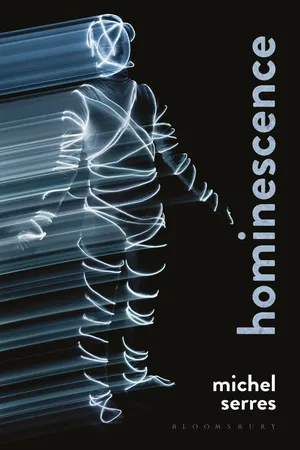
According to Michel Serres, a process of 'hominescence' has taken place throughout human history. Hominescence can be described as a type of adolescence; humanity in a state of growing, a state of constant change, on the threshold of something unpredictable. We are destined never to be the same again but what does the future hold?
In this innovative and passionately original work of philosophy, Serres describes the future of man as an adolescence, transitioning from childhood to adulthood, or luminescence, when a dark body becomes light. After considering the radical changes that humanity has experienced over the last fifty years, Serres analyzes the new relationship that man has with diverse concepts, like the dead, his own body, agriculture, and new communication networks. He alerts us to the consequences of these changes, particularly on the danger of growing inequalities between rich and poor countries.
Should we rejoice in the future, ignore it, or even dread it? Unlike other philosophies that preach doom and gloom, Hominescence calls for us to anticipate the uncertain light of the future.
- 280 pages
- English
- ePUB (mobile friendly)
- Available on iOS & Android
eBook - ePub
Hominescence
About this book
Information
PART ONE
THE BODY
The Argument
How Our Body Changed
The First Loop of Hominescence
Three Global Houses
The Greatest Contemporary Discovery
Ego: Who Signs These Pages?
1 HOW OUR BODY CHANGED
Unexpected victories
Leaving in the morning for his appointments, the family doctor took in his little bag the effective medicines made available to him by the era before the Second World War: eight to ten, not really more. From the 1950s on, a car would no longer be big enough to transport them. Discovered between 1936 and 1945, sulphonamides and antibiotics, growing in usage, transformed infectious diseases that were often deadly up until then into brief episodes of fever. The two scourges that populated the doctor’s offices with cases of syphilis and tuberculosis suddenly declined. Fairly rare up until then, concern for hygiene spread into populations that, accustomed to having horse bedding in town and sleeping not far from cow litters in the country, cared little about cleanliness. The dictates of public health imposed vaccinations and prevention. Later, psychotropic drugs appeared; chemistry was able to regulate procreation and, as they say, liberate sexuality, particularly for women; surgery followed precise medical imagery; we became attentive to children’s nourishment … Some people, like me, remember the time when no one tallied the thousands of dietary poisonings per week, while today merely ten per month will scandalize the media in wealthy countries.
In brief, around the Second World War, medicine began to cure, something it had never really succeeded at from Hippocrates to Galen, Laennec, Jenner and Semmelweis. Suddenly effective, it completely changed our relation to health, suffering, life, death, in short to our body and to ourselves insofar as pharmacy furnished an increasingly open and varied range of suitable remedies, in particular analgesics, antalgics and anaesthetics, which eased pain and sometimes made it disappear. Before the middle of the twentieth century, expert descriptions of diseases and lucid diagnoses outmatched treatments: the practitioner understood the pathologies well and even, thanks to X-rays, saw their lesions better and better but rarely cured. He can cure today to the point that the patient demands, sometimes under threat of lawsuits, his return to health. Imagine the happiness of bodies: formerly rare, now frequent, recovery becomes a right, and disease, once a daily thing, becomes intolerable. In the universe of pain and the incurable, the old-style doctor remained a sorcerer, even a demi-god; as soon as he starts to save people, society – oh, paradox – transforms him into a criminally responsible party.
This unprecedented revolution came, in its entirety, from a threefold alliance between the practitioner (the thousand-year-old adjuvant for individuals), the hundred-year-old scientist (the laboratory discoverer of substances and laws) and the more recent public health services (in charge of statistical prevention), not to mention international institutions such as the Red Cross, the World Health Organization and later Doctors Without Borders. The first one applies to immediate families the recommendations and remedies approved by the second one in international congresses and which the third ones make compulsory by enacting collective regulations. Medicine moves from the individual body to the collective and returns from the latter to the former by the paths of research and public administration. The result: life expectancy regularly increased all the way up to the recent figure, literally unbelievable, of a trimester per year. The population grows older: this verb phrase no longer has the same meaning. Not only does the body of the individual change, but the aspect of society does so as well.
The fact that, in the face of the health poverty of the third world, the probable recurrence of infectious diseases, the diminishing returns of public administration, the power of the pharmaceutical industries …, melancholy and criticism often win out doesn’t stop the fact that this victory report enchanted the years I’m talking about and marked the end of an epoch, whose beginning dates back to the beginnings of humans and even of living things, over the course of which no one knew how to defeat the majority of diseases. Faced with new deaths, the life expectancy of a completely different body increases.
Hygiene and labour
The blessing of hot and running water above the sink joined with the lights of electricity, which the beginning of the century sang of marvellously, transformed our habitat in two ways: less freezing, homes were equipped with toilets and bathrooms. With a twofold shiver of ice and disgust, my body still remembers interiors in which, dressed as for the outside so much did the cold rule there, the delicate residents would wash themselves on the days of major festivals; the others would wait for their marriages. The ceremonial rite of doing the laundry would return with the springtime, for it would take all winter to accumulate the necessary ash; between the icy walls, we would warm our beds with ‘moines’ [monks], built with oblong pieces of wood between which we would slip a brazier so as to sleep in nice sheets.1 The history of medicine also dates the decisive moment when practitioners got out of the habit of systematically sending their patients to the hospital, where comfort and cleanliness prevailed by far over the living conditions at home, to the Second World War; the improvement of these latter conditions caused them to in turn prevail over the living conditions of the public hospitals, in which several iatrogenic and nosocomial diseases were already beginning to appear. This reversal was a historical milestone.
Leaving more welcoming homes not as early, companions got to places of work that were transformed by machines; hard labour saw the number of its forced-labour convicts lower with motor power relieving the farmer and the artisan of the difficulties of lifting, drilling or transporting. The word ‘worker’ no longer has the same meaning when arms leave off the pickaxe handle so that fingers can push buttons; the peasant quits oxen, plough and yoke to drive a tractor. With cramps in my shoulder girdle, my body still remembers the early risings before dawn and the heavy trucks to be loaded with rocks by shovel or else a nine-tined pitchfork. Now, the body doesn’t sweat so much as it pilots or drives. Those people our English-speaking friends call blue-collar workers, having moved into the tertiary sector, became white-collar workers. As early as the end of the nineteenth century, Jules Verne’s novels already no longer anticipated changes in forges or mines but imagined machines intended for relations: balloons, planes, telegraph, submarine, television … In brief, Western humanity abruptly moved, during the 1960s, from means or forces of production to communication networks; the beginning of our century made the victory of the global internet and mobile phones complete. Hermes, the god of intermediaries and translators, the Angels bearing messages and their incalculable number, took the place of Prometheus, the old solitary hero of fire. Thus, our body alleviated its pains.
The old body: Height and duration
Today, a little girl of eleven would be too big to fit into the costumes of the French Academy from the early years of the nineteenth century; we can guess the presence and physical strength of Napoleon’s Grand Armée, which Victor Hugo’s bombast evoked to be like giants. Thanks to the measurements of compulsory military service, we know the average height of French conscripts changed from between 1.55 to 1.60 m during the years 1880–1890 to 1.67 m in 1940 and to around 1.78 m nowadays; embarked, at the end of the eighteenth century, for one of the most atrocious gulags in history, the first Australian convicts were no taller than 1.5 m. Likewise, a woman’s first period, which used to appear around the age of fourteen, today starts at twelve. Can we imagine how romantic relationships were shifted in time and age during eras in which the old over-possessive greybeard of The School for Wives admitted to forty years and Balzac described A Woman of Thirty as finished? In 1833, the Octave of Caprices de Marianne says to her, a beautiful young woman of nineteen summers: ‘So you still have five to six years to be loved, eight to ten to love yourself and the rest to pray to God.’ So Musset reckons about like Balzac.
With life expectancy growing regularly, do we realize that in speaking, for example, of the family and of marriage, we are no longer evoking the same institutions as our predecessors, for whom couples on average lasted six to twelve years, whereas our couples can continue on for more than half a century? I would even wager that the recent explosion in the number of divorces wouldn’t stop the married people of today from remaining united, in sum, longer than once and formerly. Likewise inheritance, whose great expectations are so often described in classical literature, no longer has the same reality or the same weight when the heir waits for it less than a decade or more than fifty years; beyond a certain waiting period, the money loses its interest.
What are we to say about the hero who offers his life to his country at around the age of twenty-five, when he has no more than five to seven years left to live? Would we find, at the same age, the same heroism when he may have several decades of life in front of him? The children of the third world who carry, slung across their shoulders, small arms sold by Western industrialists we are surprised haven't been condemned by an international tribunal for crimes against humanity, do they now seem heroic or sacrificed monstrously? When it’s no longer a question of the same body or of the same vital time, when the streets, the reunions and the nursing homes are populated with old people, once so rare, do we still think, do we still organize, do we still feel the same emotional, patriotic, legal …, in short, the same social and cultural phenomena?
The anthropology of pain
Do we suffer in the same way? The greatest monarch in the world in his time, Louis XIV, surrounded by the best doctors in his kingdom, screamed in pain every day. Impoverished and without any help, what then did his subjects have to endure? Conversely, practitioners today sometimes meet with elderly patients who haven’t yet suffered from anything. Having in part become responsible for our bodily health, we have more power over our bodies than the most powerful man in the world, disfigured by the rictuses of pain, ever had. In his day, one lost all one’s teeth before the age of forty; in the countryside, my childhood often saw and heard these mouths, singing Occitan without dentals. At the end of the nineteenth century, a third of Londoners were suffering from syphilis.
I am mixing dates and facts on purpose to resolve the question: Whose body is it a question of? So I chose the body of the king of yesteryear, in its excellent place, to show it to be impoverished and let the glory of today’s common body be seen: this double maximization in number and quality causes invariants beneath the social differences to appear. Hence this, at least statistical, stability: the life expectancy of a woman in the eighteenth century had not significantly changed for centuries. To find more severe numbers, one has to go back to the Neanderthals: 50 per cent stillborn, half of the survivors dead before the age of nine and the rest rarely reaching two decades. Here no doubt is a perenniality implied by philosophers when they spoke of human nature: Weren’t they right, unbeknownst to them?
So this is how the daily bodily landscape we all met with before the revolution of the last century was set up and coloured, a crowd painted and drawn by genius witnesses. So don’t call Velázquez or Goya, in the past, Daumier, Degas or Toulouse-Lautrec, recently, caricaturists; no, their paintings show what they saw: faces and bodies sculpted to death by suffering, hard labour, hunger, cold and privations, incurable diseases and visible wounds, which the newnesses I am describing have made us forget all about. Stated in broad strokes, that was the era of bodies in the times of pain.
Previous moralities
I attest to having lived, at the end of the 1960s, through the crevasse separating the generations shaped by constant suffering from the one that is suddenly scandalized by a tiny irritation. Consequently, how can we take the recent criticisms regarding the ‘doloristic’ moralities of our elders seriously? From having forgotten, the very day after they were lifted, these ancient constraints, we commit grave injustices and display a foolish incomprehension when holding forth on the customs, moralities and even the religions of our fathers, forced to give themselves a sustained training in suffering, on pain of not being able to brave its inevitable and daily cruelty. Who can now understand the austere precepts of the Christian or Stoic wisdoms, the high techniques of the body of the medieval mystics or even the Buddhists, all of them confronted with the pain and hunger of each day? The search for ataraxia or contrition depended on fearsome conditions whose insistency has been forgotten by the new body. Our contemporary health therefore liberated itself from this harsh fate fairly recently and in such a way that we broke with what our health had been ever since our origins: a cut so decisive that it closes an era whose beginning we don’t even know except in myths and legends concerning the first gods. A contemporary of this abrupt change, I remember the customs in use in the other epoch perfectly and still follow them from time to time, in particular in relation to pain, and I laugh to hear the culture semi-necessarily brought about by it condemned by my contemporaries.
The emergence of the new denuded body
Thus, the new work conditions straightened up the back; the hygiene of home life and a diet that’s kept better watch over smoothed the skin; heating undressed us, and we dared to exhibit a body less ugly from the traces of sufferings and diseases. Intended in the past to veil a few visible imperfections, the way people in the Renaissance concealed the Venus collar unleashed by syphilis with the ruff, clothing fashion suddenly consisted in unveiling she or he who no longer had any shame in hiding nothing. For the first time in its history, Western humanity could be seen naked on the beaches. Venus, it is said, was born in the past from the waters, and Botticelli depicts her, being reborn over the waves, dressed in a heavy braid revealing her nudity. Yet, in the same pleated waves, in August of the present years, rose the new body of men and women. The pantheon exploded in number, and the myth became incarnated. Of course, the so-called and sudden consumer society immediately produced obese people, but on the other hand, more tolerant, it no longer hides the bodies of its handicapped, which the shame of old concealed.
From Phidias to Houdon, the plastic artists showed us in glory huntress Diana or muscular Hercules; we see them today, men and women, quite simply, in the stadiums. Abandoning the ideal, a certain beauty becomes incarnated. Yes, for the first time in history, quasi-divine bodies run, jump, wrestle and play before us and, according to the calculations of Alphonse Juilland, advance in records at quasi-predictable dates. The birth of sports and their popular success largely come from the collective and global rites engendered by the progressive emergence of this body, whose performance grows because it has just been born and whose wrestling matches may replace wars.
Of course, these changes, although important, remain slight in comparison with the strong stages of hominization: the loss of heavy body hair, erect posture, the discovery of fire, the invention of the first tools … This is why I chose the differential term hominescence. In addition, although invisible, the lengthening of life expectancy or the statistical alleviation of pain contributes to a different apprehension of time, projects, life and the world; how can it happen that the ageing of the population appears to eyes exclusively trained in economics to be the weakening of a group, whereas it stimulates education, culture and the coming of a wisdom, which a perspective that’s merely economic forgets to the point of only retaining of human life what isn’t worth being lived?
Restriction
I’m not saying that we abandoned all constraint during this moment of hominescence. On the contrary, the third and fourth worlds are perhaps suffering even more because of our actions than we ever suffered. Of course, pharmacy, still imperfect, doesn’t bring the same benefits to everyone; of course, the unjust violence of money still prowls around us, searching for someone to devour; of course, the last century lived through abominations before which our entire history trembles; of course, medicine, criticized, even vilified, in short, once more at a crossroads, pays a price for its victories, in microbes that have become resistant again, in its residual ignorance, in the financial power of pharmaceutical industries and in drug mafias, in the administration of hospitals, as ponderous and imbecilic as administration is everywhere else. Of course, murder still dashes about, abominable, perhaps invariant in every collective, always as difficult to master, today celebrated every day as a spectacle; in short, we haven’t won, and far from it, the entire match. Only a singular naiveté could contest the heavy constancy of the problem of Evil.
The fact nevertheless remains that the revolution took place, that it drastically changed our body and the relation we maintain with it, a habitat so new that we have lost all memory of the one possessed by our ancestors, even our immediate ancestors, and even more so our distant ones, as well as the customs which, by constraining them, adapted them. A number of our new defeats can even often be explained by the recent victories: does the worrying demographic explosion, which also enters into the great events of hominescence, not come in part from the happy lowering of infant mortality? The criticisms of medicine, so frequent today, whose number and repetition darken opinion under their veil of melancholy, also come from them: I repeat, the wealthy are complaining about being comfortable.
Hence the change of ethics. Our old moralities trained the will to live within the inevitable constraints of suffering and early death; the new morality emanates from the freedom acquired against them. We are in part becoming responsible for the duration of our lives and for their quality. Maurice Tubiana interprets the sudden increase in the number of drug addicts (1965: 3,000; 1975: 150,000, in France) by means of the lifting of these constraints, which in fact occurred on these dates. Certain cancers depend on tobacco and on alcohol; cardiovascular diseases depend on diet and on exercise; sexually transmissible ailments depend on often intentional behaviour. Philosophy for centuries had difficulty in defining freedom exactly: when a hundred pathologies vary with our decisions, it becomes incarnate...
Table of contents
- Cover
- Halftitle Page
- Title Page
- Dedication Page
- Contents
- Deaths
- Part One: The Body
- Part Two: The World
- Part Three: The Others
- Peace
- Notes
- Imprint
Trusted by 375,005 students
Access to over 1.5 million titles for a fair monthly price.
Study more efficiently using our study tools.
Frequently asked questions
Yes, you can cancel anytime from the Subscription tab in your account settings on the Perlego website. Your subscription will stay active until the end of your current billing period. Learn how to cancel your subscription
No, books cannot be downloaded as external files, such as PDFs, for use outside of Perlego. However, you can download books within the Perlego app for offline reading on mobile or tablet. Learn how to download books offline
Perlego offers two plans: Essential and Complete
- Essential is ideal for learners and professionals who enjoy exploring a wide range of subjects. Access the Essential Library with 800,000+ trusted titles and best-sellers across business, personal growth, and the humanities. Includes unlimited reading time and Standard Read Aloud voice.
- Complete: Perfect for advanced learners and researchers needing full, unrestricted access. Unlock 1.5M+ books across hundreds of subjects, including academic and specialized titles. The Complete Plan also includes advanced features like Premium Read Aloud and Research Assistant.
We are an online textbook subscription service, where you can get access to an entire online library for less than the price of a single book per month. With over 1.5 million books across 990+ topics, we’ve got you covered! Learn about our mission
Look out for the read-aloud symbol on your next book to see if you can listen to it. The read-aloud tool reads text aloud for you, highlighting the text as it is being read. You can pause it, speed it up and slow it down. Learn more about Read Aloud
Yes! You can use the Perlego app on both iOS and Android devices to read anytime, anywhere — even offline. Perfect for commutes or when you’re on the go.
Please note we cannot support devices running on iOS 13 and Android 7 or earlier. Learn more about using the app
Please note we cannot support devices running on iOS 13 and Android 7 or earlier. Learn more about using the app
Yes, you can access Hominescence by Michel Serres, Randolph Burks in PDF and/or ePUB format, as well as other popular books in Philosophy & Social Philosophy. We have over 1.5 million books available in our catalogue for you to explore.