eBook - ePub
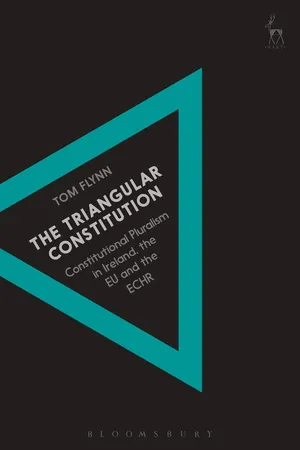
The Triangular Constitution
Constitutional Pluralism in Ireland, the EU and the ECHR
- 224 pages
- English
- ePUB (mobile friendly)
- Available on iOS & Android
eBook - ePub
About this book
This book offers a new account of modern European constitutionalism. It uses the Irish constitutional order to demonstrate that, right across the European Union, the national constitution can no longer be understood on its own, in isolation from the EU legal order or from the European Convention on Human Rights. The constitution is instead triangular, with these three legal orders forming the points of a triangle, and the relationship and interactions between them forming the triangle's sides. It takes as its starting point the theory of constitutional pluralism, which suggests that overlapping constitutional orders are not necessarily arranged 'on top of' each other, but that they may be arranged heterarchically or flatly, without a hierarchy of superior and subordinate constitutions. However, it departs from conventional accounts of this theory by emphasising that we must still pay close attention to jurisdictional specificity in order to understand the norms that regulate pluralist constitutions. It shows, through application of the theory to case studies, that any attempt to extract universal principles from the jurisdictionally contingent interactions between specific legal orders is fraught with difficulty. The book is an important contribution to constitutional theory in general, and constitutional pluralism in particular, and will be of great interest to scholars in the field.
Information
1
European Constitutional Pluralism and the Triangular Constitution
INTRODUCTION
A major feature of the European legal landscape in the early twenty-first century is the existence of multiple, overlapping, interlocking normative orders – national, supranational and international. The questions then arise as to how best to describe and conceptualise this plurality of legal orders, and the ways in which the orders relate to each other. This book proposes a theoretical and practical framework for answering these questions – the theory of triangular constitutionalism – and does so by providing an in-depth empirical investigation of the workings of one particular triangular constitution: the constitutional order of Ireland, the European Union (EU) and the European Convention on Human Rights (ECHR), taken together. Later chapters will set out in detail the ‘horizontal’ and ‘vertical’ workings of this triangular constitution, but first, there is some significant groundwork to be laid.
This chapter begins, in section I, by situating the argument in the broadest terms, first by setting out the initial development of the idea of constitutional pluralism in the context of the constitutionalisation of EU law, and then by outlining a particular refinement and condensation of the theory into a ‘lowest-common-denominator’ conception.
In section II I seek to define my terms, starting with the preliminary conceptual and definitional difficulty of attempting to reconcile and combine two ideas, ‘constitutionalism’ and ‘pluralism’, which by some accounts are irreconcilable opposites. Having suggested that constitutionalism and pluralism are not in fact opposites, but rather end points on a spectrum, I propose a distinction between ‘constitutional pluralism’ in the strict sense, and ‘pluralist constitutionalism’, a distinction which can clarify some disagreements in the literature.
In section III, I narrow the focus of the discussion to the normatively thicker ‘metaconstitutional’ theories of pluralist constitutionalism, as opposed to the looser conceptions of ‘radical pluralism’, or the more prescriptive accounts of constitutional pluralism in the strict sense, which advocate or require specific constitutional and institutional reforms in order to become operationalised. I analyse the approaches of three major contributions in the area of metaconstitutional pluralism with reference to both the EU and the ECHR, highlighting their similarities and differences.
Section IV identifies two particular, related problems that arise from the overview of the various conceptions of pluralism in the literature, and especially the metaconstitutional conceptions: the potential (or at least alleged) threat to legal integrity and the rule of law caused by the absence of a single actor empowered to give the ‘final say’ in cases of constitutional conflict; and the alleged universality of the ‘interface norms’ which regulate the relationships between the legal orders. This latter issue, in particular, will be a major focus of this work.
Finally, section V outlines my conception of the legal orders of Ireland, the EU and the ECHR as a unified – but not unitary – composite whole: the triangular constitution. I suggest that this explanatory framework may be capable of being generalised into a normative theory – triangular constitutionalism – capable of application to each Member State of the Union, but that this can only be done by paying close attention to jurisdictional specificities. While triangular constitutionalism may be universalisable, it is not itself universal.
I.CONSTITUTIONAL PLURALISM’S ORIGINS IN THE EU
A.Constitutionalisation and Disorder
The story of the European Communities’ (and later the Union’s) growth from a classical, treaty-based creature of international law, nothing more than a set of binding obligations between states, to the autonomous, supranational legal order that exists today is well known, and will not be recounted at great length here.1 Suffice it to say that the then European Court of Justice (ECJ),2 through its formulation and elaboration of the twin doctrines of the direct effect of Community law and its primacy over national law, effected the steady ‘constitutionalisation’ of the Community. The famous statement from van Gend en Loos that ‘[t]he Community constitutes a new legal order of international law for the benefit of which the States have limited their sovereign rights’3 lost its ‘of international law’ qualifier five years later in Molkerei-Zentrale.4 Not only was the EEC Treaty capable of ‘producing direct effects and creating individual rights which national courts must protect’,5 but ‘[t]he law stemming from the Treaty, an independent source of law, could not, because of its special and original nature, be overridden by domestic legal provisions, however framed’.6 By 1986, the ECJ felt confident enough in Les Verts to call the EEC Treaty the Community’s ‘basic constitutional charter’.7
This judicial constitutionalisation of the Union did not occur in a vacuum, but was aided by the agreement – or at least the acquiescence – of the Member States. There is the obvious fact that 22 of the 28 Member States acceded to the Community or Union long after 1964, aware of the implications of van Gend and Costa. But more importantly, Joseph Weiler notes that this constitutionalisation was ‘brought about with the full collaboration of national governments [and] national parliaments, who again and again … ratified the new order’.8 He invokes Albert Hirschman’s theory of exit and voice to show that as Community law developed, political intergovernmentalism provided a counterweight to legal supranationalism, ‘allowing the Member States to digest and accept the process of constitutionalization’, which they could do ‘because they took real control of the decision-making process, thus minimizing its threatening features’.9
However, having had less of a Hirschmanian voice in the matter, the supreme and constitutional courts of some Member States were rather less enthusiastic, particularly the German Federal Constitutional Court, the Bundesverfassungsgericht (BVerfG). In its Solange I judgment,10 the BVerfG claimed for itself the jurisdiction to review Community norms for conformance with fundamental rights as set out in the German Basic Law (Grundgesetz). This was in clear defiance of the ECJ’s ruling in Internationale Handelsgesellschaft11 (itself a stage in the proceedings that led to the Solange I judgment), which had reserved such jurisdiction to itself. Faced with the threat of open rebellion by one of the most powerful and influential constitutional courts in Europe – and an apex constitutional actor in what has long been the continent’s economic powerhouse – the ECJ staged a remarkable about-turn in its jurisprudence. Whereas once it had held that fundamental rights as they appear in national constitutions were entirely outwith the scheme of the Treaties,12 or, later, were to be protected only insofar as they formed part of the constitutional traditions common to the Member States,13 the ECJ held in Nold14 that:
[F]undamental rights form an integral part of the general principles of law, the observance of which [the Court] ensures. In safeguarding these rights, the Court is bound to draw inspiration from constitutional traditions common to the Member States, and it cannot therefore uphold measures which are incompatible with fundamental rights recognized and protected by the Constitutions of those States. Similarly, international treaties for the protection of human rights on which the Member States have collaborated or of which they are signatories, can supply guidelines which should be followed within the framework of Community law.15
The ECJ went on to develop its case law16 to the satisfaction of the BVerfG, which held in Solange II17 that as the EU’s (and in particular the ECJ’s) rights protection was now at a level comparable to its own, it would no longer exercise (but did not renounce) the jurisdiction it had claimed for itself.
It is in response to this ‘disorder of normative orders’18 – wherein the legal orders of both the EU and its Member States make claims to autonomy and to primacy in their own domain, with all the potential for jurisdictional overlap and conflict that this entails – that the various different strands and species of constitutional pluralism have been developed.
B.Beginnings: MacCormick’s ‘Radical Pluralism’ and ‘Pluralism Under International Law’
The title of ‘inventor’ of constitutional pluralism – at least insofar as it relates to European law of both kinds – belongs to Neil MacCormick, who set out to show that:
[S]overeignty and sovereign states, and the inexorable linkage of law with sovereignty and the state, have been but the passing phenomena of a few centuries, that their passing is by no means regrettable, and that current developments in Europe exhibit the possibility of going beyond all that.19
MacCormick illustrated this claim by reference to the UK’s position within the legal orders of the European Communities and of the ECHR: to regard the UK as still being sovereign in the classical, all-encompassing sense is to blind ourselves to objective reality, but to regard the Communities as being sovereign, with Member States merely their subordinates, is to overstate the case.20 Problematically, the traditional concept of sovereignty by its very nature – indivisible, exclusive, etc21 – lends itself only to one of these either/or approaches. Alternatively, ‘[t]o escape from the idea that all law must originate in a single power source, like a sovereign, is thus to discover the possibility of taking a broader, more diffuse, view of law’.22
It is exactly this broader, more diffuse approach that MacCormick took in response to the Maastricht judgment23 of the BVerfG two years later.24 Here, the BVerfG held the Maastricht Treaty to be compatible with the Grundgesetz, but also drew a line in the sand: sovereignty in Germany continues to be vested in the German people, and Germany is still (for the BVerfG) a sovereign state. Accordingly, the competences of the EU are specified and limited, and its authority derived from and dependent on that of the Member States: neither the EU corporately, nor any of its individual actors – such as the Court of Justice – has interpretive Kompetenz-Kompetenz, the power to decide the limits of its own jurisdiction and powers. As a result, if the BVerfG detected an intrusion by a future EU legislative instrument into the still-sovereign sphere of German law, such instrument would have no binding power within Germany.25 How can this be squared with the CJEU’s long-standing jurisprudence on the autonomy and primacy of Community – and now Union – law? Clearly, the BVerfG and the CJEU cannot both be right. Or can they?
MacCormick observed that from the point of view of an institutional (rather than pure) theory of law, institutions and actors within municipal European legal systems derive their authority and competence from the national legal order, independently of whatever international or supranational organisations to which the state may belong. Equally, EU legal actors derive their authority and competence from the Treaties, without reference (for doctrinal purposes) to the ins and outs of the national law of any one Member State. The conclusion MacCormick drew from this observation is a clear statement of the fundamentals of constitutional pluralism, and merits quoting at length:
[T]he doctrine of supremacy of Community law is not to be confused with any kind of all-purpose subordination of Member State law to Community law. Rather, the case is that these are interacting systems, one of which constitutes in its own context and over the relevant range of topics a source of valid law superior to other sources recognised in each of the Member State systems … On the whole, therefore, the most appropriate analysis of the relations of legal systems is pluralistic rather than monistic, and interactive rather than hierarchical. The legal systems of Member States and their common legal system of EC law are distinct but interacting systems of law, and hierarchical relationships of validity within criteria of validity proper to distinct systems do not add up to any sort of all-purpose superiority of one system over another.26
This refusal to accept (from anything other than an internal epistemic perspective, on which more below in section IV.A) the claims of apex actors within both national and E...
Table of contents
- Cover
- Title Page
- Acknowledgements
- Table of Contents
- Table of Cases
- Table of Legislation
- Introduction
- 1. European Constitutional Pluralism and the Triangular Constitution
- 2. The Vertical Frame
- 3. The Horizontal Frame
- 4. The Triangular Frame
- 5. Towards Triangular Constitutionalism: Universalising the Triangular Constitution
- Bibliography
- Index
- Copyright Page
Trusted by 375,005 students
Access to over 1.5 million titles for a fair monthly price.
Study more efficiently using our study tools.
Frequently asked questions
Yes, you can cancel anytime from the Subscription tab in your account settings on the Perlego website. Your subscription will stay active until the end of your current billing period. Learn how to cancel your subscription
No, books cannot be downloaded as external files, such as PDFs, for use outside of Perlego. However, you can download books within the Perlego app for offline reading on mobile or tablet. Learn how to download books offline
Perlego offers two plans: Essential and Complete
- Essential is ideal for learners and professionals who enjoy exploring a wide range of subjects. Access the Essential Library with 800,000+ trusted titles and best-sellers across business, personal growth, and the humanities. Includes unlimited reading time and Standard Read Aloud voice.
- Complete: Perfect for advanced learners and researchers needing full, unrestricted access. Unlock 1.5M+ books across hundreds of subjects, including academic and specialized titles. The Complete Plan also includes advanced features like Premium Read Aloud and Research Assistant.
We are an online textbook subscription service, where you can get access to an entire online library for less than the price of a single book per month. With over 1.5 million books across 990+ topics, we’ve got you covered! Learn about our mission
Look out for the read-aloud symbol on your next book to see if you can listen to it. The read-aloud tool reads text aloud for you, highlighting the text as it is being read. You can pause it, speed it up and slow it down. Learn more about Read Aloud
Yes! You can use the Perlego app on both iOS and Android devices to read anytime, anywhere — even offline. Perfect for commutes or when you’re on the go.
Please note we cannot support devices running on iOS 13 and Android 7 or earlier. Learn more about using the app
Please note we cannot support devices running on iOS 13 and Android 7 or earlier. Learn more about using the app
Yes, you can access The Triangular Constitution by Tom Flynn in PDF and/or ePUB format, as well as other popular books in Law & International Law. We have over 1.5 million books available in our catalogue for you to explore.