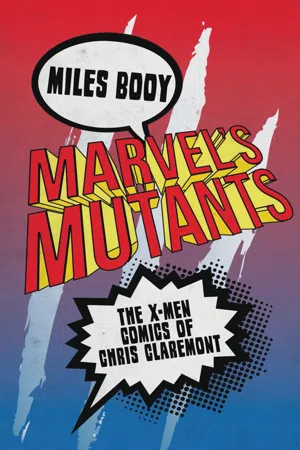
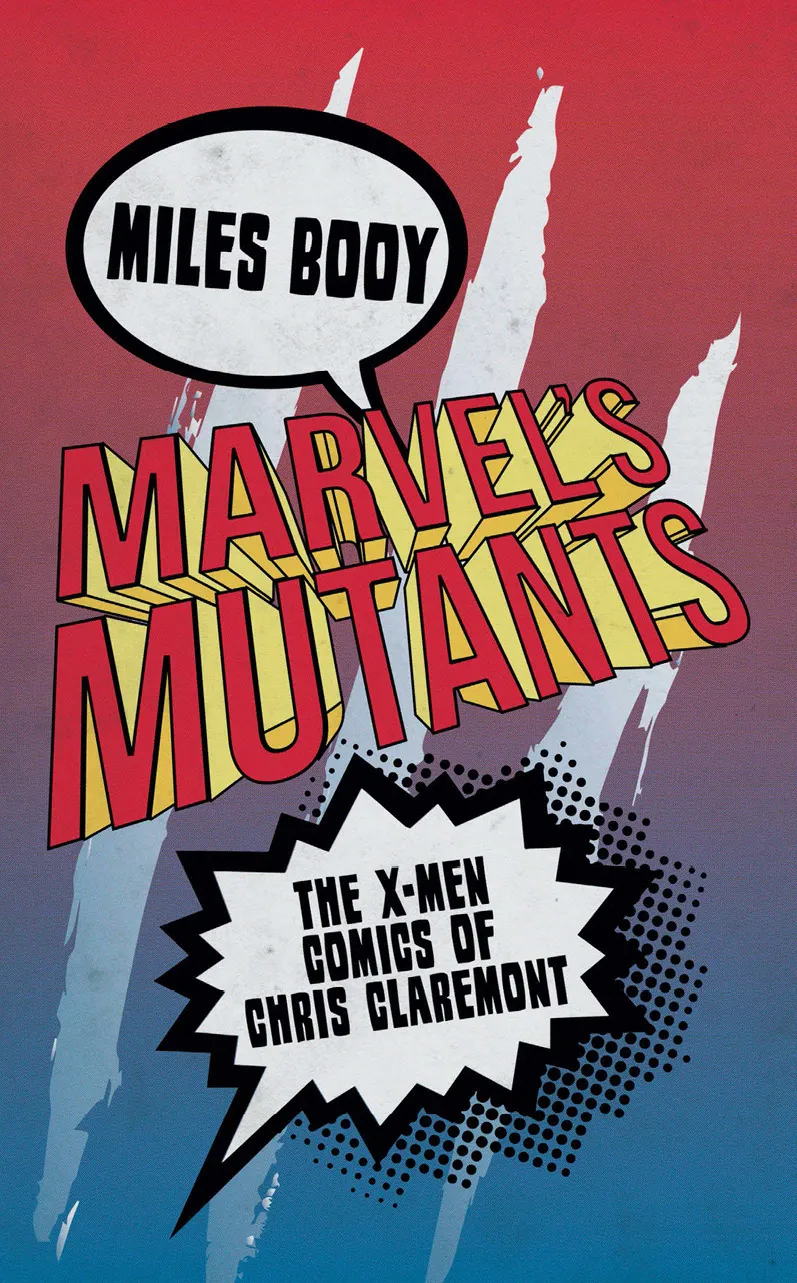
In 1975, Marvel Comics revived the X-Men, a failed title which hadn't used new material for half a decade. It was a marginal project in an industry then in crisis. Five years later, it was the bestseller in a revived comics market. Unusually in the comics world, one man, Chris Claremont wrote the comic over seventeen years, from 1975 to 1991, developing new characters such as Wolverine and Storm, and taking themes from Freudian psychology, Christian temptation narratives, Existentialist philosophy and the language of sub-cultural identity.
Marvel's Mutants is the first book to be devoted to the aesthetics of these comics that laid the foundation for the worldwide X-Men franchise we know today. Miles Booy explores Claremont's recurrent themes, the evolution of his reputation as an auteur within a collaborative medium, the superhero genre and the input of the artists with whom Claremont worked. Also covered are the successful spin-off projects, which Claremont wrote: solo Wolverine mini-series and whole new teams of mutant superheroes.
- 224 pages
- English
- ePUB (mobile friendly)
- Available on iOS & Android
eBook - ePub
About this book
Information
MILES BOOY studied film at the College of St Mark and St John in Plymouth and the University of East Anglia. He loves Doctor Who, Marvel Comics and science-fiction cinema, and studies them from both academic and fan perspectives. He is the author of Love and Monsters: The Doctor Who Experience, 1979 to the Present (2012) and a contributor to The Cult TV Book (2012), both from I.B.Tauris. He lives in Stafford with his wife and son.
‘Miles Booy is an expert critic and his much-welcomed account of Chris Claremont’s tenure on Marvel’s X-Men will be essential reading for comic fans and historians alike. Booy succeeds in analysing the narratives and politics of comics with admirable scholarly detachment while never losing sight of the fun nature of his subject. This book is likely to be the definitive survey of Claremont’s contribution to the Marvel universe.’
JAMES CHAPMAN
author of British Comics: A Cultural History
author of British Comics: A Cultural History
‘An excellent and timely book about the unsung genius of Chris Claremont, the most under-appreciated comics writer, who nevertheless made a vast contribution to the super-hero genre. Booy gets deep into the work, and why Claremont is so influential.’
PAUL CORNELL
award-winning comics writer of Wolverine, X-Men and more
award-winning comics writer of Wolverine, X-Men and more
‘Marvel’s Mutants provides the sort of literary analysis of the X-Men that we’ve been waiting for. This is not more of the same, endless discussions of the X-Men’s politics. Rather, Miles Booy excavates and illuminates the subtle but often forgotten themes and tropes – joy and hunger, civilisation and savagery, humanity and machinery – that truly gripped the attention of long-time writer Chris Claremont. This is a compelling, novel, and necessary reconsideration of the foundational period of the X-Men.’
NEIL SHYMINSKY
pop cultural commentator and Program Co-ordinator, Cambrian College
pop cultural commentator and Program Co-ordinator, Cambrian College

Published in 2018 by
I.B.Tauris & Co. Ltd
London • New York
www.ibtauris.com
I.B.Tauris & Co. Ltd
London • New York
www.ibtauris.com
Copyright © 2018 Miles Booy
The right of Miles Booy to be identified as the author of this work has been asserted by the author in accordance with the Copyright, Designs and Patents Act 1988.
All rights reserved. Except for brief quotations in a review, this book, or any part thereof, may not be reproduced, stored in or introduced into a retrieval system, or transmitted, in any form or by any means, electronic, mechanical, photocopying, recording or otherwise, without the prior written permission of the publisher.
References to websites were correct at the time of writing.
ISBN: 978 1 78831 152 6
eISBN: 978 1 78672 331 4
ePDF: 978 1 78673 331 3
eISBN: 978 1 78672 331 4
ePDF: 978 1 78673 331 3
A full CIP record for this book is available from the British Library
A full CIP record is available from the Library of Congress
A full CIP record is available from the Library of Congress
Library of Congress Catalog Card Number: available
Text design, typesetting and eBook by Tetragon, London
‘I want to fight. And I want just as much to give in.’
ILLYANA RASPUTIN
Magik #4 (March 1984)
Magik #4 (March 1984)
‘We are born biological beings, but we must become existential individuals by accepting responsibility for our actions.’
THOMAS R. FLYNN
Existentialism: A Very Short Introduction
Existentialism: A Very Short Introduction
Contents
- Acknowledgements and Housekeeping
- Introduction
- I. Claremont’s Characters
- II. History and Futures Past
- III. Bringing It All Back Home
- IV. Existential X-Men: The New Mutants
- V. The Harder They Come…
- Appendix Sales Figures of Uncanny X-Men During the Claremont Era
- Notes
- Bibliography
Acknowledgements and Housekeeping
The comic which is this study’s central text underwent a name change. Originally entitled X-Men in the 1960s, it became The Uncanny X-Men with #114 (October 1978). For brevity’s sake, this is abbreviated to X-Men in my discussion. Such an abbreviation was traditionally used in fan discourse and, indeed, Marvel’s own publicity materials, so this should be simple enough – except that X-Men (that one hyphenated word without elaboration or description) is also the name of a film (Bryan Singer, 2000) and of a second comic, launched in October 1991. For the purposes of this book, the italicised term X-Men refers to the comic begun in 1963 and written by Chris Claremont from 1976 to 1991. Where any other work of that name is being referred to, I have made it clear. Where the word is used without italics, it refers to the characters, not the published comic. All comic titles are italicised.
The story contained in every issue of X-Men had a title which was usually given on the opening page, though delaying it a page or two was not unknown. These titles, where given, are in single quotation marks (e.g. ‘The Submergence of Japan’), although in referring to a given comic I have normally cited the issue number rather than the story title. Sometimes an umbrella title would link several issues (e.g. ‘The Fall of the Mutants’), usually as part of a marketing initiative, and these and any other variations from the normal pattern are noted along the way. Fans often made a point of referring to the characters by their human birth names (e.g. Scott Summers, Logan, etc.) as part of their claim that Claremont wrote three-dimensional human beings (as discussed in Chapter I). By contrast, I have primarily referred to them by their superhero code names (Wolverine, Storm, etc.) as that is how they are best known, especially by those who lack decades of immersion in X-lore. The exception is Kitty Pryde, who has always been more frequently referred to by that name than any of her various code names. As regards the storylines themselves, I have generally assumed that readers have some familiarity with the comic during this period but need reminding of the details. Every chapter begins with a passage which outlines the major storylines and industrial developments in the period under discussion. Whatever degree of familiarity readers bring to this book, they should be able to orientate themselves there.
Throughout this book, I have given the date of each comic as it is cited or discussed. This date refers to the one on the front (the ‘cover date’), unless explicitly stated. It should be noted, however, that outside of news periodicals (which are more time-specific), American practice has been to place dates on the covers which were two or three months ahead of their actual publication date, thus allowing the issue to remain ‘current’ on the news stands for longer. During the period under discussion, an issue of X-Men bearing the cover date ‘December 1980’ would actually have been published in September of that year. This explains why X-Men #143 (March 1981) is a Christmas story – it was on American news stands for Christmas. The title of the three-part ‘Fall of the Mutants’ story (#225–7) is a pun, but one which only works if you understand that the issues were on sale in America during the autumn of 1987 despite cover dates early in 1988.
Marvel comics have their own stylistic conventions. Where I quote the dialogue or explanatory panels, most of these have been carried over. In a strange grammatical move, for instance, Marvel use two hyphens where the normal usage would be a single dash (e.g. ‘But within the club is an inner circle open only to a select few -- an inner circle who see the club as an avenue to achieving power’ (#130, February 1980)). I have carried this over into my quotations from the text. Conversely, all lettering – be it in dialogue bubbles or captions – is written in the comics in upper case letters (e.g. ‘SUDDENLY’), but I have not rendered all quotations in this manner. Anyone who wants to see how odd it looks when a book quotes comics in this way is directed to Grant Morrison’s volume Supergods.1
Lastly, within the US, comics are known as ‘comic books’, and this is routinely abbreviated to ‘books’ (or ‘book’ singular, as in ‘I started to write the book…’). This might well reflect the industry’s need for respect, its claim to be a properly literary experience. I wouldn’t dispute that, but since my bibliophily still outweighs my comic fandom – and because I’m British, not American – I’m not keen on the use of the word in this manner. However, readability takes priority over personal preferences. To avoid over-repetition of the British term, I therefore use the words ‘book’ and ‘comic’ interchangeably. After all, in the world of comics, we’re all American now.
This book is solely based on public sources, primarily the comics, their letters pages and the fan magazines which surrounded them, including contemporary interviews with those working at Marvel during the period in question. Those inte...
Table of contents
- Acknowledgements and Housekeeping
Trusted by 375,005 students
Access to over 1.5 million titles for a fair monthly price.
Study more efficiently using our study tools.
Frequently asked questions
Yes, you can cancel anytime from the Subscription tab in your account settings on the Perlego website. Your subscription will stay active until the end of your current billing period. Learn how to cancel your subscription
No, books cannot be downloaded as external files, such as PDFs, for use outside of Perlego. However, you can download books within the Perlego app for offline reading on mobile or tablet. Learn how to download books offline
Perlego offers two plans: Essential and Complete
- Essential is ideal for learners and professionals who enjoy exploring a wide range of subjects. Access the Essential Library with 800,000+ trusted titles and best-sellers across business, personal growth, and the humanities. Includes unlimited reading time and Standard Read Aloud voice.
- Complete: Perfect for advanced learners and researchers needing full, unrestricted access. Unlock 1.5M+ books across hundreds of subjects, including academic and specialized titles. The Complete Plan also includes advanced features like Premium Read Aloud and Research Assistant.
We are an online textbook subscription service, where you can get access to an entire online library for less than the price of a single book per month. With over 1.5 million books across 990+ topics, we’ve got you covered! Learn about our mission
Look out for the read-aloud symbol on your next book to see if you can listen to it. The read-aloud tool reads text aloud for you, highlighting the text as it is being read. You can pause it, speed it up and slow it down. Learn more about Read Aloud
Yes! You can use the Perlego app on both iOS and Android devices to read anytime, anywhere — even offline. Perfect for commutes or when you’re on the go.
Please note we cannot support devices running on iOS 13 and Android 7 or earlier. Learn more about using the app
Please note we cannot support devices running on iOS 13 and Android 7 or earlier. Learn more about using the app
Yes, you can access Marvel's Mutants by Miles Booy in PDF and/or ePUB format, as well as other popular books in Letteratura & Critica letteraria di fumetti e graphic novel. We have over 1.5 million books available in our catalogue for you to explore.