"An extraordinary memoir" of fleeing the Nazis—and then returning to fight them (Konrad H. Jarausch, author of
Broken Lives: How Ordinary Germans Experienced the Twentieth Century).
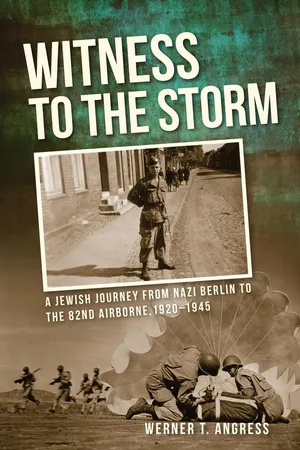
On June 6, 1944, Werner T. Angress parachuted down from a C-47 into German-occupied France with the 82nd Airborne Division. Nine days later, he was captured behind enemy lines and became a prisoner of war. Eventually, he was freed by US forces, rejoined the fight, crossed Europe as a battlefield interrogator, and participated in the liberation of a concentration camp. He was an American soldier—but less than ten years before he had been an enthusiastically patriotic German-Jewish boy.
Rejected and threatened by the Nazi regime, the Angress family fled to Amsterdam to escape persecution and death, and young Angress then found his way to the United States. In
Witness to the Storm, Angress weaves the spellbinding story of his life, including his escape from Germany, his new life in the United States, and his experiences in World War II. A testament to the power of perseverance and forgiveness,
Witness to the Storm is the compelling tale of one man's struggle to rescue the country that had betrayed him.
eBook - ePub
Witness to the Storm
A Jewish Journey from Nazi Berlin to the 82nd Airborne, 1920–1945
- 358 pages
- English
- ePUB (mobile friendly)
- Available on iOS & Android
eBook - ePub
Witness to the Storm
A Jewish Journey from Nazi Berlin to the 82nd Airborne, 1920–1945
About this book
Trusted by 375,005 students
Access to over 1.5 million titles for a fair monthly price.
Study more efficiently using our study tools.
Information
Topic
Theology & ReligionSubtopic
Military BiographiesCHAPTER 1

Family Life in Berlin, 1920–1936
In early 1990, only a few months after the Wall came down and not long after my return from almost fifty years in the United States, I went back for the first time to where the private clinic had stood, at Genthiner Strasse 12, Berlin. I was born in this clinic in June 1920. It was destroyed during the Second World War, and now another building stands in its place. To the right and left and across the street are now large furniture stores, which make Genthiner Strasse look quite different than at the time of my birth. It was strange to see the place where I was born. As a historian I noted that the clinic had been near Bendlerstrasse, today Stauffenbergstrasse, where everything went wrong on July 20, 1944 [the date of the failed attempt to assassinate Hitler via a bomb in Lieutenant Colonel von Stauffenberg’s briefcase].
Of three brothers, I was the only one born in a hospital. My two younger brothers—Fritz Peter, born on April 14, 1923, and Hans Herbert, born on April 14, 1928—were both delivered at home, probably even on the same dining room table. Their common birthday was no accident. My mother thought it would be easier on her through the years to have one birthday party for both sons, so she had her doctor help out a bit.
Until she died at age ninety-two, my mother assured me that my childhood was very happy until January 30, 1933. And if one compares it to the fate of many others, she may have been right. I often perceived things differently, however. As a child I was occasionally reproached for being reserved and, worse, for not being a “family person.” This was true, but there were, of course, reasons for it.
We were a large, complex family, which often caused confusion in my young mind. Not that the family was in any way exceptional. Like many German Jews at the time, both my parents came from the Jewish petit bourgeoisie of the nineteenth century that had slowly advanced to solid middle class. Of course, they would have liked to belong to the educated middle class and strove for that position. But my family never reached that goal, partly for financial reasons. School education ended with the tenth grade, three years earlier than today and with no Abitur, or final examination. Instead Germans either finished school with an exam called the Mittlere Reife, or we could volunteer for one year of military service. The education of my maternal grandfather, the only one of my grandparents with real intellectual interests, thus also ended at this level. I am the first of my family to have attended a university, but not in Germany and without having obtained a German high school diploma.

Thank-you card: “For the expression of your kind regards shown on the occasion of the birth of our son Werner we express our sincere thanks. Ernst Angress and wife, Henny née Kiefer.” Berlin—Schöneberg Rosenheimerstrasse 31, July 1920.
This Jewish family in Berlin—very bourgeois, very Prussian—was representative of many other Jews who lived in Berlin during the Weimar era. During the Third Reich they were all persecuted, driven out, and murdered, under the watching eyes of the educated German middle class that was “lucky” enough to be “Aryan,” often approving of what was happening, at the least indifferent, and sometimes participating. For this reason, and not because of any interest in genealogy, I would like to describe my family in more detail here.
The name “Angress” was fairly common in Upper Silesia, especially in the region of Gleiwitz, as I saw in the deportation lists of the National Socialist period. My father said we didn’t come from Upper Silesia, however, but rather from either Kleve, near the Dutch border, or Danzig (Gdánsk). He wasn’t sure which. As I was able to ascertain later, there was no family by the name of Angress in Kleve. Whether or not there were or are Angresses in Danzig I don’t know, as I’ve never been there.

Werner Angress, three years old.

My father, Ernst Angress, with us three sons in summer 1928. Left, Fritz Peter; right, me, Werner Karl; Hans Herbert is in our father’s arms.
Like his father before him, Papa was a native of Berlin. Born on August 5, 1883, at Jerusalemer Strasse 42, Papa grew up in the heart of the city, between Hausvogteiplatz and Spittelmarkt, the traditional garment district. Grandfather Isaac Angress was a businessman and worked in the clothing industry. My paternal grandparents were strict, observant Jews, and my grandmother kept a kosher household. During the first thirty years of his life my father ate only kosher food. Isaac and Amalie Angress had four children: Hanna, Rosa, Käthe, and Ernst, my father, their youngest child and only son.
I never met Grandfather Angress, but from the tone of a remark Papa once made about him, I concluded that their relationship wasn’t good. That remark (whose precise content I don’t remember) is all Papa ever said to me about his father. He got along better with his mother, and I got to know her before she died in the mid-1920s. Her maiden name was Trepp and she came from Fulda, where the Trepp family is documented back to the second half of the fifteenth century. The Jüdenhaus an der Trepp [Jew house above the stairs], the ancestral seat of the family, which in its five-hundred-year history had produced rabbis and many doctors, was torn down in the 1960s.
My grandmother Angress I saw rarely and briefly. She lived with her oldest daughter, Tante Hanna, in the Tiergarten district on Holsteiner Ufer. I remember a hunched-over, almost blind old lady who groped her way around the apartment. When we went to visit, my father would lovingly administer her eyedrops. When she died and was buried at Weissensee I was only seven years old, and my parents thought I was too young to attend the funeral. Her death didn’t affect me; the fact that my father wore a black crepe band around his left arm for a year struck me as peculiar, but I didn’t ask questions.
For the first fifteen years of my life my father was above all a figure of authority. He was of medium height and muscular but slim. At the age of twenty his hair began to fall out, and by the time he became my father at the age of thirty-seven, he was completely bald. Until the beginning of the 1920s he wore a beard. His eyes were light blue, and when I look in the mirror, my father’s eyes look back at me. He liked to smoke cigars, and of course he always wore a dark suit, a stiff collar, and a tie to work. He had a salaried position at the private Berlin bank Königsberger and Lichtenhein, which in my childhood had its offices on the ground floor of Französische Strasse 60–61. He had begun at that bank as an apprentice at the turn of the century, and at the end of the First World War he became the Prokurist, a leading executive who, as the owners’ representative, has the right to sign financial contracts. In 1932 he took over the bank, or what was left of it after the stock market crash of 1929 and the ensuing Depression. Moritz Lichtenhein had, according to rumor, taken his own life in July 1930. Leo Königsberger had retired at the end of 1930, and Dr. Werner Lichtenhein, the son of Moritz and his successor, left the bank in March 1932 and went abroad with his wife.
My father’s two elderly bosses were something quite special in my mind, because, on the one hand, they were always spoken of at home in an unusually respectful tone of voice, and, on the other hand, I always had to be dressed in my Sunday best when my parents took me along to visit them. I detested Sunday clothes like the plague. I remember only Leo Königsberger clearly. He was a tall man, at least from my perspective at the time, had a very deep voice, and resembled President Paul von Hindenburg to an amazing degree. He was kind, polite, and always seemed a bit absent. When he visited us, which didn’t happen often, he brought small gifts, mostly a kind of chocolate that I didn’t much like—I ate only chocolate with nuts—and of course I had to thank him for it nonetheless. I don’t believe that Moritz Lichtenhein ever visited us at home, but he had us over to his villa in Nikolassee/Wannsee now and then. Their property radiated wealth, from the wrought iron entrance gate to the magnificent huge lawns.
Every weekday morning I saw Papa for only a moment in my parents’ bedroom, where I dutifully gave him and my mother a hasty kiss before I raced off to school, since I was usually late. Normally he didn’t come home until we children had eaten dinner, and so on weekdays I didn’t see much of him. On Saturdays he got home from work in the early afternoon, but then his friends came to play cards, or he went to one of their homes. We only saw each other on Sundays, but in the afternoons he often worked at the enormous dark desk in his study or went somewhere with my mother. After lunch, however, the family did take the obligatory Sunday walk, weather permitting. We walked down the streets of Westend, where we lived from 1923 to 1932, and I was horribly bored. Papa and Mutti walked in front, and Fritz and I followed, both wearing the same coats, the same shirts and short pants, the same black berets. He and I didn’t have much to say to each other back then. He was three years younger and developed quite slowly. Being somewhat plump, he had picked up the nickname “Möpschen” [Little Pug Nose]. He learned to speak quite late, but quickly made up for it. When he grew up he became a good-looking, very athletic young man. Together with my mother and our youngest brother, Hans, he survived the war in Holland in hiding. After the end of the war both of my brothers went to the United States, where they still live today, in California, and we get together regularly.
I look back on this phase of my early childhood, approximately from my sixth to my twelfth year, with some discomfort. I hated the Sunday walks, hated the clothes that my mother chose and bought for me, and hated having to greet adult visitors to our home (who for the most part meant little to me) with a kiss and a bow, after which I was usually sent to my room. Mutti surely knew how annoying all this was to me, but convention was more important. Papa most likely didn’t waste a thought on the matter.
My father was a conscientious German businessman and at home he took care of all our finances. He demanded precise accounting of expenditures from his wife and children and didn’t tolerate wasting money. He could be quite stingy when it came to little things. I had to go to him whenever I wanted to buy something for which my meager allowance didn’t suffice (when I was fifteen it still amounted to only one mark a week). We children found it humiliating to have to, first, beg for every penny and then afterward give a precise accounting of how these pennies were spent. But for Papa it was the principle of the thing. He wanted to keep us from spending money on schuschkes [junk]—one of the few Yiddish expressions that was tolerated at our house—and so he tried to teach us the value of money by not giving us much of it, especially since we didn’t yet earn any ourselves.
At the time we children weren’t conscious of the fact that we were quite well off materially; we lived in a comfortable home, wore good clothes, went on trips with our parents, and had a servant girl and a cook who took care of our daily needs. It wasn’t until years later during my agricultural training at the Gross Breesen farm, when I was seen as one of the KJs or Kapitalistenjungen [capitalist boys] by my comrades from less- prosperous social classes, that I began to think about it. At that time I also realized that my father was very generous when it came to basic matters. Not only did he make sure that his wife and three sons lacked none of the essentials; he also financially supported three relatives he wasn’t very close to: my maternal grandfather, Max Kiefer; Tante Emma, my mother’s aunt; and a cousin of my mother’s, Didi, whom I loved very much (both my grandfather Kiefer and Tante Emma had lost their savings in the inflation of the early 1920s). But during the early years of my childhood I didn’t see this generosity, and instead was annoyed at how tightfisted Papa was with me. That is why, whenever possible, I let my mother covertly finance the pleasures that were otherwise “withheld” from me. For example, I was dying to have a blank cartridge pistol, which I needed like a hole in the head. Mutti finally gave me the money for this purchase and then had to doctor her household bookkeeping to cover it up. But she was an expert at that.
My father lived in full accord with traditional Prussian virtues, the most important of which were honor and a sense of duty. In 1935 my father hired one of the leaders of the youth movement I belonged to to work in his business, and I learned from him what a conscientious businessman Papa was. He was still firmly anchored in the business tradition of the nineteenth century in which he was raised. Although he expressed reservations about some of the characteristics labeled in my youth as “Prussian,” it was clear that he highly esteemed the old Prussian virtues, and in business matters Prussian principles were his own. I must have been ten or eleven years old the evening that I asked him what it meant to be a Prussian (I was sitting in the tub and by chance he had stuck his head into the bathroom). I got a concise explanation of the essential Prussian virtues—honor, responsibility, thrift, and so on—and then, to my astonishment and delight, he sang a song I had never heard before: “I am a Prussian / you know my colors / the black and white flag waving before me.” In short, we three sons were urged from early childhood on to be honest and straightforward and always to behave toward other people in a way our father could be proud of.
Several years later, when we were living in Lichterfelde, I asked him if he had served on the front during the war. The reason for my question was that I would have loved to be able to portray my father as a frontline soldier to my classmates, most of whom were in the Jungvolk or even the Hitler Youth (the former was a version for young boys of the latter [the Hitlerjugend], a National Socialist organization founded in 1933). He gave me a curt negative answer, then added that after two years of service at a military base in Jüterbog he had been discharged as unfit for war service (he was chronically hard of hearing as a result of a severe childhood cold) and sent home. I decided to get to the bottom of the story and one day snuck into his study and rummaged around in his desk. From the military ID card he kept in one of the drawers I discovered that he had volunteered several times to go to the front but that each time he was classed g.v., that is, garnisonsverwendungsfähig [only useful on a military base]. I never brought it up again, but was, as a “German nationalist,” as I considered myself at the time, secretly proud of him for trying so hard to get to the front. Today this is incomprehensible, because the Zeitgeist that gave me those ideas is fortunately long dead. So is my father, killed with Prussian efficiency at Auschwitz on January 19, 1943.
My mother was born Henny Kiefer in 1892, also in Berlin, where she spent part of her childhood living directly above the Thalia Theater. She was twenty-seven years old in 1919 when she married my father, then thirty-six, and she remained a good-looking woman well into old age—she died in 1985, shortly before her ninety-third birthday. She wore her brown hair cut short, had dark brown eyes, and was always concerned about appearing slim, so that she wore a corset her entire life. As a ten-year-old boy I sometimes had to help her lace the thing, which was always terribly embarrassing to me. She was vivacious and enjoyed life to the full up until the end. She was a survivor, a fact she proved as a young woman during the First World War and even more substantially during the Second.

My mother, Henny Angress, née Kiefer, around 1934.

My parents with my aunt and uncle Rosa and Arthur Simonsohn at the Tegernsee, May 1922.
My uncles and aunts always said that Henny was happy-go-lucky, and this was certainly true. I can still see her in our apartment on Hessenallee sitting at the grand piano singing Schubert songs, and at parties, which my parents liked to give until 1933, Mutti in a dirndl dancing the “go-home-folks polka” with Papa, who wore a red scarf around his neck, like a Parisian apache. The dining room had been cleared out for dancing, and the guests, already in their coats and hats, stood along the walls and applauded.
Mutti’s character was much more complex than this picture suggests, however.
First of all, she always insisted on being well dressed and having her hair nicely done. Before I started school in 1926 and afterward during the various short school vacations (during the long summer vacation we routinely traveled), I spent a lot of time with my mother on Tauentzienstrasse, usually at KaDeWe (Kaufhaus des Westens), one of the largest and most luxurious Berlin department stores. Just getting off the underground train at Wittenbergplatz station put me in a bad mood. I knew that I would now have to spend one or two dreadfully boring hours in the ladies’ department of KaDeWe. Since my parents knew one of the Jandorfs, who were the owners of the department store until Hermann Tietz took it over in 1926, my mother was given a 20 percent discount on everything she bought there. That didn’t change after the KaDeWe changed owners.
And so I sat around there what seemed to me an eternity, watching Mutti try on clothes. Although my father closely examined the daily household expenditures, he was generous when it came to his wife’s wardrobe because of his deep love for her. He might get upset about dinner ingredients that had cost too much, but he was simply incapable of denying his Schneckchen [Little Snail] one or two hundred marks for a dress, skirt, or sweater. My annoyance increased considerably (and I was a very moody child who eternally pouted) when, after shopping at the KaDeWe, we sometimes went to Arnold Müller’s, where the Europa Center is today. Arnold Müller’s was a children’s clothing store where I was usuall...
Table of contents
- Cover
- Title Page
- Copyright
- Dedication
- Contents
- Acknowledgments
- Foreword
- Personal Notes
- Chapter 1: Family Life in Berlin, 1920–1936
- Chapter 2: Early Childhood and School Days
- Chapter 3: The Youth Movement
- Chapter 4: Gross Breesen Training Farm for Emigrants, 1936–1937
- Chapter 5: The Road into Exile, 1937–1939
- Chapter 6: United States—Hyde Farmlands, 1939–1941
- Chapter 7: Service in the Army and War
- Chapter 8: From the Battle of the Bulge to the End of the War, 1944–1945
- Epilogue
- Appendix 1: Diary covering jump on Normandy (June 6, 1944) through time in Prisoner of War camp (June 15–27, 1944)
- Appendix 2: Travel Authorization into Holland by Major General Gavin, November 21, 1944
- Appendix 3: Article from Richmond Times-Dispatch, June 4, 1945
Frequently asked questions
Yes, you can cancel anytime from the Subscription tab in your account settings on the Perlego website. Your subscription will stay active until the end of your current billing period. Learn how to cancel your subscription
No, books cannot be downloaded as external files, such as PDFs, for use outside of Perlego. However, you can download books within the Perlego app for offline reading on mobile or tablet. Learn how to download books offline
Perlego offers two plans: Essential and Complete
- Essential is ideal for learners and professionals who enjoy exploring a wide range of subjects. Access the Essential Library with 800,000+ trusted titles and best-sellers across business, personal growth, and the humanities. Includes unlimited reading time and Standard Read Aloud voice.
- Complete: Perfect for advanced learners and researchers needing full, unrestricted access. Unlock 1.5M+ books across hundreds of subjects, including academic and specialized titles. The Complete Plan also includes advanced features like Premium Read Aloud and Research Assistant.
We are an online textbook subscription service, where you can get access to an entire online library for less than the price of a single book per month. With over 1.5 million books across 990+ topics, we’ve got you covered! Learn about our mission
Look out for the read-aloud symbol on your next book to see if you can listen to it. The read-aloud tool reads text aloud for you, highlighting the text as it is being read. You can pause it, speed it up and slow it down. Learn more about Read Aloud
Yes! You can use the Perlego app on both iOS and Android devices to read anytime, anywhere — even offline. Perfect for commutes or when you’re on the go.
Please note we cannot support devices running on iOS 13 and Android 7 or earlier. Learn more about using the app
Please note we cannot support devices running on iOS 13 and Android 7 or earlier. Learn more about using the app
Yes, you can access Witness to the Storm by Werner T. Angress in PDF and/or ePUB format, as well as other popular books in Theology & Religion & Military Biographies. We have over 1.5 million books available in our catalogue for you to explore.