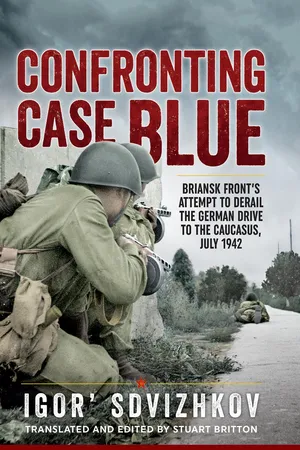
The author, Igor' Sdvizhkov, takes a close look at the attempt by the Briansk Front's Operational Group Chibisov to collapse the northern shoulder of the German drive to the Caucasus - north-west of Voronezh - in July 1942. Using both previously classified Soviet documents and German documents, Sdvizhkov focuses in particular on General A.I. Liziukov's role in the counteroffensive as commander of the 2nd Tank Corps after his 5th Tank Army was disbanded following failed counterattacks in early July. The Soviet attacks led to nine days of heavy see-saw fighting involving tens of thousands of men and hundreds of tanks and guns on both sides, and threatened to isolate the German forces holding Voronezh. Sdvizhkov also describes the German reaction to the initial penetration made by Operational Group Chibisov's offensive: a counterattack primarily with the forces of the 9th Panzer Division, which at the time of the new Soviet offensive, was in a reserve position - serving as a fire brigade. The German riposte blunted the Soviet attacks and encircled elements of Operational Group Chibisov, and ultimately stabilized the tottering German front north-west of Voronezh for the time being. General Liziukov would go missing during the 2nd Tank Corps' attack, and the author discusses why the Briansk Front and Operational Group Chibisov Command initially made little or no effort to find the General, Stalin's suspicions surrounding General Liziukov's disappearance and the results of the official wartime investigation of the matter. Sdvizhkov also addresses the numerous controversies that later ensued due to erroneous and/or misleading recollections, as well as the total inability to locate General Liziukov or his remains. Carefully examining the available evidence, Sdvizhkov offers a cogent and persuasive explanation of what happened.
eBook - ePub
Confronting Case Blue
Briansk Front's Attempt To Derail The German Drive To The Caucasus, July 1942
- 424 pages
- English
- ePUB (mobile friendly)
- Available on iOS & Android
eBook - ePub
Confronting Case Blue
Briansk Front's Attempt To Derail The German Drive To The Caucasus, July 1942
About this book
Information
Subtopic
Russian HistoryIndex
History1
And once again into battle …
Combat Order No.9 of the 2nd [Tank] Corps headquarters
Sedelki, 14:00 20 July Map 100:000
1. Up to two enemy infantry divisions with tanks are defending on the front: Ozerki – Don River. Up to two infantry regiments are defending the Bol’shaia Vereika, Hills 187.4 and 191.3 nest of resistance. Tanks have been dug into the ground. Minefields are in front of the forward line.
2. Supporting the advance of the 104th Rifle Brigade with fire and maneuver, the corps has the task to enter the breakthrough behind the 167th Rifle Division in the direction of Surikovo, Malaia Vereika, destroy the enemy’s infantry, artillery batteries and tanks in the area of Kaver’ia, Vereiskie Vyselki and Skliaevo-3 and to emerge in the Medvezh’e area. Subsequently push forward to the bridge across the Don River in Medvezh’e in order to destroy the reserves of the enemy’s Voronezh grouping.
3. I have decided that the 26th and 148th Tank Brigades are to exploit the breakthrough by the 167th Rifle Division and the 2nd Motorized Rifle Brigade in the direction of Bol’shaia Vereika. The 27th Tank Brigade is my reserve. Prior to the introduction of the corps into the breakthrough, support the attack of the 104th Rifle Brigade with fire or maneuver.
4. I am ordering:
A) The 26th Tank Brigade is to be ready to enter the breakthrough of the enemy’s defenses in the direction of Surikovo and Malaia Vereika, to destroy the enemy’s infantry, tanks and artillery in the area of Kaver’ia and Vereiskie Vyselki, and subsequently is to attack Medvezh’e. Intermediary assembly places are the northern outskirts of Kaver’ia, and then the northern patch of woods east of Medvezh’e.
B) The 148th Tank Brigade is to stand ready to exploit the breakthrough in the Surikovo – Malaia Vereika – Kaver’ia direction, to destroy the enemy’s infantry, tanks and artillery in the Rubtsovo, Skliaevo-3 area, and subsequently is to advance toward Medvezh’e on the 26th Tank Brigade’s right. Intermediary assembly places are Rubtsovo, and then the woods on the southern outskirts of Medvezh’e.
C) The 2nd Motorized Rifle Brigade with a company of T-60 tanks from the 27th Tank Brigade is to take up a jumping-off position by 2:00 21 July directly opposite the enemy defending Bol’shaia Vereika, and is to seize Bol’shaia Vereika in cooperation with the 104th Rifle Brigade and to secure the passage of the 27th Tank Brigade. Subsequently attack together with the 26th Tank Brigade.
D) The 27th Tank Brigade (minus the T-60 company) with the company of KV tanks is my reserve. As the corps enters the breakthrough, support the 104th Rifle Brigade’s attack with fire from fixed positions and accompany it with the T-60 tanks. The main areas for concentrated fire from the fixed positions are: Bol’shaia Vereika, Hill 191.3 and the woods east of Surikovo. Expend half of a combat load of ammunition on 21 July for firing from fixed positions. With the introduction of the corps into the breakthrough, be ready to advance behind the 148th Tank Brigade. Clear the minefields in front of the forward edge of Bol’shaia Vereika. With the arrival of the 26th and 148th Tank Brigades in the Kaver’ia area, the 27th Tank Brigade is to shift to the woods south of Surikovo. Subsequently, advance in the wake of the 148th Tank Brigade. The artillery preparation is to start at 3:30. The infantry attacks at 4:00. The 2nd Motorized Rifle Brigade’s chief of artillery is to organize centralized control of the 2nd Motorized Rifle Brigade’s artillery with the addition of the 27th [Tank Brigade]’s anti-tank battalion, having coordinated their actions with the 104th Rifle Brigade’s chief of artillery.
5. The signal for the start of the introduction of the tank brigades will be by radio: for the 148th Tank Brigade – “Storms”, for the 26th Tank Brigade – “Thunderstorm”, for the 27th Tank Brigade – “Lightning”, and will be repeated by the signals officer. Recognition signs with the air force will be white flags of a large dimension made out of sheets, underclothing and so forth, and green flares between our tank units.
6. The axis of communications, of combat supply and repair will be along the axis of movement: Verkhniaia Kolybelka, Murav’evka, Bol’shaia Vereika, Medvezh’e, Privol’e, Endovishche.
7. My command post from 1700 20 July will be in the patch of woods north of Dmitriashevskie Vyselki. When the 27th Tank Brigade crosses the Bol’shaia Vereika River, [my command post will be] with the 27th Tank Brigade.
Commander of the 2nd Tank Corps Hero of the Soviet Union
Guards Major General LIZIUKOV
Military Commissar Regimental Commissar ASSOROV
2nd Tank Corps chief of staff Colonel Nagaibakov1
Three days separated General Liziukov from the end of his 5th Tank Army’s failed operation and the start of a new operation – now as part of Briansk Front’s newly-formed operational group as commander of the 2nd Tank Corps. Seventy-two hours of rest between two offensives, in order to re-invigorate himself physically and emotionally after all that had happened over the previous two weeks, to restore his spirits and again commit the troops to battle. But through all this time, only little was left for him when he might catch his breath.
The restoration of strength and catch-up on sleep after the extraordinary exertions of the recent days and sleepless nights was hindered by concerns arising in connection with his new appointment, which could not be dumped on the shoulders of the commissar and chief of staff, from whom he had remained aloof after all that was happening. The army was being disbanded, and it was necessary to transfer files and papers (the headquarters of Briansk Front’s recently-formed operational group was taking over the premises of the 5th Tank Army headquarters in Slepukha) and drive to his new command post, in order to take command of the tank corps on the spot, having relinquished his command of the tank army. There is hardly any point in speaking about any emotional respite after the arrival of the Front’s order – Liziukov’s direct superior was now the same man, who just a week before had already “awarded” him with a stinging psychological slap in the face, having publicly accused him of cowardice. Now the former army commander would have to serve under the command of this same man.
Moreover, he was no longer the fresh and well-rested commander after spending three months in the rear, with the opportunity to see his family during trips to Moscow; he was not the rising commander, emboldened by prior successes and the highest trust of The Boss, but a physically exhausted and emotionally wrecked man, and in the eyes of other commanders an unsuccessful general as well, who had failed to carry out the task that had been entrusted to him.
With the disbanding of his army, Liziukov had to part from his commissar and chief of staff. While he faced a return to the front to fight once again, they together with the army’s headquarters were on their way to Vodop’ianovo in the rear. Whereas the 5th Tank Army’s chief of staff Colonel Drugov could now fully concentrate on the past, analyzing and studying the recently concluded operation in the quiet of his office, Liziukov, essentially, had no time to ponder the lessons of the recent fighting; he had to think about looming battles.
On the very same day of the order to disband the 5th Tank Army, the Commander-in-Chief of Briansk Front K.K. Rokossovsky gave the commander of the Front’s newly-formed operational group General Chibisov a directive to launch a new offensive. At the time, General Liziukov still wasn’t aware that his army was being disbanded, or that the next battle was already looming in front of him. He didn’t even have time to issue a farewell order to the 5th Tank Army, before he was to issue the order to the 2nd Tank Corps regarding the offensive. As far as working out the plan for the new offensive and pondering the received mission and the means for implementing it, he was hardly given any more time for all of this than he’d been granted prior to the 5th Tank Army’s recent star-crossed offensive. In fact, the operational directive to conduct the new operation was issued by Lieutenant General Rokossovsky on 17 July, but the commander of the operational group General Chibisov (due to hitches in the Front headquarters and problems with communications) didn’t receive it in Slepukha until 21:15 on 18 July, that is, on the evening of the following day!2 Briansk Front headquarters was requiring Chibisov to present the plan for the offensive on the morning of 19 July, while the offensive itself was to be launched between 20 and 24 July, but the operational group’s small headquarters was simply unable to prepare for the offensive in the remaining available hours.
After processing the received directive, the just-formed headquarters of the operational group hastily set to work on planning the operation, while simultaneously working to resolve a multitude of tasks with respect to establishing communications with the units subordinate to the operational group, arranging logistical support, and organizing their march and assembly in the jumping-off areas. The combat order for the operation was ready only on 20 July and distributed to the subordinate units with the demand to start the offensive at dawn on 21 July.3 Liziukov received this order in the tiny Don River hamlet of Sedelki, which was located almost 30 kilometers from the operational group’s headquarters in Slepukha. Considering as a rule the lengthy time required by the liaison officers to deliver the papers along the farm roads and cross-country, this left him in the best case only several hours to put together his own attack orders to the tank corps that had recently been entrusted to his command.
In these circumstances, taking into account as well the need to resolve the numerous questions regarding the organization of cooperation among the different types of troops, their resupply and communications, it is hardly possible to speak about any thorough elaboration of the operation’s conception and the development of a detailed plan for the offensive. The commanders of the subordinate brigades had even less time for any of this.
True, in distinction from the preceding operation, Liziukov didn’t face the thorny issue of moving his forces by rail – all of his brigades were already close to the area of forthcoming combat operations, which would finally allow him to launch a concentrated attack with all of his forces simultaneously, and not a piecemeal attack as he had made two weeks previously. There was also no Stavka insistence to keep part of his forces in deep reserve – now in command at a much lower rank, Liziukov’s own responsibility was accordingly much lower.
However, now a different problem arose: after its recent fighting as part of 5th Tank Army, the 2nd Tank Corps’ combat capabilities had diminished as a result of losses and the combat exhaustion of many units. Only the 26th Tank Brigade remained fresh and combat-ready; the remaining brigades needed replenishments and rest. However, instead of rest, they had to attack once again. (For the sake of justice it should be noted that the 7th and 11th Tank Corps, which had also fought as part of the 5th Tank Army, were so depleted and worn out that they were totally unable to take part in the new offensive; they remained in the rear for refitting. In comparison with them, the 2nd Tank Corps was in much better shape!)
Prior to the start of the 5th Tank Army’s operation, the 2nd Tank Cor...
Table of contents
- Cover
- Title
- Copyright
- Contents
- List of Photographs
- List of Maps
- Instead of a Prologue
- 1 And once again into battle …
- 2 The start of the operation: 21 July 1942
- 3 The enemy’s situation: 21 July 1942
- 4 The night of 21-22 July 1942
- 5 22 July 1942
- 6 The 148th Tank Brigade in the enemy rear
- 7 The fighting on the evening of 22 July 1942
- 8 The 2nd Tank Corps, 23 July 1942
- 9 23 July 1942 on the front of Operational Group Chibisov
- 10 Operational Group Chibisov’s reserve enters the fighting
- 11 At the command post of the 2nd Tank Corps on the night of 23/24 July 1942
- 12 A review of the enemy’s actions on 22 and 23 July 1942
- 13 24 July 1942
- 14 25 July 1942
- 15 A review of the enemy’s actions, 24-25 July 1942
- 16 26 July 1942
- 17 A review of the enemy’s actions on 26 July
- 18 27 July 1942
- 19 The end of the operation
- 20 Liziukov’s Fate
- Conclusion
- Afterword
- Appendices
- Bibliography
- Plate section
Trusted by 375,005 students
Access to over 1.5 million titles for a fair monthly price.
Study more efficiently using our study tools.
Frequently asked questions
Yes, you can cancel anytime from the Subscription tab in your account settings on the Perlego website. Your subscription will stay active until the end of your current billing period. Learn how to cancel your subscription
No, books cannot be downloaded as external files, such as PDFs, for use outside of Perlego. However, you can download books within the Perlego app for offline reading on mobile or tablet. Learn how to download books offline
Perlego offers two plans: Essential and Complete
- Essential is ideal for learners and professionals who enjoy exploring a wide range of subjects. Access the Essential Library with 800,000+ trusted titles and best-sellers across business, personal growth, and the humanities. Includes unlimited reading time and Standard Read Aloud voice.
- Complete: Perfect for advanced learners and researchers needing full, unrestricted access. Unlock 1.5M+ books across hundreds of subjects, including academic and specialized titles. The Complete Plan also includes advanced features like Premium Read Aloud and Research Assistant.
We are an online textbook subscription service, where you can get access to an entire online library for less than the price of a single book per month. With over 1.5 million books across 990+ topics, we’ve got you covered! Learn about our mission
Look out for the read-aloud symbol on your next book to see if you can listen to it. The read-aloud tool reads text aloud for you, highlighting the text as it is being read. You can pause it, speed it up and slow it down. Learn more about Read Aloud
Yes! You can use the Perlego app on both iOS and Android devices to read anytime, anywhere — even offline. Perfect for commutes or when you’re on the go.
Please note we cannot support devices running on iOS 13 and Android 7 or earlier. Learn more about using the app
Please note we cannot support devices running on iOS 13 and Android 7 or earlier. Learn more about using the app
Yes, you can access Confronting Case Blue by Igor' Sdvizhkov, Stuart Britton in PDF and/or ePUB format, as well as other popular books in History & Russian History. We have over 1.5 million books available in our catalogue for you to explore.