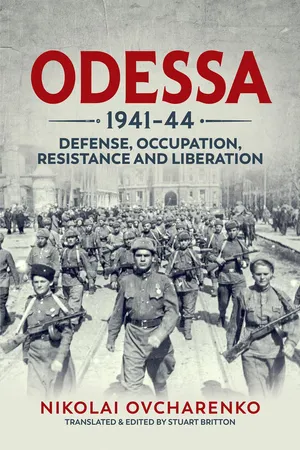
After a brief overview of the origins and development of the city of Odessa on the Black Sea Coast, author Nikolai Ovcharenko turns to its citizens' ordeal during the Second World War. In the process, he describes the heroism of the city's defenders and residents in the summer of 1941 on the land, sea and in the sky, when defending against insistent Romanian attacks. Exploiting the numerous estuaries on the Black Sea coastline, which served as natural defensive lines, under the weight of numerically superior Romanian forces, Odessa's defenders successively, fell back into the city of Odessa itself. Once the situation became critical, a valiant counterattack in part with naval infantry gained valuable space and time for Odessa. Eventually, at a time when German forces had advanced far to the east and were approaching the critical naval base of Sebastopol in the Crimea, the decision was made to evacuate the remaining Soviet forces from Odessa. There ensued more than two years of occupation and underground resistance; the partisans and activists made use of the extensive catacombs underneath the city of Odessa. The occupiers scored successes against the underground movement, which Ovcharenko details in succeeding chapters using contemporary newspapers and interviews with surviving eyewitnesses, but were never able to stamp out resistance completely. Finally, in the spring of 1944, Odessa was liberated by forces of the advancing Third Ukrainian Front. Ovcharenko describes this offensive against forces of the resurrected German Sixth Army.
eBook - ePub
Odessa 1941-44
Defense, Occupation, Resistance and Liberation
- 196 pages
- English
- ePUB (mobile friendly)
- Available on iOS & Android
eBook - ePub
About this book
Information
Topic
HistoireSubtopic
Histoire de la Russie1
The Sources of Odessa’s Military Valor
1.1 Odessa’s Military History
Odessa is one of Ukraine’s four famous Hero-cities. Each city, just like each person, has his or her own genealogy, biography, profession, and unique appearance. The Hero-city with over a million residents is a bearer of age-old military and labor traditions. As Odessans themselves like to say, Odessa was born in a sailor’s striped shirt and with a gun in its hands. A lot of brave warriors over the course of centuries have enriched its glory.
The history of the lands of the Black Sea area was difficult and harsh. The first traces of human activity belong to the Upper Paleolithic era (40 to 60 thousand years ago) – a hunting camp of Neanderthals in a cave near the village of Il’inka, 20 kilometers north of Odessa, on the right bank of the Kual’nitskii estuary. Five thousand years ago, on the territory of Usatovo near Odessa, there was a large Bronze Age settlement with enormous burial mounds nearby – these were the first burial structures discovered in the entire Black Sea steppe. In honor of the village where the first archeological diggings were made, the indigenous archeological culture was labeled “Usatov”, although it covered much of present-day Romania and Moldavia. The Usatovs drew upon the Tripolitans for their ceramics and manner of residence construction, and adapted the alien steppe-dwellers’ practice of raising kurgans above the graves of their ancestors. From these places, the Usatovs migrated to the Balkans, where they played a role in the origin of the local ethnic groups – the ancient Greeks and Phrygians.
The ancient predecessor of Odessa (2,500 years ago) is the ancient Greek city of Gavan Istrian. Its remnants were preserved under the coastal boulevard and the city’s central section, while its port was situated where today’s Harbor Terminal stands. On the Zhevakhov Hill, which rises between the Kual’nitskii and Khadzhibeiskii estuaries, there was a grandiose Ancient Greek temple in the fifth and sixth centuries dedicated to the goddess of fruitful soil and agriculture – Demeter. The residents of the city were primarily fishermen, and traded actively with the neighboring Scythians for grain and with Ancient Greece for goods and wares. The life of the ancient villages and cities on the northwest coast of the Black Sea came to an end with the invasion of savage nomadic tribes of Huns in 375. For long centuries, the land around the Gulf of Odessa was converted into the unpopulated “Wild Steppes”.
During the time of Ancient Rus’, eastern Slavs were living on the northern coast of the Black Sea. Then in the XIII Century they were driven out by the Mongol-Tatar hordes. When the Golden Horde fell into decline, in the 1460s the land of the northwestern coast of the Black Sea became part of the fiefdom of the Grand Duchy of Lithuania. The port of Kabichei was built where Odessa now stands; the first mention of it was made in 1415 by the famous Polish chronicler Ia. Dlugosch.1 Already at that time, it was a relatively large port, from whence grain was primarily shipped. A castle was also built on the grounds of the settlement.2
At the end of the XVth Century, the Black Sea lands were seized by the Ottoman Empire, and from this time the settlement is often mentioned as Khadjibey [Kocibey]. From here the Turks launched raids into Ukraine, plundering and driving thousands of young men and women for eventual sale into slavery, like cattle or objects. In the latter half of the XVIIIth Century, at the behest of the Turkish government, French engineers built a fortress and named it Yeni-Dünya (New Light). This fortress was repeatedly attacked by Ukrainian Cossacks from Zaporozh’e – in 1769, 1770 and in 1774, when it was finally taken. However, according to the terms of the Treaty of Küçük Kaynarca, the fortress was returned to the Turks. The population of Khadjibey was growing; Ukrainians, Greeks, Armenians and others took up residence here. After the defeat of the Zaporizhian Sich [several Cossack keeps on the Dnepr River] at the hands of Catherine the Great’s troops in 1775, the former Ukrainian Cossacks were resettled on the territory of Peresyp’ and Nerubaiskii, not far from Khadjibey.3 Grain, delivered from the Dniester lands and Podolia, was shipped out of the harbor.
During the Russian-Turkish War of 1787-1792, on 14 September 1789, a forward detachment of Major General José de Ribas (known as Osip Mikhailovich Deribas in Russia), consisting of Russian troops and detachments of Black Sea Cossack troops, which were formed from the former Zaporozhian Cossacks, fully seized Khadjibey in a daring night assault, which up to this point served as the base of the entire Turkish fleet. In the course of this war, through the joint operations of Russian forces and Ukrainian Black Sea Cossacks, great victories were achieved at Kinburn, Focsani and Rimnik, and important Turkish fortresses were taken: Ochakov, Bender, Akkerman, and Izmail. The newly created Black Sea Fleet under the command of F.F. Ushakov achieved its first victories, primarily thanks to the skillful actions of the Cossack flotilla led by Attamans Sidor Belyi and Fedor Golovatyi, who ensured the destruction of the Turkish fleet and the capture of the Ochakov and Izmail fortresses.
In December 1792, Turkey was compelled to sign the Treaty of Jassy [Iași], which returned the Crimea to Russia, as well as the entire northern coast of the Black Sea from the Dniester River to the Kuban. The access to the Black Sea had enormous economic, political and military significance for the Russian Empire.
The Khadjibey’s convenient bay permitted the construction of a fortress and port here. The fortress began construction in 1793 under the guidance of A.V. Suvorov, while work on the city began in 1794 according to the plan of Franz Devolan. In the detailed draft of the design he noted that maritime traffic “could move year-round despite any winds”, and that it was suitable “to base an acting fleet in wartime and to build a harbor for trade with the wealthy provinces of Podolia, Vohlynia [Volyn] and Galicia bordering the Dniestr.”4 F. Devolan’s design was approved by Catherine the Great, and construction of the military harbor “integrated with a quay for merchant shipping” began pursuant to “the highest decree”. Major General De Ribas and engineer for port construction Colonel Devolan, under the supervision of A.V. Suvorov, received the assignment to build the harbor and city in five years. At this time, only 8 men and 2 women were counted in the newly conceived city at Khadjibey, for which 30,200 arpents [an old French unit of area equal to about one acre] were set aside.5 On 2 September 1794, the first trench was ceremoniously dug, which would mark the layout of the streets of the new city, and stones for the foundation of the first building were set in place. This day in fact became the birthday of the new city. It was bestowed with the name of Odessa, after the name of the Greek colony of Odesos, which was thought to have existed nearby at one time.6
The port began to operate almost as soon as the first dock supports were set in place. In 1794, it took in seven merchant ships, in 1795 – 39, and in the following year – 86. Grain and fleece for shipment abroad arrived here along the Dnepr, Bug and Dniester Rivers by horse-drawn transport. In 1805, the port took in 666 foreign and 496 coastal ships, and 120,000,000 kilograms of wheat was shipped away.
Together with the port, the city’s population also quickly grew. By 1797, there were now 346 homes, 223 earthen dugouts and various stone buildings here.7 Soldiers and peasants who had fled to the south to escape the oppression of serfdom were building the city. In 1797, its population, excluding the garrison, amounted to 4,753, including Black Sea Cossacks and their families (187 men and 108 women) who had settled here.8
In 1858, the population of Odessa reached 104,000, the third largest city in the Russian Empire by population. Serfdom stimulated the intensive movement of fugitive Ukrainian and Russian serfs, tradesmen and petty merchants from many places of the right-bank Ukraine and Belorussia to the city. After completing their service, Russian and Ukrainian soldiers and officers were granted land and settled here. Greeks and Bulgarians fled to Odessa to escape the Turkish yoke. Italian, Serbian, Slovakian and Polish peasants and tradesmen found shelter here from their persecutors. The Tsarist government, which had become interested in assimilating the vast Black Sea coastal area and the development of foreign trade, was motivated to offer significant financial incentives to working people in order to attract a labor force. Passports weren’t demanded of the fugitive peasants; homeless wanderers received accommodations; people of different faith weren’t subjected to religious persecution; and after 1834, the so-called “Volunteer Sailors”, those who willingly signed up for the organization, were freed from paying special taxes, the obligation to provide accommodations to military personnel when needed, and the obligation to provide recruits from their communities.9 However, the conditions of work at the port and on construction sites were miserable. The shortage of potable water, the overcrowded living conditions in damp barracks and the very poor diet led to a high mortality rate among the builders of the city.10
The hard living conditions, though, didn’t break the freedom-loving spirit of its builders and settlers, but rather fortified it, and strengthened their desire for freedom and social justice. Already in the first years of its life, Odessa became a center of the revolutionary and national liberation movement of the Greek and southern Slav peoples. In 1814, a secret Greek national organization called Filiki Eteria [“Company of Friends”] was founded here, and its members planned a rebellion of the Greek people against Turkish rule. Later, the “Odessa Bulgarian Rector” was founded here, which became a center of the Bulgarian social and cultural movement. The Italian revolutionary D. Garibaldi repeatedly visited Odessa. The Polish poet A. Mickiewicz lived in exile here. The names of many of the Decembrists were connected with Odessa: P.I. Pestel’, M.S. Lunin, M.F. Orlov, V.F. Raevsky, A.V. Podzhno, and A.O. Kornilovich. In 1825, when the secret Decembrist societies were uncovered, Tsar Nikolai I gloomily observed, “from all appearances it is obvious that there must be a nest of conspirators in Odessa ….”11
Already in the first decades of its existence, Odessa became a significant cultural center. The first city theater opened in 1809, in which the Italian opera and leading Russian and Ukrainian dramatic troupes performed. The Rishel’evsky Lyceum, which subsequently grew into Novorossisk University, was founded in Odessa in 1817. The second public library in the Russian Empire (after the one in Petersburg) opened here, which with the passage of time became a genuine “free university” for many generations of city residents. Philharmonic and historical societies formed here. Periodic literature began to be published in Odessa in 1820, including the popular Odessa Almanacs, and print shops were opened. A.S. Pushkin resided in Odessa for more than a year, after being exiled to the south by the Tsar for his freedom-loving verses. Here he finished his work on The Fountain of Bakchisaray, began work on his narrative poem Tsygane [The Gypsies], wrote the first chapters of his verse novel Evgenii Onegin, and penned many lyrical poems, which widely circulated in the city. In the first half of the XIXth Century, the talented architects and sculptors Francesco Boffo, Thomas de Thomon, Frants Fr...
Table of contents
- Cover
- Title
- Copyright
- Contents
- List of Photographs
- List of Maps
- Preface: A People’s War
- 1 The Sources of Odessa’s Military Valor
- Part I The Defense of Odessa 1941
- 2 The situation on the Southern Front in the summer of 1941
- 3 Defensive fighting on the distant approaches to the city
- 4 The fighting on the nearest approaches to the city
- 5 Tanks in the battle for Odessa
- 6 The joint counterattack by the defenders of Odessa and the stabilization of the front
- 7 The evacuation of the Odessa defensive area
- Part II The Occupation and Liberation of Odessa 1941-44
- 8 Odessa under occupation
- 9 Odessa resists the occupation
- 10 The 3rd Ukrainian Front’s Odessa offensive and the liberation of Odessa
- 11 Odessa rises from the ruins
Trusted by 375,005 students
Access to over 1.5 million titles for a fair monthly price.
Study more efficiently using our study tools.
Frequently asked questions
Yes, you can cancel anytime from the Subscription tab in your account settings on the Perlego website. Your subscription will stay active until the end of your current billing period. Learn how to cancel your subscription
No, books cannot be downloaded as external files, such as PDFs, for use outside of Perlego. However, you can download books within the Perlego app for offline reading on mobile or tablet. Learn how to download books offline
Perlego offers two plans: Essential and Complete
- Essential is ideal for learners and professionals who enjoy exploring a wide range of subjects. Access the Essential Library with 800,000+ trusted titles and best-sellers across business, personal growth, and the humanities. Includes unlimited reading time and Standard Read Aloud voice.
- Complete: Perfect for advanced learners and researchers needing full, unrestricted access. Unlock 1.5M+ books across hundreds of subjects, including academic and specialized titles. The Complete Plan also includes advanced features like Premium Read Aloud and Research Assistant.
We are an online textbook subscription service, where you can get access to an entire online library for less than the price of a single book per month. With over 1.5 million books across 990+ topics, we’ve got you covered! Learn about our mission
Look out for the read-aloud symbol on your next book to see if you can listen to it. The read-aloud tool reads text aloud for you, highlighting the text as it is being read. You can pause it, speed it up and slow it down. Learn more about Read Aloud
Yes! You can use the Perlego app on both iOS and Android devices to read anytime, anywhere — even offline. Perfect for commutes or when you’re on the go.
Please note we cannot support devices running on iOS 13 and Android 7 or earlier. Learn more about using the app
Please note we cannot support devices running on iOS 13 and Android 7 or earlier. Learn more about using the app
Yes, you can access Odessa 1941-44 by Nikolai Ovcharenko, Stuart Britton in PDF and/or ePUB format, as well as other popular books in Histoire & Histoire de la Russie. We have over 1.5 million books available in our catalogue for you to explore.