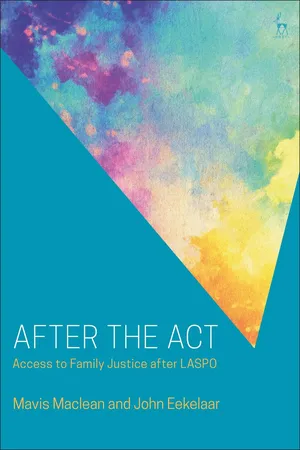
After the Act describes the aftermath of the recent removal under LASPO of public funding from legal services in family matters other than in defined cases such as child protection and domestic abuse. Through analysis of the policy context, interviews with key players, observation of services provided by lawyers, students, lay support workers and the advice sector, the authors outline the work being done and the skills being used in a range of settings.
The book raises questions not only about access to family justice, but about the role of law in family matters in an increasingly post-legal society.
Fragmentation of the market in the new services offering information, initial advice, online or alternative dispute resolution – but rarely ongoing casework – raises questions about where costs fall and how quality can be assured. Many of these services are forms of private ordering, where outcomes are hard to assess.
If neither the state nor the individual can afford full legal services where the best interests of any child involved are of paramount importance, and lawyers negotiate to make best use of the resources available, perhaps it is time to consider using lawyers differently, with lay support, to solve problems before they become disputes.
- 208 pages
- English
- ePUB (mobile friendly)
- Available on iOS & Android
eBook - ePub
About this book
Information
1
Family Legal Problems and the Collapse of the Supportive State
I.Introduction
The Legal Aid, Sentencing and Punishment of Offenders Act (LASPO) 2012 removed private family law matters, with a few exceptions, from the scope of publicly funded legal help and representation. In 2017 its effects on all areas affected by the legal aid reforms (not just family) were closely examined in a Memorandum submitted by the Ministry of Justice to Parliament’s Justice Committee as the first stage in the post-implementation review of the Act which began to collect information in March 2018.1 In January 2015, the Ministry of Justice had been criticised in the Thirty-Sixth Report of the House of Commons Public Accounts Committee2 over the lack of evidence about the effects of the legal aid changes. In March 2015 the House of Commons Justice Committee3 reviewed the stated objectives for the reforms, namely: (1) to discourage unnecessary adversarial litigation; (2) to target legal aid at those most in need; (3) to make substantial savings in legal aid expenditure; and (4) to bring about better value for money for the taxpayer. It concluded that, while the reforms had succeeded in making significant savings in the cost of the scheme, they had not achieved the other three out of the four objectives and indeed had harmed access to justice for some litigants.
The Memorandum sought to assess the changes against the four declared objectives of the reforms. As regards objective (1), the Memorandum acknowledged the failure to divert family cases to mediation and to reduce family court proceedings. But it noted the difficulty in attributing this to LASPO,4 as it did the difficulty in evaluating the success of (2).5 (3) had clearly been achieved,6 but insofar as assessing (4) required looking at society as a whole, that would require considering the overall impact of the reforms ‘on organisations such as charities, advice providers, individuals with justice problems and so on’ which was a ‘difficult task’ requiring cost-benefit analysis.7 However, in the Terms of Reference of the Evidence Gathering Exercise for the Review it is concluded that ‘it is right that the government takes the time to assess the extent to which the objectives of the LASPO changes were achieved. In addition, this process of consultation and engagement with interested parties also represents an opportunity for the government to consider what the future should look like’.8
This book does not purport to undertake those difficult tasks. However, it does try to throw light on how those reforms have altered the forms of assistance that may be available to those experiencing what can generally be described as ‘family’ problems of a legal nature which do not involve the state (as in child protection cases) and who lack the resources to purchase such help. While we cannot supply any kind of sophisticated cost-benefit analysis, we are able to suggest how actual or incipient changes in professional roles might develop in response to the reforms, which have implications for public expenditure, the experience of citizens in need and the place of law in situations of family discord.
Much has been written about LASPO9 and we will not spell out all the details, although we will provide a brief account of the background so the changes it has brought about can be seen in a wider perspective. We start by presenting data on the nature and scope of the issues with which we are concerned.
II.The Scope of the Problem
The problems or issues with which we are concerned might arise when a dispute or uncertainty arises over how parties in a family or family-type relationship should be required to behave towards each other. The words ‘be required’ suggest that the obligation is one that could reasonably be considered to be recognised by the law, and is thus a legal problem, and it may be necessary to obtain advice as to whether it is so recognised. That itself is a legal question.
It is not easy to quantify the extent to which individuals experience the types of problem which could be legal problems as described above. Hazel Genn’s pioneering study10 aimed to elicit the extent to which people experienced a ‘justiciable’ problem over the period 1992–96 (five years) by asking specific questions in face-to-face interviews. The study covered a wide range of problems that people encounter, including those arising from family-type relationships. The questions included whether the respondent ‘or your wife/partner’ had been involved in divorce proceedings since January 1992, and if so, whether they had problems concerning division of money/property, payment of maintenance/child support, fostering or adopting a child, domestic violence, or inheritance;11 or residence or contact regarding children under 18, child protection, abduction, ‘or your child going to the school you want’.12 These were reduced down to incidence figures for the whole sample of 4,125 respondents as 6 per cent having ‘relationship’ problems, 4 per cent divorce proceedings, and 3 per cent children problems.13 There could be overlap between the categories, so the total incidence is probably 6 per cent or a little above. People across all income groups who experienced divorce or separation problems were more likely than people who experienced any other problem (eg, concerning faulty goods, employment difficulties, accidents or property issues) to seek advice, most often from a solicitor. They were the least likely to do nothing (‘lump it’).14
More recent information can be found in the English and Welsh Civil and Social Justice Surveys, based on face-to-face interviews of respondents from a survey of 10,537 adults drawn from a random selection of 6,234 household addresses across 390 postcode sectors in England and Wales. The survey published in 2010 gives figures given in Table 1 for surveys conducted in 2004 and 2006–09 of the percentages of respondents experiencing the listed ‘civil justice problems’ that had been ‘difficult to resolve’ in the preceding three years.15 The survey published in 2013, also using face-to-face interviews, gives (for the period 2009–11) the information given in Table 2 for respondents who had experienced the stated ‘problems’ in the preceding 18 months (the words ‘difficult to resolve’ had been dropped). Wave 1 respondents were interviewed between June and October 2010; wave 2 respondents 18 months later.16
Table 1 Respondents experiencing civil justice problems

Table 2 Prevalence of civil justice problems

In 2016, Ipsos Mori published a large online survey of legal needs on behalf of the Law Society. 54 per cent of the 8,912 respondents had experienced ‘issues or problems’ over the past three years, and, of those, Table 3 gives the proportions who experienced problems on family-related issues.17
Table 3 Percentage of respondents experiencing issues or problems that were family-related

Since these proportions are of those who experienced some problem (about half of the total), the figures should be halved to represent proportions of the total. There will also be overlap between these categories, so the proportion experiencing problems associated with relationship breakdown would be 5 per cent or at most a little over. Finally, the Legal Problem and Resolution Survey (LPRS) 2014–15, published by the Ministry of Justice in 2017,18 gives a figure of one per cent for an 18 month period across 2014–15 of those experiencing ‘family problems’ that ‘people might encounter in everyday life’ arising from relationship breakdown, such as division of property, financial arrangements and access to and care of children. It does not mention domestic violence. However, a further one per cent should be added for those who divorced, even though this did not represent a ‘problem’,19 giving a total of two per cent. The survey was conducted by telephone with 10,058 respondents.
What can explain the differences in these results? One factor is the period over which respondents were asked to report their experiences. Genn’s respondents reported experiences going back six years. The Law Society/Ipsos Mori reports, as well as those in the English and Welsh Civil and Social Justice Survey of 2010 covered three years, whilst the Wave 2 Survey and the LPRS respondents only reported on the last 18 months. One would expect respondents to report fewer experiences if reporting on a shorter time period. Still, it can perhaps be said that the problems with which we are concerned are probably experienced by somewhere between four and six per cent of the population20 over a three year period, though of course a much larger portion of the population would experience this over a lifetime. It is also striking that people who did experience family problems as opposed to consumer or other problems were either the most likely or among the most likely to seek professional advice.21
In order better to understand how policies regarding the role of the legal system in these matters and the public support to be provided for its use have changed, we give a short account of the background to recent developments regarding legal aid in England and Wales.
III.The Post-War Changes to Legal Aid
While it is now widely accepted that the state should support an individual’s access to the law when they come into conflict with the state, this view is of relatively recent origin. Provision for legal assistance for poor prisoners has historically been abysmal, if only because of their restricted rights during trial. Only after 183622 could lawyers address the court on behalf of the defendant in a jury trial, if the defendant could afford it, unless he could take advantage of the bizarre custom of the ‘dock brief’, allowing a defendant in the dock to select a barrister who happened to be in court and gowned to act for him. Statutes in 1903 and 1930 allowed courts (including magistrates’ courts) to grant legal aid in ‘grave cases’ if they pleaded not guilty and disclosed their defence23 and in 1930 this was extended to those pleading guilty. Payment would be from local funds at a fixed rate.
The Rushcliffe Committee Report, published in May 1945,24 laid the foundations for the post-war legal aid system. Tamara Goriely has pointed out that its publication, a month after the German surrender in World War II,25 reflected a time when confidence in ...
Table of contents
- Cover
- Preface
- Contents
- 1. Family Legal Problems and the Collapse of the Supportive State
- 2. Government Activity After LASPO
- 3. The Response of the Legal Professions to LASPO: I Solicitors’ Innovative and Pro Bono Activity
- 4. Legal Advice Clinics: Observational Data
- 5. The Response of the Legal Professions to LASPO: II Barristers in Action Pro Bono
- 6. Judicial Initiatives
- 7. Support in Court by Non-Lawyers
- 8. The Student Contribution: Clinical Legal Education
- 9. The Third Sector
- 10. Public Legal Education – Legal Capability and the Boundaries of Lawr
- 11. A Post-Legal World for Family Disputes?
- Bibliography
- Index
Trusted by 375,005 students
Access to over 1.5 million titles for a fair monthly price.
Study more efficiently using our study tools.
Frequently asked questions
Yes, you can cancel anytime from the Subscription tab in your account settings on the Perlego website. Your subscription will stay active until the end of your current billing period. Learn how to cancel your subscription
No, books cannot be downloaded as external files, such as PDFs, for use outside of Perlego. However, you can download books within the Perlego app for offline reading on mobile or tablet. Learn how to download books offline
Perlego offers two plans: Essential and Complete
- Essential is ideal for learners and professionals who enjoy exploring a wide range of subjects. Access the Essential Library with 800,000+ trusted titles and best-sellers across business, personal growth, and the humanities. Includes unlimited reading time and Standard Read Aloud voice.
- Complete: Perfect for advanced learners and researchers needing full, unrestricted access. Unlock 1.5M+ books across hundreds of subjects, including academic and specialized titles. The Complete Plan also includes advanced features like Premium Read Aloud and Research Assistant.
We are an online textbook subscription service, where you can get access to an entire online library for less than the price of a single book per month. With over 1.5 million books across 990+ topics, we’ve got you covered! Learn about our mission
Look out for the read-aloud symbol on your next book to see if you can listen to it. The read-aloud tool reads text aloud for you, highlighting the text as it is being read. You can pause it, speed it up and slow it down. Learn more about Read Aloud
Yes! You can use the Perlego app on both iOS and Android devices to read anytime, anywhere — even offline. Perfect for commutes or when you’re on the go.
Please note we cannot support devices running on iOS 13 and Android 7 or earlier. Learn more about using the app
Please note we cannot support devices running on iOS 13 and Android 7 or earlier. Learn more about using the app
Yes, you can access After the Act by Mavis Maclean,John Eekelaar in PDF and/or ePUB format, as well as other popular books in Law & Family Law. We have over 1.5 million books available in our catalogue for you to explore.