An essential companion to a timeless spiritual classic
The Lotus S?tra is among the most venerated scriptures of Buddhism. Composed in India some two millennia ago, it asserts the potential for all beings to attain supreme enlightenment. Donald Lopez and Jacqueline Stone provide an essential reading companion to this inspiring yet enigmatic masterpiece, explaining how it was understood by its compilers in India and, centuries later in medieval Japan, by one of its most influential proponents.
In this illuminating chapter-by-chapter guide, Lopez and Stone show how the s?tra's anonymous authors skillfully reframed the mainstream Buddhist tradition in light of a new vision of the path and the person of the Buddha himself, and examine how the s?tra's metaphors, parables, and other literary devices worked to legitimate that vision. They go on to explore how the Lotus was interpreted by the Japanese Buddhist master Nichiren (1222–1282), whose inspired reading of the book helped to redefine modern Buddhism. In doing so, Lopez and Stone demonstrate how readers of sacred works continually reinterpret them in light of their own unique circumstances.
An invaluable guide to an incomparable spiritual classic, this book unlocks the teachings of the Lotus for modern readers while providing insights into the central importance of commentary as the vehicle by which ancient writings are given contemporary meaning.
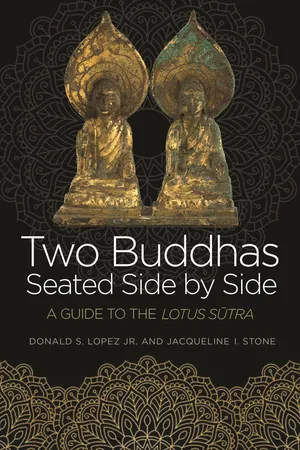
eBook - ePub
Two Buddhas Seated Side by Side
A Guide to the Lotus Sūtra
- 320 pages
- English
- ePUB (mobile friendly)
- Available on iOS & Android
eBook - ePub
About this book
Information
Publisher
Princeton University PressYear
2019Print ISBN
9780691227948
9780691174204
eBook ISBN
9780691189802
Topic
Theology & ReligionSubtopic
Asian HistoryCHAPTER ONE
Introduction
The Lotus Sūtra begins, like almost all Buddhist sūtras, with the statement, “Thus have I heard” (3). This is meant to indicate its authenticity, as something heard by the narrator from the Buddha himself. The narrator is typically considered to be Ānanda, the Buddha’s cousin and personal attendant, the monk who was most often in the Buddha’s presence and thus heard his many teachings. When Ānanda agreed to serve as the Buddha’s attendant, he asked that the Buddha repeat to him any teachings that he might not have been present to hear. According to tradition, after the Buddha’s death, a council of five hundred enlightened monks was convened to compile his teachings. Ānanda was asked to recite all of the sūtras that he had heard; he is said to have heard 84,000 teachings, which took seven months to recite. He began his recitation of each sūtra with the phrase, “Thus have I heard.”
The words “Thus have I heard” at the beginning of the Lotus Sūtra are thus hardly surprising, except for the fact that Ānanda did not hear the Lotus Sūtra. In fact, scholars are unsure as to exactly what Ānanda heard, as nothing that the Buddha taught was written down for some four centuries after his death. Although accounts of the so-called first council at which Ānanda’s prodigious memory was on display have likely been highly mythologized, most scholars assume that at least some of the teachings preserved in the early canons derived from the Buddha himself. The Lotus Sūtra, however, was not composed until long after the Buddha’s, and Ānanda’s, time. As we shall see, the Lotus Sūtra is obsessed, perhaps above all, with its own legitimation, with an almost palpable anxiety to prove that it was spoken by the Buddha. That obsession is evident from the first three words of the Sanskrit text: evaṃ mayā śrutam, “thus have I heard.”
The next standard element of a Buddhist sūtra is a statement of the location where the Buddha delivered the discourse. There are a number of standard places, including Jetavana, a grove in the city of Śrāvastī, as well as the Gabled Hall in the Great Wood near Vaiśālī. Many sūtras are said to have been taught on Vulture Peak (Gṛdhrakūṭa), near the city of Rājagṛha in the kingdom of Magadha. Traditional etymologies say that it was so named because it is shaped like the head of a vulture or because many vultures inhabited a nearby charnel ground. Translations from the Chinese or Japanese often render this name as Eagle Peak. In a second effort at legitimation, the preaching of the Lotus Sūtra (like the Perfection of Wisdom sūtras) is set at Vulture Peak.
A third element in the opening to a sūtra is a description of the audience. Here the Lotus Sūtra again follows the conventional form, stating that the audience comprises twelve thousand monks, all of whom have achieved the state of the arhat, or “worthy one,” someone who has followed the path to its conclusion, has destroyed all causes for future rebirth, and will enter final nirvāṇa at death. To provide specificity, twenty-one of these twelve thousand are mentioned by name. They include the Buddha’s most famous disciples, such as Mahākāśyapa, who would convene the first council to compile the teachings after the Buddha’s death; Mahāmaudgalyāyana, the monk foremost in supernatural powers; Śāriputra, the monk foremost in wisdom; and Rāhula, the Buddha’s only son, conceived before he renounced the world. Also in attendance is the Buddha’s foster mother Mahāprajāpatī, who had convinced him to establish the order of nuns and who had become a nun, and an arhat, herself. She is accompanied by six thousand attendants. Also present is Yaśodharā, the Buddha’s former wife, who is also a nun and an arhat. Another two thousand monks are also in attendance, some who have reached the rank of arhat and others who have not.
Up to this point, the members of the audience would be entirely familiar to those who knew the canon, the texts accepted as authoritative by the Buddhist mainstream. What is different is the numbers. Works in the Pāli canon, for example, do not include such multitudes when describing the audience of a sūtra. Readers of the text who had visited the sacred sites would know that Vulture Peak is more hill than peak; it is difficult to imagine a crowd of twenty thousand monks and nuns seated at its small summit, or how the members of such a huge assembly could hear the Buddha. The size of the Lotus Sūtra’s audience is the first sign of something extraordinary. A second sign is a second constituency within the audience: eighty thousand bodhisattvas.
In the early Buddhist tradition, and in what scholars have come to call “mainstream Buddhism” (that is, non-Mahāyāna), there are three paths to enlightenment. The first is the path of the śrāvaka or disciple (literally, “listener”), one who listens to the teachings of the Buddha, puts them into practice, and eventually achieves the state of the arhat, entering final nirvāṇa at death. The second is the path of the pratyekabuddha, or “solitary enlightened one.” Pratyekkabuddhas are rather enigmatic figures in Buddhist literature, said to prefer a solitary existence, achieving their liberation at a time when there is no buddha in the world. Having achieved their enlightenment, they do not teach others. The third path is that of the bodhisattva, a person capable of achieving the state of an arhat but who instead seeks the far more difficult and distant goal of buddhahood, perfecting himself over many billions of lifetimes so that he may teach the path to liberation to others at a time when it has been forgotten. Thus, a bodhisattva only achieves buddhahood at a time when the teachings of the previous buddha have faded entirely into oblivion, a process that takes many millions of millennia. Different versions of the tradition say that Śākyamuni Buddha, the buddha who appeared in India some two thousand five hundred years ago, was the fourth, the seventh, or the twenty-fifth buddha to appear in our world during the present cosmic age. There is a bodhisattva, Maitreya, said to be waiting in the Tuṣita (“Satisfaction”) heaven to be the next buddha, who will appear in our world when the teachings of our buddha have been completely forgotten, something that will not occur for millions of years. Śākyamuni and other, prior buddhas were bodhisattvas before their enlightenment. In the present age, mainstream Buddhism essentially recognizes only a single bodhisattva: Maitreya. The audience of the Lotus Sūtra, however, has eighty thousand bodhisattvas. The sūtra tells us that these eighty thousand bodhisattvas have “paid homage to countless hundreds of thousands of buddhas” (3), far more than four, seven, or twenty-five. The text lists eighteen of these bodhisattvas by name. They include two who would become the most famous in the Mahāyāna pantheon: Avalokiteśvara and Mañjuśrī. And they include the only bodhisattva whose name would have been recognized and whose existence would have been accepted by all: again, Maitreya. Thus, on the first page of the sūtra, a reader familiar with the canon would have been comforted by the familiar opening phrase and the familiar setting, only to be dumbfounded, and perhaps confounded, by the size and composition of the audience, an audience that grows even further as one reads on, with all manner of gods and demigods arriving from their various heavens, each with hundreds of thousands of attendants. Also present is one human king, Ajātaśatru, apparently after he had repented the murder of his father, the Buddha’s patron and friend, Bimbisāra, king of Magadha.1
With the audience having been enumerated, the Buddha then teaches a Mahāyāna sūtra identified in Sanskrit as Mahānirdeśa. However, nothing of the content of that teaching is provided, and mahānirdeśa is a generic term that simply means “great instruction.” Kumārajīva’s Chinese translation, however, renders this as “a Mahāyāna sūtra named Immeasurable Meanings,” and by the fifth century, a text purporting to be this very sūtra was circulating in China, also with the name Sūtra of Immeasurable Meanings (Ch. Wuliang yi jing), said to have been translated by a monk named Dharmāgatayaśas. No Sanskrit original, or reference to the Sanskrit original, has been located, nor are any other translations attributed to Dharmāgatayaśas, leading scholars to consider the text to be a Chinese apocryphon, a work composed in China that purports to be not only of Indian origin but spoken by the Buddha himself. It achieved canonical status in China, where it is regarded as the first of three sūtras comprising the so-called threefold Lotus Sūtra. The text itself is short, not quite thirty pages in English translation, and has only three chapters. The first describes the bodhisattvas present in the assembly and reports their lengthy praise of the Buddha. In the second, the Buddha praises the importance of the Sūtra of Immeasurable Meanings and then gives the actual teaching, which is that, although buddhas teach immeasurable meanings, they all originate from a single dharma, which is without form. Also in the chapter the Buddha says, “For more than forty years I have expounded the dharma in all manner of ways through adeptness in skillful means, but the core truth has still not been revealed.”2 East Asian commentators would find great meaning in this statement, for it serves to position the Lotus Sūtra as the Buddha’s final teaching. The third and longest chapter is devoted to ten benefits accruing to those who hear one verse of this sūtra or keep, read, recite, and copy the sūtra.
After expounding this sūtra, we read, the Buddha then enters a state of deep meditation (samādhi). In the Mahāyāna sūtras, such states often have specific names, and this one is called “abode of immeasurable meanings” (5). This causes various celestial flowers to rain from sky. The audience is filled with joy.
The body of a buddha is famously adorned with the thirty-two marks of a superman (mahāpuruṣa), among which is a small tuft of white hair between his eyebrows, called the ūrṇā. In the Mahāyāna sūtras, the Buddha often shoots a beam of light from it, and he does so here at the beginning of the Lotus Sūtra. The light illuminates eighteen thousand worlds in the east, extending as far up as Akaniṣṭha, the highest heaven of the Realm of Form, and extending as far down as Avīci, the lowest and most horrific of the many Buddhist hells. The light reveals all of the beings who inhabit these realms, all the buddhas who are teaching there, as well as the monks, nuns, male lay disciples, and female lay disciples who are practicing their teachings. The audience can see bodhisattvas following the bodhisattva path and buddhas who have passed into final nirvāṇa, together with the jewel-encrusted stūpas that enclose their relics.
As we have noted, Maitreya will be the next buddha. He has reached the end of the bodhisattva path and, like all future buddhas, spends his penultimate lifetime as a god in Tuṣita heaven, the fourth of six heavens of the Realm of Desire, where he awaits the appropriate moment to be born in the world of humans, achieve buddhahood, and teach the dharma. As such, Maitreya, having perfected himself over many lifetimes, should be endowed with wisdom surpassed only by the Buddha himself. Yet, in one of the inversions used so skillfully in the Lotus Sūtra, Maitreya is here made to play the fool. He does not understand why the Buddha has performed this miracle of illuminating vast reaches of the cosmos. And so he asks a wiser bodhisattva, indeed, the bodhisattva of wisdom himself, Mañjuśrī, “What is the reason for this marvelous sign, this great ray of light that illuminates the eighteen thousand worlds in the east and renders visible the adornments of all the buddha worlds?” (6). As noted above, Maitreya was the only bodhisattva of the present time familiar to the non-Mahāyāna, mainstream tradition of Buddhism. But he does not understand the Buddha’s miracle and so he is made to ask a bodhisattva unknown to that mainstream. Here again, this would give the traditional reader pause. The question that would typically open a sūtra is a question addressed to the Buddha from an unenlightened person. Here, the question is asked by an advanced bodhisattva, a bodhisattva a mere one lifetime away from buddhahood, and it is addressed to another bodhisattva, one not part of the mainstream Buddhist tradition. As we shall see, such things occur throughout the Lotus Sūtra, where something or someone familiar appears in a way that also seems unfamiliar, evoking recognition but also hesitation. Something is not quite right; indeed, the ground has shifted, and conventional expectations no longer apply.
But before asking his question, as the text says, “Thereupon the bodhisattva Maitreya, wanting to elaborate the meaning of this further, spoke to Mañjuśrī in verse” (6). Over the next seven pages, Maitreya asks, in verse, why the Buddha has emitted a ray of light from between his eyebrows. One wonders why Maitreya here in effect bursts into song, a rather redundant song, a pattern that occurs regularly throughout the first twenty-one chapters of the sūtra. However, this is not The Lotus Sūtra: The Musical. Instead, the verses may provide an important clue to the text’s origins, a clue that is invisible in translation, as Eugène Burnouf pointed out in 1844.
The Lotus Sūtra is written chiefly in what the Indologist Franklin Edgerton called “Buddhist Hybrid Sanskrit,” that is, Sanskrit containing grammar and vocabulary common to Indian vernaculars of the period. Much scholarly debate has surrounded the relative dating of the verse and prose sections. One theory has maintained that, although presented in the Lotus text as “elaborations” on the prose, at least in the oldest stratum of the sūtra, the verse sections may have been compiled first, with the prose portions being added later.3 Whatever may be the case, to the dismay of generations of undergraduates, one cannot simply skip...
Table of contents
- Cover
- Title Page
- Copyright
- Contents
- Acknowledgments
- A Note on Sources
- Authors’ Introduction
- Chapter One: Introduction
- Chapter Two: Skillful Means
- Chapter Three: A Parable
- Chapter Four: Willing Acceptance
- Chapter Five: Herbs
- Chapter Six: Prediction
- Chapter Seven: The Apparitional City
- Chapters Eight and Nine: The Five Hundred Disciples Receive Their Predictions and The Predictions for Those Who Still Have More to Learn and for Those Who Do Not
- Chapter Ten: Expounder of the Dharma
- Chapter Eleven: The Appearance of the Jeweled Stūpa
- Chapter Twelve: Devadatta
- Chapter Thirteen: Perseverance
- Chapter Fourteen: Ease in Practice
- Chapter Fifteen: Bodhisattvas Emerging from the Earth
- Chapter Sixteen: The Lifespan of the Tathāgata
- Chapters Seventeen and Eighteen: Description of Merits and The Merits of Joyful Acceptance
- Chapter Nineteen: The Benefits Obtained by an Expounder of the Dharma
- Chapter Twenty: Bodhisattva Sadāparibhūta
- Chapters Twenty-One and Twenty-Two: The Transcendent Powers of the Tathāgata and Entrustment
- Chapter Twenty-Three: Ancient Accounts of Bodhisattva Bhaiṣajyarāja
- Chapters Twenty-Four and Twenty-Five: Bodhisattva Gadgadasvara and The Gateway to Every Direction
- Chapter Twenty-Six: Dhāraṇī
- Chapter Twenty-Seven: Ancient Accounts of King Śubhavyūha
- Chapter Twenty-Eight: Encouragement of Bodhisattva Samantabhadra
- Conclusion
- Notes
- Index
Trusted by 375,005 students
Access to over 1.5 million titles for a fair monthly price.
Study more efficiently using our study tools.
Frequently asked questions
Yes, you can cancel anytime from the Subscription tab in your account settings on the Perlego website. Your subscription will stay active until the end of your current billing period. Learn how to cancel your subscription
No, books cannot be downloaded as external files, such as PDFs, for use outside of Perlego. However, you can download books within the Perlego app for offline reading on mobile or tablet. Learn how to download books offline
Perlego offers two plans: Essential and Complete
- Essential is ideal for learners and professionals who enjoy exploring a wide range of subjects. Access the Essential Library with 800,000+ trusted titles and best-sellers across business, personal growth, and the humanities. Includes unlimited reading time and Standard Read Aloud voice.
- Complete: Perfect for advanced learners and researchers needing full, unrestricted access. Unlock 1.5M+ books across hundreds of subjects, including academic and specialized titles. The Complete Plan also includes advanced features like Premium Read Aloud and Research Assistant.
We are an online textbook subscription service, where you can get access to an entire online library for less than the price of a single book per month. With over 1.5 million books across 990+ topics, we’ve got you covered! Learn about our mission
Look out for the read-aloud symbol on your next book to see if you can listen to it. The read-aloud tool reads text aloud for you, highlighting the text as it is being read. You can pause it, speed it up and slow it down. Learn more about Read Aloud
Yes! You can use the Perlego app on both iOS and Android devices to read anytime, anywhere — even offline. Perfect for commutes or when you’re on the go.
Please note we cannot support devices running on iOS 13 and Android 7 or earlier. Learn more about using the app
Please note we cannot support devices running on iOS 13 and Android 7 or earlier. Learn more about using the app
Yes, you can access Two Buddhas Seated Side by Side by Donald S. Lopez, Jr.,Jacqueline I. Stone in PDF and/or ePUB format, as well as other popular books in Theology & Religion & Asian History. We have over 1.5 million books available in our catalogue for you to explore.