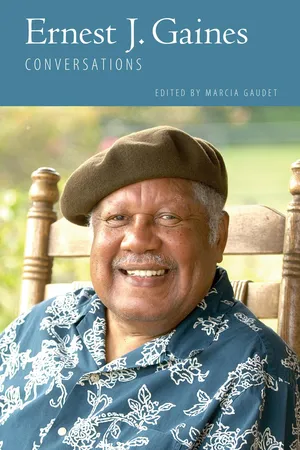
As the acclaimed author of The Autobiography of Miss Jane Pittman and A Lesson Before Dying, Ernest J. Gaines (b. 1933) has been publishing stories and novels for more than sixty years. His brilliant portrayals of race, community, and culture in rural south Louisiana have made him one of the most respected and beloved living American writers. Ernest J. Gaines: Conversations brings together the author's own thoughts and words in interviews that range from 1994 to 2017, discussing his life, his work, and his literary legacy. The interviews cover all of Gaines's works, including his two latest books, Mozart and Leadbelly: Stories and Essays (2005) and The Tragedy of Brady Sims (2017). The book provides a retrospective of his work from the viewpoint of a senior writer, now eighty-five years old, and gives an important international perspective on Gaines and his work.Among the many things Gaines discusses in his interviews are the recurrent themes in his works: the search for manhood, the importance of personal responsibility and standing with dignity, the problems of fathers and sons, and the challenges of race and racism in America. He examines his fictional world and his strong sense of place, his role as teacher and mentor, the importance of strong women in his life, and the influence of spirituality, religion, and music on his work. He also talks about storytelling, the nature of narrative, writing as a journey, and how he sees himself as a storyteller.
- 250 pages
- English
- ePUB (mobile friendly)
- Available on iOS & Android
eBook - ePub
About this book
Trusted by 375,005 students
Access to over 1.5 million titles for a fair monthly price.
Study more efficiently using our study tools.
Information
Subtopic
Literary BiographiesIndex
LiteratureInterview with Ernest J. Gaines, Part I
Interview conducted in Oscar, Louisiana, April 11, 2008. Published with permission.
Dominique Audiat: I would like to start with a personal comment: If I were asked to use one single word to qualify your work, I would say, “Authenticity.” Your characters are so convincing that they seem alive to the reader. You said that lots of people could not believe that Jane Pittman was not a real person, and the same could be said about many other protagonists of your novels and short stories. All the details you give about their surroundings add to this feeling of authenticity, reinforced by the great sensitivity in your depiction that makes these characters seem so true. You do much more than just look at people: you see them and you perceive and transmit their deepest emotions. Stendhal, the French novelist, used a metaphor to describe the novel, which he compared to a mirror being shifted along a road. That is obviously what you did with the transcription of true events and true people in a true locale, Louisiana, through the fictional characters and settings you created. And whatever the hardships they have to endure, their lives are pervaded by pride and dignity. How would you define yourself, as a novelist?
Ernest J. Gaines: I’ve never been part of any “school” of writing. I write about the South because I am from the South, but I followed no school. I lived in San Francisco during the Beat Generation, but I was not interested in that school; I lived in San Francisco during the black militant demonstrations, but I didn’t follow that school of militant writing either—though you may find anger and protest in my writing if you read it close enough—but I followed no school of writing. What is important to me is to tell a good story, and the reader takes from it whatever he or she wishes.
DA: You wrote The Autobiography of Miss Jane Pittman during the turbulent sixties, that militant period when people were saying, “Black is Beautiful.” What do you think of that slogan?
EJG: I’ve not heard or spoken or read in print that slogan lately, but it was popular back in the sixties and in the seventies. It was a time of rebellion; demonstrations were going on. There was a feeling of pride in the African American community and that slogan was adopted to counter all the negative that had been said about black. It is different from identification fads that come and go, like hair, make-up. There was a time when young black males wore what they called “Afros”; then they had “cornrows.” Now, at this point, they’re shaving their heads. So, they go from one fad to another. They try to identify themselves in that way. “Black is Beautiful” is not a fad; it is different: we are proud of what we are, and we felt it was necessary to inform the world how we felt—Black is Beautiful.
I am seventy-five years old, and maybe I’m just too old to know all these things going around me today. But even when I was younger, I was very seldom joining in. I was never in: I was always outside looking in. Even when I lived here as a child, I was an outsider. I used to play ball and shoot marbles and do all things guys would do, but there were certain times when I would just be alone. I would walk from here back to the swamps, just to be alone. It was the same thing in California; I lived four miles from the ocean, and I would walk to the ocean, then back to my apartment.
I read the great writers, Greek writers, tragedians. I read Maupassant and Flaubert and Stendhal. I’m sure I’ve learned something from all these writers. I learned from the American writers: Faulkner, Hemingway; and I also learned from others: Chekhov, especially Tolstoy. I’ve learned more from my spirituals and gospel music, and blues and jazz, than I have from African American writers. The music had greater impact and impress on me than any writing. I couldn’t be the writer I am today if it were not for my African American experience. That’s what Mozart and Leadbelly is all about.
DA: How do you explain the title of this latest book you published in 2005?
EJG: Mozart represents form, the influence of white western writers, European and American writers. That’s where I got my form, where I learned how to write a novel, a short story. But Leadbelly represents source, the soul experience. Flaubert, Joyce, Hemingway, they showed me how to form the paragraph, the sentence. It’s just like a house, and what you put in that house. And this is where Leadbelly comes in: jazz, spiritual, my experience with my race. I needed both in order to be the writer that I am. I believe in writing well. I believe in rewriting and rewriting and rewriting to get the form down. But you have to say something in your writing. Form is nothing if you have nothing to say.
DA: Mozart and Leadbelly contains the only story whose action does not take place in Louisiana, but in San Francisco, where you lived for so many years. I am talking of “Christ Walked Down Market Street.” You said that in all your stories and novels no one ever escaped Louisiana, probably because your soul never left Louisiana. However, there is certainly a great part of your soul in that beautiful story which occurs in San Francisco, in that famous street you know so well.
EJG: This is one of my favorite stories, I suppose. And at the same time, I feel it’s not complete.
DA: Throughout all your work, there seems to be a clear distinction between your personal relation to God and your relation with preachers. Can you say more about it?
EJG: You know, the preachers I’ve been writing about in my books, I would not write the same today. People were not very well-educated. They felt that they had been called to preach the gospel. Many of them were suspicious of someone who was educated because that person began to ask questions they could not answer. Those preachers, at that time, could not explain anything. They could only refer to the Bible. I believe in God, in my heart. But this is not enough for some people, as you can see in “The Sky Is Gray” with the preacher or with Grant in A Lesson Before Dying. Oh yes, I believe in God. Definitely.
DA: You seem to see God in all creation.
EJG: Yes, God is everywhere, in this little book, in the leaves, the flowers. I don’t believe in any particular religion. I was baptized and raised as Baptist, and I attended a Catholic school for three years. I got away from both and tried to find God in another thing.
DA: It is very moving to see that little church in your garden, the church you attended when you were a child.
EJG: People who owned the plantation gave me the permission to move that church here, and it was also my school. It is constantly reminding me of the past. I still hear my people singing, praying.
DA: You talk of these strong links with your people in the essay entitled “Reconstructing Identity,” published in Mozart and Leadbelly, in which you describe yourself as “a young man who was searching for that elusive I.” You explain the difficulties you had to pack, going to California, probably because it was so painful to leave the ones you loved. And you evoke that piece of oak wood they gave you, which was such a heavy burden for you. What can you say about that symbol, and did you feel that, in a certain way, your folks were drawing you back, even though they crystallized all their dreams of education on you? Does that piece of wood symbolize the ties between personal identity and collective identity?
EJG: My people did not try to draw me back: they set me free. When I came to California, I had lots of freedom. I had to go to school, of course. But my folks just told me to stay out of trouble, not to hang around in the streets with the guys. That’s how I spent so much of my time in libraries, reading and reading and reading, trying to discover who I was and how to write a novel, a short story—because they told me not to hang around in the streets. Much of my life was pleasant as a child in Louisiana, but very hard at the same time, going into the fields at six, seven years old, picking potatoes, pulling onions, and working all day. Education was limited to four to five months a year.
That block of wood said a lot about the place, the people. I had to move it down to give it form. The burden of carrying it represents the burden of becoming educated, the writing I had to do in the future. I had many stories to tell: how could I do those stories? I had to learn, and until I had learned to write, that block of wood would always be there. But I could only take a little piece at a time, and that would amount to a short story. You had to cut the piece off and do everything to make it smooth and beautiful. My agent, when I turned the story to her, said: “Yes, but it’s not ready yet. You have to go back and cut another piece of that block, and you work on that.” I took it to her, and she said, “Yes, but not yet.” There were times when I thought I would not be a writer. Then, what could I do with my life? At those times, everybody wanted to be a writer. My agent was telling me, “You have so much to say, and they have very little to say. And that’s why your burden is so heavy, and that’s why you’re so lucky.” There were times—those cold, foggy nights in San Francisco—when I wondered what I was going to do. Then, I would think about my aunt who never gave up. She was crippled and never walked in her life. She was always crawling. And she raised us, and she never complained. When I thought of giving up and getting rid of that heavy burden, I thought of her. Whenever I felt sorry for myself, I thought of all the things she had to go through.
DA: You have very often talked of the importance of the past. I would like to tell you a little anecdote: I visited a large plantation last week, and I was alone with the black lady, in her sixties, in charge of the visiting tour. She was obviously very proud to show me the magnificence of the Big House, telling me the high price of furniture or mirrors in each room, the most beautiful one being the wedding room. She kept on explaining to me how wealthy were those masters who owned a thousand slaves and how gorgeous were the weddings in such a setting. I could not but think of the contrast between so many splendors and the cruel and miserable condition of the slaves, so well depicted by Margaret Walker in Jubilee, and I said so to that lady. She just answered that these were good masters and that, besides, it was the past. What do you think of her reaction?
EJG: You know, during the thirties, there were many ex-slaves alive, and very well-known writers wrote about those people: their biographies are kept in the Library of Congress. I talked to one of them, a black man, an African American professor, and he told me that with these ex-slaves, it depended who was the person asking the question: black or white, they would get a different answer. And at the same time, you will find people standing for their white masters. Then you will get different information, people who will say, “Well, it was different from that.”
DA: You talked a lot about change too. In the short story, “Mary Louise,” the protagonist has been waiting for ten years for Jackson, but he does not respond any longer to her love. And when he tells her, “It can’t ever be like that again … Time changes people … Everybody changes,” Mary Louise cannot understand him, and she is overcome with sorrow. It seems obvious that the ones who left, and came back for a short while, have definitely changed, while the ones who stayed home seem to be the same. You talked, too, about the courageous ones who allow things to change. You have known segregation and the civil rights struggle, the disillusions that led to the nationalist movement of the sixties. It is at that time that you wrote The Autobiography of Miss Jane Pittman, whose life ends at the beginning of the civil rights struggle. Your characters who make things change by breaking the rules, like Ned, Jimmy, even Tee Bob, pay all their actions at the cost of their lives. But this was forty years ago, and things have certainly changed a lot. Don’t you have the impression to live in a completely different world today?
EJG: Things have changed, yes. Many of us have improved our condition. I obviously have, my sisters have … But at the same time, we have more African American young men in prison than we have in college. They don’t have the same opportunities. Then, what has really changed?
DA: In the first draft of Of Love and Dust you wrote a happy end for Marcus succeeding in escaping from the plantation with Louise, the Cajun overseer’s wife, after he killed that man who put so much pressure on him and treated him so badly. But your editor asked you to change it. Why did you follow his advice?
EJG: He told me, “I like the first part and I like the second part, but they don’t fit together. The first part is tragic; the second part becomes farcical. It becomes funny with this guy doing all kinds of crazy things. You should go one way or the other with this story. You’re not taking this murder seriously; you should take it seriously.” And I said, “The state of Louisiana didn’t take it seriously. They let people like this black man come out of prison any time after killing another black man, not a white, but a black.” He said, “That’s too bad for the state of Louisiana to act that way, but I think Marcus should pay for his crime.” Then I had to rewrite that part of the book over and make the book a tragedy and not a farce. I just thought I was much more interested in the character of Marcus than I was in the result of that crime.
DA: Marcus was a rebel. But do you think it was just because of morality that your editor reacted that way, or because at that time, in 1968, people would not have accepted that a black man could get away after having killed a white man? Since you just said that when a black man had killed another black man, he could get out of prison after a few years, and then nobody seemed to be bothered about it.
EJG: It’s quite possible. I never really discussed it. The reason I wanted to end Of Love and Dust as fast as I could was that I wanted my Bloodline stories to be published. And my editor had asked me to write a novel, and then he would publish them. So, I didn’t care so much when he told me to change those things around. I changed them around because I wanted my short stories published.
DA: In the story “Bloodline,” Copper Laurent being half white and half black cannot exist in any of these two worlds, and he becomes mad trying to keep his dignity in the world he has created in his imagination, in order to survive. But you wrote that story forty years ago, and I read in a recent issue of Newsweek magazine that, today, it was the chance of Barack Obama to be half-white and half-black because he knew the aspirations and fears of both communities.
EJG: We have many people in the same situation. Many of the mayors in this country, in the cities here, are African American.
DA: But Barack Obama is running for the presidency, and he has won many states. Don’t you think that it is a sign of hope for the future, so many white people voting for an African American, when it would have been unimaginable not so long ago?
EJG: We hope so. We all hope so. Times have changed … I always felt that combination of white and black would change much in this country. Barack Obama has white ancestry, and he was raised by a white family; then he has a greater chance to be listened to. If he had been raised by a totally black family, I don’t think people would recognize him today. Being in a white family, he had a better chance to get educated. He went to Harvard.
DA: In Louisiana, interracial relations are particularly complex with the coexistence of Creoles, black and white, African Americans, Americans, and Cajuns. Do they mix today, for instance in church?
EJG: My wife goes to church right here, in New Roads, to Saint Augustine, the little Catholic school I went to. It’s only ten miles from our house. Most of the people there are African Americans. But they mix: you have the Creoles, you have the whites, you have the blacks; you have people who own the plantations, you have wealthy people and poor people; they all mix on Sunday. Everybody goes to the same c...
Table of contents
- Cover
- Title Page
- Copyright
- Contents
- Introduction
- Chronology
- Interview with Ernest J. Gaines
- A Gathering of Old Men: An Interview with Ernest J. Gaines
- A MELUS Interview: Ernest J. Gaines
- An Interview with Ernest J. Gaines
- An Interview with Ernest J. Gaines
- Talking with Ernest J. Gaines: Religion, Spirituality, and Belief
- The Last Regionalist?: An Interview with Ernest J. Gaines
- A Lesson for Living
- The Influence of Multi-Art Forms on the Fiction of Ernest J. Gaines
- “What Men Dream about Doing”: A Conversation with Ernest J. Gaines
- The Scribe of River Lake Plantation: A Conversation with Ernest J. Gaines
- Working from Home: An Interview with Ernest J. Gaines
- Interview with Ernest J. Gaines, Part I
- Interview with Ernest J. Gaines, Part II
- The Tragedy of Brady Sims and Other Works: A Conversation with Ernest J. Gaines
- Additional Resources
Frequently asked questions
Yes, you can cancel anytime from the Subscription tab in your account settings on the Perlego website. Your subscription will stay active until the end of your current billing period. Learn how to cancel your subscription
No, books cannot be downloaded as external files, such as PDFs, for use outside of Perlego. However, you can download books within the Perlego app for offline reading on mobile or tablet. Learn how to download books offline
Perlego offers two plans: Essential and Complete
- Essential is ideal for learners and professionals who enjoy exploring a wide range of subjects. Access the Essential Library with 800,000+ trusted titles and best-sellers across business, personal growth, and the humanities. Includes unlimited reading time and Standard Read Aloud voice.
- Complete: Perfect for advanced learners and researchers needing full, unrestricted access. Unlock 1.5M+ books across hundreds of subjects, including academic and specialized titles. The Complete Plan also includes advanced features like Premium Read Aloud and Research Assistant.
We are an online textbook subscription service, where you can get access to an entire online library for less than the price of a single book per month. With over 1.5 million books across 990+ topics, we’ve got you covered! Learn about our mission
Look out for the read-aloud symbol on your next book to see if you can listen to it. The read-aloud tool reads text aloud for you, highlighting the text as it is being read. You can pause it, speed it up and slow it down. Learn more about Read Aloud
Yes! You can use the Perlego app on both iOS and Android devices to read anytime, anywhere — even offline. Perfect for commutes or when you’re on the go.
Please note we cannot support devices running on iOS 13 and Android 7 or earlier. Learn more about using the app
Please note we cannot support devices running on iOS 13 and Android 7 or earlier. Learn more about using the app
Yes, you can access Ernest J. Gaines by Marcia Gaudet in PDF and/or ePUB format, as well as other popular books in Literature & Literary Biographies. We have over 1.5 million books available in our catalogue for you to explore.