Rheology is primarily concerned with materials: scientific, engineering and everyday products whose mechanical behaviour cannot be described using classical theories. From biological to geological systems, the key to understanding the viscous and elastic behaviour firmly rests in the relationship between the interactions between atoms and molecules and how this controls the structure, and ultimately the physical and mechanical properties. Rheology for Chemists An Introduction takes the reader through the range of rheological ideas without the use of the complex mathematics. The book gives particular emphasis on the temporal behaviour and microstructural aspects of materials, and is detailed in scope of reference. An excellent introduction to the newer scientific areas of soft matter and complex fluid research, the second edition also refers to system dimension and the maturing of the instrumentation market. This book is a valuable resource for practitioners working in the field, and offers a comprehensive introduction for graduate and post graduates. "... well-suited for self-study by research workers and technologists, who, confronted with technical problems in this area, would like a straightforward introduction to the subject of rheology." Chemical Educator, "... full of valuable insights and up-to-date information." Chemistry World
The study of rheology is the study of the deformation of matter resulting from the application of a force. The type of deformation depends on the state of matter; for example, gases and liquids will flow when a force is applied, whilst solids will deform by a fixed amount and we expect them to regain their shape when the force is removed. In other words we are studying the “handling properties of materials”. This immediately reminds us that we must consider solutions and dispersions and not simply pure materials. In fact, the utility of many of the materials we make use of every day is due to their rheological behaviour and many chemists are formulating materials to have a particular range of textures, flow properties, etc. or are endeavouring to control transport properties in a manufacturing plant. Interest in the textures of materials, such as say a chocolate mousse or a shower gel, may be of professional interest to the chemist in addition to natural curiosity. How do we describe these quantitatively? What measurements should we make? What is the chemistry underlying the texture so that we may control it? All these questions make us focus on rheology.
The aim of this text is to enable the reader to gain an understanding of the physical origins of viscosity, elasticity, and viscoelasticity. The route that we shall follow will be to introduce the key concepts through physical ideas and analogues that are familiar to chemists and biologists. Ideas from chemical kinetics, infrared, and microwave spectroscopy are invariably covered in some depth in many science courses and so should aid the understanding of rheological processes. The mathematical content will be kept to the minimum necessary to give us a quantitative description of a process, and we have taken care to make any manipulations as transparent as possible.
There are two important underlying ideas that we shall return to throughout this work. Firstly, we should be aware that intermolecular forces control the way our materials behave. This is where the chemical nature is controlling the physical response. The second is the importance of the timescale of our observations, and here we may observe quite different physical responses when our experiments are carried out at different timescales. The link between the two arises through the structure that is the consequence of the forces and the timescale for changes by microstructural motion resulting from thermal or mechanical energy. What is so exciting about rheology is the insights that we gain into the origins of the behaviour of such a wide variety of systems in our everyday mechanical world.
1.1 DEFINITIONS
1.1.1 Stress and Strain
The stress is simply defined as the force divided by the area over which it is applied. Pressure is a compressive bulk stress. When we hang a weight on a wire, we are applying an extensional stress and, when we slide a piece of paper over a gummed surface to reach the correct position, we are applying a shear stress. We shall focus more strongly on this latter stress as most of our instruments are designed around this format. The units of stress are Pascals.
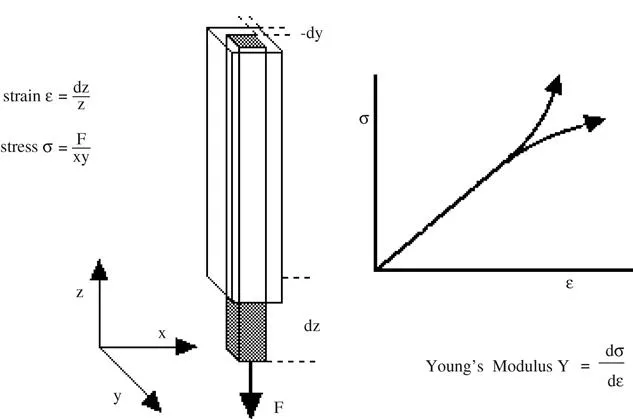
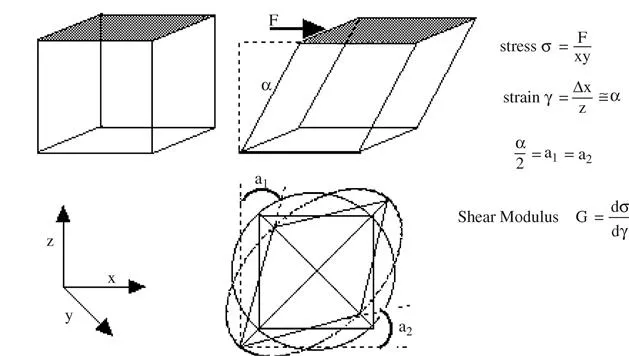
When a stress is applied to a material, a deformation will be the result. In order to make calculations tractable, we define the strain as the relative deformation, that is, the deformation per unit length. The length that we use is the one over which the deformation occurs. This is illustrated in Figures 1.1 and 1.2.
There are several features of note in Figures 1.1 and 1.2:
The elastic modulus is constant at small stresses and strains. This linearity gives us Hooke’s law,1 which states that the stress is directly proportional to the strain.
The shear strain, produced by the application of a shear stress σ, is illustrated in Figure 1.2. The lower section of the figure shows the general case where there is no rotation of the principal axes of strain. These are simply the diagonals of the material element, one of which shortens whilst the other lengthens. We will see later how this leads to compressive and extensional forces on pairs of particles as they collide in a flowing system.
At high stresses and strains, nonlinearity is observed. Strain hardening (an increasing modulus with increasing strain up to fracture) is normally observed with polymeric networks. Strain softening is observed with some metals and colloids until yield is observed.
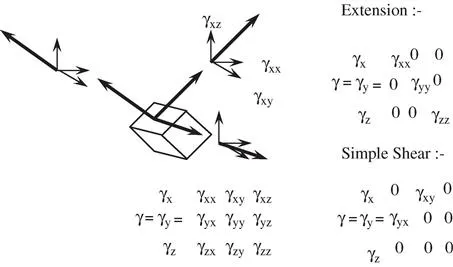
We should recognise that stress and strain are tensor quantities and not scalars. This will not present any difficulties in this text but we should bear it in mind as the consequences can be dramatic and can be useful. To illustrate the mathematical problem, we can think what happens when we apply a strain to an element of our material. The strain is made up of three orthogonal components that can be further subdivided into components, each of which are lined up with our axes. This is shown in Figure 1.3.
Figures 1.2 and 1.3 show how if we apply a simple shear strain, γ, in our rheometer this is formally made up of two equal components, γxy and γyx. By restricting ourselves to simple and well-defined deformations and flows, i.e. simple viscometric flows, most algebraic difficulties will be avoided but the exciting consequences will still be seen.
Figure 1.3 Strain and stress are tensors.
1.1.2 Rate of Strain and Flow
When a fluid system is studied by the application of a stress, motion is produced until the stress is removed. Consider two surfaces separated by a small gap containing a liquid as illustrated in Figure 1.4. A constant shear stress must be maintained on the upper surface for it to move at a constant velocity, u. If we can assume that there is no slip between the surface and the liquid, there is a continuous change in velocity across the small gap to zero at the lower surface. Now, in each second the displacement produced is x and the strain is:
(1.1)
and as
, we can write the rate of strain as:
(1.2)
The terms rate of strain, velocity gradient, shear rate are all used synonymously and Newton’s dot is normally used to indicate the differential operator with resp...
Table of contents
Cover
Title Page
Copyright Page
Preface
Contents
Chapter 1 Introduction
Chapter 2 Elasticity: High Deborah Number Measurements
Chapter 3 Viscosity: Low Deborah Number Measurements
Chapter 4 Linear Viscoelasticity I: Phenomenological Approach
Chapter 5 Linear Viscoelasticity II: Microstructural Approach
Chapter 6 Nonlinear Responses
Subject Index
Trusted by 375,005 students
Access to over 1.5 million titles for a fair monthly price.
Study more efficiently using our study tools.
Frequently asked questions
Yes, you can cancel anytime from the Subscription tab in your account settings on the Perlego website. Your subscription will stay active until the end of your current billing period. Learn how to cancel your subscription
No, books cannot be downloaded as external files, such as PDFs, for use outside of Perlego. However, you can download books within the Perlego app for offline reading on mobile or tablet. Learn how to download books offline
Perlego offers two plans: Essential and Complete
Essential is ideal for learners and professionals who enjoy exploring a wide range of subjects. Access the Essential Library with 800,000+ trusted titles and best-sellers across business, personal growth, and the humanities. Includes unlimited reading time and Standard Read Aloud voice.
Complete: Perfect for advanced learners and researchers needing full, unrestricted access. Unlock 1.5M+ books across hundreds of subjects, including academic and specialized titles. The Complete Plan also includes advanced features like Premium Read Aloud and Research Assistant.
Both plans are available with monthly, semester, or annual billing cycles.
We are an online textbook subscription service, where you can get access to an entire online library for less than the price of a single book per month. With over 1.5 million books across 990+ topics, we’ve got you covered! Learn about our mission
Look out for the read-aloud symbol on your next book to see if you can listen to it. The read-aloud tool reads text aloud for you, highlighting the text as it is being read. You can pause it, speed it up and slow it down. Learn more about Read Aloud
Yes! You can use the Perlego app on both iOS and Android devices to read anytime, anywhere — even offline. Perfect for commutes or when you’re on the go. Please note we cannot support devices running on iOS 13 and Android 7 or earlier. Learn more about using the app
Yes, you can access Rheology for Chemists by J W Goodwin,R W Hughes in PDF and/or ePUB format, as well as other popular books in Physical Sciences & Higher Education. We have over 1.5 million books available in our catalogue for you to explore.