- 322 pages
- English
- ePUB (mobile friendly)
- Available on iOS & Android
eBook - ePub
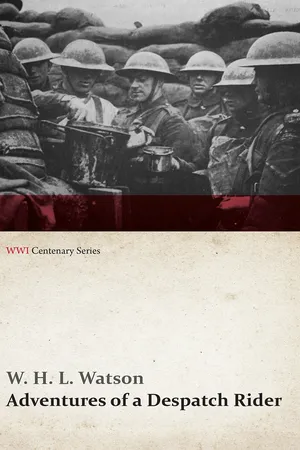
Adventures of a Despatch Rider (WWI Centenary Series)
About this book
"All letters are censored. This book contains nothing but the truth, but not the whole truth. When I described things that were actually happening round me, I had to be exceedingly careful-and when, as in the first two or three chapters, my letters were written several weeks after the events, something was sure to crop up in the meantime that unconsciously but definitely altered the memory of experiences....
I have dwelt at length upon little personal matters. It may not interest you to know when I had a pork-chop-though, as you now realise, on active service a pork-chop is extremely important-but it interested my mother. She liked to know whether I was having good and sufficient food, and warm things on my chest and feet, because, after all, there was a time when I wanted nothing else."
This book is part of the World War One Centenary series; creating, collating and reprinting new and old works of poetry, fiction, autobiography and analysis. The series forms a commemorative tribute to mark the passing of one of the world's bloodiest wars, offering new perspectives on this tragic yet fascinating period of human history. Each publication also includes brand new introductory essays and a timeline to help the reader place the work in its historical context.
Information
CHAPTER I.
ENLISTING
ENLISTING
At 6.45 p.m. on Saturday, July 25, 1914, Alec and I determined to take part in the Austro-Servian War. I remember the exact minute, because we were standing on the “down” platform of Earl’s Court Station, waiting for the 6.55 through train to South Harrow, and Alec had just remarked that we had ten minutes to wait. We had travelled up to London, intending to work in the British Museum for our “vivas” at Oxford, but in the morning it had been so hot that we had strolled round Bloomsbury, smoking our pipes. By lunch-time we had gained such an appetite that we did not feel like work in the afternoon. We went to see Elsie Janis.
The evening papers were full of grave prognostications. War between Servia and Austria seemed inevitable. Earl’s Court Station inspired us with the spirit of adventure. We determined to take part, and debated whether we should go out as war correspondents or as orderlies in a Servian hospital. At home we could talk of nothing else during dinner. Ikla, that wisest of all Egyptians, mildly encouraged us, while the family smiled.
On Sunday we learned that war had been declared. Ways and means were discussed, but our great tennis tournament on Monday, and a dance in the evening, left us with a mere background of warlike endeavour. It was vaguely determined that when my “viva” was over we should go and see people of authority in London....
On the last day of July a few of us met together in Gibson’s rooms, those neat, white rooms in Balliol that overlook St Giles. Naymier, the Pole, was certain that Armageddon was coming. He proved it conclusively in the Quad with the aid of large maps and a dissertation on potatoes. He also showed us the probable course of the war. We lived in strained excitement. Things were too big to grasp. It was just the other day that ‘The Blue Book,’ most respectable of Oxford magazines, had published an article showing that a war between Great Britain and Germany was almost unthinkable. It had been written by an undergraduate who had actually been at a German university. Had the multitudinous Anglo-German societies at Oxford worked in vain? The world came crashing round our ears. Naymier was urgent for an Oxford or a Balliol Legion—I do not remember which—but we could not take him seriously. Two of us decided that we were physical cowards, and would not under any circumstances enlist. The flower of Oxford was too valuable to be used as cannon-fodder.
The days passed like weeks. Our minds were hot and confused. It seemed that England must come in. On the afternoon of the fourth of August I travelled up to London. At a certain club in St James’s there was little hope. I walked down Pall Mall. In Trafalgar Square a vast, serious crowd was anxiously waiting for news. In Whitehall Belgians were doing their best to rouse the mob. Beflagged cars full of wildly gesticulating Belgians were driving rapidly up and down. Belgians were haranguing little groups of men. Everybody remained quiet but perturbed.
War was a certainty. I did not wish to be a spectator of the scenes that would accompany its declaration, so I went home. All the night in my dreams I saw the quiet, perturbed crowds.
War was declared. All those of us who were at Balliol together telephoned to one another so that we might enlist together. Physical coward or no physical coward—it obviously had to be done. Teddy and Alec were going into the London Scottish. Early in the morning I started for London to join them, but on the way up I read the paragraph in which the War Office appealed for motor-cyclists. So I went straight to Scotland Yard. There I was taken up to a large room full of benches crammed with all sorts and conditions of men. The old fellow on my right was a sign-writer. On my left was a racing motor-cyclist. We waited for hours. Frightened-looking men were sworn in and one phenomenally grave small boy. Later I should have said that a really fine stamp of man was enlisting. Then they seemed to me a shabby crew.
At last we were sent downstairs, and told to strip and array ourselves in moderately dirty blue dressing-gowns. Away from the formality of the other room we sang little songs, and made the worst jokes in the world—being continually interrupted by an irritable sergeant, whom we called “dearie.” One or two men were feverishly arguing whether certain physical deficiencies would be passed. Nobody said a word of his reason for enlisting except the sign-writer, whose wages had been low.
The racing motor-cyclist and I were passed one after another, and, receiving warrants, we travelled down to Fulham. Our names, addresses, and qualifications were written down. To my overwhelming joy I was marked as “very suitable.” I went to Great Portland Street, arranged to buy a motor-cycle, and returned home. That evening I received a telegram from Oxford advising me to go down to Chatham.
I started off soon after breakfast, and suffered three punctures. The mending of them put despatch-riding in an unhealthy light. At Rochester I picked up Wallace and Marshall of my college, and together we went to the appointed place. There we found twenty or thirty enlisted or unenlisted. I had come only to make inquiries, but I was carried away. After a series of waits I was medically examined and passed. At 5.45 p.m. I kissed the Book, and in two minutes I became a corporal in the Royal Engineers. During the ceremony my chief sensation was one of thoroughgoing panic.
In the morning four of us, who were linguists, were packed off to the War Office. We spent the journey in picturing all the ways we might be killed, until, by the time we reached Victoria, there was not a single one of us who would not have given anything to un-enlist. The War Office rejected us on the plea that they had as many Intelligence Officers as they wanted. So we returned glumly.
The next few days we were drilled, lectured, and given our kit. We began to know each other, and make friends. Finally, several of us, who wanted to go out together, managed by slight misstatements to be put into one batch. We were chosen to join the 5th Division. The Major in command told us—to our great relief—that the Fifth would not form part of the first Expeditionary Force.
I remember Chatham as a place of heat, intolerable dirt, and a bad sore throat. There we made our first acquaintance with the army, which we undergraduates had derided as a crowd of slavish wastrels and empty-headed slackers. We met with tact and courtesy from the mercenary. A sergeant of the Sappers we discovered to be as fine a type of man as any in the wide earth. And we marvelled, too, at the smoothness of organisation, the lack of confusing hurry....
We were to start early on Monday morning. My mother and sister rushed down to Chatham, and my sister has urgently requested me to mention in “the book” that she carried, with much labour, a large and heavy pair of ski-ing boots. Most of the others had enlisted like myself in a hurry. They did not see “their people” until December.
All of us were made to write our names in the visitors’ book, for, as the waiter said—
“They ain’t nobodies now, but in these ‘ere times yer never knows what they may be.”
Then, when we had gone in an ear-breaking splutter of exhausts, he turned to comfort my mother—
“Pore young fellers! Pore young fellers! I wonder if any of ‘em will return.”
That damp chilly morning I was very sleepy and rather frightened at the new things I was going to do. I imagined war as a desperate continuous series of battles, in which I should ride along the trenches picturesquely haloed with bursting shell, varied by innumerable encounters with Uhlans, or solitary forest rides and immense tiring treks over deserted country to distant armies. I wasn’t quite sure I liked the idea of it all. But the sharp morning air, the interest in training a new motor-cycle in the way it should go, the unexpected popping-up and grotesque salutes of wee gnome-like Boy Scouts, soon made me forget the war. A series of the kind of little breakdowns you always have in a collection of new bikes delayed us considerably, and only a race over greasy setts through the southern suburbs, over Waterloo Bridge and across the Strand, brought us to Euston just as the boat-train was timed to start. In the importance of our new uniforms we stopped it, of course, and rode joyfully from one end of the platform to the other, much to the agitation of the guard, while I posed delightfully against a bookstall to be photographed by a patriotic governess.
Very grimy we sat down to a marvellous breakfast, and passed the time reading magazines and discussing the length of the war. We put it at from three to six weeks. At Holyhead we carefully took our bikes aboard, and settled down to a cold voyage. We were all a trifle apprehensive at our lack of escort, for then, you will remember, it had not yet been proved how innocuous the German fleet is in our own seas.[1]
Ireland was a disappointment. Everybody was dirty and unfriendly, staring at us with hostile eyes. Add Dublin grease, which beats the Belgian, and a crusty garage proprietor who only after persuasion supplied us with petrol, and you may be sure we were glad to see the last of it. The road to Carlow was bad and bumpy. But the sunset was fine, and we liked the little low Irish cottages in the twilight. When it was quite dark we stopped at a town with a hill in it. One of our men had a brick thrown at him as he rode in, and when we came to the inn we didn’t get a gracious word, and decided it was more pleasant not to be a soldier in Ireland. The daughter of the house was pretty and passably clean, but it was very grimly that she had led me through an immense gaudy drawing-room disconsolate in dust wrappings, to a little room where we could wash. She gave us an exiguous meal at an extortionate charge, and refused to put more than two of us up; so, on the advice of two gallivanting lancers who had escaped from the Curragh for some supper, we called in the aid of the police, and were billeted magnificently on the village.
A moderate breakfast at an unearthly hour, a trouble with the starting up of our bikes, and we were off again. It was about nine when we turned into Carlow Barracks.
The company sighed with relief on seeing us. We completed the establishment on mobilisation. Our two “artificers,” Cecil and Grimers, had already arrived. We were overjoyed to see them. We realised that what they did not know about motor-cycles was not worth knowing, and we had suspected at Chatham what we found afterwards to be true, that no one could have chosen for us pleasanter comrades or more reliable workers.
A fine breakfast was soon prepared for us and we begun looking round. The position should have been a little difficult—a dozen or so ‘Varsity men, very fresh from their respective universities, thrown as corporals at the head of a company of professional soldiers. We were determined that, whatever vices we might have, we should not be accused of “swank.” The sergeants, after a trifle of preliminary stiffness, treated us with fatherly kindness, and did all they could to make us comfortable and teach us what we wanted to learn.
Carlow was a fascinating little town. The National Volunteers still drilled just behind the barracks. It was not wise to refer to the Borderers or to Ulster, but the war had made all the difference in the world. We were to represent Carlow in the Great War. Right through the winter Carlow never forgot us. They sent us comforts and cigarettes and Christmas Puddings. When the 5th Signal Company returns, Carlow will go mad.
My first “official” ride was to Dublin. It rained most of the way there and all the way back, but a glow of patriotism kept me warm. In Dublin I went into a little public-house for some beer and bread and cheese. The landlord told me that though he wasn’t exactly a lover of soldiers, things had changed now. On my return I was given lunch in...
Table of contents
- ADVENTURES OF A DESPATCH RIDER
- Introduction to the World War One Centenary Series
- A Timeline of the Major Events of World War One in Europe
- Memoirs, Diaries and Poems of World War One
- The Western Front
- A Soldier’s Cemetery
- A LETTER BY WAY OF INTRODUCTION.
- CHAPTER I. ENLISTING
- CHAPTER II. THE JOURNEY TO THE FRONT
- CHAPTER III. THE BATTLE OF MONS
- CHAPTER IV. THE BATTLE OF LE CATEAU
- CHAPTER V. THE GREAT RETREAT
- CHAPTER VI. OVER THE MARNE TO THE AISNE
- CHAPTER VII. THE BATTLE OF THE AISNE.
- CHAPTER VIII. THE MOVE TO THE NORTH.
- CHAPTER IX. ROUND LA ASSÉE.
- CHAPTER X. THE BEGINNING OF WINTER.
- CHAPTER XI. ST JANS CAPPEL.
- CHAPTER XII. BEHIND THE LINES.
Trusted by 375,005 students
Access to over 1.5 million titles for a fair monthly price.
Study more efficiently using our study tools.
Frequently asked questions
Yes, you can cancel anytime from the Subscription tab in your account settings on the Perlego website. Your subscription will stay active until the end of your current billing period. Learn how to cancel your subscription
No, books cannot be downloaded as external files, such as PDFs, for use outside of Perlego. However, you can download books within the Perlego app for offline reading on mobile or tablet. Learn how to download books offline
Perlego offers two plans: Essential and Complete
- Essential is ideal for learners and professionals who enjoy exploring a wide range of subjects. Access the Essential Library with 800,000+ trusted titles and best-sellers across business, personal growth, and the humanities. Includes unlimited reading time and Standard Read Aloud voice.
- Complete: Perfect for advanced learners and researchers needing full, unrestricted access. Unlock 1.5M+ books across hundreds of subjects, including academic and specialized titles. The Complete Plan also includes advanced features like Premium Read Aloud and Research Assistant.
We are an online textbook subscription service, where you can get access to an entire online library for less than the price of a single book per month. With over 1.5 million books across 990+ topics, we’ve got you covered! Learn about our mission
Look out for the read-aloud symbol on your next book to see if you can listen to it. The read-aloud tool reads text aloud for you, highlighting the text as it is being read. You can pause it, speed it up and slow it down. Learn more about Read Aloud
Yes! You can use the Perlego app on both iOS and Android devices to read anytime, anywhere — even offline. Perfect for commutes or when you’re on the go.
Please note we cannot support devices running on iOS 13 and Android 7 or earlier. Learn more about using the app
Please note we cannot support devices running on iOS 13 and Android 7 or earlier. Learn more about using the app
Yes, you can access Adventures of a Despatch Rider (WWI Centenary Series) by W. H. L. Watson in PDF and/or ePUB format, as well as other popular books in History & Military Biographies. We have over 1.5 million books available in our catalogue for you to explore.