- 186 pages
- English
- ePUB (mobile friendly)
- Available on iOS & Android
eBook - ePub
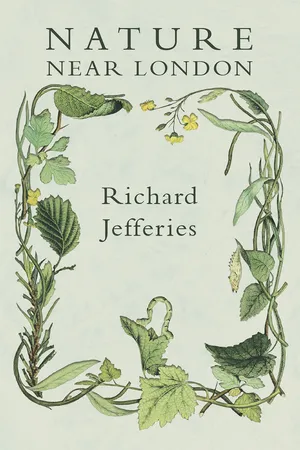
Nature Near London
About this book
First published in 1883, "Nature Near London" presents an authentic illustration of the idyllic countryside to be found near London, England. This volume constitutes a must-read for all lovers of nature writing, and it would make for a worthy addition to collections of vintage literature. John Richard Jefferies (1848 - 1887) was an English nature writer. He is famous for his exceptional depictions of English country life in his natural history books, essays, and novels. Most of his major works were inspired by his early life spent on a small farm in Wiltshire, England. Other notable works by this author include: "Bevis" (1882), a classic children's novel, and "After London" (1885), an fantastic example of classic nature writing. Contents include: "Woodlands", "Footpaths", "Flocks Of Birds", "Nightingale Road", "A Brook", "A London Trout", "A Barn", "Wheatfields", "The Crows", "Heathlands", "The River", "Nutty Autumn", "Round A London Copse", "Magpie Fields", "Herbs", "Trees About Town", "To Brighton", etc. Many vintage books such as this are becoming increasingly scarce and expensive. We are republishing this volume now in an affordable, modern, high-quality edition complete with a specially commissioned new biography of the author.
Information
Topic
Personal DevelopmentSubtopic
Philosophical EssaysTO BRIGHTON
The smooth express to Brighton has scarcely, as it seems, left the metropolis when the banks of the railway become coloured with wild flowers. Seen for a moment in swiftly passing, they border the line like a continuous garden. Driven from the fields by plough and hoe, cast out from the pleasure-grounds of modern houses, pulled up and hurled over the wall to wither as accursed things, they have taken refuge on the embankment and the cutting.
There they can flourish and ripen their seeds, little harassed even by the scythe and never by grazing cattle. So it happens that, extremes meeting, the wild flower, with its old-world associations, often grows most freely within a few feet of the wheels of the locomotive. Purple heathbells gleam from shrub-like bunches dotted along the slope; purple knapweeds lower down in the grass; blue scabious, yellow hawkweeds where the soil is thinner, and harebells on the very summit; these are but a few upon which the eye lights while gliding by.
Glossy thistledown, heedless whither it goes, comes in at the open window. Between thickets of broom there is a glimpse down into a meadow shadowed by the trees of a wood. It is bordered with the cool green of brake fern, from which a rabbit has come forth to feed, and a pheasant strolls along with a mind, perhaps, to the barley yonder. Or a foxglove lifts its purple spire; or woodbine crowns the bushes. The sickle has gone over, and the poppies which grew so thick a while ago in the corn no longer glow like a scarlet cloak thrown on the ground. But red spots in waste places and by the ways are where they have escaped the steel.
A wood-pigeon keeps pace with the train—his vigorous pinions can race against an engine, but cannot elude the hawk. He stops presently among the trees. How pleasant it is from the height of the embankment to look down upon the tops of the oaks! The stubbles stretch away, crossed with bands of green roots where the partridges are hiding. Among flags and weeds the moorhens feed fearlessly as we roll over the stream: then comes a cutting, and more heath and hawkweed, harebell, and bramble bushes red with unripe berries.
Flowers grow high up the sides of the quarries; flowers cling to the dry, crumbling chalk of the cliff-like cutting; flowers bloom on the verge above, against the line of the sky, and over the dark arch of the tunnel. This, it is true, is summer; but it is the same in spring. Before a dandelion has shown in the meadow, the banks of the railway are yellow with coltsfoot. After a time the gorse flowers everywhere along them; but the golden broom overtops all, perfect thickets of broom glowing in the sunlight.
Presently the copses are azure with bluebells, among which the brake is thrusting itself up; others, again, are red with ragged robins, and the fields adjacent fill the eye with the gaudy glare of yellow charlock. The note of the cuckoo sounds above the rushing of the train, and the larks may be seen, if not heard, rising high over the wheat. Some birds, indeed, find the bushes by the railway the quietest place in which to build their nests.
Butcher-birds or shrikes are frequently found on the telegraph wires; from that elevation they pounce down on their prey, and return again to the wire. There were two pairs of shrikes using the telegraph wires for this purpose one spring only a short distance beyond noisy Clapham Junction. Another pair came back several seasons to a particular part of the wires, near a bridge, and I have seen a hawk perched on the wire equally near London.
The haze hangs over the wide, dark plain, which, soon after passing Redhill, stretches away on the right. It seems to us in the train to extend from the foot of a great bluff there to the first rampart of the still distant South Downs. In the evening that haze will be changed to a flood of purple light veiling the horizon. Fitful glances at the newspaper or the novel pass the time; but now I can read no longer, for I know, without any marks or tangible evidence, that the hills are drawing near. There is always hope in the hills.
The dust of London fills the eyes and blurs the vision; but it penetrates deeper than that. There is a dust that chokes the spirit, and it is this that makes the streets so long, the stones so stony, the desk so wooden; the very rustiness of the iron railings about the offices sets the teeth on edge, the sooty blackened walls (yet without shadow) thrust back the sympathies which are ever trying to cling to the inanimate things around us. A breeze comes in at the carriage window—a wild puff, disturbing the heated stillness of the summer day. It is easy to tell where that came from—silently the Downs have stolen into sight.
So easy is the outline of the ridge, so broad and flowing are the slopes, that those who have not mounted them cannot grasp the idea of their real height and steepness. The copse upon the summit yonder looks but a short stroll distant; how much you would be deceived did you attempt to walk thither! The ascent here in front seems nothing, but you must rest before you have reached a third of the way up. Ditchling Beacon there, on the left, is the very highest above the sea of the whole mighty range, but so great is the mass of the hill that the glance does not realise it.
Hope dwells there, somewhere, mayhap, in the breeze, in the sward, or the pale cups of the harebells. Now, having gazed at these, we can lean back on the cushions and wait patiently for the sea. There is nothing else, except the noble sycamores on the left hand just before the train draws into the station.
The clean dry brick pavements are scarcely less crowded than those of London, but as you drive through the town, now and then there is a glimpse of a greenish mist afar off between the houses. The green mist thickens in one spot almost at the horizon; or is it the dark nebulous sails of a vessel? Then the foam suddenly appears close at hand—a white streak seems to run from house to house, reflecting the sunlight: and this is Brighton.
"How different the sea looks away from the pier!" It is a new pleasure to those who have been full of gaiety to see, for once, the sea itself. Westwards, a mile beyond Hove, beyond the coastguard cottages, turn aside from the road, and go up on the rough path along the ridge of shingle. The hills are away on the right, the sea on the left; the yards of the ships in the basin slant across the sky in front.
With a quick, sudden heave the summer sea, calm and gleaming, runs a little way up the side of the groyne, and again retires. There is scarce a gurgle or a bubble, but the solid timbers are polished and smooth where the storms have worn them with pebbles. From a grassy spot ahead a bird rises, marked with white, and another follows it; they are wheatears; they frequent the land by the low beach in the autumn.
A shrill but feeble pipe is the cry of the sandpiper, disturbed on his moist feeding-ground. Among the stones by the waste places there are pale-green wrinkled le...
Table of contents
- Richard Jefferies
- PREFACE
- WOODLANDS
- FOOTPATHS
- FLOCKS OF BIRDS
- NIGHTINGALE ROAD
- A BROOK
- A LONDON TROUT
- A BARN
- WHEATFIELDS
- THE CROWS
- HEATHLANDS
- THE RIVER
- NUTTY AUTUMN
- ROUND A LONDON COPSE
- MAGPIE FIELDS
- HERBS
- TREES ABOUT TOWN
- TO BRIGHTON
- THE SOUTHDOWN SHEPHERD
- THE BREEZE ON BEACHY HEAD
Trusted by 375,005 students
Access to over 1.5 million titles for a fair monthly price.
Study more efficiently using our study tools.
Frequently asked questions
Yes, you can cancel anytime from the Subscription tab in your account settings on the Perlego website. Your subscription will stay active until the end of your current billing period. Learn how to cancel your subscription
No, books cannot be downloaded as external files, such as PDFs, for use outside of Perlego. However, you can download books within the Perlego app for offline reading on mobile or tablet. Learn how to download books offline
Perlego offers two plans: Essential and Complete
- Essential is ideal for learners and professionals who enjoy exploring a wide range of subjects. Access the Essential Library with 800,000+ trusted titles and best-sellers across business, personal growth, and the humanities. Includes unlimited reading time and Standard Read Aloud voice.
- Complete: Perfect for advanced learners and researchers needing full, unrestricted access. Unlock 1.5M+ books across hundreds of subjects, including academic and specialized titles. The Complete Plan also includes advanced features like Premium Read Aloud and Research Assistant.
We are an online textbook subscription service, where you can get access to an entire online library for less than the price of a single book per month. With over 1.5 million books across 990+ topics, we’ve got you covered! Learn about our mission
Look out for the read-aloud symbol on your next book to see if you can listen to it. The read-aloud tool reads text aloud for you, highlighting the text as it is being read. You can pause it, speed it up and slow it down. Learn more about Read Aloud
Yes! You can use the Perlego app on both iOS and Android devices to read anytime, anywhere — even offline. Perfect for commutes or when you’re on the go.
Please note we cannot support devices running on iOS 13 and Android 7 or earlier. Learn more about using the app
Please note we cannot support devices running on iOS 13 and Android 7 or earlier. Learn more about using the app
Yes, you can access Nature Near London by Richard Jefferies in PDF and/or ePUB format, as well as other popular books in Personal Development & Philosophical Essays. We have over 1.5 million books available in our catalogue for you to explore.