- 324 pages
- English
- ePUB (mobile friendly)
- Available on iOS & Android
eBook - ePub
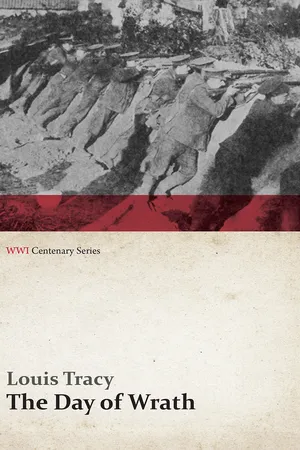
The Day of Wrath: A Story of 1914 (WWI Centenary Series)
About this book
This early work by Louis Tracy was originally published in 1916 and we are now republishing it as part of our WWI Centenary Series. 'The Day of Wrath: A Story of 1914' is a novel about the horrors of the first year of the Great War. The New York Times Book Review published this critique of the work: "The Human mind is so constituted that it becomes deadened by the weight of numbers, needing the personal, the individual, to awaken its liveliest sympathies. We read with pity and horror of the sufferings of a nation; but that they may be brought really home to us, become really vivid and forceful, they must be embodied in some person or small group of persons. And it is something of this embodiment which Mr. Tracy has achieved in his latest book, The Day of Wrath. We have all read of burned villages, murdered noncombatants, tortured women-all the horror and agony undergone by heroic Belgium in the cruel days of August and September, 1914. Mr. Tracy takes a little company of six people, two of them English, the others Belgium, and shows us what happens to them during that awful time." This book is part of the World War One Centenary series; creating, collating and reprinting new and old works of poetry, fiction, autobiography and analysis. The series forms a commemorative tribute to mark the passing of one of the world's bloodiest wars, offering new perspectives on this tragic yet fascinating period of human history. Each publication also includes brand new introductory essays and a timeline to help the reader place the work in its historical context.
Trusted by 375,005 students
Access to over 1.5 million titles for a fair monthly price.
Study more efficiently using our study tools.
Information
CHAPTER I
THE LAVA-STREAM
“For God’s sake, if you are an Englishman, help me!”
That cry of despair, so subdued yet piercing in its intensity, reached Arthur Dalroy as he pressed close on the heels of an all-powerful escort in Lieutenant Karl von Halwig, of the Prussian Imperial Guard, at the ticket-barrier of the Friedrich Strasse Station on the night of Monday, 3rd August 1914.
An officer’s uniform is a passe-partout in Germany; the showy uniform of the Imperial Guard adds awe to authority. It may well be doubted if any other insignia of rank could have passed a companion in civilian attire so easily through the official cordon which barred the chief railway station at Berlin that night to all unauthorised persons.
Von Halwig was in front, impartially cursing and shoving aside the crowd of police and railway men. A gigantic ticket-inspector, catching sight of the Guardsman, bellowed an order to “clear the way;” but a general officer created a momentary diversion by choosing that forbidden exit. Von Halwig’s heels clicked, and his right hand was raised in a salute, so Dalroy was given a few seconds wherein to scrutinise the face of the terrified woman who had addressed him. He saw that she was young, an Englishwoman, and undoubtedly a lady by her speech and garb.
“What can I do for you?” he asked.
“Get me into a train for the Belgian frontier. I have plenty of money, but these idiots will not even allow me to enter the station.”
He had to decide in an instant. He had every reason to believe that a woman friendless and alone, especially a young and good-looking one, was far safer in Berlin—where some thousands of Britons and Americans had been caught in the lava-wave of red war now flowing unrestrained from the Danube to the North Sea—than in the train which would start for Belgium within half-an-hour. But the tearful indignation in the girl’s voice—even her folly in describing as “idiots” the hectoring jacks-in-office, any one of whom might have understood her—led impulse to triumph over saner judgment.
“Come along! quick!” he muttered. “You’re my cousin, Evelyn Fane!”
With a self-control that was highly creditable, the young lady thrust a hand through his arm. In the other hand she carried a reticule. The action surprised Dalroy, though feminine intuition had only displayed common-sense.
“Have you any luggage?” he said.
“Nothing beyond this tiny bag. It was hopeless to think of——”
Von Halwig turned at the barrier to insure his English friend’s safe passage.
“Hallo!” he cried. Evidently he was taken aback by the unexpected addition to the party.
“A fellow-countrywoman in distress,” smiled Dalroy, speaking in German. Then he added, in English, “It’s all right. As it happens, two places are reserved.”
Von Halwig laughed in a way which the Englishman would have resented at any other moment.
“Excellent!” he guffawed. “Beautifully contrived, my friend.—Hi, there, sheep’s-head!”—this to the ticket-inspector—“let that porter with the portmanteau pass!”
Thus did Captain Arthur Dalroy find himself inside the Friedrich Strasse Station on the night when Germany was already at war with Russia and France. With him was the stout leather bag into which he had thrown hurriedly such few articles as were indispensable—an ironic distinction when viewed in the light of subsequent events; with him, too, was a charming and trustful and utterly unknown travelling companion.
Von Halwig was not only vastly amused but intensely curious; his endeavours to scrutinise the face of a girl whom the Englishman had apparently conjured up out of the maelström of Berlin were almost rude. They failed, however, at the outset. Every woman knows exactly how to attract or repel a man’s admiration; this young lady was evidently determined that only the vaguest hint of her features should be vouchsafed to the Guardsman. A fairly large hat and a veil, assisted by the angle at which she held her head, defeated his intent. She still clung to Dalroy’s arm, and relinquished it only when a perspiring platform-inspector, armed with a list, brought the party to a first-class carriage. There were no sleeping-cars on the train. Every wagon-lit in Berlin had been commandeered by the staff.
“I have had a not-to-be-described-in-words difficulty in retaining these corner places,” he said, whereupon Dalroy gave him a five-mark piece, and the girl was installed in the seat facing the engine.
The platform-inspector had not exaggerated his services. The train was literally besieged. Scores of important officials were storming at railway employés because accommodation could not be found. Dalroy, wishful at first that Von Halwig would take himself off instead of standing near the open door and peering at the girl, soon changed his mind. There could not be the slightest doubt that were it not for the presence of an officer of the Imperial Guard he and his “cousin” would have been unceremoniously bundled out on to the platform to make room for some many-syllabled functionary who “simply must get to the front.” As for the lady, she was the sole representative of her sex travelling west that night.
Meanwhile the two young men chatted amicably, using German and English with equal ease.
“I think you are making a mistake in going by this route,” said Von Halwig. “The frontier lines will be horribly congested during the next few days. You see, we have to be in Paris in three weeks, so we must hurry.”
“You are very confident,” said the Englishman pleasantly.
He purposely avoided any discussion of his reasons for choosing the Cologne-Brussels-Ostend line. As an officer of the British army, he was particularly anxious to watch the vaunted German mobilisation in its early phases.
“Confident! Why not? Those wretched little piou-pious”—a slang term for the French infantry—“will run long before they see the whites of our eyes.”
“I haven’t met any French regiments since I was a youngster; but I believe France is far better organised now than in 1870,” was the noncommittal reply.
Von Halwig threw out his right arm in a wide sweep. “We shall brush them aside—so,” he cried. “The German army was strong in those days; now it is irresistible. You are a soldier. You know. To-night’s papers say England is wavering between peace and war. But I have no doubt she will be wise. That Channel is a great asset, a great safeguard, eh?”
Again Dalroy changed the subject. “If it is a fair question, when do you start for the front?”
“To-morrow, at six in the morning.”
“How very kind of you to spare such valuable time now!”
“Not at all! Everything is ready. Germany is always ready. The Emperor says ‘Mobilise,’ and, behold, we cross the frontier within the hour!”
“War is a rotten business,” commented Dalroy thoughtfully. “I’ve seen something of it in India, where, when all is said and done, a scrap in the hills brings the fighting men alone into line. But I’m sorry for the unfortunate peasants and townspeople who will suffer. What of Belgium, for instance?”
“Ha! Les braves Belges!” laughed the other. “They will do as we tell them. What else is possible? To adapt one of your own proverbs: ‘Needs must when the German drives!’”
Dalroy understood quite well that Von Halwig’s bumptious tone was n...
Table of contents
- THE DAY OF WRATH
- Introduction to the World War One Centenary Series
- A Timeline of the Major Events of World War One in Europe
- In Flanders Fields
- PREFACE
- CHAPTER I
- CHAPTER II
- CHAPTER III
- CHAPTER IV
- CHAPTER V
- CHAPTER VI
- CHAPTER VII
- CHAPTER VIII
- CHAPTER IX
- CHAPTER X
- CHAPTER XI
- CHAPTER XII
- CHAPTER XIII
- CHAPTER XIV
- CHAPTER XV
Frequently asked questions
Yes, you can cancel anytime from the Subscription tab in your account settings on the Perlego website. Your subscription will stay active until the end of your current billing period. Learn how to cancel your subscription
No, books cannot be downloaded as external files, such as PDFs, for use outside of Perlego. However, you can download books within the Perlego app for offline reading on mobile or tablet. Learn how to download books offline
Perlego offers two plans: Essential and Complete
- Essential is ideal for learners and professionals who enjoy exploring a wide range of subjects. Access the Essential Library with 800,000+ trusted titles and best-sellers across business, personal growth, and the humanities. Includes unlimited reading time and Standard Read Aloud voice.
- Complete: Perfect for advanced learners and researchers needing full, unrestricted access. Unlock 1.5M+ books across hundreds of subjects, including academic and specialized titles. The Complete Plan also includes advanced features like Premium Read Aloud and Research Assistant.
We are an online textbook subscription service, where you can get access to an entire online library for less than the price of a single book per month. With over 1.5 million books across 990+ topics, we’ve got you covered! Learn about our mission
Look out for the read-aloud symbol on your next book to see if you can listen to it. The read-aloud tool reads text aloud for you, highlighting the text as it is being read. You can pause it, speed it up and slow it down. Learn more about Read Aloud
Yes! You can use the Perlego app on both iOS and Android devices to read anytime, anywhere — even offline. Perfect for commutes or when you’re on the go.
Please note we cannot support devices running on iOS 13 and Android 7 or earlier. Learn more about using the app
Please note we cannot support devices running on iOS 13 and Android 7 or earlier. Learn more about using the app
Yes, you can access The Day of Wrath: A Story of 1914 (WWI Centenary Series) by Louis Tracy in PDF and/or ePUB format, as well as other popular books in Literature & European History. We have over 1.5 million books available in our catalogue for you to explore.