- 67 pages
- English
- ePUB (mobile friendly)
- Available on iOS & Android
eBook - ePub
Camping & Tramping with Roosevelt
About this book
First published in 1907, this is an account of the author's time spent travelling and observing nature with U.S. President Roosevelt. This volume offers both an authentic glimpse of U.S. wildlife and a unique insight into the mind of Theodore Roosevelt, and it is not to be missed by lovers of nature writing. John Burroughs (1837 - 1921) was an American naturalist, essayist, and active member of the U.S. conservation movement. Burroughs' work was incredibly popular during his lifetime, and his legacy has lived on in the form of twelve U.S. Schools named after him, Burroughs Mountain, and the John Burroughs Association-which publicly recognizes well-written and illustrated natural history publications. Other notable works by this author include: "Winter Sunshine" (1875), "Birds and Poets" (1877), and "Locusts and Wild Honey" (1879). Contents include: "The President on Glacier Point, Yosemite Valley", "Arrival at Gardiner, Montana", "The President, Mr. Burroughs and Secretary Loeb", "The President in the Bear Country", "Mr. Burroughs's Favorite Pastime", etc. Many vintage books such as this are becoming increasingly scarce and expensive. We are republishing this volume now in an affordable, modern, high-quality edition complete with a specially commissioned new biography of the author.
Information
CAMPING &
TRAMPING
WITH
ROOSEVELT
TRAMPING
WITH
ROOSEVELT
BY
JOHN BURROUGHS
WITH ILLUSTRATIONS
Published October 1907
Copyright © 2016 Read Books Ltd.
This book is copyright and may not be
reproduced or copied in any way without
the express permission of the publisher in writing
British Library Cataloguing-in-Publication Data
A catalogue record for this book is available from
the British Library
the British Library
List of Illustrations
The President On Glacier Point,
Yosemite Valley
Yosemite Valley
Arrival At Gardiner, Mont.
(Entrance To Yellowstone National Park.)
(Entrance To Yellowstone National Park.)
The President With Mr. Burroughs And Secretary Loeb Just Before Entering The Park.
The President In The Bear Country
Mr. Burroughs's Favorite Pastime.
Sunrise In Yellowstone Park.
The President On A Trail
The President's Home On Sagamore Hill, Showing Addition Known As The Trophy Room
A Bit Of Woodland On The Slope
Towards Oyster Bay
Towards Oyster Bay
A Path In The Woods Leading
To Cold Spring Harbor
To Cold Spring Harbor
A Yearling In The Apple Orchard
Hallway, Sagamore Hill
John Burroughs
John Burroughs was born on April 3 1837 in Catskill Mountains near Roxbury in Delaware County, New York, United States. As a child he played on the slopes of the Catskill Mountains and worked on the family farm. He was enthralled by the birds and other wildlife around him. Burroughs developed an interest in learning, but his father believed the rudimentary education given at the local school was enough, and refused to pay for the higher education that Burroughs desired. At seventeen he left home to earn the money needed for college by teaching at a school in Olive, New York. Between 1854 and 1856 he worked as a teacher whilst completing his studies. He continued to teach until 1863.
In 1857, Burroughs left his teaching position in Illinois to find employment near his hometown and that same year, he married the pious Ursula North (1836-1917). After five years of marital discord, Ursula concluded that her husband’s sexual demands were immoral. She suggested a short separation to encourage him to value chastity. Their separation lasted until 1864, during which, Burroughs valued other female company. He remained unfaithful after their reunion. In 1901, he met Clara Barrus (1864-1931), a physician at a psychiatric hospital. She was half his age, but was the love of his life. She moved into his house after Ursula died in 1917.
Burroughs’ first published essay was Expression (1860). In 1864, Burroughs began work as a clerk at the Treasury and eventually became a federal banker. He worked there until the 1880s, but continued writing and acquired an interest in the poetry of Walt Whitman (1819-1892). The pair met in 1863 and became friends. Whitman encouraged Burroughs to develop his nature writings, as well as his essays on philosophy and literature. In 1867, Burroughs published Notes on Walt Whitman as Poet and Person which was the first biography and critical work on Whitman, and was anonymously edited by Whitman before it was published. In 1871, Burroughs’ first collection of nature essays, Wake Robin, was published.
Burroughs left Washington for New York in 1873 where he bought a fruit farm in West Park, New York and built his Riverby estate. In 1895, he bought additional land near Riverby and built an Adirondack style cabin named Slabsides. There, Burroughs wrote and entertained visitors. His famous friends included Theodore Roosevelt (1858-1919), Henry Ford (1863-1947) - who gave him an automobile, and Thomas Edison (1847-1931). In 1899, Burroughs accompanied E. H Harriman (1848-1909) on his expedition to Alaska and also travelled to the Grand Canyon and Yosemite with John Muir (1838-1914).
In 1903, after publishing an article, Real and Sham Nature History, Burroughs began a publicised debate known as the nature fakers controversy where he condemned certain writers for their absurd representation of wildlife. He also criticised the naturalistic animal stories genre. This disagreement lasted for four years and included many environmental and political figures.
Burroughs was best known for his writings on wildlife and rural life and his writing achievements were recognised by his election as a member of the American Academy of Arts and Letters. Some of his essays recalled his trips to the Catskills, for example, The Heart of the Southern Catskills, depicts the ascent of Slide Mountain. Other Catskills essays commented on fishing, hiking or rafting. He was an enthusiastic fly fisherman and contributed some notable fishing essays to angling literature, including Speckled Trout (1870). The Complete Writings of John Burroughs runs to twenty three volumes. Wake Robin was the first and the following volumes were published regularly with the final two, Under the Maples (1921) and The Last Harvest (1922), being published posthumously by Clara Barrus. Burroughs also published a biography of John James Audubon (1902), Camping and Tramping with Roosevelt (1906), and Bird and Bough (1906).
Shortly before his death, Burroughs suffered from lapses in memory and a decline in heart function. In February 1921, he had an operation to remove an abscess from his chest, after which his health worsened. He died on March 29 1921 on a train near Kingsville, Ohio. He was buried in Roxbury, New York on what would have been his eighty fourth birthday, at the foot of a rock he had termed Boyhood Rock.
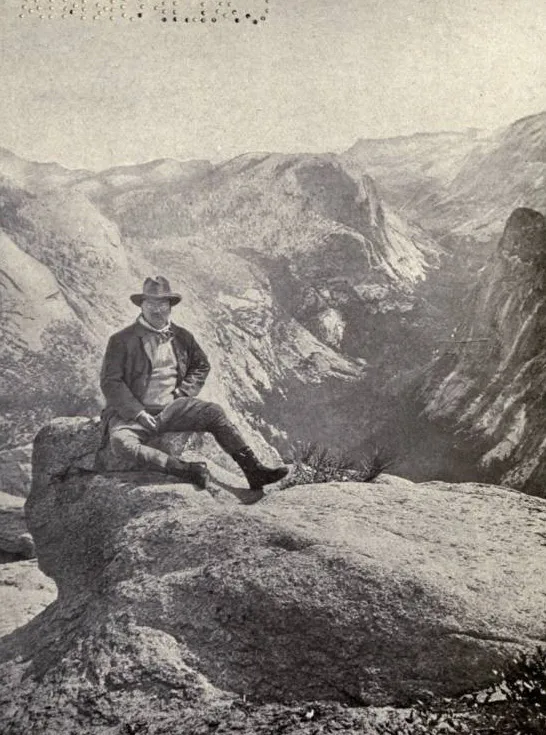
THE PRESIDENT ON GLACIER POINT,
YOSEMITE VALLEY
YOSEMITE VALLEY
INTRODUCTION
This little volume really needs no introduction; the two sketches of which it is made explain and, I hope, justify themselves. But there is one phase of the President's many-sided character upon which I should like to lay especial emphasis, namely, his natural history bent and knowledge. Amid all his absorbing interests and masterful activities in other fields, his interest and his authority in practical natural history are by no means the least. I long ago had very direct proof of this statement. In some of my English sketches, following a visit to that island in 1882, I had, rather by implication than by positive statement, inclined to the opinion that the European forms of animal life were, as a rule, larger and more hardy and prolific than the corresponding forms in this country. Roosevelt could not let this statement or suggestion go unchallenged, and the letter which I received from him in 1892, touching these things, is of double interest at this time, as showing one phase of his radical Americanism, while it exhibits him as a thoroughgoing naturalist. I am sure my readers will welcome the gist of this letter. After some preliminary remarks he says:—
"The point of which I am speaking is where you say that the Old World forms of animal life are coarser, stronger, fiercer, and more fertile than those of the New World." (My statement was not quite so sweeping as this.) "Now I don't think that this is so; at least, comparing the forms which are typical of North America and of northern Asia and Europe, which together form but one province of animal life. "Many animals and birds which increase very fast in new countries, and which are commonly spoken of as European in their origin, are really as alien to Europe as to their new homes. Thus the rabbit, rat, and mouse are just as truly interlopers in England as in the United States and Australia, having moved thither apparently within historic times, the rabbit from North Africa, the others from southern Asia; and one could no more generalize upon the comparative weakness of the American fauna from these cases of intruders than one could generalize from them upon the comparative weakness of the British, German, and French wild animals. Our wood mouse or deer mouse retreats before the ordinary house mouse in exactly the same way that the European wood mouse does, and not a whit more. Our big wood rat stands in the same relation to the house rat. Casting aside these cases, it seems to me, looking at the mammals, that it would be quite impossible to generalize as to whether those of the Old or the New World are more fecund, are the fiercest, the hardiest, or the strongest. A great many cases could be cited on both sides. Our moose and caribou are, in certain of their varieties, rather larger than the Old World forms of the same species. If there is any difference between the beavers of the two countries, it is in the same direction. So with the great family of the field mice. The largest true arvicola seems to be the yellow-cheeked mouse of Hudson's Bay, and the biggest representative of the family on either continent is the muskrat. In most of its varieties the wolf of North America seems to be inferior in strength and courage to that of northern Europe and Asia; but the direct reverse is true with the grizzly bear, which is merely a somewhat larger and fiercer variety of the common European brown bear. On the whole, the Old World bison, or so-called aurochs, appears to be somewhat more formidable than its American brother; but the difference against the latter is not anything like as great as the difference in favor of the American wapiti, which is nothing but a giant representative of the comparatively puny European stag. So with the red fox. The fox of New York is about the size of that of France, and inferior in size to that of Scotland; the latter in turn is inferior in size to the big fox of the upper Missouri, while the largest of all comes from British America. There is no basis for the belief that the red fox was imported here from Europe; its skin was a common article of trade with the Canadian fur traders from the earliest times. On the other hand, the European lynx is much bigger than the American. The weasels afford cases in point, showing how hard it is to make a general law on the subject. The American badger is very much smaller than the European, and the American otter very much larger than the European otter. Our pine marten, or sable, compared with that of Europe, shows the very qualities of which you speak; that is, its skull is slenderer, the bones are somewhat lighter, the teeth less stout, the form showing more grace and less strength. But curiously enough this is reversed, with even greater emphasis, in the minks of the two continents, the American being much the largest and strongest, with stouter teeth, bigger bones, and a stronger animal in every way. The little weasel is on the whole smaller here, while the big weasel, or stoat, is, in some of its varieties at least, largest on this side; a...
Table of contents
- THE PRESIDENT ON GLACIER POINT, YOSEMITE VALLEY
- ARRIVAL AT GARDINER, MONT.(ENTRANCE TO YELLOWSTONE NATIONAL PARK.)
- THE PRESIDENT'S HOME ON SAGAMORE HILL, SHOWING ADDITION KNOWN AS THE TROPHY ROOM
Trusted by 375,005 students
Access to over 1.5 million titles for a fair monthly price.
Study more efficiently using our study tools.
Frequently asked questions
Yes, you can cancel anytime from the Subscription tab in your account settings on the Perlego website. Your subscription will stay active until the end of your current billing period. Learn how to cancel your subscription
No, books cannot be downloaded as external files, such as PDFs, for use outside of Perlego. However, you can download books within the Perlego app for offline reading on mobile or tablet. Learn how to download books offline
Perlego offers two plans: Essential and Complete
- Essential is ideal for learners and professionals who enjoy exploring a wide range of subjects. Access the Essential Library with 800,000+ trusted titles and best-sellers across business, personal growth, and the humanities. Includes unlimited reading time and Standard Read Aloud voice.
- Complete: Perfect for advanced learners and researchers needing full, unrestricted access. Unlock 1.5M+ books across hundreds of subjects, including academic and specialized titles. The Complete Plan also includes advanced features like Premium Read Aloud and Research Assistant.
We are an online textbook subscription service, where you can get access to an entire online library for less than the price of a single book per month. With over 1.5 million books across 990+ topics, we’ve got you covered! Learn about our mission
Look out for the read-aloud symbol on your next book to see if you can listen to it. The read-aloud tool reads text aloud for you, highlighting the text as it is being read. You can pause it, speed it up and slow it down. Learn more about Read Aloud
Yes! You can use the Perlego app on both iOS and Android devices to read anytime, anywhere — even offline. Perfect for commutes or when you’re on the go.
Please note we cannot support devices running on iOS 13 and Android 7 or earlier. Learn more about using the app
Please note we cannot support devices running on iOS 13 and Android 7 or earlier. Learn more about using the app
Yes, you can access Camping & Tramping with Roosevelt by John Burroughs in PDF and/or ePUB format, as well as other popular books in Biological Sciences & Science & Technology Biographies. We have over 1.5 million books available in our catalogue for you to explore.