eBook - ePub
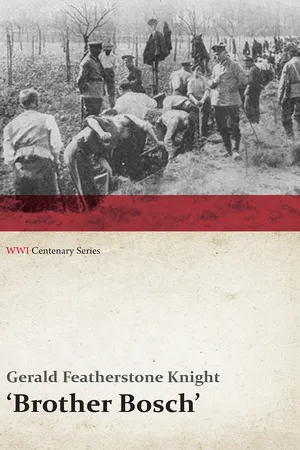
Brother Bosch', an Airman's Escape from Germany (WWI Centenary Series)
- 182 pages
- English
- ePUB (mobile friendly)
- Available on iOS & Android
eBook - ePub
Brother Bosch', an Airman's Escape from Germany (WWI Centenary Series)
About this book
This early work by Gerald Featherstone Knight was originally published in 1919 and we are now republishing it as part of our WWI Centenary Series. ''Brother Bosch', an Airman's Escape from Germany' is a memoir written by a member of the Royal Flying Corps who was taken prisoner by German forces. During his nine months in prison, he made three escape attempts, the last of which was successful. He was awarded the Military Cross Posthumously after his death in 1919. This book is part of the World War One Centenary series; creating, collating and reprinting new and old works of poetry, fiction, autobiography and analysis. The series forms a commemorative tribute to mark the passing of one of the world's bloodiest wars, offering new perspectives on this tragic yet fascinating period of human history. Each publication also includes brand new introductory essays and a timeline to help the reader place the work in its historical context.
Information
CHAPTER I
CAPTURED
It was November 9th, 1916. I lay in a state of luxurious semi-consciousness pondering contentedly over things in general, transforming utter impossibilities into plausible possibilities, wondering lazily the while if I were asleep. Presently, to my disgust an indefinable, yet persistent “something” came into being, almost threatening to dispel the drowsy mist then pervading my brain. The slow thought waves gradually ceased their surging, and after a slight pause began to collect round the offending mystery, as if seeking to unravel it in a half-hearted sort of way. They gave me to understand that the “something” recurred at intervals, and even suggested that it might be a voice, though from which side of the elastic dividing line it emanated they were quite unable to say. With the consoling thought that voices often come from dreamland I allowed the whole subject to glide gently into the void and the tide of thought to continue its drugged revolutions. The next instant a noisy whirlwind swept the cobwebs away. I knew that the voice was indeed a reality, for it delivered the following message: “A very fine morning, sir!” Obviously my dutiful servant desired me to rise and enjoy the full benefit of the beautiful day. Agreeing with Harry Lauder, that “It’s nice to get up in the morning, but it’s nicer to stay in bed!” I am sorry to say I cunningly dismissed the orderly with a few false assurances, turned over on my side and promptly forgot all about such trivial matters. Conscience was kicking very feebly, and just as sleep was about to return, the air commenced to vibrate and something swept overhead with a whirling roar—an “early bird” testing the air. Galvanised into action by this knowledge, I sprang out of bed, and seizing whatever garments happened to be the nearest, was half dressed before I had even time to yawn! Then snatching up my map, coat, hat, and goggles, I burst from the hut and began slithering along the duck-boards towards the hangars, at the same time endeavouring to fasten the unwilling hooks of my Flying Corps tunic and devoutly hoping that I should not be late for the bomb raid. For weeks we had been standing by for this raid in particular, the object of which was to bomb Douai aerodrome. This was a particularly warm spot to fly over, for in these days it was regarded as the home of “Archies” and the latest hostile aircraft. It is, therefore, not surprising that the general feeling of the squadron was that the sooner it was over the better for all concerned. Arrived at the sheds I was relieved to find that I was in good time, at all events. The machines (two-seater artillery machines, then commonly known as “Quirks”) were lined up on the aerodrome with bomb racks loaded, their noses to the wind, awaiting the signal to ascend. I saluted the C.O., waved to a friend or two and climbed into the pilot’s seat of my waiting machine. Then, adjusting the levers, I signified to the waiting mechanics that I was ready for them to “suck in” (an operation necessary prior to the starting of the engine). Having made sure that everything was O.K. and waited for the others to ascend, I took off and, after climbing steadily for some time, took up my specified position in the formation. For some time we circled about over a pre-arranged rendezvous, until joined by an escort of fighting machines and another squadron of bombers, and then settled down to business. Flying straight into the sun we soon arrived at and passed over the irregular spidery lines of trenches (those on Vimy Ridge showing up particularly clearly), and continued forging ahead, past many familiar landmarks, always in the direction of Douai. I for one never dreamt of being taken prisoner and had every intention of making a record breakfast on my return. My engine was going rather badly, but the odds were that it would see me through. Only too soon the anti-aircraft started their harassing fire, throwing up a startling number of nerve-racking, high explosive shells, each one a curling black sausage of hate and steel splinters. When we were some way over my machine lagged behind the rest. The engine spluttered intermittently and could not be induced to go at all well. As my machine became more isolated I cast anxious glances about and was soon rewarded by seeing two wicked little enemy scouts waiting for an easy prey (at that time they did not usually attack a formation, but waited behind for the likes o’ me). While one scout attracted my attention on the left and I was engaged in keeping him off by firing occasional bursts, a machine gun opened fire with a deafening clatter at point-blank range from behind. In an instant the surrounding air became full of innumerable tiny, brilliant flames, passing me at an incredible speed like minute streaks of lightning, each one giving forth a curious staccato whistling crack as it plunged through or beside the tormented machine, leaving in its wake a thin curling line of blue smoke. I was in the middle of a relentless storm of burning tracer bullets, vying one with the other for the honour of passing through the petrol tank, thereby converting my machine into a seething furnace. Having no observer to defend my tail I turned steeply to meet my new adversary. However, before completing the manœuvre I received another deadly burst of fire, which, though it somehow missed me, shot away several of my control wires. What happened next I cannot be sure, but the machine seemed to turn over, and my machine gun fell off with a crash. This took place at an altitude of six thousand feet. My next impression was that I seemed to be in the centre of a whirling vortex, around which all creation revolved at an extraordinary speed, and realised that my trusty steed was indulging in a particularly violent “spinning nose dive.” A “spin” at the best of times rather takes one’s breath away, so, shutting the throttle, I endeavoured to come out of it in the usual way. To my surprise, the engine refused to slow down, or any of the controls to respond, except one, which only tended to make matters worse.
The one thing left to be done was to “switch off” and trust to luck. This, however, was more easily decided on than accomplished, for by this time the machine was plunging to earth so rapidly, with the engine full on, that I felt as if I were tied to a peg-top, which was being hurled downwards with irresistible force. Fighting blindly against the tremendous air-pressure, which rendered me hardly able to move, I forced my left arm, inch by inch, along the edge of the “cockpit” until I succeeded in turning the switch lever downwards. A glance at the speedometer did not reassure me, the poor thing seemed very much overworked. Descending very rapidly I kept getting a glimpse of a pretty red-roofed village, which became ominously more distinct at every plunging revolution.
I vaguely thought there would be rather a splash when we arrived at our destination, but at eight hundred feet Providence came to the rescue. I heard the welcome cessation of the wild screaming hum of the strained wires. After switching on, the engine informed me with much spluttering that it was sorry that I should have to land on the wrong side, but it really had done its best. I had just managed to turn towards our trenches, when the scout pilot, seeing I did not land, at once followed me down and with its machine gun impressed on me that the sooner I landed the better. As I was then a long way over the lines, sinking fast towards the tree-tops, I had no alternative, so endeavoured to reach the village green. By this time the machine was literally riddled with bullets, though, luckily, I had not been touched. Before landing I overtook a German horseman, so thinking to introduce myself I dived on him from a low altitude, just passing over his head. Well, scare him I certainly did, poor man; he was much too frightened to get off, and seemed to be doing his best to get inside his would-be Trojan animal. The machine landed on a heap of picks and shovels, ran among a number of Huns who were having a morning wash at some troughs (or rather I should say, a lick and a promise!). They scattered and then closed in on the machine. I ran one wing into a post, and tried the lighter, which did not work. I was a prisoner. Undoubtedly, the next German communique announced that the gallant Lieutenant X. had brought down his thirtieth machine; it is probable that this gallant officer had heard strange rumours of what lay behind the British lines, but preferred cruising on the safer side. I could hardly believe that these grey-clad, rather unshaven men who jabbered excitedly were genuine “Huns.” I was furious and very “fed-up,” but that did not help, so turning in my seat and raising my hand I said, “Gutten Morgen.” This surprised them so much that they forgot to be rude and mostly returned the compliment.
CHAPTER II
CAMBRAI
The immediate treatment I received was rather better than I had expected. Several officers came forward, and one, who held a revolver, told me in broken English to get out. So leaving my poor old machine, we proceeded to the village headquarters.
Photographers appeared from nowhere and I was twice “snapped” on the way, though I’m afraid I did not act up to the usual request, “look pleasant.” On arriving at a small house I was received by a German general, who looked rather like an Xmas tree, the Iron Crosses were so numerous. As I stood to attention he politely inquired if I spoke German, even condescending to smile faintly when I replied, “Ja, un peu!” At first when I answered a few preliminary questions he was politeness itself. He then asked for my squadron number, to which I could only reply that I was sorry but could not answer him, whereupon he pointed out that it was of no military value whatever, and that it was only to assist in my identification in the report of my capture which would go to England. So thoughtful of him; such a plausible excuse! Of course I remained silent, whereupon “la politesse” vanished and an angry Hun took its place. He screamed, threatened, and waved his arms about, but as I did not seem very impressed at the display, he rushed out of the room, slamming the door and not returning. Oh, for a “movie” camera! A Flying Corps officer then took me in a car to an aerodrome, and told me I should have lunch with the officers at the chateau, where they were quartered. Here I met about nine German airmen, who greeted me in a typically foreign manner. They seemed quite a nice lot on the whole, though I did not know them long enough to really form an opinion. Soon a good German gramophone was playing and lunch began. The food was rather poor, but champagne plentiful. During the meal the gramophone, which was nearest to me, finished a record, so getting up I changed the needle and started the other side. But it wasn’t the “Bing Boys” this time! Strange to say, they were quite astonished at this performance, thinking, perhaps, that I could not change the needle. Afterwards, at coffee, a lieutenant asked me what we thought of their flying corps, to which I replied that I thought it was all right. He seemed quite prepared for this, and hastily said that I must remember that they had fewer machines. I think it must have occurred to every captured airman how splendid it would be to steal an enemy aeroplane and fly back, then after a graceful landing report to the C.O. that you had returned. These flights are not infrequently pleasurably accomplished in imagination, but such opportunities do not often, if ever, present themselves.
Just before leaving the chateau, I excused myself and got as far as the back door, where I had to explain to some German orderlies that I was only trying to find my coat. I was taken by car to corps headquarters at another chateau, where I saw some young officers, elegantly dressed, lounging about. After much useless bowing and scraping I was again interrogated by an objectionable colonel, but they seemed used to failure, and soon ceased their efforts. A major who assisted spoke English well, and made himself quite pleasant till I left. On hearing that I was in the Devons he told me that on leaving the university his father had sent him to live at a small village near Barnstaple, where he had remained for several years. Doubtless, a hard-working man of leisure! He seemed a very able officer, but decidedly young for a German major. On being told that all leather goods were confiscated, I was forced to give up my Sam Brown belt much against my will. They seemed very familiar with the movements of our troops, and I noticed that though their telephones were rather large and clumsy they carried slight sounds very distinctly, so much so, that when at the other end of the room I could hear practically the whole conversation.
Towards evening the major told me to get ready to go to Cambrai, and at the same time said, that as my leather flying coat was also confiscated they had cut off the fur collar, which he then handed back. This rather annoyed me, so I told him to keep it, which incident I regretted afterwards. However, he lent me a German coat, which was some comfort. On the way to Cambrai we again passed near the lines, some British star shells being plainly visible. What a difference a few kilometres make! The Germans depend on their railway transport more than we do. Certainly their road transport cannot be compared with ours. We passed a few cars and motor lorries, the majority giving one the impression that they were falling to bits, so noisy and shabby were they. I only saw two or three motor cyclists the whole time, and those I did see rode machines of an antiquated pattern. We passed a lot of horse transport, nearly all the ambulances in the district being horse drawn. Most cars, including our own, were only capable of emitting useless squeaks on emergencies.
Soon we entered Cambrai, an old, picturesque French town, and drew up at the entrance to the citadel, where a guard allowed us to enter. I was then left with a Lieutenant Schram, the intelligence officer, who gave me coffee and cigars and plied me with questions. He was very anxious to discover all he could about our tanks, and possessed many supposed models, mostly not in the least like them. He emphasised the opinion that, of course we should not get Bapaume, at the same time allowing he thought there might be a moving battle in the spring. From his conversation I gathered that they were very familiar with formation and movements of most of our Colonial units. The tête-à-tête at an end, I was taken to my quarters, a bare whitewashed room, containing one French flying officer, two British lieutenants, if I remember rightly, both in the D.L.I., having been taken near Bapaume, and also a Canadian sergeant-major. It is unnecessary to say how pleased I was to see them. Some one had acquired a portion of an old magazine, which was much sought after, it being the only means of passing the time. Our sleeping accommodation consisted of two old straw mattresses, one on the floor and the other on a shelf above.
Being tired we slept soundly, but in the morning we were horrified to find we had not been alone, but that quite a varied menagerie had shared our couches with us. Why the blankets did not run away in the night I cannot think. The Huns promised to have lots of things done but never did anything, in fact, they lie as easily as they breathe, even when there is nothing to be gained by it.
A comparatively nice N.C.O. was in charge of us, called Nelson! We afterwards learnt that his father had been English, and that his own knowledge of England appeared to be confined to an Oxford restaurant. One day when our lunch, consisting of black and watery soup, was brought up he sympathetically remarked that it was a pity we could not have chicken and ham. I wonder what he would have done had some one enticingly rattled a shilling on a plate?
During the day we were allowed to walk round the barrack square for about three hours with eighty British and a hundred and fifty French soldiers, some of whom...
Table of contents
- “Brother Bosch”
- Introduction to the World War One Centenary Series
- A Timeline of the Major Events of World War One in Europe
- Memoirs, Diaries and Poems of World War One
- A Song of the Plane
- CHAPTER I
- CHAPTER II
- CHAPTER III
- CHAPTER IV
- CHAPTER V
- CHAPTER VI
- CHAPTER VII
- CHAPTER VIII
- CHAPTER IX
- CHAPTER X
- CHAPTER XI
Trusted by 375,005 students
Access to over 1.5 million titles for a fair monthly price.
Study more efficiently using our study tools.
Frequently asked questions
Yes, you can cancel anytime from the Subscription tab in your account settings on the Perlego website. Your subscription will stay active until the end of your current billing period. Learn how to cancel your subscription
No, books cannot be downloaded as external files, such as PDFs, for use outside of Perlego. However, you can download books within the Perlego app for offline reading on mobile or tablet. Learn how to download books offline
Perlego offers two plans: Essential and Complete
- Essential is ideal for learners and professionals who enjoy exploring a wide range of subjects. Access the Essential Library with 800,000+ trusted titles and best-sellers across business, personal growth, and the humanities. Includes unlimited reading time and Standard Read Aloud voice.
- Complete: Perfect for advanced learners and researchers needing full, unrestricted access. Unlock 1.5M+ books across hundreds of subjects, including academic and specialized titles. The Complete Plan also includes advanced features like Premium Read Aloud and Research Assistant.
We are an online textbook subscription service, where you can get access to an entire online library for less than the price of a single book per month. With over 1.5 million books across 990+ topics, we’ve got you covered! Learn about our mission
Look out for the read-aloud symbol on your next book to see if you can listen to it. The read-aloud tool reads text aloud for you, highlighting the text as it is being read. You can pause it, speed it up and slow it down. Learn more about Read Aloud
Yes! You can use the Perlego app on both iOS and Android devices to read anytime, anywhere — even offline. Perfect for commutes or when you’re on the go.
Please note we cannot support devices running on iOS 13 and Android 7 or earlier. Learn more about using the app
Please note we cannot support devices running on iOS 13 and Android 7 or earlier. Learn more about using the app
Yes, you can access Brother Bosch', an Airman's Escape from Germany (WWI Centenary Series) by Gerald Featherstone Knight in PDF and/or ePUB format, as well as other popular books in History & European History. We have over 1.5 million books available in our catalogue for you to explore.