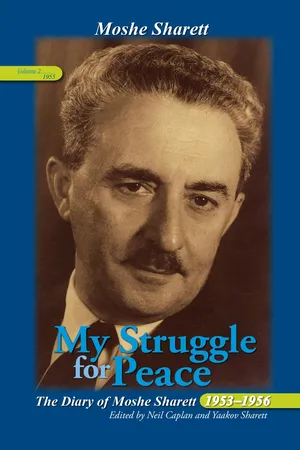
The second volume of the former Israeli prime minister's journals from the nation's early years, centering on his time in office.
My Struggle for Peace is a remarkable political document offering insights into the complex workings of the young Israeli political system, set against the backdrop of the disintegration of the country's fragile armistice with the Arab states. Replete with Moshe Sharett's candid comments on Israel's first-generation leaders and world statesmen of the day, the diary also tells the dramatic human story of a political career cut short—the removal of an unusually sensitive, dedicated, and talented public servant.
My Struggle for Peace is, above all, an intimate record of the decline of Sharett's moderate approach and the rise of more "activist-militant" trends in Israeli society, culminating in the Suez/Sinai war of 1956. The diary challenges the popular narrative that Israel's confrontation with its neighbors was unavoidable by offering daily evidence of Sharett's statesmanship, moderation, diplomacy, and concern for Israel's place in international affairs.
This is the second volume in the 3-volume English abridgement of Sharett's
Yoman Ishi [Personal diary] (Ma'ariv, 1978) maintains the integrity, flavor, and impact of the 8-volume Hebrew original and includes additional documentary material that was not accessible at the time. The volumes are also available to purchase as a set or individually.
"The editors . . . vastly improved on the Hebrew version by adding Sharett's speeches, reports, cabinet minutes, and other sources to the text. . . . These additions makes this work so important and welcome by all who aspire to understand the foreign and defense policies of Israel in its first decade." —
Israel Studies Review
eBook - ePub
My Struggle for Peace, Volume 2 (1955)
The Diary of Moshe Sharett, 1953–1956
- 576 pages
- English
- ePUB (mobile friendly)
- Available on iOS & Android
eBook - ePub
My Struggle for Peace, Volume 2 (1955)
The Diary of Moshe Sharett, 1953–1956
About this book
Trusted by 375,005 students
Access to over 1.5 million titles for a fair monthly price.
Study more efficiently using our study tools.
Information
1955
Débâcle in Egypt
Saturday, January 1
[No diary entry found for this date.]
Sunday, January 2
I am renewing my diary writing after who-knows-how-many months of cessation, which caused me deep frustration, but which I have not found the energy to overcome. I do have the skeleton of events I wrote down daily, and I have not given up hope of filling in the gaps. But who knows if and when I will find the time necessary for this and if my memory won’t fail me when I try to revive it all. It seems only the protruding events have remained intact while the colors and experiences have become dull or have even been erased completely.
Two decisions are going to fall this week: the verdict in the trial of the ten Jews in Cairo and the resolution of the Security Council debate in the matter of the “Bat Galim.” As regards the trial, we have received worse news than what we had before and decided to take up vigorous measures again. This morning Gideon Rafael set out for Paris once again for the purpose of this affair, and yesterday I wired London to ask Orbach to come to Paris and be prepared to fly immediately to Cairo.1
The press is overflowing with the details of the story told by the captain and the nine sailors of the “Bat Galim” who were returned to Israel yesterday. [- - -]
Before the Cabinet meeting, Yosef Tekoah summarized for me his conclusions of the “Bat Galim” affair in light of the return of the crew. Even though Joe could easily have reached a completely negative assessment of the entire operation, having had no part in the decision to send the boat, he – a sensible observer and sober-minded analyst – saw some definite positive achievements in its aftermath. First, the Egyptian position had been completely exposed and laid bare before the entire world. As much as they had tried to cover it up with false allegations, they had been forced to retract them. Second, for the first time an explicit resolution had been adopted by a UN institution – the this time – regarding the legality of Israeli navigation in the Canal. Third, it may be assumed with confidence that from now on there would be no interference with the passage of Israeli cargoes on non-Israeli ships. This last improvement was not something to be viewed lightly. I praised Joe for his clear thinking and good spirits. I was truly much relieved and the world around me seemed a bit less gloomy.2
[- - -]
At the last moment before the opening of the Cabinet meeting, Eshkol entered the meeting room, followed immediately by Lavon. Evidently, Eshkol wanted to talk in private, but that became impossible. He voiced a strong appeal against my establishing a commission of inquiry.3
The consequences, he said, would be most disastrous. Dayan has apparently managed to explain the matter to him from his point of view. I rejected his critical response both in principle and in practice. The inquiry begins this afternoon.
In the course of the Cabinet meeting, I signed the instrument of authority which I had drawn up last evening and [my secretary] Shamai copied them by hand. Lavon asked to see them and I assented. There remained a paragraph in the above document making it obligatory to draw my attention to defects in the apparatus of command and the political control over it. I was sure that this would suffice for the commission to spread its net.4
Most of the Cabinet meeting was swallowed up by an argument about the Law of Inheritance. The religious Ministers are satisfied with the minimum: they are not demanding the delegation of all matters of inheritance within the rabbinical authorities, but insist on making it possible for those interested to have their matters brought before a rabbinical court. Our Ministers and [Pinhas] Rosen vehemently opposed this: We are a modern state. In all properly governed states, including Turkey, Pakistan and Egypt, inheritance matters were taken out from the hands of religious courts and handed over to civil courts. It is just impossible that we shall have two parallel juridical systems. What about the status of women? I suggested we postpone a decision, and hinted I would be ready for a compromise with the religious on condition that the right of women to full equality [be assured] without any discrimination.5
In the afternoon there was a consultation at my home on the matter of the [planned] Israeli delegation to China, headed by David Hacohen,6 and the implications of this move for our relations with the US. The consensus was not to postpone the trip which was scheduled for the last week in January. The delegation would look into trade possibilities in Rangoon too, and also visit Thailand and the Philippines. All this is to impart greater scope to the trip and slightly blunt the Chinese sting therein. I suggested that we emphasize in the press that the boycott enacted against us by the [organizers of the] Conference of Asian and African Nations [which would convene in April in Bandung, Indonesia] made it even more imperative for us to develop our contacts with China. The Americans have to be told that, facing such extensive isolation, we cannot be expected to sentence ourselves to additional isolation of our own accord. Walter voiced his opinion that Nehru’s defense of our right to take part in the [scheduled] conference, which he’d expressed both in Jakarta and at the press conference in Calcutta on his return to New Delhi, was likely to hasten the establishment of diplomatic contacts between ourselves and India. Would that it be so. The truth is that Nehru has gotten himself tangled up in a moral contradiction by defending our right of equality vis-à-vis other nations while denying us this same right in our relations with his own country.
For dinner at home, in our kitchen, Charles Shulman, a Reform Rabbi from New York, active in the UJA and an old friend. A good chap but and endless talker. I learned from him that the very same Henry Crown, who had visited me a few months ago, is so heavy with money that he may be the richest Jew on Earth – Charles is breaking his head over how to warm Crown’s heart.
[- - -]
Pinhas Sapir renewed Eshkol’s protest over the inquiry into the Cairo mess. Harsh words were exchanged between us. I resolutely announced that I was not willing to bear the responsibility for the unruly situation which had arisen without an authoritative inquiry which I could trust. The fear that, as a result of this [commission], the terrible relations pervading the defense leadership and the criminal allegations bandied about there by one and all would become public knowledge does not hold water. And this, not because this fear is unfounded, but because such is the reality and the absence of an inquiry would not remedy the ill; it would only constitute a scandal in its own right. Golda supported me with all her vigor. She related that, two weeks ago, she had already demanded that I launch an inquiry, and that I had answered that I was postponing it until after the trial in Cairo. In an aside she said that she had been highly impressed by my behavior during the whole course of dealing with the affair of the trial, not having busied myself with internal accusations, which it would have been my right to do, but having devoted myself entirely to saving the accused from the danger of hanging.
Meanwhile, it became clear that word of the inquiry is known throughout the IDF upper echelons and the directorate of the Defense Ministry. Apparently both the CoS and the the Defense Ministry DG [Shimon Peres] have spread it about.
I telephoned Shamai in Tel Aviv (he is serving as secretary to the Olshan-Dori Commission) and instructed him to see Moshe Dayan and Shimon Peres in my name tomorrow morning, to express my resentment at the disclosure of the Inquiry to people who have nothing to do with the matter, and to demand that a strict order be given to everybody in the know to desist from all discussion of the matter.
[- - -]
Monday, January 3
[- - -]
At home in the afternoon. Aryeh Bahir came to see me. He is now the election campaign coordinator at the Mapai Center. A conversation developed on the status of BG, among whose professed followers Aryeh is prominent. At the time when we held a consultation on ending the impasse with the GZ over the percentage threshold, Aryeh tried to put off the decision. Was it possible, he contended, to come to an agreement with the GZ on this matter just when BG was beginning negotiations with them for far-reaching changes in the election statutes? And in general, was it permissible to make a decision in any matter now without BG’s participation? At the time, Aryeh’s fighting BG’s battles without being asked had kindled my wrath, as it did Golda’s, Ziama’s and others’. I now confronted him with his crude behavior. I further explained to him that, at the meeting of Mapai leaders at Oholo7 on December 15th, I had agreed to allow BG freedom of initiative to examine possibilities for the future under the obvious assumption that no step he took or was about to take would delay or prevent any action which the present government viewed as necessary, to say nothing of action on which the very existence of the government was dependent. And, in regard to these, the present PM would enjoy the exclusive right to decide. In other words, I was by no means willing – nor should it be demanded of me – to subject my present authority to any considerations for the future according to which BG is acting. There was no question here of a personal confrontation. And in the same vein I am sure that BG himself does not even entertain the notion of tying the present government’s hands lest its freedom of action dictated by the need of the hour frustrate any idea he harbors for rectifying our system of government in the future.
Aryeh, whose method would countenance the subjugation of the entire party central apparatus to the campaign staff and who views every step and every problem only from the perspective of the coming contest, made an effort to extend this conception to the level of high policy. He attempted to persuade me that now was the time to establish a central “panel” around which a select group, including BG, would assemble, before which every basic problem that occupied the government would be brought. I said that I was always prepared to consult, but would by no means accept an obligation to consult with BG specifically before deciding on matters which I was responsible for on a daily basis. I adhered to this position all the more so since a permanent arrangement concerning consultations with BG might necessitate trips to Sde Boker, or at least to Be’er Sheva, or at the very least to one of the southern municipalities, since BG, residing at Sde Boker, is willing to come to meetings “anywhere except for Tel Aviv and Jerusalem” – a principle whose logic is apparent only to BG himself. Aryeh implored me to agree to the establishment of the “panel.”
Finally Aryeh raised the problem of the inquiry into the Cairo matter. He had received “delegations” – he was alluding to Shimon Peres and Shlomo Hillel, and perhaps someone else – warning of the gravity of the consequences. Matters would become known – they already had, in effect – and relations among the defense leadership would reach a falling-out that would preclude any possibility of working together. I said that “the matter” itself was known to many anyway. The fact of the inquiry had been intended to be – and could have been – kept secret, had not the CoS and Defense Ministry DG taken the trouble to spread it. And perhaps the Defense Minister also had a hand in this disclosure. Each had his own interest. As to the “relations,” they were undermined and utterly ruined anyway. On the other hand, postponement of the inquiry for any unlimited period could not be entertained from any public-moral or internal-political point of view, first and foremost from the viewpoint of personal responsibility, mine to begin with. As for myself, I may lock up the report I receive in my secret cabinet and not draw any conclusions from it until after a period of time. However, I cannot accept responsibility for not investigating the horrific affair, at least for the benefit of my own knowledge. I am also sure that, within the Army, the fact that, after what had happened, there should be no questioning and no investigation, and the problem of responsibility for the whole terrible nightmare should be left to whispers and guesses with no attempt at an authoritative determination – that would have corrupted whatever still remained intact. This way it would at least be known that there is law and order in this country and that the PM has made up his mind to clear up the mystery and saddle those who are responsible for the disaster with the blame. I explained why I had rejected Eshkol’s proposal – which he must certainly have had from Dayan – that I myself be the investigator. This procedure would have roused the corps of officers against me, since everyone knows about the struggle between Lavon and Dayan and myself on the question of the political-military “line.” Had I taken investigation and judgement into my hands, I would have been accused of exploiting the opportunity to settle accounts and get my revenge. The fact that I had not done so, but had appointed two personages whose integrity and complete impartiality were beyond doubt or suspicion, could only strengthen the repute of this government in the eyes of the military, which was not over-endowed with respect towards it.
A conversation developed about Lavon and the pernicious role he has played in corroding the Army’s sense of loyalty to the elected government, and in instituting a regime of deceitful relations within it. Aryeh contended that, as soon as I had discovered that Lavon was not telling me the truth, I should have immediately demanded his resignation, regardless of the consequences to the party and the government. I explained that the matter of Lavon’s dismissal, which had worried me unceasingly, was not simple. The history of my relations and entanglements with Lavon should be divided into two periods: prior to the disaster in Egypt, and after it. During the first period, I hoped to check him and bring him under control with the help of the haverim who supported me. I had an absolute moral right – and perhaps a duty – to demand his removal, but the fact remained that those same haverim were not yet prepared for such an extreme surgical procedure. In this situation, it was clear that the removal would have caused a severe crisis within the party, since numerous of its responsible members were unfamiliar with his contemptible deeds. There was no point in fomenting a crisis before the awareness of the public, upon whose head it was to explode, should have ripened. If there was no avoiding it, the ground for it had to be prepared first. In this respect, the disaster in Egypt had caught me in the middle of the road – both in my efforts to take control and in preparing the ground for a clear decision. Once that disaster occurred, it was no longer possible to consider the removal. That would have served as irrefutable proof to the outside world that we had had a hand in the Egyptian affair and would have delivered the accused into the hands of the hangman.
[- - -]
Later on I sat for a long time over my papers, but when I went to bed the tension inside me grew again and I could not fall asleep. God almighty, I thought, how complex is Your world and ho...
Table of contents
- Cover
- Title Page
- Copyright
- Table of contents
- Volume 2: January 2, 1955 – December 31, 1955
Frequently asked questions
Yes, you can cancel anytime from the Subscription tab in your account settings on the Perlego website. Your subscription will stay active until the end of your current billing period. Learn how to cancel your subscription
No, books cannot be downloaded as external files, such as PDFs, for use outside of Perlego. However, you can download books within the Perlego app for offline reading on mobile or tablet. Learn how to download books offline
Perlego offers two plans: Essential and Complete
- Essential is ideal for learners and professionals who enjoy exploring a wide range of subjects. Access the Essential Library with 800,000+ trusted titles and best-sellers across business, personal growth, and the humanities. Includes unlimited reading time and Standard Read Aloud voice.
- Complete: Perfect for advanced learners and researchers needing full, unrestricted access. Unlock 1.5M+ books across hundreds of subjects, including academic and specialized titles. The Complete Plan also includes advanced features like Premium Read Aloud and Research Assistant.
We are an online textbook subscription service, where you can get access to an entire online library for less than the price of a single book per month. With over 1.5 million books across 990+ topics, we’ve got you covered! Learn about our mission
Look out for the read-aloud symbol on your next book to see if you can listen to it. The read-aloud tool reads text aloud for you, highlighting the text as it is being read. You can pause it, speed it up and slow it down. Learn more about Read Aloud
Yes! You can use the Perlego app on both iOS and Android devices to read anytime, anywhere — even offline. Perfect for commutes or when you’re on the go.
Please note we cannot support devices running on iOS 13 and Android 7 or earlier. Learn more about using the app
Please note we cannot support devices running on iOS 13 and Android 7 or earlier. Learn more about using the app
Yes, you can access My Struggle for Peace, Volume 2 (1955) by Moshe Sharett, Neil Caplan,Yaakov Sharett, Neil Caplan, Yaakov Sharett in PDF and/or ePUB format, as well as other popular books in Política y relaciones internacionales & Biografías políticas. We have over 1.5 million books available in our catalogue for you to explore.