An urgent challenge to the prevailing moral order from one of the freshest, most compelling voices in radical politics today
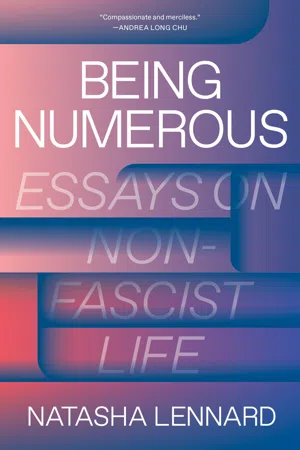
Being Numerous shatters the mainstream consensus on politics and personhood, offering in its place a bracing analysis of a perilous world and how we should live in it. Beginning with an interrogation of what it means to fight fascism, Natasha Lennard explores the limits of individual rights, the criminalization of political dissent, the myths of radical sex, and the ghosts in our lives. At once politically committed and philosophically capacious, Being Numerous is a revaluation of the idea that the personal is political, and situates as the central question of our time - How can we live a non-fascist life?
- 304 pages
- English
- ePUB (mobile friendly)
- Available on iOS & Android
eBook - ePub
About this book
Trusted by 375,005 students
Access to over 1.5 million titles for a fair monthly price.
Study more efficiently using our study tools.
Information
1
We, Anti-Fascists
Between spells of January drizzle, in the midst of scattered street protests, on a particularly bad afternoon in Washington, DC, Richard Spencer got punched in the face.
That morning, Donald Trump commenced his term as president with rageful, nationalistic oration. Nearby, police penned in and mass-arrested over 200 inauguration counter-protesters. The demonstrators, participants in an “anti-fascist, anti-capitalist bloc”—in which I had also marched—would go on to face a repressive array of bogus felony charges and potential decades in prison. By the afternoon of January 20, protests were dispersed, gloating frat boys in red “Make America Great Again” hats ambled through DC’s dreary avenues, and Donald Trump was president.
Any silver lining that day was going to be thin. But there it was, gleaming: a sublime right hook to Richard Spencer’s face.
I didn’t see it in person, but on a YouTube clip, which during the coming weeks would be viewed well over 3 million times.
Spencer, a neo-Nazi who claims America belongs to white men, was in the middle of telling an Australian TV crew that he was not a neo-Nazi, while pointing to the white nationalist mascot, Pepe the Frog, on his lapel pin. A black-clad figure, face covered (the unofficial uniform of our march that morning) jumps into frame, deus ex machina, with a flying punch to Spencer’s left jaw. The alt-right poster boy stumbles away, and his anonymous attacker bounds out of sight.
Within hours it was a meme, set to backing tracks from Springsteen, New Order, Beyoncé and dozens more. A thing of kinetic beauty, the punch was made for an anthem’s beat; the punch was made for sharing.
I had thought we could all agree: a prominent neo-Nazi was punched in the face; it was a good thing.
I had miscalculated “we.”
In the weeks and months prior to Trump’s inauguration, an outpouring of media commentary was dedicated to determining whether the soon-to-be president was or was not a fascist, and whether we were or were not on the verge of living under a fascist regime. Characteristics like selective populism, nationalism, racism, traditionalism, the deployment of Newspeak and a disregard for reasoned debate were rightly noted as fascist tendencies, if not sufficient for some to call the Trump phenomenon a fascist one.
These articles spoke to a genuine panic that the arc of history had been bent in the wrong direction, twisting back on itself toward early twentieth-century Europe. They were steeped in modernity’s progress myth, conveniently forgetting that fascism has, in fact, always been continuous with modernity. Whether or not the commentators concluded that Trump was an actual fascist, they all agreed that fascism was to be understood as The Worst. This glut of commentary treated fascism as something that takes shape only in the context of a historically constituted regime—the problem of fascism was real, but located only in the threat of its possible return: Will Donald Trump bring fascism to America?
It was as if decades of theorizing fascism—as an ideology, or a tendency, a practice, something that never quite disappeared —had been erased overnight and all that mattered in the media frenzy was delineating Trump’s similarities and differences to Hitler or Mussolini.
I didn’t consider at the time that most of the commentators weighing in on Trump’s fascism (or lack thereof) presumed their position to be anti-fascist enough. Every argument was premised on the post–World War II a priori that fascism is an evil to which we are opposed: a departure from or aberration of the sociopolitical status quo, something outside of ourselves. It’s perhaps no accident that a liberal commentariat would focus on this sort of state fascism—one that reductive histories pretend was conquered by liberal democracy, rather than crumbled in protracted war. But there’s nothing so easy, nor so empty, as opposition to a fascism that is framed as an unparalleled historical horror that could return.
I took in good faith these professed concerns about the Trumpian specter of fascism, and I believed in turn that we would see a broad liberal-to-left acceptance of vigorous anti-fascist action. And so, I advocated, and continue to advocate, for a particular response to perceived fascism, one that has enjoyed successes throughout the twentieth and early twenty-first centuries. I’m talking about the anti-fascism abbreviated as “Antifa”—a militant, no-tolerance approach to far-right, racist nationalism, the sort that, while it is not new, has become newly empowered and utterable. As such, I am talking about that messy, instable, ever-oversimplified category: violence. Or, as I see it, counterviolence. I delighted, publicly, in Richard Spencer getting punched.
Antifa is not a group, nor a movement, nor even an identity. To state one’s political position as anti-fascist after 1945 is close to empty and, I will argue, in a certain sense necessarily false. But as a practice taken up by the pan–far left (socialist and anarchist alike), Antifa is an illiberal intervention that in resisting fascism does not rely on the state, the justice system or any liberal institution. It finds organization online, in the streets, on campuses—wherever fascism is to be found.
Having spent much of my writing career arguing against the old canard of violence versus nonviolence, I did not think liberal aversions to the idea of political violence would suddenly vanish. But I thought, with fear of fascism in the air and a clamor for some unified resistance, that we could at least agree that it was okay, if not good, to punch a neo-Nazi. How wrong I was.
The gleeful social media circulation of the Spencer punch video was met with censure from the same liberal media microcosms that had spent the previous weeks nail-biting about fascism. Even the most simply Antifa act—a silencing, anti-Nazi punch—would not find broad support in the so-called resistance.
A year into the Trump presidency, I felt like I’d fallen through the looking glass. The apparent panic about the rise of fascism had been overtaken by paranoiac fear and condemnation of the rise of anti-fascism.
I had thought that Charlottesville would take on the valence of historic Event—the sort about which we speak of “before” and “after”; a turning point. A neo-Nazi plowed his Dodge Charger into a crowd of anti-fascist counterprotesters, killing one and injuring many. A young black man was viciously beaten by racists with metal poles in a parking lot by a police station. White supremacists marched, Klan-like, with burning torches and Nazi salutes around a Confederate statue of General Robert E. Lee while chanting, “Jews will not replace us!”—a gruesome pastiche of nineteenth-century American and twentieth-century European race hate, never vanquished but newly Trump-emboldened. The day after the rally, the president blamed “many sides.” Some days later, like a pantomime villain at another campaign-less campaign rally in Phoenix, he let out an ominous roar: “Anteefa!”
In Charlottesville, the already-flimsy veil of plausible deniability about the racist fascism of the so-called alt-right had been ripped away. Faced with the spectacle of Charlottesville, liberal commentators who had written baseless screeds comparing the threat of far-left anti-fascists to that of white nationalism would surely think twice about such a false equivalency.
Upon hearing the “two sides” argument from the puckered, impossible mouth of the president, I was sure the mainstream narrative equating far-left and far-right violence would shift. Instead, it doubled down. In the month that followed the intolerable events in Charlottesville, America’s six top broadsheet newspapers ran twenty-eight opinion pieces condemning anti-fascist action, but only twenty-seven condemning neo-Nazis, white supremacists and Trump’s failure to disavow them.
Meanwhile, magazines and news outlets—only a year ago lousy with warnings against the “normalization” of hate—have published a string of profiles platforming white supremacists and neo-Nazis as if they were now an accepted part of the social fabric (thus interpellating them as such). The “polite” Midwestern Hitler fan with a Twin Peaks tattoo whose manners “would please anyone’s mother.” The “dapper” white nationalist. The description of right extremist rallies drenched in dog whistle and foghorn neo-Nazi symbolism as mere “pro-Trump” gatherings—or worse, as “free speech” rallies.
What changed? In truth, nothing. We are observing a phenomenon that Martin Luther King Jr. noted well in his 1963 “Letter from a Birmingham Jail.” We are dealing with “the white moderate, who is more devoted to ‘order’ than to justice; who prefers a negative peace which is the absence of tension to a positive peace which is the presence of justice; who constantly says: ‘I agree with you in the goal you seek, but I cannot agree with your methods of direct action.’” There is no shortage of irony in the invocation of MLK by today’s white moderates in order to decry Antifa tactics as violent; in fact, I believe (if one can so speculate) that these same commentators would have been critical of his radical nonviolence, predicated as it was on the provocation of violent spectacle. It is a great liberal tradition to stand on the wrong side of history until that history is comfortably in the past.

We’re seeing a liberal aversion to violence, but it is one that fails to locate violence in the right places.
Any discussion about violence and Antifa must note that since 1990, there have been 450 deaths caused by white supremacist violence in the United States, compared to only one believed to be related to far-left activity. While property damage, minor clashes and a few neo-Nazi black eyes drew cries of leftist extremism in the last year, an active white supremacist traveled to New York with the precise aim of murdering black men. He succeeded in stabbing and killing a homeless man. In Portland, Oregon, another white supremacist killed two men who were standing up for two Muslim women on a train. Outside a talk by right-wing commentator Milo Yiannopoulos in Seattle, one of his fans, wearing a “Make America Great Again” cap, shot and wounded an anti-fascist counterprotester in the stomach. To name but a few examples. In the ten days that followed Trump’s election alone, the Southern Poverty Law Center reported 900 separate incidents of bias and violence against immigrants, Latinos, African Americans, women, LGBTQ people, Muslims and Jews.
Centrist liberals criticize Antifa activists for responding with counterviolence, urging instead that we follow Michelle Obama’s gracious direction: “When they go low, we go high.” Insisting on the importance of debate with fascists, they decry violent or confrontational intervention.
Some see tactical and moral value in allowing the likes of Richard Spencer to speak publicly and rally, believing that the fallacies of their hateful views are best made visible and therefore subject to debate and reason. The idea, then, is that the best way to defeat hate speech, such as vile arguments for race realism, would be to listen to it and thus allow its internal contradictions and idiocy to thwart itself.
This is wishful thinking, proven false by the actual state of things—tantamount to telling a patient with a pus-seeping wound that sunlight is the best disinfectant. The alt-right might be a fumbling fractured mess, and the white supremacists in the White House make their buffoonery clear. But support for racist ideology and its mainstream normalization are not dwindling by virtue of this—quite the opposite. This is not a fringe group whose unreasoned racism, if articulated and forcefully debated, will lose traction and self-implode.
In a recent video that earned a lot of liberal praise, Guardian journalist Gary Younge interviewed Richard Spencer. Younge recounted the encounter as follows: “In the course of our exchange he claims that Africans contributed nothing to civilisation (they started it), that Africans benefited from white supremacy (they didn’t) and that, since I’m black I cannot be British (I am).” His retelling is accurate, and Spencer’s facade equally paper thin, but this did nothing to impede Spencer’s bluster. In the video, a flustered Younge tells Spencer, “You’re really proud of your racism, aren’t you … you’re talking nonsense.” Spencer, unmoved, continues, “You’ll never be an Englishman.” A racist for whom the tenets of white supremacy are foundational will not be swayed by Younge’s correctness. This was neither interlocution, nor a particularly revelatory exposure of Spencer’s well-publicized views; this was the incommensurability of a white supremacist Weltanschauung with one of tolerance.
Liberal appeals to Truth will not break through to a fascist epistemology of power and domination—these are Spencer and his ilk’s first principles. And it is this aspect of fascism that needs to be grasped to understand the necessity of Antifa’s confrontational tactics.
There is no one uniting ideology between those—across history and geography—who see Antifa practices as the best means to combat certain fascist iterations. I say “certain” because neo-Nazi and white supremacist groups, public figures, and (in our case) presidents are not the sum total of fascism. Even their total obliteration would not rid us of fascism.
Rather, each is simply a dangerous locus of what I want to call “fascistic habit”—formed of fascistic desire to dominate, oppress and obliterate the nameable “other.” (I don’t use the word “habit” lightly; I mean no less than the modes by which we live). Their fascism is not a perversion of our society’s business as usual, but an outgrowth. I won’t talk of “neo-fascism” any more than I will talk of “neo-Antifa”; for fascism never disappeared but simply reiterates, sometimes with greater force. Antifa, as I see it, is one aspect of a broader abolitionist project, which would see all racist policing, prisons and oppressive hierarchies abolished. As German Social Democrat and playwright Bertolt Brecht wrote in 1935, “How can anyone tell the truth about Fascism, unless he is willing to speak out against capitalism, which brings it forth?”
Also writing in Germany during the early 1930s, Freudian acolyte Wilhelm Reich wrestled with the operations by which a society chooses a fascist, authoritarian system. Rejecting narratives in which ignorant masses are duped or led into supporting a system they do not in fact want, he instead insisted that if we are to explain the rise of fascism, we must account for the fact that people, en masse, choose and desire fascism, and that we must understand their desire as genuine. Reich’s diagnosis—that the fascist subject is the product of societally enforced sexual repression, and can be thus treated with psychoanalysis—is biologically essentialist, overly general and totally out of date. Nevertheless, his reckoning with fascistic desire is something sorely lacking in this moment of Trump-emboldened fascism and the battle against it.
Certain lines from Reich’s The Mass Psychology of Fascism (1933) get regurgitated more than others in moments like this—moments in which a media cottage industry seems dedicated to defining fascism in order to prove that we are, or are not, faced with it. “Fascist mentality is the mentality of the subjugated ‘little man’ who craves authority and rebels against it at the same time”—that’s a popular one, and apt. So is the reflection that it is “not by accident that all fascist dictators stem from the milieu of the little reactionary man.” However, I’m more interested in some of his less-cited observations, in particular those that describe the everyday forms of fascism: that “there is today not a single individual who does not have the elements of fascist feeling and thinking in his structure”; and that “one cannot make the Fascist harmless if, according to the politics of the day, one looks for him only in the German or Italian, or the American or the Chinese; if one does not look for him in oneself; if one does not know the social institutions which hatch him every day.”
Reich’s insight is not restricted to Germany during Hitler’s rise. The problem of everyday fascisms—micro-fascisms with and by which we live—is real and complicates the fascist/anti-fascist dichotomy; indeed, there is a certain impossibility to “anti-fascist” as an identity. Among the twentieth-century thinkers who have built on Reich’s idea of a perverted desire for fascism, perhaps most notable are the French philosopher Gilles Deleuze and psychoanalyst Félix Guatarri. They wrote that it is “too easy to be anti-fascist on the molar level, and not even see the fascist inside of you.” In his famed introduction to their 1972 text Anti-Oedipus, theorist Michel Foucault noted, “The fascism in us all, in our heads and in our everyday behaviour, the fascism that causes us to love power, to desire the very thing that dominates and exploits us.”
So if in this sense we are all somehow possessed of fascism, how can we speak of anti-fascism, and how can we name and delineate the fascists of our political targeting? It is precisely through the recognition of fascism as a developed tendency. The fascism Deleuze and Guattari are talking about is not some innate disease or pathology that we can’t shake, but rather a perversion of desire produced through forms of life under capitalism and modernity: practices of authoritarianism and domination and exploitation that form us, such that we can’t just “decide” our way out of them. But not everyone becomes a neo-Nazi; only a few people seek the white supremacy that grimly organizes society as it stands. This, too, takes fascist practice, fascist habit; a nurturance and constant reaffirmation of that fascistic desire to oppress and live in an oppressive world. And, to be sure, the world provides that pernicious affirmation: Donald Trump is president, after all.
How to break a habit? Thought, therapy, or reasoning may sometimes prove useful. Sometimes. There are rare stories of neo-Nazis who left the movement that way. On the other hand, the introduction of serious consequences, if not breaking the habit entirely, may redirect it such that its practices cannot be continued, fed or maintained. When “serious consequences” are taken to mean brushes with criminal justice and the carceral system, that simply introduces state-sanctioned fascistic practices into the mix (not to mention the unlikelihood of the US criminal justice system treating white supremacy as an enemy). This is the importance of anti-fascism also as practice and habit: if desire for fascism is not something that happens out of reason, then we cannot break it with reason. So our interventions must instead make the entertainment and maintenance of fascist living intolerable. The desire for fascism will not be thus undone: it is by its nature self-destructive. But at least the spaces for it to be nurtured and further normalized will be withdrawn.
And what of the fascisms in each of us who would be anti-fascist? “Kill the cop inside your head!” goes the anarchist dictum. As philosopher John Protevi noted in his 2000 essay, following Deleuze and Guatarri, “A thousand independent and self-appointed policemen do not make a Gestapo, though they may be a necessary condi...
Table of contents
- Cover Page
- Title Page
- Copyright Page
- Dedication
- Contents
- Introduction
- 1. We, Anti-Fascists
- 2. Ghost Stories
- 3. Riots for Black Life
- 4. Homegrown
- 5. Making Felons
- 6. Freedom for Herman Bell
- 7. Still Fighting at Standing Rock
- 8. Know Your Rights
- 9. Beyond Free Speech
- 10. Love According to the State
- 11. Policing Desire
- 12. Looking at Corpses
- 13. Being Numerous
- 14. Of Suicide
Frequently asked questions
Yes, you can cancel anytime from the Subscription tab in your account settings on the Perlego website. Your subscription will stay active until the end of your current billing period. Learn how to cancel your subscription
No, books cannot be downloaded as external files, such as PDFs, for use outside of Perlego. However, you can download books within the Perlego app for offline reading on mobile or tablet. Learn how to download books offline
Perlego offers two plans: Essential and Complete
- Essential is ideal for learners and professionals who enjoy exploring a wide range of subjects. Access the Essential Library with 800,000+ trusted titles and best-sellers across business, personal growth, and the humanities. Includes unlimited reading time and Standard Read Aloud voice.
- Complete: Perfect for advanced learners and researchers needing full, unrestricted access. Unlock 1.5M+ books across hundreds of subjects, including academic and specialized titles. The Complete Plan also includes advanced features like Premium Read Aloud and Research Assistant.
We are an online textbook subscription service, where you can get access to an entire online library for less than the price of a single book per month. With over 1.5 million books across 990+ topics, we’ve got you covered! Learn about our mission
Look out for the read-aloud symbol on your next book to see if you can listen to it. The read-aloud tool reads text aloud for you, highlighting the text as it is being read. You can pause it, speed it up and slow it down. Learn more about Read Aloud
Yes! You can use the Perlego app on both iOS and Android devices to read anytime, anywhere — even offline. Perfect for commutes or when you’re on the go.
Please note we cannot support devices running on iOS 13 and Android 7 or earlier. Learn more about using the app
Please note we cannot support devices running on iOS 13 and Android 7 or earlier. Learn more about using the app
Yes, you can access Being Numerous by Natasha Lennard in PDF and/or ePUB format, as well as other popular books in Politics & International Relations & Local & Regional Planning Public Policy. We have over 1.5 million books available in our catalogue for you to explore.