- 176 pages
- English
- ePUB (mobile friendly)
- Available on iOS & Android
eBook - ePub
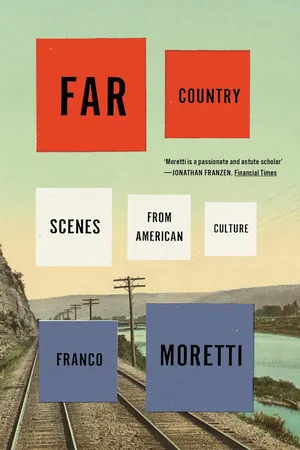
Far Country
About this book
A dazzling account of the development of American cultural hegemony from one of the world's leading literary theorists. Franco Moretti, acclaimed author of Graphs, Maps, Trees and Distant Reading, distils a lifetime of teaching and research to present "the university, in the form of an essay". Ranging from poetry and the novel to theatre and the visual arts, Far Country juxtaposes canonical figures in American art and letters with European counterparts-Whitman and Baudelaire, Hemingway and Joyce, Miller and Brecht, Hopper and Vermeer-charting ruptures in the medium of form that have transformed the cultural landscape on either side of the Atlantic over the past century.
Trusted by 375,005 students
Access to over 1.5 million titles for a fair monthly price.
Study more efficiently using our study tools.
Information
Notes
I. TEACHING IN AMERICA
I
* The third section of the course, in which I was involved, was initially taught by me (for the period 1850–1914), Nicholas Jenkins (1914–1945), and Ursula Heise (1945 to the present). Later, the number of instructors was cut to two (myself and Mark McGurl), and eventually one.
II
* Many disparate influences had contributed to this view of history: Russian formalism and 1960s structuralism were the initial—and strictly literary—sources of inspiration; later, my wanderings through the natural sciences made me encounter Gould’s and Eldredge’s “punctuated equilibria” and Kuhn’s “paradigm shifts”; while in the last few years, Brecht’s notion of the “epic theater”—where “each scene exists for itself,” the story advances by “leaps,” and the meaning of the whole can only be grasped through the “montage” of disparate elements—has become very important for the way I think about these matters.
* György Lukács, Theory of the Novel, 1914–15, MIT Press, 1974, p. 62. On this point, Lukács is not alone; Kenneth Burke famously defined art forms as “‘strategies’ for living” (Attitudes Toward History, 1937, 3rd ed., UC Press, 1984, p. 43), while George Kubler wrote that “every important work of art can be regarded […] as a hard won solution to some problem” (The Shape of Time: Remarks on the History of Things, 1972, Yale UP, 2008, p. 30). Building on Lévi-Strauss’s Structural Anthropology, Fredric Jameson defined narrative as “the imaginary resolution of a real contradiction” (The Political Unconscious, Cornell UP, 1981, p. 77), while for Michael Baxandall “the historical explanation of pictures” consists in “reconstructing both the specific problem [they were] designed to solve and the specific circumstances out of which [they were] addressing it” (Patterns of Intention: On the Historical Explanation of Pictures, Yale UP, 1985, pp. 14–15).
* Theodor W. Adorno, letter of November 10, 1938, in Adorno et al., Aesthetics and Politics, Verso, London, 1977, p. 129.
* Aby Warburg, Der Bilderatlas Mnemosyne. Einleitung, 1929, in Gesammelte Schriften, II.1, Martin Warnke, ed., De Gruyter, Berlin, 2000, p. 3.
† Erwin Panofsky, “Der Begriff des Kunstwollens,” Zeitschrift für Ästhetik und allgemeine Kunstwissenschaft XIV (1920), p. 339.
‡ Henrik Ibsen, When We Dead Awaken, 1899, in The Complete Major Prose Plays, translated and introduced by Rolf Fjelde, New York, 1978, p. 1044.
* On Growth and Form, 1917, rev. ed., 1942, Dover, New York, 1992, p. 16.
* Georg Simmel, The Philosophy of Money, rev. ed. [1907], Routledge, London and New York, 1990, p. 462.
† By reverse-engineering I mean the following three steps: first, extracting a specific technique from a given text, and seeing it as a “formal resolution” in Lukács’s sense; second, conjecturing what was the historical “dissonance” the technique was designed to resolve; and, third, trying to imagine what kind of pleasure—or, in some cases, which way of avoiding pain and discomfort—could be provided by such resolution. Once again: the “how,” “why,” and “what for” of aesthetic form.
IV
* In the case of Hopper and Miller, the hegemonic theme is de facto absent, as theirs is an America in the grip of economic depression (Hopper), or without any hope of future progress (Miller). The relevance of these two authors to other aspects of my argument, and the light they shed on American life, explains, I hope, their inclusion here.
† Colletti, a philosopher, combined rigorous Marxian philology and a ferocious hostility to dialectics; Rossanda, one of the founders of Il Manifesto, wrote memorable articles on the putsch against Allende and the Portuguese revolution; Eco, not yet a novelist, used his semiotic intelligence for all-round cultural polemics; and Placido, a freelance intellectual, was to become the leading cultural journalist for La Repubblica.
* Theodor W. Adorno, Alban Berg: Master of the Smallest Link, 1968, Cambridge UP, 1991, pp. 35–37.
† Max Weber, “Science as a Vocation,” in H. H. Gerth and C. Wright Mills, eds., From Max Weber: Essays in Sociology, Oxford UP, 1958, p. 151.
* Robert Boyle, “A Proemial Essay, wherein, with some Considerations touching Experimental Essays in general, Is interwoven such an Introduction to all those written by the Author, as is necessary to be perused for the better understanding of them,” in The Works of the Honourable Robert Boyle, ed. Thomas Birch, 2nd ed., J.&F. Rivington, London, 1772, vol. I, p. 312.
† Nor to their form only. Once I finished writing, I became aware that the thesis of the book was not as explicit as it could have been: that, for instance, the constellation of values that characterize American hegemony—democracy, violence, and consumer capitalism—had emerged only sporadically, and had not been taken as far as it could have. At first I thought of simply correcting this state of affairs; then I realized that, if the problem was there in the first place, it was because my idea of a university course is that of a series of meetings with (hopefully) some interesting things to say, but where the lecturer’s convictions remain more in the background than is usually the case in a book. Right or wrong, it seemed important that the book should preserve this aspect of the original course.
* “Notes on the Opera Rise and Fall of the City of Mahagonny,” 1931, in John Willett, ed., Brecht on Theatre: The Development of an Aesthetic, Farrar, Straus and Giroux, New York, 1992, p. 37.
† “Theatre for Pleasure or Theatre for Instruction,” ca. 1936, in John Willett, ed., Brecht on Theatre, cit., p. 71.
‡ “Isn’t the pleasure of drinking milk and washing oneself one and the same thing with the pleasure which he takes in new ideas?” wonders Brecht about his character in the Kleines Organon: “Don’t forget: he thinks for the pleasure of thinking!” “A Short Organum for the Theater,” 1948, in John Willett, ed., Brecht on Theatre, cit., p. 198.
* Richard P. Feynman, The Pleasure of Finding Things Out, Perseus, Cambridge, MA, 1999, p. 112.
† Max Weber, “Science as a Vocation,” cit., p. 149.
‡ Kenneth Burke, Attitudes Toward History, 1937, 3rd ed., UC Press, 1984, p. 4.
II. WALT WHITMAN OR CHARLES BAUDELAIRE?
I
* “Aber Freund! wir kommen zu spät. Zwar leben die Götter, / Aber über dem Haupt droben in anderer Welt. / Endlos wirken sie da und scheinen’s wenig zu achten, / Ob wir leben …”
* György Lukács, Theory of the Novel, cit., pp. 88 and 56.
† Max Weber, “Science as a Vocation,” cit., p. 155.
‡ “Indessen dünket mir öfters / Besser zu schlafen, wie so ohne Genossen zu seyn, / So zu harren, und was zu thun indeß und zu sagen, / Weiß ich nicht, und wozu Dichter in dürftiger Zeit?”
* G. W. F. Hegel, Aesthetics: Lectures on Fine Art, 1818–30, Clarendon Press, Oxford, 2010, pp. 9–10.
* Lee Erickson, The Economy of Literary Form: English Literature and the Industrialization of Publishing, 1800–1850, Johns Hopkins UP, 1996, p. 26.
† Walter Benjamin, “On Some Motifs in Baudelaire,” 1940, in Selected Writings, IV, 1938–40, Harvard UP, 2003, p. 313.
‡ “La sottise, l’erreur, le péché, la lésine, / Occupent nos esprits …”
II
* Walt Whitman, Poetry and Prose, Library of America, New York, 1982, p. 5.
* “Census, Map, Museum” is the title of the chapter of Imagined Communities in which Benedict Anderson describes the “grid” of state classifications, and the underlying assumption that the world, like Whitman’s America, “was made up of replicable plurals.” Benedict Anderson, Imagined Communities, Verso, London, 1983, rev. ed., 1991, pp. 184–85.
* Leo Spitzer, “La enumeracion caotica en la poesia moderna,” 1945, in Linguistica y historia literaria, Greidos, Madrid, 1961, p. 259n.
† Antonio Gramsci, Quaderni del carcere, Einaudi, Torino, 1975, p. 2141.
* “Dice al águila: ‘Vuela!’; ‘Boga!,’ al marino / y ‘Trabaja!’ al robusto trabajador.”
* “The phrase […] provides the fundamental technique Whitman uses to become the poet of democracy,” writes Angus Fletcher in A New Theory for American Poetry; unlike clauses, which “express superordinate and subordinate relationships […] no phrase is ever grammatically […] superior to any other phrase.” Angus Fletcher, A New Theory for American Poetry: Democracy, the Environment, and the Future of Imagination, Harvard UP, 2004, p. 219.
* David Simpson, “Destiny Made Manifest: The Style of Whitman’s Poetry,” in Homi K. Bhabha, ed., Nation and Narration, Routledge, London and New York, 1990, pp. 188, 182.
† David S. Reynolds, “Politics and Poetry: Leaves of Grass and the Social Crisis of the 1850s,” in Ezra Greenspan, ed., The Cambridge Companion to Walt Whitman, Cambridge UP, 1995, pp. 82–83. “Since the entire scheme was based upon an ideal of all-pervasive and almost promiscuous Union,” writes Kenneth Burke, “the motives of secession that culminated in the Civil War necessarily filled him with anguish.” Kenneth Burke, “Policy Made Personal—Whitman’s Verse and Prose-Salient Traits,” 1955, in Edwin Haviland Miller, ed., A Century of Whitman Criticism, Indiana UP, Bloomington, 1971, p. 293.
III
* On this, see Ezra Greenspan, who speaks of a “lifelong attachment to the grammatical form of the present participle” (“Some Remarks on the Poetics of ‘Participle-Loving Whitman,’” in The Cambridge Companion to Walt Whitman, cit., p. 92).
† Randall Jarrell, “Some Lines on Whitman,” in Poetry and the Age, Knopf, New York, 1953, p. 117.
‡ Charles Baudelaire, “Le peintre de la vie moderne,” 1863, in Charles Baudelaire, Oeuvres complètes, II, Gallimard, Paris, 1976, p. 695. Though the claim that Baudelaire coined the word “modernité” is a legend (others had used it before him), he does seem to have been the first to focus explicitly on it (using it, among other things, as the title for the fourth section of his essay).
* “Un matin, cependant que dans la triste rue” (“Les sept vieillards”); “La rue assourdissante autour de m...
Table of contents
- Cover Page
- Halftitle Page
- Title Page
- Copyright Page
- Contents
- I. Teaching in America
- II. Walt Whitman or Charles Baudelaire?
- III. Prose and History in “Big Two-Hearted River”
- IV. Day and Night: On the Counterpoint of Western and Film Noir
- V. Causality in Death of a Salesman
- VI. Amsterdam, New Amsterdam
- Illustration Credits
- Notes
Frequently asked questions
Yes, you can cancel anytime from the Subscription tab in your account settings on the Perlego website. Your subscription will stay active until the end of your current billing period. Learn how to cancel your subscription
No, books cannot be downloaded as external files, such as PDFs, for use outside of Perlego. However, you can download books within the Perlego app for offline reading on mobile or tablet. Learn how to download books offline
Perlego offers two plans: Essential and Complete
- Essential is ideal for learners and professionals who enjoy exploring a wide range of subjects. Access the Essential Library with 800,000+ trusted titles and best-sellers across business, personal growth, and the humanities. Includes unlimited reading time and Standard Read Aloud voice.
- Complete: Perfect for advanced learners and researchers needing full, unrestricted access. Unlock 1.5M+ books across hundreds of subjects, including academic and specialized titles. The Complete Plan also includes advanced features like Premium Read Aloud and Research Assistant.
We are an online textbook subscription service, where you can get access to an entire online library for less than the price of a single book per month. With over 1.5 million books across 990+ topics, we’ve got you covered! Learn about our mission
Look out for the read-aloud symbol on your next book to see if you can listen to it. The read-aloud tool reads text aloud for you, highlighting the text as it is being read. You can pause it, speed it up and slow it down. Learn more about Read Aloud
Yes! You can use the Perlego app on both iOS and Android devices to read anytime, anywhere — even offline. Perfect for commutes or when you’re on the go.
Please note we cannot support devices running on iOS 13 and Android 7 or earlier. Learn more about using the app
Please note we cannot support devices running on iOS 13 and Android 7 or earlier. Learn more about using the app
Yes, you can access Far Country by Franco Moretti in PDF and/or ePUB format, as well as other popular books in Literature & North American Literary Criticism. We have over 1.5 million books available in our catalogue for you to explore.