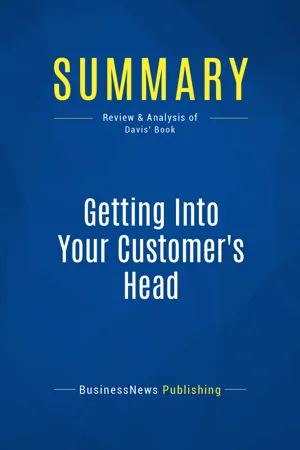
The must-read summary of Kevin Davis' book: "Getting Into Your Customer's Head: 8 Secret Roles of Selling Your Competitors Don't Know".
This complete summary of the ideas from Kevin Davis' book "Getting Into Your Customer's Head" explains that most sales today are made through a four-stage buy-learning process: 1. Prospective customers become aware of a need for something 2. They study all the options available to meet that need, and the cost of each option 3. They make a buying decision and 4. They evaluate whether or not they are receiving value-for-money on an ongoing basis. To be most effective, the sales process requires the sales person to adopt different roles at different times, depending on which stage of the buy-learning process the person is at. The various sales roles provide suggested modes of action that will be appropriate for each of those given situations. Customer-focused selling requires sellers to go through an entire sequence of customer-focused selling roles: student, doctor, architect, coach, therapist, negotiator, teacher and farmer. Each of these distinctive roles are designed to match productive sales techniques with the buyer's behavior and requirements throughout the overall sales sequence.
Added-value of this summary:
• Save time
• Understand key concepts
• Increase your business knowledge
To learn more, read "Getting Into Your Customer's Head" and discover a useful and practical guide for salespeople willing to succeed in today's marketplace.
eBook - ePub
Summary: Getting Into Your Customer's Head
Review and Analysis of Davis' Book
- English
- ePUB (mobile friendly)
- Available on iOS & Android
eBook - ePub
Summary: Getting Into Your Customer's Head
Review and Analysis of Davis' Book
About this book
Information
Subtopic
Consumer BehaviourIndex
BusinessSummary of Getting Into Your Customer’s Head (Kevin Davis)
SALES ROLE #1 – THE STUDENT
Main Idea
In the student sales role, study how changes in the marketplace are affecting your prospects and find opportunities where you can add value.
Supporting Ideas
Once upon a time, a salesman was judged solely on the strength of his product knowledge – how well he knew the technical features of the products he was selling. In today’s business marketplace, however, sales personnel are gauged not by their product knowledge but by how well they understand the business needs of their prospective customer – and by the value they can add by suggesting new ways to integrate their products and services into the prospect’s business.
The good thing is that change is a constant – the marketplace is always evolving, new products and new services are always being released, the competitive landscape for existing businesses is dynamic and fluid rather than static and inflexible. Each of these changes create openings by which an astute sales person can create new opportunities to generate added value.
Different areas of focus exist within the company’s management structure, and you should tailor your sales program specifically to these market needs. For example:
- If you sell products and services to executives in top management (CEO, CFO, senior vice presidents), you should concentrate on new developments that can steer the business towards greater profitability. At this level, management is on the lookout for ways to cut costs, solidify a competitive advantages. These executives measure success by the profitability yardstick.
- Below the top management are the core level managers – people who are hands-on in the manufacturing, operations, sales and service areas. These managers are primarily interested in products or services that solve problems. Come up with a viable idea to improve their operations and you have their full attention.
- The bottom level of any business is support – the essential functions and resources of the company like legal, accounting, purchasing, training, etc. At this level, every decision is price-driven. Show these people a way to get more product for less money and they’ll immediately be on board with you.
In all three levels, you’ll be more effective if you have empathy. Put yourself in the position of the person you want to sell to. Study their requirements closely. What problems are they facing? How can you help in those problem areas. The more problems you become aware of, the more you’ll be able to sell to them.
As you study the business, find the answers to these questions:
- What changes (external and internal) are impacting on the business being conducted by this person.
- How does work flow within the business? How is everything linked together? Will improvements in one area significantly impact on the overall operation?
- How does this company differentiate itself from its competition? Are there ways to further strengthen and build on those distinctive features?
- What is the criteria by which the prospect’s success is measured? What motivate them to action? What are they passionate about?
- What specific problems does the prospect have that can be solved with your product or service? How will their job performance or company performance be improved if they follow your recommendation?
The more successfully you can study the real-world problems the business faces, the more readily you can position yourself as a consultant who can add value to their business. The more problems you uncover that you can genuinely solve, the more you’ll sell.
Sales productivity is derived by both the quantity and the quality of the amount of time you spend in front of a person who can make a decision. By studying your prospect’s business from his view point, you’re going to be better prepared than most of the other sales people he meets. That means the quality of the time spent with you will be better – which, in turn, will lead to more opportunities for further business in the future.
Quantity, on the other hand, is largely dependent on the persistence of the sales person. Persistence can’t be taught...
Table of contents
- Book Presentation: Getting Into Your Customer’s Head by Kevin Davis
Trusted by 375,005 students
Access to over 1.5 million titles for a fair monthly price.
Study more efficiently using our study tools.
Frequently asked questions
Yes, you can cancel anytime from the Subscription tab in your account settings on the Perlego website. Your subscription will stay active until the end of your current billing period. Learn how to cancel your subscription
No, books cannot be downloaded as external files, such as PDFs, for use outside of Perlego. However, you can download books within the Perlego app for offline reading on mobile or tablet. Learn how to download books offline
Perlego offers two plans: Essential and Complete
- Essential is ideal for learners and professionals who enjoy exploring a wide range of subjects. Access the Essential Library with 800,000+ trusted titles and best-sellers across business, personal growth, and the humanities. Includes unlimited reading time and Standard Read Aloud voice.
- Complete: Perfect for advanced learners and researchers needing full, unrestricted access. Unlock 1.5M+ books across hundreds of subjects, including academic and specialized titles. The Complete Plan also includes advanced features like Premium Read Aloud and Research Assistant.
We are an online textbook subscription service, where you can get access to an entire online library for less than the price of a single book per month. With over 1.5 million books across 990+ topics, we’ve got you covered! Learn about our mission
Look out for the read-aloud symbol on your next book to see if you can listen to it. The read-aloud tool reads text aloud for you, highlighting the text as it is being read. You can pause it, speed it up and slow it down. Learn more about Read Aloud
Yes! You can use the Perlego app on both iOS and Android devices to read anytime, anywhere — even offline. Perfect for commutes or when you’re on the go.
Please note we cannot support devices running on iOS 13 and Android 7 or earlier. Learn more about using the app
Please note we cannot support devices running on iOS 13 and Android 7 or earlier. Learn more about using the app
Yes, you can access Summary: Getting Into Your Customer's Head by BusinessNews Publishing in PDF and/or ePUB format, as well as other popular books in Business & Consumer Behaviour. We have over 1.5 million books available in our catalogue for you to explore.