![]()
| 1 | Keeping Count Writing Whole Numbers |
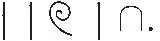
The problem of how to write numbers efficiently has been with humanity for as long as there have been sheep to count or things to trade. The simplest, most primitive way to do this was (and still is) by tallying — making a single mark, usually | or something just as simple, for each thing counted. Thus, one, two, three, four, five,... were written or carved as
and so on. People still use this for scorekeeping in simple games, class elections, and the like, sometimes bunching the stroke marks by fives.
The simplicity of the tally system is its greatest weakness. It uses only one symbol, so very long strings of that symbol are needed for writing even moderately large numbers. As civilization progressed, various cultures improved on this method by inventing more number symbols and combining them in different ways to represent larger and larger numbers. During the past six millennia, more than 100 distinct numeration systems have been used by various groups of people at various times.1 Examining a few of those earlier numeration systems can illustrate the power and convenience of our current system for writing numbers.
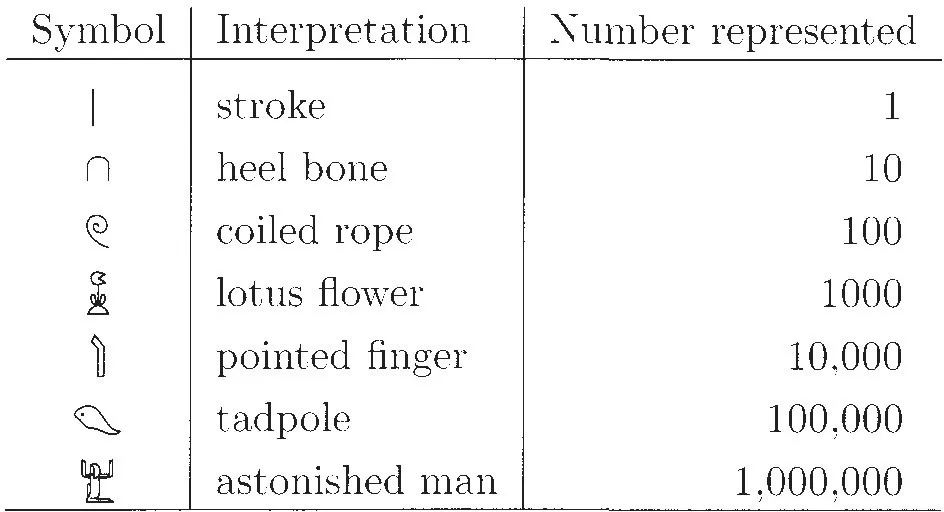
Sometime before 3000 B.C., the ancient Egyptians improved on the tally system by choosing a few more number symbols and stringing them together until their values added up to the number they wanted. These symbols were ''hieroglyphic"; that is, they were small picture drawings of common things. The basic pictures of the Egyptian system and their numerical values appear in Display 1.
In this system the number
one hundred thirteen, for instance, could be written as
or as
The order of the symbols didn't matter, as long as they added up to the right value. Of course, the pictures with the largest possible values in each case were used to make the writing process more efficient. Even so, larger numbers often required fairly long strings of symbols. For instance, the number they would write as 1,213,546 is
Egyptian hieroglyphic numerals
Display 1
One of the earliest artifacts showing this system in use is a royal Egyptian mace dating from about 3000 B.C., now in a museum at Oxford, England. It is a record of a successful military campaign, adorned with numbers in the hundreds of thousands and even in the millions.
Much of our knowledge of Egyptian hieroglyphic numerals comes to us by way of inscriptions carved on monuments and other durable artifacts. The hieroglyphic symbols were used for such purposes throughout the entire span of the ancient Egyptian civilization, even up to the 5th century A.D. Around 2600 B.C., the scribes of Egypt developed a more efficient system for writing numerals with ink on papyrus. The new system, called "hieratic," used distinct basic symbols for each unit value from 1 to 9 and for each power-of-ten multiple from 10 to 9000. This allowed for more compact expressions, at the expense of an added strain on the writer's and reader's memories.
The region known as Mesopotamia (now part of Iraq), has been called the "cradle of civilization." At least ten distinct numeration systems were used at one time or another in that region during the three millennia after about 3500
B.C. From the period between 2000 and 1600
B.C. comes the one of particular interest to us, a system that the Babylonian scribes used in their computations. It was based on two wedge-shaped ("cuneiform") symbols, represented here as
and
Those basic symbols were quickly and easily formed in soft clay tablets with a simple scribing tool. When baked hard, these tablets formed a permanent record, and many of them have survived.
This was a positional or "place-value") system; that is, it used the position of the symbols to determine the value of a symbol combination. The scribes multiplied successive groups of symbols by increasing powers of sixty, much as we multiply successive digits by increasing
powers of ten. Thus, their system is called a
sexagesimal system, just as ours is a
decimal system. The numbers 1 to 59 were represented by combinations of the two basic symbols used additively, with each
representing
one and each
representing
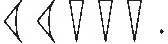
ten. For instance,
twenty-three was written as
The numbers from 60 to 3599 were represented by two groups of symbols, the second group placed to the left of the first one and separated from it by a space. The value of the whole thing was found by adding the values of the symbols within each group, then multiplying the value of the left group by 60 and adding that to the value of the right group. For instance,
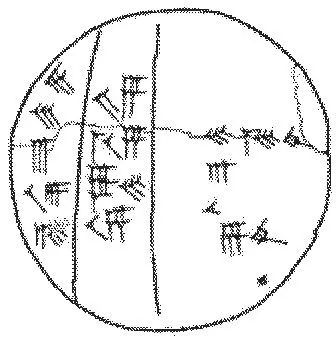
A hand tablet2
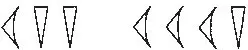
represented
(10 + 1 + 1) · 60 + (10 + 10 + 10 + 1) = 12 · 60 + 31 = 751.
They wrote numbers 3600 (= 602) or greater by using more combinations of the two basic wedge shapes, placed further to the left, each separated from the others by spaces. Each single combination value was multiplied by an appropriate power of 60 — the combination on the far right by 60° (=1), the second from the right by 601, the third from the right by 602, and so on. For example, 7883 was thought of as 2 · 3600 + 11 · 60 + 23 and written
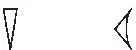
A major difficulty with the Babylonian system is the ambiguity of the spacing between symbol groups. For instance, it is not clear how
should be interpreted; it could be
1 · 602 + 10 or l · 6 0 3 + 10·602 or 1·60 + 10 or ...
By 400
B.C. or so, the Maya civilization of Central America had a numeration system similar to that of the Babylonians, but free from this spacing difficulty. They had two basic symbols, a dot "'·" for the number one, and a bar
for the number five. The numbers one through nineteen were written like this:
The Maya used groupings of the basic symbols to represent larger numbers, often arranged vertically. They were evaluated by adding the place-value amounts for each group. The lowest group represented single units; the value of the second group was multiplied by 20, the value of the third by 18 · 20, the value of the fourth by 18 · 202, the value of the fifth by 18 · 203, and so on. This Mayan positional system, which was based on twenty except in the third place, apparently was used only for recording dates in their Long Count calendar. Thus, the peculiar use of 18 · 20 = 360 as the third place value probably stems from its approximation of the number of days in a year.
The spacing difficulty of the Babylonian system was circumvented by the invention of a shell-like symbol,
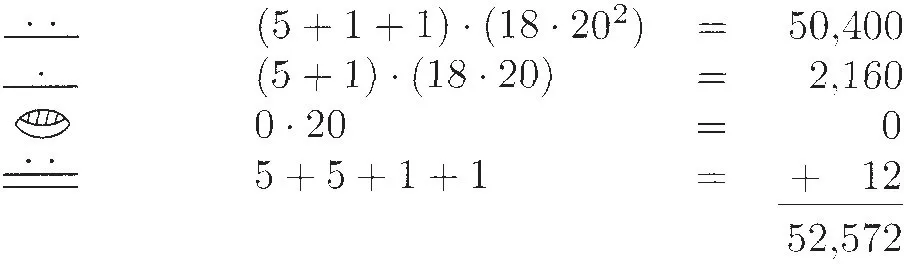
, to show when a grouping position was skipped. For example, 52,572 was written as follows:
The Mayan symbol was better than the Babylonians' ambiguous spacing. However, since their culture was not known to Europeans until many centuries later, their system had no influence on the development of Western numeration. The roots of Western European culture go back mainly to the ancient Greeks and Romans. In many ways, both the Greek and the Roman systems were more primitive than the relatively efficient Babylonian system. The main Greek numeration system required the 25 letters of their alphabet and two extra symbols — nine for the units, nine for the tens, and nine for the hundreds — and a special mark for representing numbers larger than 1000.
The Roman Empire's domination of civilized Europe from about the first century B.C. to the fifth century A.D. made Roman numeration the commonly accepted European way of writing numbers for many centuries afterwards, even into the Renaissance. Like the Egyptian system, Roman numeration is additive and not positional (with one minor exception). Display 2 shows its basic symbols and their corresponding values. The values of these basic symbols were added to determine the value of t...