The must-read summary of Stan Liebowitz's book: "Re-Thinking the Network Economy: The True Forces that Drive the Digital Marketplace".
This complete summary of the ideas from Stan Liebowitz's book "Re-Thinking the Network Economy" shows that the euphoria which suggested the Internet was going to rewrite every law of economics and create a "New Economy" has now been largely superseded by a more rational realisation that the tried-and-true laws of economics will still continue to apply in the digital marketplace. What will need to change, however, are our expectations. In his book, the author explains that instead of abandoning established business strategies altogether, a better approach is to understand how these traditional strategies will still apply in different circumstances. To forecast how markets will evolve in the future, therefore, don't look for the dramatic or revolutionary changes forecast at the birth of the e-commerce frenzy. Instead, anticipate more evolutionary changes which build on the foundation of the tried-and-true economic principles which have stood the tests of time.
Added-value of this summary:
• Save time
• Understand key concepts
• Expand your knowledge
To learn more, read "Re-Thinking the Network Economy" and discover the key to successful e-commerce.
eBook - ePub
Summary: Re-Thinking the Network Economy
Review and Analysis of Liebowitz' Book
- English
- ePUB (mobile friendly)
- Available on iOS & Android
eBook - ePub
Summary: Re-Thinking the Network Economy
Review and Analysis of Liebowitz' Book
About this book
Information
Subtopic
E-CommerceIndex
EconomicsSummary of Re-Thinking the Network Economy (Stan Liebowitz)
1. The Basic Economics of the Internet
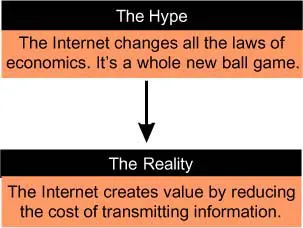
When all of the hyperbole and technical mumbo-jumbo is swept away, the Internet has the potential to create value by offering a more efficient way to send and receive information. This is a very important benefit because the means by which information is transmitted and retrieved underpins the entire economy, but the Internet is much more evolutionary than its early promoters would have us believe. In large part, the Internet is an enhancement of what the telephone, television, newspapers and radio did previously with the added benefit of offering two way transmission – where the recipient can specify the information they want.
In light of these facts, there is no economic reason why an Internet based business should be any more profitable than a traditional business. On the contrary, the very fact customers can readily find alternative suppliers suggests prices will need to remain low for Internet-based companies. It most likely will come back to a mundane economic principle: “Those companies which manage to provide the best products at the best prices will prosper.”
Most commentators have assumed the Internet will have three special economic characteristics:
- Network Effects Some products become more useful as the number of people who use them increase. For example, if just one person owned a fax machine, it wouldn’t be worth much at all. The more people who have faxes, however, the more things you can then do with them, and the more valuable a fax machine becomes.Many business analysts wrongly assumed all e-commerce applications would enjoy the benefit of network effects. This is an erroneous conclusion. It was probably based on a line of thought that goes since the Internet is a big network, all products sold using this network will enjoy network effects. With this potential benefit in mind, many e-commerce pioneers spent heavily to lock-in a large share of the market in anticipation of huge profits as network effects kicked in.Reality, however, is less idealistic. In practice, most products sold over the Internet do not have any network effects whatsoever. Thus, the idea of sustaining short-term losses in anticipation of long-term benefits thanks to network effects is misguided. This is part of the reason the early dot-com companies have struggled. Most of them had business models which were built on an expectation network effects would come to the fore reasonably quickly. When this was shown to be an incorrect assumption, the start-up companies were unable to secure follow-up funding.
- Economies of Scale This is a well known concept – average costs decrease as the company sells more of any specific product. This is very logical. As fixed costs get amortized over a larger production run, they become progressively a smaller part of the overall costs. Almost all manufacturing exhibits at least some economies of scale.It is assumed most high-tech products have significant economies of scale. Often, the costs to develop a new product are huge whereas the costs of duplicating and distributing are minuscule by comparison. Although network effects tend to get more publicity, it is actually more likely economies of scale will be a bigger long-term benefit.
- Winner-takes-all Markets When network effects and economies of scale work in tandem, large companies have a competitive advantage over small companies. Most analysts have assumed this will logically lead to a winner-takes-all scenario where one company comes to dominate its market niche. The only problem with this thinking is that it does not seem to work out in the real world.Specifically, most industries have more than one dominant company. Each of these companies tend to specialize – they develop products with features that appeal to different segments of the market. In addition, at some point for large companies, their costs don’t keep falling (as forecast by economies of scale) but actually start increasing again for a variety of reasons.Some computer products (like operating system software from Microsoft and computer processing chips from Intel) seem to have winner-takes-all characteristics. Therefore, many analysts assumed all Internet-based companies would exhibit this trait. There was also the “scalability factor” – the fact one Web site could handle hundreds or thousands of customers simultaneously with equal competence. What was missed out in this conclusion, however, was the fact even when products are sold via the Web site, the companies still has to perform all the usual back-office functions – warehousing, shipping, production, customer relations and so forth. In these areas, the Internet companies are fa...
Table of contents
- Book Presentation: Re-Thinking the Network Economy by Stan Liebowitz
- Summary of Re-Thinking the Network Economy (Stan Liebowitz)
Trusted by 375,005 students
Access to over 1.5 million titles for a fair monthly price.
Study more efficiently using our study tools.
Frequently asked questions
Yes, you can cancel anytime from the Subscription tab in your account settings on the Perlego website. Your subscription will stay active until the end of your current billing period. Learn how to cancel your subscription
No, books cannot be downloaded as external files, such as PDFs, for use outside of Perlego. However, you can download books within the Perlego app for offline reading on mobile or tablet. Learn how to download books offline
Perlego offers two plans: Essential and Complete
- Essential is ideal for learners and professionals who enjoy exploring a wide range of subjects. Access the Essential Library with 800,000+ trusted titles and best-sellers across business, personal growth, and the humanities. Includes unlimited reading time and Standard Read Aloud voice.
- Complete: Perfect for advanced learners and researchers needing full, unrestricted access. Unlock 1.5M+ books across hundreds of subjects, including academic and specialized titles. The Complete Plan also includes advanced features like Premium Read Aloud and Research Assistant.
We are an online textbook subscription service, where you can get access to an entire online library for less than the price of a single book per month. With over 1.5 million books across 990+ topics, we’ve got you covered! Learn about our mission
Look out for the read-aloud symbol on your next book to see if you can listen to it. The read-aloud tool reads text aloud for you, highlighting the text as it is being read. You can pause it, speed it up and slow it down. Learn more about Read Aloud
Yes! You can use the Perlego app on both iOS and Android devices to read anytime, anywhere — even offline. Perfect for commutes or when you’re on the go.
Please note we cannot support devices running on iOS 13 and Android 7 or earlier. Learn more about using the app
Please note we cannot support devices running on iOS 13 and Android 7 or earlier. Learn more about using the app
Yes, you can access Summary: Re-Thinking the Network Economy by BusinessNews Publishing in PDF and/or ePUB format, as well as other popular books in Economics & E-Commerce. We have over 1.5 million books available in our catalogue for you to explore.